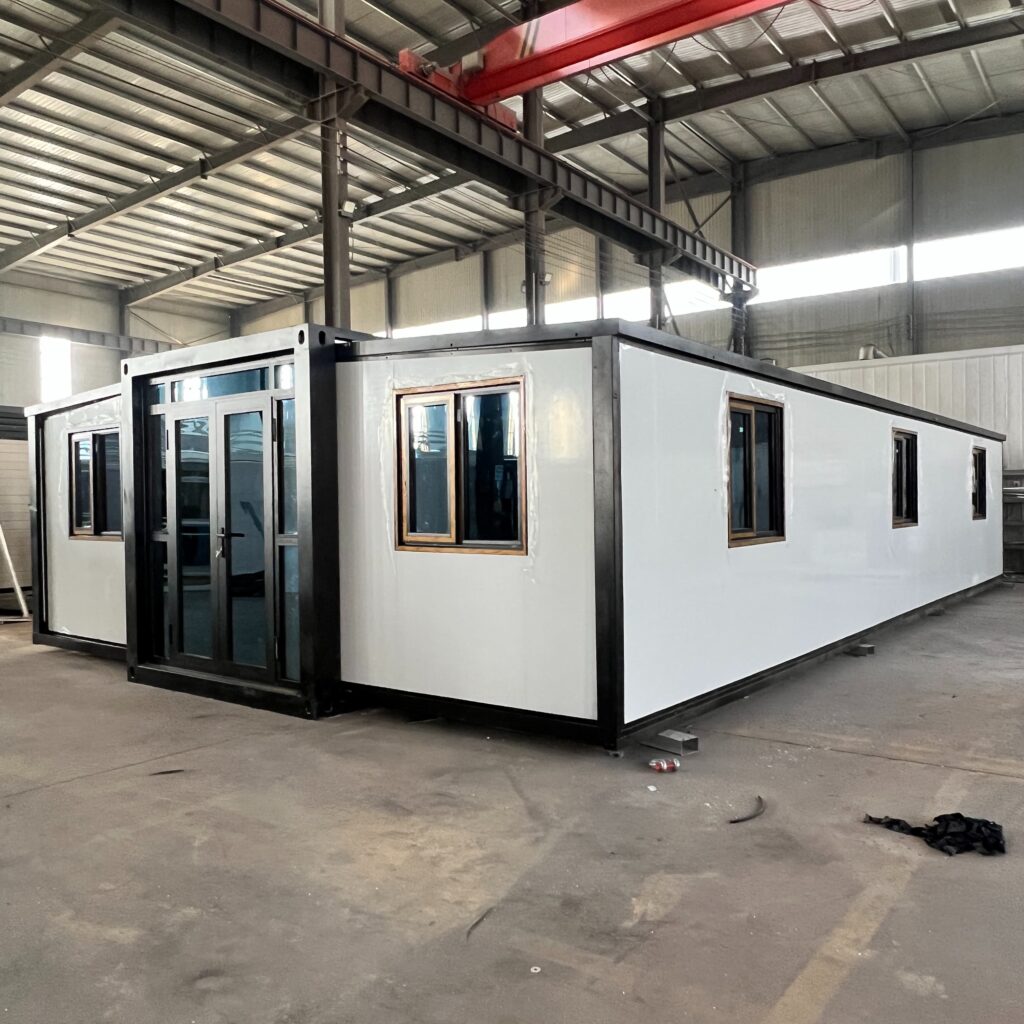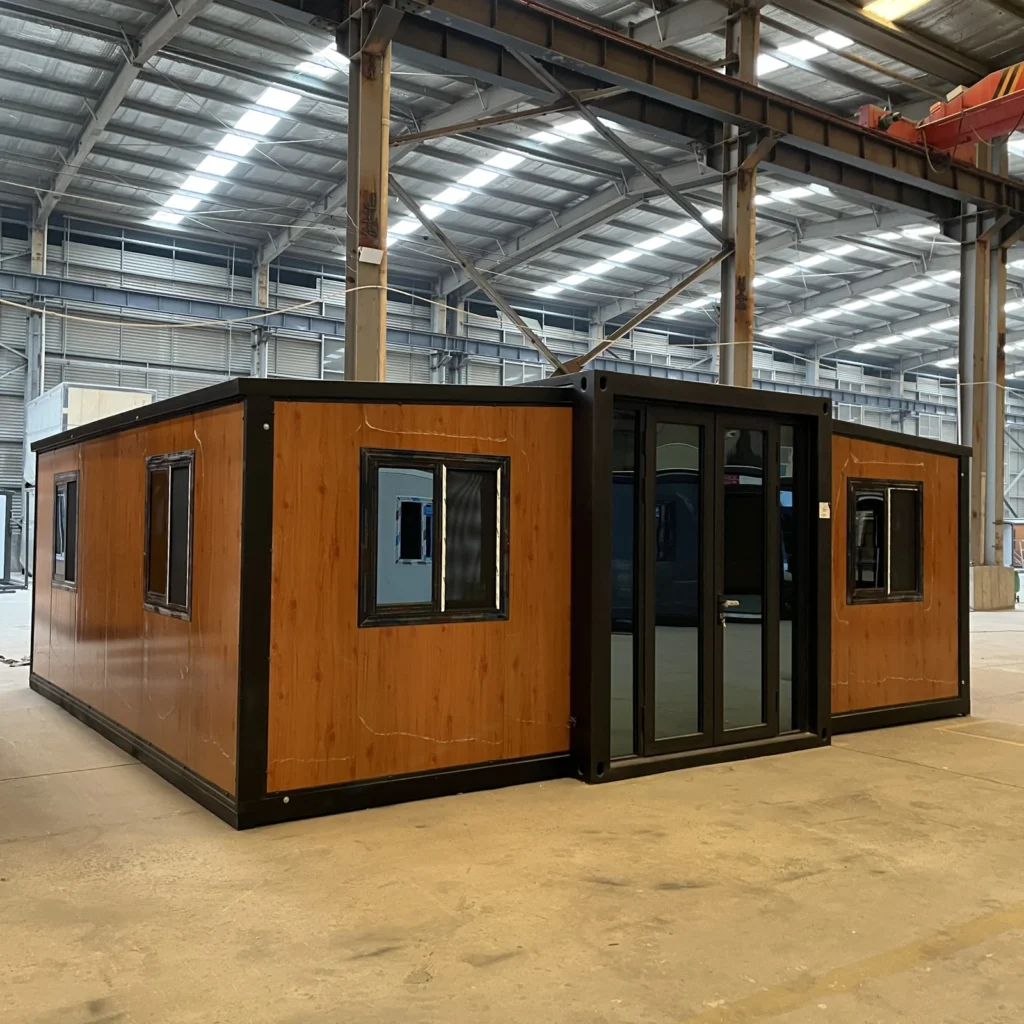
A 10 ft expandable container house is often marketed in India as a
two-bedroom home. It is not one. The unit unfolds to roughly 15 to 17 m2 of net
usable floor, which holds a bedroom, a compact bathroom and a living-kitchen
zone — comfortably, for one or two people. The two-bedroom brief starts at
the 20 ft model.
That distinction matters because it decides whether the purchase works. This
guide gives the real dimensions, the current duty stack to an Indian port, a
line-by-line landed cost, and the delivery route. If the number at the bottom
does not fit the budget, it is better to know before the deposit than after the
container arrives.
What a 10 ft expandable unit actually is
The module ships as a closed box about 3.0 m long, 2.2 m wide and 2.5 m high.
On site the side wall swings out on a hinge line, adding roughly 1.1 m to the
width, and the floor panel folds down to become the extended floor. Assembly
takes two people and a few hours; no crane is needed for a single unit.
The closed box fits a 20 ft flat-rack or travels as break-bulk, which is why
freight on a single 10 ft unit costs almost as much as on a 20 ft container. Two
10 ft units do not fit a 20 ft container side by side. This is the single most
misunderstood point in the pricing: the 10 ft format saves on the unit, not on
the shipping.
Dimensions and areas, stated plainly
| Parameter | Closed (transport) | Open (habitable) |
|---|---|---|
| Length | 3.0 m | 3.0 m |
| Width | 2.2 m | 3.3 m |
| Height | 2.5 m | 2.5 m |
| Gross floor area | 6.6 m² | 9.9 m² |
| Net usable area after walls and services | — | 15–17 m² |
| Self-weight | 1.6–1.9 t | 1.6–1.9 t |
| Foundation | — | 4 concrete pads, 300 × 300 mm |
The difference between 9.9 m2 gross and 15 to 17 m2 net is the folding floor
panel that extends beyond the original footprint on both long sides. The figure
is quoted net because that is the area a buyer can furnish. Any supplier quoting
gross area for a 10 ft unit is quoting the shipping box.
What fits inside 15 to 17 m2
A workable layout for this area is a 2.6 m by 2.8 m bedroom, a 1.2 m by 1.8 m
bathroom pod, and a 2.6 m by 3.0 m living-kitchen zone. Circulation takes the
remainder. That is a genuine one-bedroom dwelling, and it is a good one.
What does not fit is a second bedroom. A 10 by 8 ft room alone consumes 7.4 m2,
nearly half the net floor, and leaves no plausible route to a bathroom and a
kitchen. Buyers who need two bedrooms should be looking at the 20 ft model at
31 to 33 m2, which ships two units per 40HC and therefore carries a lower
freight per unit.
For a site office, a security gatehouse, a farm worker unit, a studio for a
single occupant or a rental pod, 15 to 17 m2 is the right size and the economics
work. For a family of four, it is the wrong product, and no amount of interior
design changes that.
The duty stack into an Indian port, 2026
India has no de-minimis threshold for commercial imports. Every consignment is
assessed, and the assessment is layered, not flat. Steel expandable units
classify under HS 9406.90. The 2026 stack is:
| Component | Base | Rate | Recoverable? |
|---|---|---|---|
| Assessable value (AV) | CIF + 1% landing charge | — | — |
| Basic Customs Duty (BCD) | AV | 10% | No |
| Agriculture Infrastructure & Development Cess (AIDC) | BCD | 10% | No |
| Social Welfare Surcharge (SWS) | BCD + AIDC | 10% | No |
| Integrated GST (IGST) | AV + BCD + AIDC + SWS | 18% | Yes, as input credit |
Two errors are common in quotes prepared outside India. The first is applying
SWS to the cargo value; it applies only to BCD plus AIDC, so a quote built on
cargo value overstates the cost by roughly a third of the SWS line. The second
is treating IGST as a cost. For a GST-registered importer it is an input credit,
recovered against output tax, so the true cost of importing is BCD plus AIDC plus
SWS, not the headline duty figure.
The combined tax and cess works out to 32.6 percent of CIF. That is the number
to remember, and it is close to the 31 to 33 percent range the trade press quotes
for this heading.
What the effective rate means for a buyer
If the importer is GST-registered, the cash outflow includes IGST but the
economic cost does not. If the importer is not registered — a private
individual buying one unit, for example — the whole stack is a real cost and
there is no credit to claim. This single fact changes the landed cost by about
17 percent and is the reason two buyers of the same unit at the same FOB can
report very different totals.
Landed cost, line by line
The table below is a single 10 ft expandable unit at USD 8,500 FOB Tianjin,
routed to Nhava Sheva. Freight is a mid-2026 estimate for a single unit as
break-bulk; consolidated shipments of four or more units reduce the per-unit
figure materially.
| Line item | USD | Basis |
|---|---|---|
| FOB Tianjin, basic specification | 8,500 | Ex-works plus inland to port and export clearance |
| Ocean freight to Nhava Sheva | 1,150 | Single unit, break-bulk, 18–22 days |
| Marine insurance | 29 | 0.3% of FOB plus freight |
| CIF value | 9,679 | Duty base before landing charge |
| Basic Customs Duty, 10% of AV | 978 | AV = CIF × 1.01 |
| AIDC, 10% of BCD | 98 | Not creditable |
| SWS, 10% of BCD + AIDC | 108 | Not creditable |
| IGST, 18% of AV + BCD + AIDC + SWS | 1,973 | Creditable if GST-registered |
| Port handling and customs broker | 380 | Nhava Sheva terminal and CHA fees |
| Inland haulage to Pune or Nashik | 520 | Single unit, low-bed trailer |
| Concrete pads and site levelling | 640 | Four pads, local contractor |
| Assembly, connections and commissioning | 480 | Two-person crew, one day |
| Non-recoverable total | 12,882 | 1.52× FOB, excluding IGST credit |
| Cash outlay including IGST | 14,854 | 1.75× FOB, before the credit is recovered |
At INR 88 to the dollar, the non-recoverable total is about INR 11.3 lakh. The
cash outlay before credit is about INR 13.1 lakh. Buyers comparing this against
a quoted figure of INR 12 to 15 lakh for a “10 ft two-bedroom” should now see the
gap: the lower number is a bare unit with duty, the upper number typically
includes a foundation, a septic connection and interior fit-out that the table
above prices separately.
Port choice changes the total by about 2 percent
| Port | CIF | Duty and cess | Non-recoverable | Transit |
|---|---|---|---|---|
| Nhava Sheva (Mumbai) | 9,679 | 3,155 | 12,882 | 18–22 days |
| Chennai | 9,579 | 3,123 | 12,829 | 16–20 days |
| Mundra (Gujarat) | 9,729 | 3,172 | 13,178 | 20–24 days |
Chennai is marginally cheapest for a south India site, but the difference is
under one percent and is usually erased by inland distance. Mundra carries the
highest inland leg for a Maharashtra destination. The port decision should follow
the site, not the freight table.
Delivery: what the 45 to 60 days are spent on
Production on a 10 ft unit runs 15 to 25 days from confirmed deposit, because
the format is a standard line item rather than a bespoke build. Export clearance
and booking add 5 to 8 days. Ocean transit is 16 to 24 days depending on port.
Customs clearance at an Indian port typically takes 3 to 5 working days if the
Bill of Entry is filed before arrival and the Importer Exporter Code, invoice,
packing list and Certificate of Origin are all consistent.
Clearance is where Indian imports most often stall. The Bill of Entry must
match the commercial invoice exactly, including the HS code at eight digits. A
mismatch between the invoice description and the declared HS line triggers a
query, and a query moves the consignment to a second examination queue. That
costs 5 to 10 days and demurrage. Getting the paperwork right before the vessel
sails is worth more than any freight negotiation.
Regulatory items specific to India
Three items are not optional. The buyer needs an Importer Exporter Code issued
by the DGFT; without it the consignment cannot be cleared at all. Steel expandable
units fall under a free import policy, so no restricted-goods licence is needed.
And a Certificate of Origin is required if any preferential rate is claimed —
India has no FTA with China for this heading, so the MFN rate of 10 percent BCD
applies, but the certificate is still requested at assessment.
On the building side, a unit placed on a concrete foundation and connected to
municipal services is treated as a permanent structure in most Indian
municipalities, which brings it under the National Building Code and local
Floor Space Index limits. A structural certificate for the steel frame is
commonly required, and fire-rated insulation is required for residential use.
On agricultural land, most states restrict permanent structures outright, so a
site should be confirmed as convertible before an order is placed.
What this means for an Indian buyer
The 10 ft expandable unit is a good product at a real price, and the price is
about USD 12,882 landed to Nhava Sheva before the IGST credit, not the INR 12
lakh figure that circulates in dealer quotes and not a two-bedroom home.
The decision that matters is not which supplier quotes lowest at FOB. It is
whether the unit is declared correctly, whether the importer is GST-registered so
the IGST is recovered, and whether the site is legally able to take a permanent
structure. Each of those moves the outcome more than a 5 percent discount on the
factory price.
Frequently asked questions
Can a 10 ft expandable unit really be a two-bedroom home?
No. Net usable floor is 15 to 17 m2 after the walls fold out, which supports
one bedroom plus a bathroom and a living-kitchen zone. A second bedroom requires
the 20 ft model at 31 to 33 m2.
Is IGST a cost or a credit?
A credit, if the importer is GST-registered. IGST is 18 percent of the
assessed value plus duty and cess, and it is recovered against output tax. For an
unregistered private buyer it is a real cost, which raises the landed total by
about 17 percent.
Why is freight on a 10 ft unit almost the same as on a 20 ft container?
Because a single 10 ft unit occupies a full slot. Two units do not fit a 20 ft
container side by side, so the unit cannot share the freight. Consolidating four
or more units into one shipment is the only way to reduce the per-unit figure.
Which port should a Maharashtra buyer use?
Nhava Sheva. Mundra is 2.3 percent more expensive on this routing once the
inland leg is included, and the transit advantage does not compensate for the
road distance.
Does a container house need municipal approval in India?
If it sits on a concrete foundation and connects to water and sewer, most
municipalities treat it as a permanent structure, which brings it under the
National Building Code and local FSI rules. A structural certificate for the steel
frame is commonly required. Confirm the zoning before ordering.
What is the realistic lead time from order to occupancy?
45 to 60 days to site, plus one day for assembly. Production takes 15 to 25
days, ocean transit 16 to 24 days, and clearance 3 to 5 working days if the
paperwork is consistent at arrival.
Next step
If a site plan and a target budget are available, we will run the landed cost
for the actual port and inland destination rather than the generic routing above,
and send the specification sheet with both transport and habitable dimensions
stated separately.
Email jack@huayinghouse.com or call
+86 153-0318-4505. Include the site state and the intended use
— single occupancy, site office, or family — and we will say plainly
whether the 10 ft unit is the right format or whether the 20 ft model is the
honest answer.