
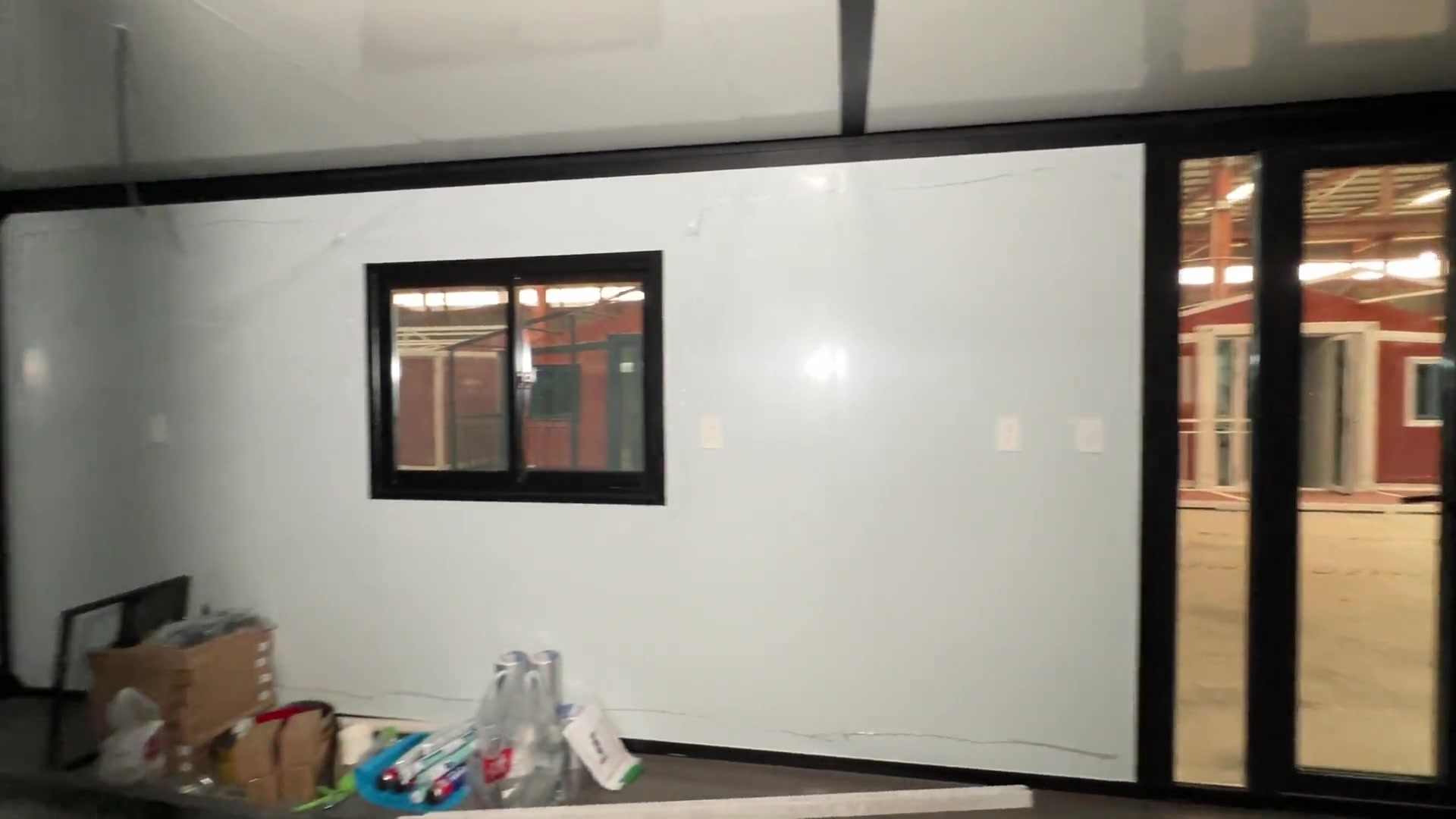
Discover how innovative 10ft expandable container houses are addressing the affordable housing segment in Malaysia. This article explores pricing comparisons with traditional 40ft container homes, key features, and why compact expandable units are becoming a common choice for budget-conscious homeowners seeking modern, sustainable living spaces.
When Malaysians think of container homes, the first image that often comes to mind is a bulky 40ft shipping container converted into living space. While popular, these traditional units come with significant challenges – high transportation costs, complex site preparation, and prices that can easily exceed RM50,000. But what if there’s a more affordable alternative? The 10ft expandable container house designed for compact living.
Unlike conventional 40ft container homes in Malaysia that require cranes and flatbed trucks for delivery, this innovative 10ft unit arrives compactly folded on a standard trailer. Once positioned, it transforms into a fully functional living space through a simple hydraulic expansion process. a top part? Prices start from just RM18,000 – less than half the cost of most basic 40ft container conversions. This dramatic price difference makes expandable containers particularly attractive for first-time homeowners, remote workers, and those seeking affordable vacation properties.
So how does the pricing compare when you break it down? A standard 40ft container home in Malaysia typically costs between RM45,000-RM80,000 for basic models, with premium designs reaching RM120,000+. These prices exclude land preparation, foundation work, and utility connections which can add another RM15,000-RM30,000. In contrast, the 10ft expandable unit includes integrated insulation, electrical wiring, and basic fixtures in its base price. Its minimal foundation requirements (just concrete pads) reduce site costs by nearly 70% compared to 40ft containers.
But don’t let the compact footprint fool you – these expandable units maximize every inch. When folded for transport, it measures just 3m x 2.2m, yet expands to provide 20m² of livable space. Smart design features include fold-down furniture, vertical storage solutions, and large windows that create an airy feel. The kitchenette comes equipped with a sink, induction cooker, and refrigerator, while the bathroom features a space-saving shower-toilet combo. For Malaysian homeowners, this means getting all essential amenities without the premium price tag of larger container homes.
Durability is another area where these expandable containers shine. Built with corrosion-resistant steel frames and reinforced walls, they’re engineered to withstand Malaysia’s tropical climate – from intense sun to heavy monsoon rains. The insulated walls maintain comfortable temperatures naturally, reducing air conditioning costs by up to 40% compared to traditional container homes. For eco-conscious buyers, many models incorporate solar panel readiness and rainwater harvesting systems as optional upgrades.
The units can be adapted to several Malaysian site and climate conditions. Use them as granny annexes in suburban backyards, affordable staff accommodation on plantations, or even as pop-up retail spaces. Their rapid deployment – most units are fully installed within 48 hours of delivery – makes them ideal for emergency housing or temporary offices. For landowners in Penang or Johor looking to generate rental income, these expandable containers offer a faster ROI than constructing traditional 40ft container homes.
When considering total cost of ownership, the advantages become even clearer. Maintenance requirements are minimal thanks to high-quality finishes and weather-resistant materials. Unlike 40ft containers that often require rust treatment and repainting every 2-3 years, expandable units maintain their appearance with just occasional cleaning. Their smaller footprint also translates to lower property taxes in many Malaysian municipalities.
For Malaysians priced out of the conventional housing market, these expandable containers represent more than just affordable shelter – they’re a pathway to homeownership. With financing options available through several Malaysian banks, and prices starting at RM18,000, they’re accessible to a much broader demographic than traditional 40ft container homes. As urban land prices continue to rise across Kuala Lumpur, Selangor, and Penang, compact expandable units offer a practical solution for sustainable, budget-friendly living without sacrificing modern comforts.
Ready to explore how a 10ft expandable container home could fit your lifestyle and budget? Contact local Malaysian suppliers for personalized quotes and understand why this innovative housing solution is gaining popularity across the country. Remember, when comparing container home prices in Malaysia, always factor in delivery costs, site preparation, and included features – that’s where the true value of expandable containers becomes undeniable.
)
Related: 10ft container guard house in Malaysia — landed cost, 0% import duty and site specification — for security booths at construction sites, residential complexes and industrial buildings.
10ft Expandable Container House: Malaysia Cost Breakdown (FOB to Landed)
Malaysian buyers should compare total delivered costs rather than factory prices alone. The table below estimates the full cost chain for a 10ft expandable unit delivered to Port Klang and installed on a residential site in the Klang Valley, using mid-2026 rates.
| Cost component | Amount (MYR) | Notes |
|---|---|---|
| FOB price (factory, China) | 29,000 – 36,000 | 10ft expandable, interior fit-out, standard finishes (USD 6,800–8,500) |
| Sea freight (Tianjin → Port Klang) | 5,500 – 8,000 | LCL or single 20ft slot, mid-2026 rates |
| Import duty (HS 9406.90) | 0 | 0% under ACFTA with valid Form E (China-ASEAN FTA) |
| Sales & Service Tax | 0 – 1,100 | Building materials are SST-exempt; service tax applies to certain installation services (6% from Jul 2025 for non-residential work) |
| Port handling + customs clearance | 800 – 1,500 | Forwarder, customs agent, and terminal charges |
| Road transport (Port Klang → site) | 500 – 1,800 | Distance dependent; permits for oversize loads if needed |
| Site works + foundations | 3,000 – 7,000 | Level pad, concrete footings, or steel piers |
| Installation + connections | 2,500 – 5,500 | Crane hire, plumbing/electrical, certification |
| Total landed & installed | 41,300 – 60,900 | Varies with site access and finish level |
Planning note: the FOB price is roughly 65–70% of the final installed figure in Malaysia because import duty is zero under the China-ASEAN FTA. The largest controllable items are site works and installation, so obtain a local builder quote before committing. All permanent or semi-permanent installations should confirm compliance with UBBL 1984 and register with CIDB where required.
Related guide: Complete 2026 Malaysia Container House Guide
For a full breakdown of import duties, UBBL 1984 permits, and landed costs, see our comprehensive guide: Container Houses in Malaysia 2026: Complete Cost Guide, 0% Import Duty & UBBL Permits.
Malaysia site conditions that change the specification
Malaysia is not a single building environment for a steel module. Three conditions are present in most of the peninsula and they interact: year-round relative humidity above 80 % for much of the day, a monsoon pattern that delivers short intense rainfall rather than a steady season, and a coastal chloride load on both the Strait of Malacca side and the South China Sea side.
The humidity is the constraint most often underestimated. When mean daytime relative humidity stays above 80 % and the outdoor dew point sits at 24–26 °C, an air-conditioned interior at 24 °C becomes a condensation sink. Water forms on the inner face of any assembly whose surface temperature falls below the indoor dew point, and a steel panel with thin insulation does exactly that. The practical answer is a closed-cell insulation with a sealed foil facing, an airtight internal lining rather than a vapour-tight one, and ventilation that removes moisture at source — kitchen and bathroom extract, not merely window opening.
The rainfall pattern matters for a different reason. Malaysian storms deliver 60–100 mm in a few hours rather than the same total over a day, so roof drainage has to be sized against peak intensity, not annual volume. A 5° minimum pitch with a gutter and downpipe one nominal size above the temperate default, plus an overflow scupper set above the gutter invert, prevents the failure mode that actually occurs: water backing under the roof flashing when an outlet blocks.
On the coating, sites within a kilometre of the coast — which covers most of Penang, Port Klang, Johor Bahru and Kota Kinabalu — should be specified at C4 or above with 160 µm minimum dry film thickness. Inland Selangor and Negeri Sembilan can use C3. A uniform C3 system across a Malaysian order is the most common cost shortcut and produces the earliest corrosion callbacks.
Permits and site rules in practice
A 10 ft expandable unit is normally placed as a detached structure on a residential lot, a plantation, or a commercial site, and the approval path depends on which of those it is. On residential land under the local authority’s purview, a detached structure used as a dwelling generally requires a planning submission and a building plan endorsement; a unit used as a store, guard post or site office usually falls under a lighter category. On plantation and industrial land the state authority’s conditions govern, and some states require a separate temporary occupation arrangement.
Two documents decide the timeline. The first is the foundation design signed by a Malaysian professional engineer, because the local authority will not endorse a building plan without it. The second is the electrical installation certificate from a Suruhanjaya Tenaga registered electrician, which is required before the supply authority will energise the connection. Buyers who obtain both before the unit ships generally avoid the cycle where a partially installed unit sits unpowered for weeks.
What the 10 ft unit is and is not suited to
The 10 ft expandable model unfolds to roughly 15–17 m² of net usable floor area. That is enough for a bedroom with an en-suite, a small studio, a guard post, a clinic consulting room, or a site office for four people. It is not a substitute for a family house, and the most common disappointment in this market comes from buyers who purchase a 10 ft unit expecting 20 ft space. If the intended use is permanent family accommodation, the 20 ft model at roughly 31–33 m² is the correct starting point, and it ships two units per 40HC container which reduces the per-unit freight.
Frequently asked questions
How much is a 10ft expandable container house in Malaysia?
FOB is from USD 6,800 ex-Tianjin for the base unit. Landed and installed at Port Klang or Penang, allow roughly USD 13,500 to 16,500 including freight, local delivery, foundation and installation, depending on the climate upgrades your site needs.
Do I pay import duty on a container house into Malaysia?
Prefabricated steel buildings are one of the lines that benefit from preferential treatment under the ASEAN–China Free Trade Area. With a Form E certificate of origin, qualifying goods can enter at 0 % duty. Without it, the MFN rate applies. The certificate must be arranged before shipment and the HS code and description must match the invoice and declaration exactly.
What does SST add to the cost?
Malaysia applies Sales and Service Tax rather than a single VAT. For a commercial import the sales tax rate depends on the classification of the goods, and a service tax applies to certain services. Confirm the current rate with a Malaysian customs broker for your classification, because the rate has changed with recent SST revisions.
Does a 10ft container house need a permit in Malaysia?
For permanent occupation, yes. Local authority approval under the Uniform Building By-Laws is required, and the submission is made to the relevant municipal council. Temporary structures such as site offices generally have a simpler path. The two items most often requested are a foundation drawing and confirmation of the wind and structural design.
Questions or a custom quote? Contact us at jack@huayinghouse.com or WhatsApp +86 153-0318-4505 for factory-direct pricing.
FOB to landed cost: 10ft expandable unit into Port Klang
| Cost line | USD |
|---|---|
| FOB Tianjin, 10ft expandable | 8,500 – 9,800 |
| Ocean freight, 10ft unit (4 per 40HC share) | 620 |
| Marine insurance | 35 |
| CIF Port Klang | 9,155 – 10,455 |
| Import duty, ACFTA Form E at 0% | 0 |
| SST on import, 10% | 916 – 1,046 |
| Port handling, forwarding, clearance | 430 |
| Inland haulage to site, Peninsular Malaysia | 180 – 420 |
| Foundation and site preparation | 700 |
| Assembly and commissioning | 520 |
| Landed and installed | 11,901 – 13,571 |
Malaysian buyers should confirm the ACFTA Form E is issued before shipment. Without it the 0% rate does
not apply and the duty line returns at the MFN rate, which changes the total by more than the freight cost.
The four-unit loading plan matters here: a 10ft module shares a 40HC with three others, so the effective
freight per unit depends on how the order is batched, not on the unit price.