
引言(买家焦虑场景)
A buyer in Andalusia or the Alentejo is usually told the same thing: “the Mediterranean is mild — any container house will do.” That advice costs money. Madrid’s July mean high is 34.1 °C while its coldest-month mean low is 1.5 °C — an annual swing of more than 31 °C, larger than London’s. Portugal’s Atlantic north coast takes winter rain the centre of Spain never sees. The design brief for a container house in Spain or Portugal is therefore not “mild”, it is two opposite problems in one building: cut a brutal summer solar load, then hold onto heat through a real winter with frost in the ground.
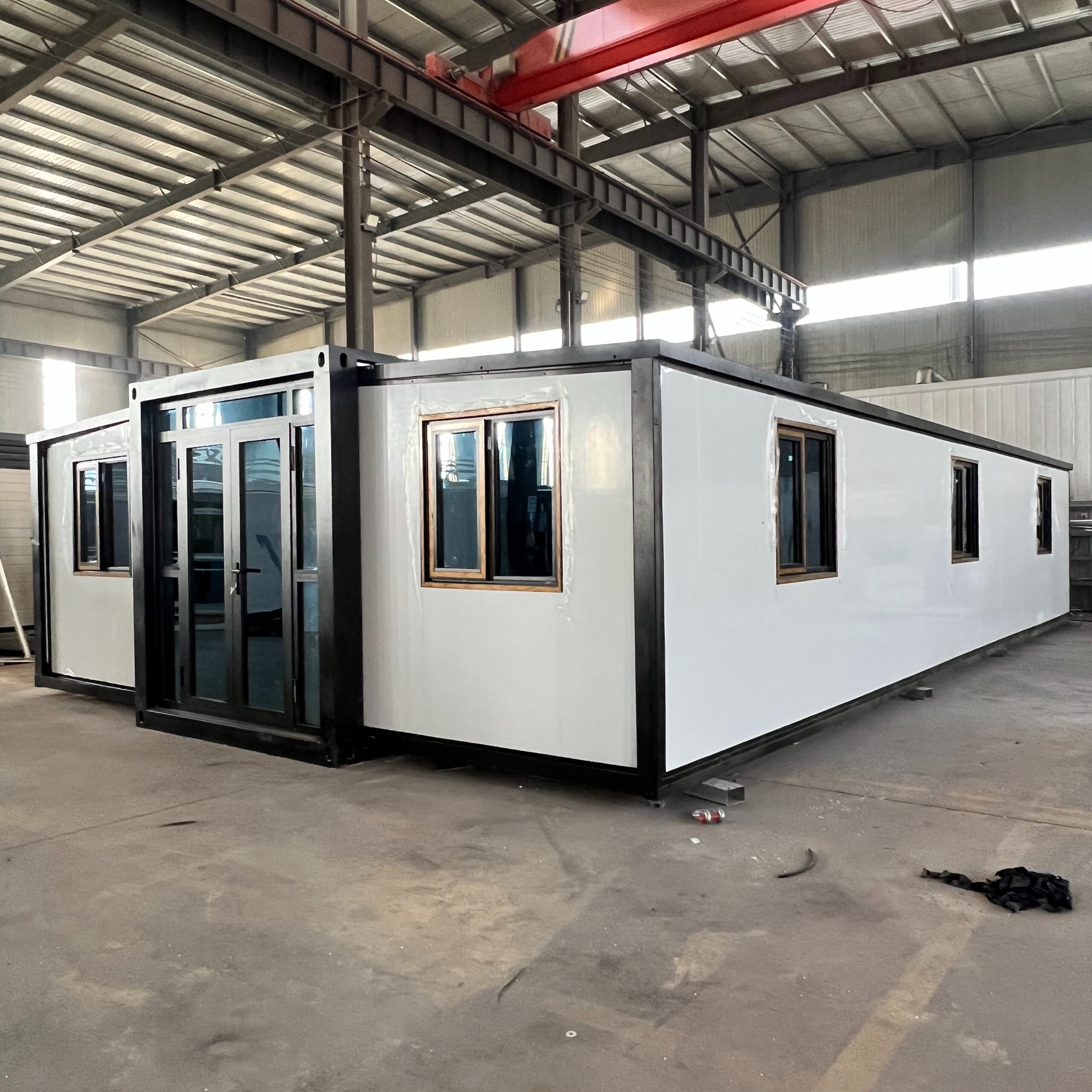
This guide works through that brief with numbers: the climate data, the failure modes, the shading geometry that actually works at Iberian latitudes, the landed cost, and the compliance path under the Spanish CTE and the Portuguese RSA.
§1 Spain and Portugal climate data at a glance
Both countries sit between 37°N and 43.7°N. Three variables drive the design.
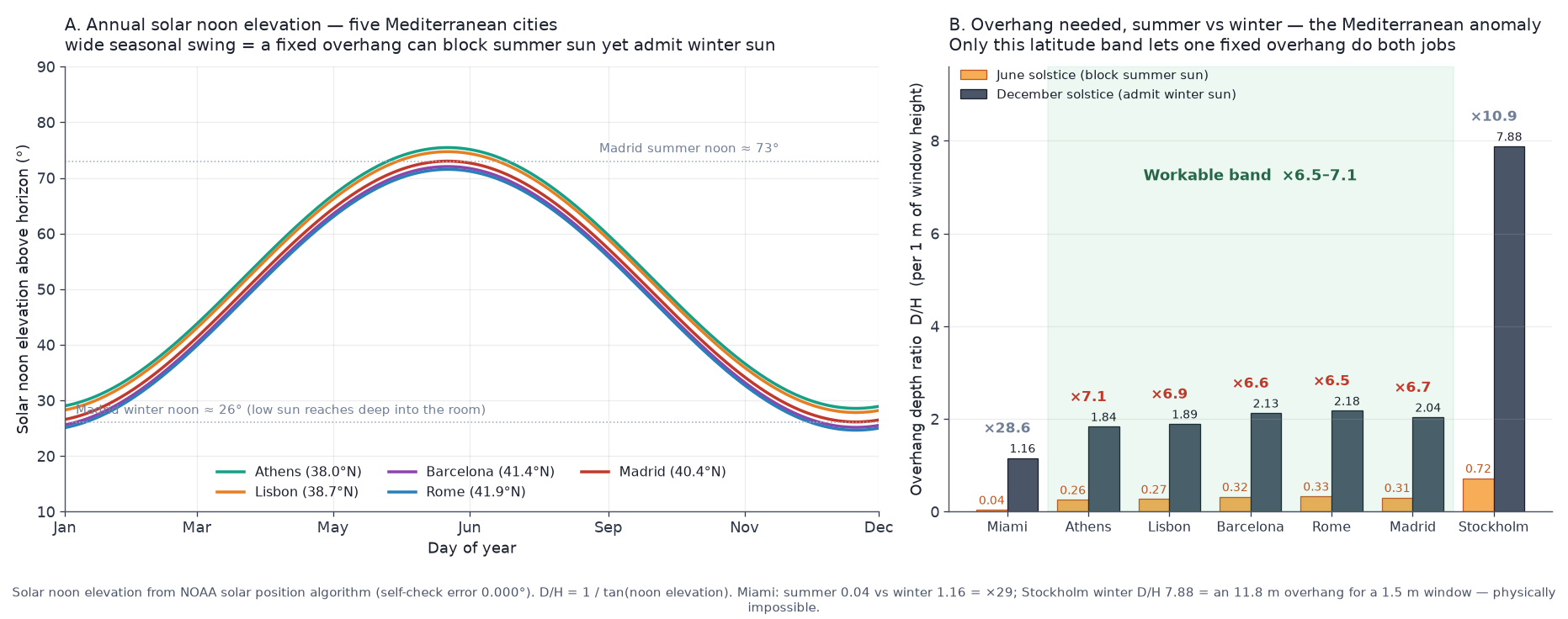
Solar geometry. Madrid’s solar noon elevation runs from 73.0° at the June solstice to 26.2° at the December solstice. Lisbon: 74.7° down to 27.9°. That swing — a factor of 6.5 to 7.1 in the overhang depth ratio between seasons — is the largest workable seasonal contrast of any populated latitude band, and it is the geometric basis of every recommendation in this guide.
Heat and dryness inland. Madrid is Europe’s dry-heat outlier: 478 mm of rain a year, mean relative humidity about 55% — falling to roughly 35% in July — with 34.1 °C July mean highs. It behaves like a semi-arid climate, not a humid one.
The Atlantic modifier. Lisbon and especially northern Portugal are wetter (roughly 750–1,000 mm) and more humid than the Meseta. Coastal strips from Barcelona to the Algarve add salt spray: ISO 12944 corrosivity C3 inland Madrid, C4 within a few kilometres of the coast.
| Parameter | Madrid | Lisbon | Design consequence |
|---|---|---|---|
| Latitude | 40.4°N | 38.7°N | noon sun always south of zenith |
| Coldest month mean low | 1.5 °C | 8.5 °C | heating is required inland |
| Hottest month mean high | 34.1 °C | 31.5 °C | summer solar control is critical |
| Annual range | 31 °C | 23 °C | expansion joints + thermal breaks |
| Annual precipitation | 478 mm | ~750 mm | single pitch 3–5% suffices inland |
| Mean RH (July) | 55% (35%) | ~65% | evaporative cooling works in Madrid |
| Ground snow load | 0.30 kPa | 0 kPa | conventional roof is fine |
| Design wind speed | 26.0 m/s (10-min) | ~25 m/s | EN 1991-1-4 National Annex |
| Frost depth | 0.6 m | ~0 m | footings below frost in the Meseta |
| Corrosivity (ISO 12944) | C3 | C4 coastal | coating system by site |
§2 Six failure modes specific to the Iberian climate
1. Roof heat gain — not wall heat gain. At Madrid’s June-solstice noon elevation of 73°, the solar incidence angle on a flat roof is 17°, giving a cosine of 0.96 — near-perfect absorption. The roof is the largest heat-collection surface of the building. Insulating the walls while leaving a bare dark steel roof is the most common and most expensive configuration error.
2. Low-angle east and west sun defeating the overhang. A horizontal overhang sized for noon sun does nothing at 08:00. In Lisbon at 08:00 on the December solstice the sun is 0.7° above the horizon — a horizontal overhang would need D/H = 19 to intercept it; even at the equinox it needs 9.2. East and west glazing needs vertical shading, full stop.
3. Winter thermal shock across a 31 °C annual range. Steel expands roughly 12 µm/m·°C. Across Madrid’s annual range that is millimetres of movement at every panel joint of a 6-metre module, cycled twice a year, plus nightly swings of 15–20 °C in summer. Rigid sealed joints fatigue; fastener holes elongate; the leak starts at the same lap every time.
4. Condensation on thermal bridges — inland, in winter. With 1.5 °C January lows, an uninsulated steel frame member is a condensation rail: warm humid interior air touches it and dumps water on the inside of the wall. Madrid’s dry summer does not protect you from a wet January wall.
5. UV and coating degradation. Southern Iberia receives around 2,800 hours of sunshine a year. Polyurethane topcoats, EPDM gaskets and sealant joints age measurably faster here than in Central Europe; a coating specified without UV-stable chemistry chalks and micro-cracks within a few seasons.
6. Corrosion where the coast meets the detail. Inland Madrid at C3 is gentle on steel. The Atlantic and Mediterranean littorals are not: fasteners, hinge pins and cut edges within a few hundred metres of salt water sit in C4, and a corroded anchor bolt loses capacity quietly.
§3 Design responses that actually change performance
M1 — South horizontal overhang, sized by geometry. At Madrid’s June-solstice elevation of 73°, shading a 1.5 m window needs a projection of only 0.46 m (D/H = 0.305); at Lisbon, 0.41 m. Size the south overhang for roughly the equinox condition (D/H ≈ 0.8, about 1.2 m for a 1.5 m window) and the winter sun — noon elevation 26–28° — pours under it. This is the “block summer, admit winter” manoeuvre, and the Mediterranean band is the only latitude where one fixed overhang achieves it.
M2 — Vertical fins on east and west. Because the horizontal overhang is geometrically helpless against low-angle morning and afternoon sun (D/H 9–19 at the times that matter), east and west openings need vertical louvres or fins, or glass with a high shading coefficient placed under deep side reveal. Do not buy more horizontal projection — the sun is not coming from there.
M3 — Cool roof with high SRI. A light-coloured, high-reflectance roof coating (SRI ≥ 78) cuts the roof surface temperature by 20–30 °C under the Iberian summer sun. Combined with insulation below the deck and a ventilated cavity, it is the single biggest energy measure on the building.
M4 — Insulation specified for both seasons. 80 mm PIR in the walls and 100 mm in the roof, with thermal-break pads at every frame connection. The winter case matters as much as the summer one: 1.5 °C nights in Madrid with a 0.6 m frost depth is a heating climate, and the insulation pays for itself twice a year.
M5 — Movement-tolerant jointing. Sliding or gasketed panel connections, elastic sealants rated for the movement, and an expansion joint on any build longer than two modules. This is the direct answer to failure mode 3.
M6 — Vapour-open but rain-tight build-up, with VCL inland. In Madrid’s semi-arid climate the priority is air- and vapour-tightness in winter, not rain defence: a vapour control layer on the warm side of the insulation prevents the January condensation rail. On the Atlantic coast, add the rain defence layer — fully sealed laps and a drained cavity.
M7 — UV-stable exterior chemistry. Polyurethane or PVDF topcoats, EPDM or silicone gaskets, and sealant joints detailed for replacement. In 2,800 sunshine-hours a year, coating chemistry is a maintenance budget.
M8 — Coating system matched to the site, not the catalogue. ISO 12944 C3 inland, C4 within coastal salt range: zinc-rich primer plus topcoat at 240 µm total, stainless A2 fasteners at the coast. Galvanised or stainless everything below 300 mm from grade, where splash and soil moisture concentrate.
§4 FOB → Landed cost breakdown
The table models a 20ft expandable container house shipped Tianjin → Valencia (Spain) and Tianjin → Lisbon (Portugal). Indicative USD for planning, not a quotation.
| Cost line | Spain (Valencia) | Portugal (Lisbon) |
|---|---|---|
| FOB Tianjin (20ft expandable) | 9,800 | 9,800 |
| Ocean freight, 40HQ share | 2,600 | 2,500 |
| Marine insurance | 45 | 45 |
| CIF | 12,445 | 12,345 |
| Import duty, HS 9406.20 | 0% → 0 | 0% → 0 |
| VAT | 21% of CIF → 2,613 | 23% of CIF → 2,839 |
| Customs broker / clearance | 350 | 350 |
| Port handling | 450 | 450 |
| Inland transport to site | 600 (Valencia→Madrid) | 500 |
| Foundation (below 0.6 m frost, Madrid) | 1,500 | 1,200 |
| Installation and utility hookup | 700 | 700 |
| Total landed, installed | ≈ 18,658 | ≈ 18,334 |
Two observations. First, classification is worth real money: prefabricated buildings of wood under CN 9406.20 enter the EU at 0%, while the steel-structure heading 9406.90 carries roughly 2.7% — on a single container that difference is around USD 400, and it must be settled with the broker before shipping, not at the border. Second, VAT is the largest single line after the unit itself, and it applies to CIF — which is why any quote that stops at FOB understates the true budget by 45–50%.
Mediterranean specification — incremental cost
| Upgrade | Function | Added USD |
|---|---|---|
| South brise-soleil / 0.8 m overhang kit | Blocks summer noon sun, admits winter | 380 |
| Vertical fins, east and west | Kills the low-angle sun the overhang cannot | 220 |
| High-SRI cool roof coating | Roof surface −20–30 °C | 260 |
| PIR 80/100 mm + thermal-break pads | Winter heat retention, kills cold bridges | 320 |
| Low-E double glazing | Cuts winter loss and summer gain | 240 |
| Movement-tolerant joints + UV-stable sealants | Survives the 31 °C annual range | 150 |
| ISO 12944 C3/C4 system + stainless fasteners | Coastal and inland durability | 300 |
| Total | ≈ 1,870 |
The package adds roughly 10% to the landed cost and addresses every failure mode above. In Madrid’s dry heat it typically cuts cooling load by 30–50%; in winter it is the difference between a house that needs constant backup heating and one that does not.
§5 Permits, code and compliance in Spain and Portugal
Spain. A permanently sited container house is treated as a building under the Código Técnico de la Edificación (CTE): structural actions to DB SE-AE (EN 1991 with the Spanish National Annex), moisture to DB HS, and energy to DB HE — including the energy-performance certification that applies on sale or rental. A municipal licencia de obra is required; processing runs roughly 2–4 months depending on the ayuntamiento.
Portugal. The framework is the RSA (Regulamento de Segurança e Ações) with Eurocodes, plus the REH energy rules; licensing runs through the câmara municipal. Rural land in both countries is zoned separately from urban — verify the plot’s buildability before ordering the unit, not after.
Both — EU product law. As a structural kit, the module needs CE marking under EN 1090-1 with a declared performance, plus DoP documentation. Our production is ISO 3834-2 and EN 1090 certified, which is what a Spanish or Portuguese engineer needs to sign off the structure.
Seismic — a one-line check, not an afterthought. Iberia is a moderate seismic zone (the 1755 Lisbon earthquake remains the reference event); EN 1998 applies to permanent structures. A lightweight steel module carries a structural advantage here — seismic force is mass times acceleration — but the module-to-foundation connection still needs engineered bolts, not gravity.
Import mechanics. Production takes 15–25 days; ocean freight to Valencia or Lisbon runs 30–40 days. Plan 50–70 days order-to-site, and start the municipal licence in parallel with fabrication.
§6 Where container houses work in Spain and Portugal
The strongest use cases are on the dry interior and the touristic coasts: rural land in Castilla, Aragón or the Alentejo, where a lightweight module on a shallow foundation solves the problem traditional construction cannot — hard ground, small budgets, and owners who want the house in weeks; tourism accommodation in the Algarve, Andalusia and the islands, where a pitched-roof expandable unit can be tested against the rental market before committing to a larger build; agricultural and vineyard support buildings that must be sited far from utilities; and backyard studios and granny flats in the suburbs of Madrid, Barcelona and Lisbon, where municipal rules increasingly accommodate small modular dwellings.
In each case the discipline is the same: the factory supplies a certified envelope, and a locally licensed engineer confirms the foundation, wind and seismic checks for the exact plot.
FAQ
Will a container house be unbearably hot in a Spanish summer?
Not if the roof and the geometry are handled. The roof takes near-perpendicular summer sun (incidence cosine 0.96 in Madrid in June), so a high-SRI coating, 100 mm of insulation and a ventilated cavity come first; a south overhang of about 0.8 m then blocks the noon sun before it reaches the glass. Madrid’s dry heat (35% July humidity) also makes evaporative and night-flush ventilation unusually effective. What fails is a bare dark box with unshaded west-facing glass.
What import duty and VAT apply in Spain and Portugal?
Prefabricated buildings classified under CN 9406.20 enter the EU at 0% duty; the steel-structure heading 9406.90 carries about 2.7%. Spain charges 21% VAT on the CIF-plus-duty value, Portugal 23%. Confirm the classification with your customs broker before the vessel sails — reclassification at the border costs more than the duty.
How deep should the roof overhang be?
South-facing: about 0.8 m for a 1.5 m window at Madrid or Lisbon latitudes — that corresponds to roughly the equinox sun and shades everything from spring to autumn while admitting the 26–28° winter noon sun. East and west cannot be shaded by a horizontal overhang at all (the required ratio at 08:00 in winter is around 19 to 1); those facades need vertical fins.
Does a container house in Madrid need heating in winter?
Yes. The coldest-month mean low is 1.5 °C, design frost depth is 0.6 m, and the ground snow load is 0.30 kPa. “Mediterranean” is a summer statement, not a winter one. With 80–100 mm PIR insulation, thermal-break pads and Low-E double glazing, a small split-unit heat pump covers the heating season comfortably.
Do I need planning permission for a container house in Spain or Portugal?
For a permanent dwelling, yes: a municipal licence (licencia de obra in Spain, câmara municipal licensing in Portugal), with the structure checked against the CTE in Spain or the RSA in Portugal, plus energy-performance certification. Budget 2–4 months and start while the unit is in production.
Will it rust on the coast?
Not if the coating system matches the site: ISO 12944 C3 inland, C4 within the coastal salt range — a zinc-rich system around 240 µm total with stainless A2 fasteners. The quiet failure is not the visible panel but a corroded fixings line, which is why fastener material is specified, not assumed.
How long does shipping and installation take?
Production is 15–25 days and ocean freight to Valencia or Lisbon 30–40 days, so 50–70 days from order to site, with installation in days once the foundation pad is ready.
Next steps
Send us your city or site coordinates, whether the plot is inland or coastal, and the intended use. We will prepare a CIF Valencia or CIF Lisbon quotation with the Mediterranean specification, duty, VAT, port handling and inland delivery shown line by line — plus the solar geometry annex (noon-elevation curve and overhang sizing) for your permit submission.
Contact jack@huayinghouse.com or WhatsApp +86 153-0318-4505.
Related reading: Prefab Houses in Spain: 2026 Cost Guide & Regulations · Container Houses in Portugal: 2026 Cost Guide, Import Duty & Licensing · Container House Climate Adaptability Reference (11 cities) · Container Houses in Italy: 2026 Cost Guide & Seismic Compliance