1. Five climate zones inside one set of import papers
Pakistan is usually described to overseas suppliers as a hot country. That description is accurate for about four months of the year and misleading for the other eight. The same 20 ft module that performs well in Lahore will fail in Skardu, and a unit that meets the brief on the Sindh plain will underperform in Quetta for the opposite reason.
The table below sets out the five design zones that matter for container and expandable housing. Pakistan’s neighbour faces the same problem in a different form, as we set out in the five-zone India guide. Elevation is the variable most suppliers ignore, and it drives snow load, air density and equipment derating simultaneously.
| Zone | Representative cities | Elevation | Design heating | Design cooling | Dominant hazard |
|---|---|---|---|---|---|
| Indus plain desert | Jacobabad, Sukkur, Multan | 50–120 m | negligible | 47 °C dry bulb (1%) | Heat, dust, drought |
| Punjab monsoon belt | Lahore, Faisalabad, Islamabad | 210–540 m | 4 °C | 42 °C / 26 °C WB | Monsoon rain, hail |
| Coastal belt | Karachi, Port Qasim, Gwadar | 5–30 m | negligible | 38 °C / 28 °C WB | Humidity, salt, tidal flooding |
| Balochistan plateau | Quetta, Kalat, Zhob | 1,500–2,300 m | −6 °C | 34 °C | Cold nights, seismic |
| Northern mountains | Skardu, Gilgit, Murree | 1,200–2,500 m | −12 °C | 28 °C | Snow load, seismic |
Two entries in that table deserve attention. First, Jacobabad’s June mean daily maximum is 44.3 °C, with a recorded extreme of 52.5 °C. The town sits on the thermal equator and is routinely listed among the hottest inhabited places on earth. Second, Quetta and Skardu are cold-design locations that many importers treat as “hot country” stock.
2. The counterintuitive finding: dry-bulb temperature is the wrong design variable
Most container house specifications are written around a single number, the peak dry-bulb temperature. In Pakistan that number peaks in May and June, before the monsoon arrives. Air conditioning capacity is then selected against that peak.
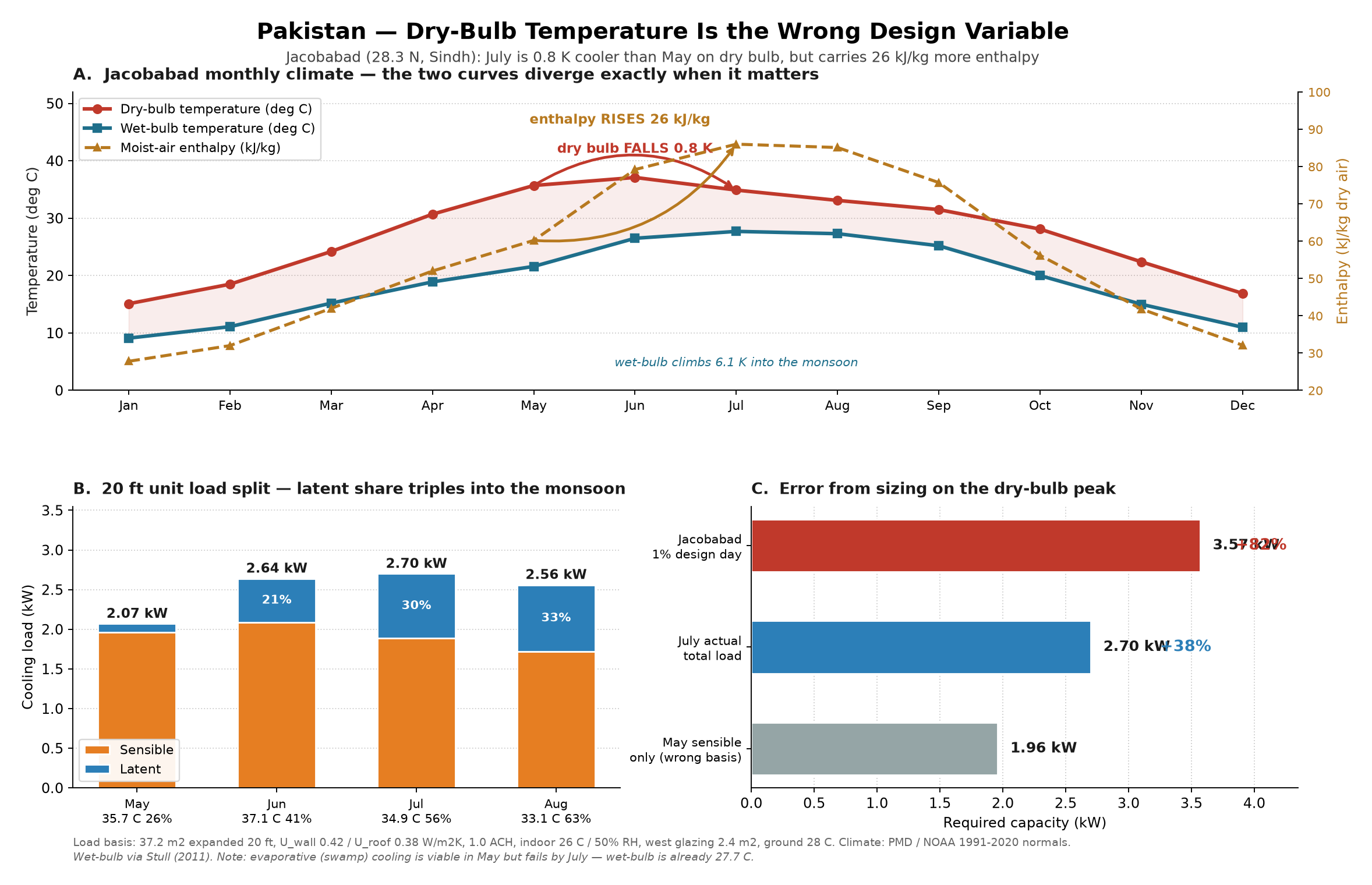
This is the wrong basis, and the error is not small. Using Jacobabad’s 1991–2020 climate normals, the picture is as follows.
| Month | Dry bulb °C | RH % | Wet bulb °C | Enthalpy kJ/kg |
|---|---|---|---|---|
| April | 30.7 | 30 | 18.9 | 52.0 |
| May | 35.7 | 26 | 21.6 | 60.2 |
| June | 37.1 | 41 | 26.5 | 79.2 |
| July | 34.9 | 56 | 27.7 | 86.0 |
| August | 33.1 | 63 | 27.3 | 85.1 |
| September | 31.5 | 59 | 25.2 | 75.7 |
July is 0.8 K cooler than May on dry bulb. On wet bulb it is 6.1 K hotter. On moist-air enthalpy, which is the quantity that actually determines how much work a cooling coil must do, July carries 25.8 kJ/kg more than May — an increase of 43%.
A supplier who sizes to the dry-bulb peak selects equipment for May. The building then operates at its highest total load in July and August, when the compressor is already working against a wet bulb near 27.7 °C. The result is a unit that runs continuously, holds temperature but not humidity, and is blamed on the equipment rather than the specification.
Running the load calculation for a 37.2 m² expanded 20 ft unit makes the scale of the error concrete.
| Condition | Sensible kW | Latent kW | Total kW | Latent share |
|---|---|---|---|---|
| May, 35.7 °C / 26% | 1.96 | 0.11 | 2.07 | 5% |
| June, 37.1 °C / 41% | 2.09 | 0.55 | 2.63 | 21% |
| July, 34.9 °C / 56% | 1.89 | 0.81 | 2.70 | 30% |
| August, 33.1 °C / 63% | 1.72 | 0.84 | 2.56 | 33% |
| Jacobabad 1% design, 47 °C / 25% | 2.99 | 0.58 | 3.57 | 16% |
Sizing on the May sensible load gives 1.96 kW. The July requirement is 2.70 kW, 38% higher. Sizing on the true 1% design day gives 3.57 kW, 82% higher. A unit bought on the dry-bulb peak is undersized for the season in which it will actually be used hardest.
There is a second consequence, and it concerns evaporative cooling. Direct evaporative coolers are widely marketed in Pakistan as a low-cost alternative to compressor air conditioning, and in May they work well. At 80% saturation effectiveness, a May unit delivers supply air at 24.4 °C from 35.7 °C ambient. By July the same unit delivers 29.1 °C, because the wet bulb it is working against has risen to 27.7 °C. The technology does not fail; the season changes underneath it. Any specification that names evaporative cooling without a wet-bulb limit is incomplete.
3. The second counterintuitive finding: the roof is not the binding constraint after noon
Shading strategy for hot climates is usually written around the roof. In Pakistan that is correct for the middle of the day and wrong for the hours that set the indoor peak.
Clear-sky beam irradiance on a horizontal roof in Lahore on 21 June peaks at 894 W/m² at 12:00 solar time, when the sun is at 82° altitude. A west-facing wall receives nothing at that hour. By 16:00 the position reverses: the roof is down to 488 W/m² while the west wall is receiving 634 W/m², and the west wall stays above 600 W/m² until 17:00.
The reason this matters is thermal lag. The roof’s peak arrives when the building is still recovering from the previous night. The west wall’s peak arrives at exactly the hour when indoor temperature is already at its daily maximum and the occupants are home. A specification that adds roof insulation and roof shading but leaves 2.4 m² of unshaded west glazing has addressed the smaller of the two afternoon loads.
The practical response is orientation-dependent, which is why it cannot be solved by a catalogue. On a plot where the long axis runs north–south, the west elevation is the narrow end and the problem is manageable. On a plot where the long axis runs east–west, the west elevation is 6.3 m wide and the same unit needs external shading, low-e glazing at a solar heat gain coefficient of 0.30 or below, or both.
4. Six failure modes that recur across the zones
These are the faults that appear repeatedly in service across Pakistan, in rough order of frequency.
Dust ingress into the envelope and equipment. Sindh and Balochistan experience sustained dust-laden winds before the monsoon. Standard container door gaskets and panel joints are not dust-tight. Fine silt accumulates in the wall cavity, degrades insulation performance over two to three seasons, and contaminates filters and condenser coils faster than European maintenance schedules assume.
Monsoon water entry at the panel joint, not the roof. Roof leaks are visible and get fixed. Water entry at the horizontal joint between stacked panels, and at the penetration where the expansion mechanism meets the fixed module, is not visible until the ceiling board stains. Lahore receives 202 mm in July alone, most of it in high-intensity events, and wind-driven rain at 15° incidence will find any unsealed lap. The comparable failure mode in the Bangladesh monsoon build is identical in mechanism and worse in magnitude.
Condensation on the inside face in monsoon, not in winter. This is the inverse of the European problem. In July, outdoor dew point is around 24 °C. Any internal surface below that temperature — a supply duct, a cold water pipe, an uninsulated ceiling in a cooled room — will run with water. Vapour drive in Punjab is inward during the monsoon and outward in winter, which means a single-direction vapour barrier is wrong for eight months of the year.
Salt-driven corrosion on the coastal belt. Karachi and Gwadar sit in an ISO 9223 corrosivity category C4 to C5 environment. Standard polyester powder coat on a 1.6 mm galvanised frame will show red rust at cut edges and at fixings within three to five years. Hot-dip galvanising to 85 µm, plus a coastal-grade topcoat and stainless fixings, is the minimum defensible specification.
Seismic anchorage treated as an afterthought. Quetta sits close to the Chaman fault and is classified in the highest seismic zone. The building frame is rarely the weak point; the connection between the container and its foundation is. Units installed on unanchored precast blocks have moved in past events.
Undersized plinth in flood-prone districts. The 2022 monsoon submerged roughly one third of the country and damaged or destroyed more than two million homes. In Sindh and southern Punjab, plinth height is not a detail. A unit set 300 mm above grade is a reasonable default for most of the world and an inadequate one for a district that flooded to 1.5 m.
5. Engineering responses, zone by zone
5.1 Indus plain desert: Jacobabad, Sukkur, Multan
The governing decision here is the cooling system, and it follows directly from section 2. Specify a split system sized on total load at the July wet bulb, not on dry bulb. For the 37.2 m² unit that means 3.5 kW nominal, with a sensible heat ratio the equipment can actually deliver at 27 °C wet bulb. Negotiate an expanded performance table from the manufacturer rather than accepting a nominal tonnage.
Envelope: 75 mm polyurethane panels rather than 50 mm, white or light-grey external finish to cut roof sol-air gain, and a ventilated roof gap of at least 50 mm if the unit will be occupied through June. Wall and roof U-values of 0.30 W/m²K or better.
Dust: specify brush seals plus a secondary EPDM gasket on all external doors, filter class G4 minimum on the return, and access panels that allow coil cleaning without dismantling the unit.
5.2 Punjab monsoon belt: Lahore, Faisalabad, Islamabad
Lahore’s design problem is the two-sided one — 40.4 °C in June and 202 mm of rain in July, from the same building in the same year. The detail that decides performance is the joint, not the panel.
Specify a continuous external rain screen over the horizontal joints, drained and back-ventilated, rather than relying on sealant. Sealant in Punjab’s thermal cycle — 40 °C day, 27 °C night, repeated 120 times a season — will fail in two to three years, and it will fail at the lap that matters.
Vapour: specify a humidity-variable membrane rather than a fixed vapour barrier. It should resist vapour drive inward during July and August and allow drying outward in the dry months. A fixed polyethylene barrier traps monsoon moisture in the wall and produces the mould that importers then attribute to “Chinese panels”.
Hail: Punjab experiences hail in the pre-monsoon period. A 0.5 mm steel roof skin will dent, and dented roof sheets pool water. Specify 0.6 mm minimum, or a standing-seam profile.
5.3 Coastal belt: Karachi, Gwadar
Corrosion, not heat, sets the service life. Specify hot-dip galvanised structure at 85 µm minimum, a topcoat system rated for ISO 12944 C5, and A2 or A4 stainless fixings throughout. Aluminium and galvanised steel in direct contact will galvanically corrode at the coast, so isolate the interface with a barrier tape or nylon washer.
Salt also attacks the equipment. Condenser coils need a coated or epoxy finish; the standard bare aluminium fin will be consumed in three to four seasons in Karachi.
The coastal belt is additionally the one place in Pakistan where design humidity is high and design temperature moderate. Dehumidification capacity matters more than sensible capacity, and the same total-load sizing logic from section 2 applies with an even higher latent share.
5.4 Balochistan plateau: Quetta
Quetta’s problem is the diurnal swing and the cold night, not the summer afternoon. Minimum temperatures below freezing occur from November to March, and the heating design condition is around −6 °C.
Envelope: 100 mm panels, and a thermal break at the frame-to-panel junction. Steel conducts, and a continuous frame will produce a cold bridge that shows as a condensation line along every stud.
Heating: specify a heat pump with a rated capacity at −7 °C, not a nominal capacity at +7 °C. The difference between those two figures in a Pakistani procurement document is often 40% of real output.
Seismic: Quetta is in the highest zone. Anchor design should be signed by a PEC-registered structural engineer, and the unit should be tied to a reinforced ring beam rather than to individual pads. Zone peak ground acceleration reaches 0.32g and above.
5.5 Northern mountains: Skardu, Gilgit, Murree
Skardu at 2,228 m combines snow load, low temperature and altitude derating. Ground snow load must be taken from the Building Code of Pakistan 2021 maps for the specific site, not from a default. Roof design should assume the snow will be retained for weeks rather than cleared daily.
Altitude affects equipment. Air density at 2,300 m is roughly 76% of sea-level density, which reduces the heat rejection capacity of an air-cooled condenser by a similar order. A unit that performs at 34 °C in Karachi will not perform at 28 °C in Skardu without a larger coil.
Foundations: in the northern valleys, frost depth and slope stability dominate. Sites on colluvial slopes above Gilgit and Hunza need a geotechnical report, and a container house is light enough that uplift and sliding, not bearing capacity, become the governing cases.
6. What the climate package actually costs
The table below compares a base specification suitable for a temperate market against the adaptation required for each zone. Figures are incremental to the base unit, in USD, and exclude freight and duties, which are handled in section 7.
| Adaptation | Base | Desert | Monsoon | Coastal | Plateau | Mountain |
|---|---|---|---|---|---|---|
| Panel thickness 50 → 75/100 mm | — | +620 | +480 | +180 | +1,050 | +1,480 |
| Roof shading / ventilated gap | — | +340 | +140 | — | — | — |
| Rain screen and joint drainage | — | — | +410 | +260 | — | — |
| Humidity-variable membrane | — | — | +190 | +210 | — | — |
| Corrosion class C5 upgrade | — | — | — | +690 | — | — |
| Stainless fixings | — | — | — | +180 | — | — |
| Seismic anchorage + ring beam | — | — | — | — | +740 | +920 |
| Snow load reinforcement | — | — | — | — | — | +680 |
| Plinth / flood riser 600 mm | — | — | +380 | +340 | — | — |
| Total increment | — | +960 | +1,600 | +1,860 | +1,790 | +3,080 |
Two observations. The desert package is the cheapest, which is counterintuitive given that the desert is the hottest zone — and we reached the same conclusion for the Gulf heat profile. Heat is solved with insulation and a properly sized air conditioner, both of which are commodity items. The coastal package costs almost twice as much because corrosion protection is a materials problem, and materials cannot be substituted at installation. The mountain package is the most expensive because it stacks snow load, insulation and altitude derating.
7. FOB to landed cost: the full chain
This is the calculation most buyers get wrong, and the error is usually in the duty cascade rather than the freight. If you want the method rather than this worked example, the landed cost walkthrough sets out each line and where it is usually mis-stated.
Take a 20 ft expandable unit at USD 13,800 FOB Tianjin, shipped two units per 40HC to Karachi Port.
| Line | Basis | USD |
|---|---|---|
| FOB Tianjin | — | 13,800 |
| Ocean freight | 40HC ÷ 2 units | 1,450 |
| Marine insurance | 0.4% of FOB + freight | 61 |
| CIF Karachi | 15,311 | |
| Customs duty, PCT 9406.9090 | 20% of CIF | 3,062 |
| Additional customs duty | 4% of CIF | 612 |
| Sales tax | 18% of CIF + CD + ACD | 3,417 |
| Provincial cess (Sindh) | 1.85% of CIF | 283 |
| Customs-cleared cost | 22,685 | |
| Advance income tax, s.148 | 12%, adjustable | 2,278 |
| Clearing agent and port charges | — | 320 |
| Inland haulage Karachi → Lahore | — | 480 |
| Foundation, screw piles | — | 1,750 |
| Installation and commissioning | — | 850 |
| Local electrical connection | — | 420 |
| Landed and installed on site | 26,505 |
The tax burden is USD 7,374, or 48.2% of the CIF value. The single largest line is sales tax at 18%, and it is levied on the duty-inclusive value, not on the CIF value alone — which is why estimating duty as a flat percentage of FOB understates the total by a wide margin.
The advance income tax is the line buyers most often misread as a cost. It is adjustable against the importer’s annual income tax liability, so for a registered importer on the Active Taxpayer List it is a cash-flow item, not a permanent cost. For a non-filer it is charged at a higher rate and is harder to recover.
Where the China–Pakistan FTA changes the answer
Under Phase II of the China–Pakistan Free Trade Agreement, which took effect on 1 January 2020, the two countries committed to eliminating tariffs on 75% of tariff lines, phased over ten years on the Chinese side and fifteen on the Pakistani side. Some lines were reduced immediately; others were placed on a protected list.
Whether a specific container house attracts a preferential rate depends on the eight-digit PCT code and on presenting a valid Certificate of Origin. The difference is material. If customs duty on the example above falls from 20% to nil while the other levies stand, the customs-cleared cost drops from USD 22,685 to roughly USD 19,072 — a saving of about USD 3,600 per unit, or 26%.
Two cautions. First, the buyer must confirm the rate for their exact PCT code against the current tariff schedule at the time of import, because rates are revised through statutory regulatory orders and finance acts. Second, a concession claimed without a compliant Certificate of Origin exposes the importer to post-clearance recovery with penalties, which is a far worse outcome than paying the statutory rate.
Do not accept a supplier’s verbal assurance that “it is zero under the FTA”. Ask for the PCT code in writing, check it on the Trade Information Portal of Pakistan, and confirm the certificate requirement with the clearing agent before the goods ship.
8. Compliance and approvals in Pakistan
The Building Code of Pakistan 2021, published by the Pakistan Engineering Council, is the national reference standard. It replaced the seismic provisions of the earlier BCP-SP-2007 and is built on the 2021 International Building Code, with Pakistan-specific wind speeds, ground snow loads, 100-year design rainfall and mapped seismic acceleration parameters.
Three points on how it applies to imported container housing.
The code is national, but enforcement is local. The Authority Having Jurisdiction is typically the provincial development authority or building control authority — the Sindh Building Control Authority, Lahore Development Authority, Capital Development Authority, or the cantonment and housing society boards. Practice varies between them, and a design accepted in one jurisdiction may require additional documentation in another.
Structural design must be signed by a PEC-registered engineer. Under S.R.O. 971(I) of 8 September 2008, construction in violation of the code is treated as a violation of professional engineering work under the Pakistan Engineering Council Act 1975. For an imported module this means the supplier’s factory calculations are supporting documents, not a substitute for local sign-off.
Fire safety and energy sit in separate documents. Fire provisions are in the Building Code of Pakistan — Fire Safety Provisions 2016, and energy efficiency in the Building Code of Pakistan — Energy Provisions 2011. For container housing the fire question is almost always the core material: polyurethane-core panels are combustible and some institutional buyers now require mineral wool or rock wool cores, particularly for schools, clinics and accommodation blocks.
A compliance sequence that works
- Confirm the PCT code and current duty rates before issuing the purchase order.
- Appoint a PEC-registered structural engineer in the destination province at design stage, not at installation.
- Submit for the local AHJ approval with the seismic anchorage design and the fire rating of the panel core.
- Confirm the Certificate of Origin route with the clearing agent before shipment, not after arrival.
- Hold the factory test certificates for panel density, steel yield strength and coating thickness — these are the documents an AHJ will ask for.
9. Frequently asked questions
A wider set of general procurement questions is answered in the expandable container house FAQ.
Can a standard 20 ft unit be used across all of Pakistan?
Physically yes, but the specification cannot be the same. The unit that meets the desert brief in Sukkur will be under-insulated for Quetta and under-strength for Skardu’s snow load. The frame is common; the envelope, anchorage and equipment are not.
Is evaporative cooling a legitimate alternative to air conditioning in Pakistan?
In the Indus plain in May and early June, yes. By July the wet bulb rises to around 27.7 °C and a direct evaporative cooler delivers supply air close to 29 °C, which is not useful. Any specification relying on evaporative cooling should state a wet-bulb limit and include a mechanical backup.
How much does the monsoon actually add to the cooling load?
For a 37.2 m² unit, latent load rises from 0.11 kW in May to 0.84 kW in August, taking the latent share of total load from 5% to 33%. Total load rises 30% between May and July even though dry-bulb temperature falls.
What is the real duty on a container house into Pakistan?
For PCT 9406.9090 the statutory position is 20% customs duty, 4% additional customs duty, 18% sales tax and 12% advance income tax, plus provincial cess. On a CIF value of USD 15,311 that is roughly USD 7,374 of levies, about 48% of CIF. Preferential rates under the China–Pakistan FTA may apply to specific codes with a valid Certificate of Origin.
Does the building code require a local engineer?
Yes. Structural design for a building in Pakistan must be signed by a PEC-registered engineer. The supplier’s factory structural calculations support that submission but do not replace it.
What foundation is appropriate?
It depends on the zone. Screw piles or a reinforced strip footing suit the Indus plain. The coastal belt needs sulphate-resistant concrete and a raised plinth. Quetta and the northern valleys need a geotechnical report and a tied ring beam, with uplift and sliding checked as well as bearing.
How long should the coating last in Karachi?
With standard polyester powder coat on galvanised steel in a C4–C5 corrosivity environment, expect red rust at cut edges within three to five years. A C5-rated system with hot-dip galvanising at 85 µm and stainless fixings should give fifteen years or more before first maintenance.
Can the unit be relocated after installation?
Yes, if it was designed for it. Relocation requires the anchorage to be demountable and the expansion mechanism to be re-commissioned. Units installed on a cast-in-situ ring beam are effectively permanent.
10. Next step
If you are specifying for a site in Pakistan, the useful information to send is the city or district, the elevation if you know it, the intended use and occupancy, and whether the site is inside a development authority jurisdiction. Those four items determine the zone, and the zone determines the envelope, the anchorage and the equipment.
We can return a zone-specific specification with the cooling load calculated at the correct wet bulb for your location, the climate package priced as a line item rather than absorbed into the unit price, and a landed cost model built on the current PCT rate for your code.
Send the site details to jack@huayinghouse.com or WhatsApp +86 153-0318-4505. If you already have a quotation from another supplier, send that as well — the most common finding in our review is a unit sized on dry-bulb peak, and it is cheaper to correct on paper than on site.