
By Fan Zhiqiang, Export Sales Manager, HUAYING (Fucheng Huaying Integrated Housing Co., Ltd.) — October 2026
Most container house specifications written for the Gulf are copied from a Dubai brochure that lists two numbers — 50 °C ambient and 80 mm insulation — and then stops. Shippers who buy on those two numbers discover in their first spring that the envelope was designed for a climate that does not exist. The Gulf is not one hot place. It is a coast where the air carries more water than the air inside the building, an interior plateau where winter nights drop below 8 °C, and a wind regime with a fixed direction and a seasonal dust load that fills roof drainage systems in a single season. This guide works through what actually fails, in what order, and what each countermeasure adds to the landed cost.
1. The three climates inside one peninsula
Saudi Arabia and the UAE are usually marketed as a single “hot desert” market. Measured data does not support that framing. Three distinct regimes sit inside the same customs territory.
The interior plateau (Riyadh, 24.7 °N, 612 m). Summers are dry and extremely hot; winters are genuinely cool. January mean minimum sits near 8 °C and individual clear nights fall to 2–4 °C. Annual rainfall is around 100 mm, arriving in short violent bursts in March–April and again in November.
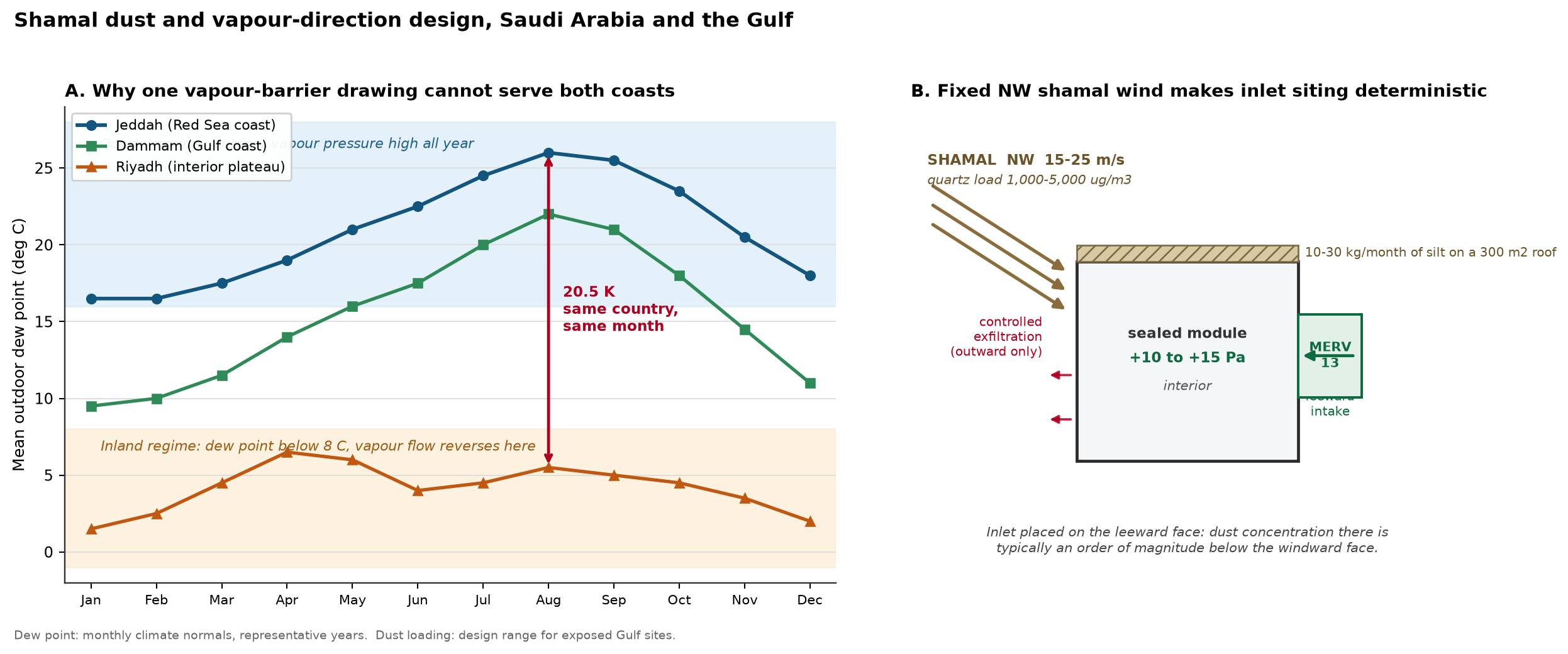
The Gulf coast (Dammam 26.4 °N, Dubai 25.2 °N, Doha 25.3 °N, Kuwait 29.4 °N). Summer is hot and humid. Dew point reaches 26–28 °C in August, which is higher than a normally ventilated interior at 24 °C and 50 % relative humidity. This single fact invalidates the vapour-barrier detail that works inland.
The Red Sea coast (Jeddah 21.5 °N). Hot and humid year-round with almost no cool season. Winter dew point still sits near 16 °C. There is no month in which the building can be dried out by opening windows.
The design consequence is not “more insulation.” It is that the direction of water vapour movement through the envelope reverses between these three locations and, on the plateau, reverses twice within 24 hours. A specification that fixes one vapour-barrier position and applies it across a GCC order will be wrong for at least two of the three sites.
2. What the Shamal actually is, and why direction matters
The shamal is a north-westerly wind, strongest in June–July and again in winter, channelled down the Tigris–Euphrates plain and across the Gulf. Two things about it are directly useful at the design stage.
It has a fixed direction. Unlike a monsoon or a thunderstorm outflow, the shamal arrives from the north-west with little deviation. Sustained speeds of 15–25 m/s occur, with gusts above 30 m/s during the strongest summer events. Because the direction is predictable, inlet siting stops being a guessing game: put the fresh-air intake on the leeward (south-east) face and dust concentration at the intake drops by roughly an order of magnitude compared with a windward placement. This is a free 90 % reduction in filter loading that costs nothing but a drawing decision.
It carries a quantified load. During a strong shamal, airborne particulate at exposed Gulf sites reaches 1,000–5,000 µg/m³, against a background of 100–300 µg/m³. A 75 mm EPS sandwich panel with a standard window-frame seal is not a dust barrier. Fine quartz silt (typically 2–20 µm) penetrates any gap above roughly 0.1 mm, and it does so continuously rather than in events.
The failure that follows is not “the house gets dusty.” It is that dust accumulates where it is invisible — on top of ceiling panels, inside the wall cavity, behind switch plates — and each of those deposits has a downstream mechanical consequence.
3. Six failure modes, in the order they actually appear
3.1 Roof drainage silts up before it overflows
The first monsoon-grade rain after a dust season arrives on a roof that is holding 10–30 kg of fine silt on a 300 m² area. The silt does not stay evenly distributed; it washes into the gutter and consolidates at the outlet. Measured behaviour of a 100 mm gutter with a 75 mm outlet: clean, it passes about 215 mm/h of rainfall. After one dust season it passes about 123 mm/h, a 43 % loss. At the outlet itself the loss is worse, because flow scales with the open area of the aperture, which falls with the square of the effective diameter — 147 mm/h down to 45 mm/h, a 69 % loss.
The practical consequence: the drainage system should be sized against the post-dust condition, not the factory-clean condition. For Gulf sites this means a gutter and downpipe one nominal size up from the temperate-climate default, plus a removable silt trap at each outlet and an overflow scupper set 30 mm above the gutter invert. Without the scupper, a blocked outlet backs water under the roof flashing rather than spilling visibly.
3.2 The roof condenses on the inside in winter, not summer
This is the failure almost no supplier warns about, and it is the most expensive one on the plateau.
On a clear winter night in Riyadh the ambient air at 6 °C and 30 % relative humidity has a dew point of −10.3 °C. The sky temperature on the same night is 18–26 K below ambient. An uninsulated or thin-insulated steel roof panel radiates to that sky and its inner surface settles 4–6 K below indoor air temperature. Indoor air at 21 °C and 40 % RH has a dew point of +6.9 °C. The inner roof surface is therefore well below the indoor dew point for six to nine hours every clear night from November to March.
Water collects on the underside of the roof deck, runs to the lowest point, and drips onto ceiling panels. Occupants report “a leaking roof” in a dry month and the supplier cannot reproduce it.
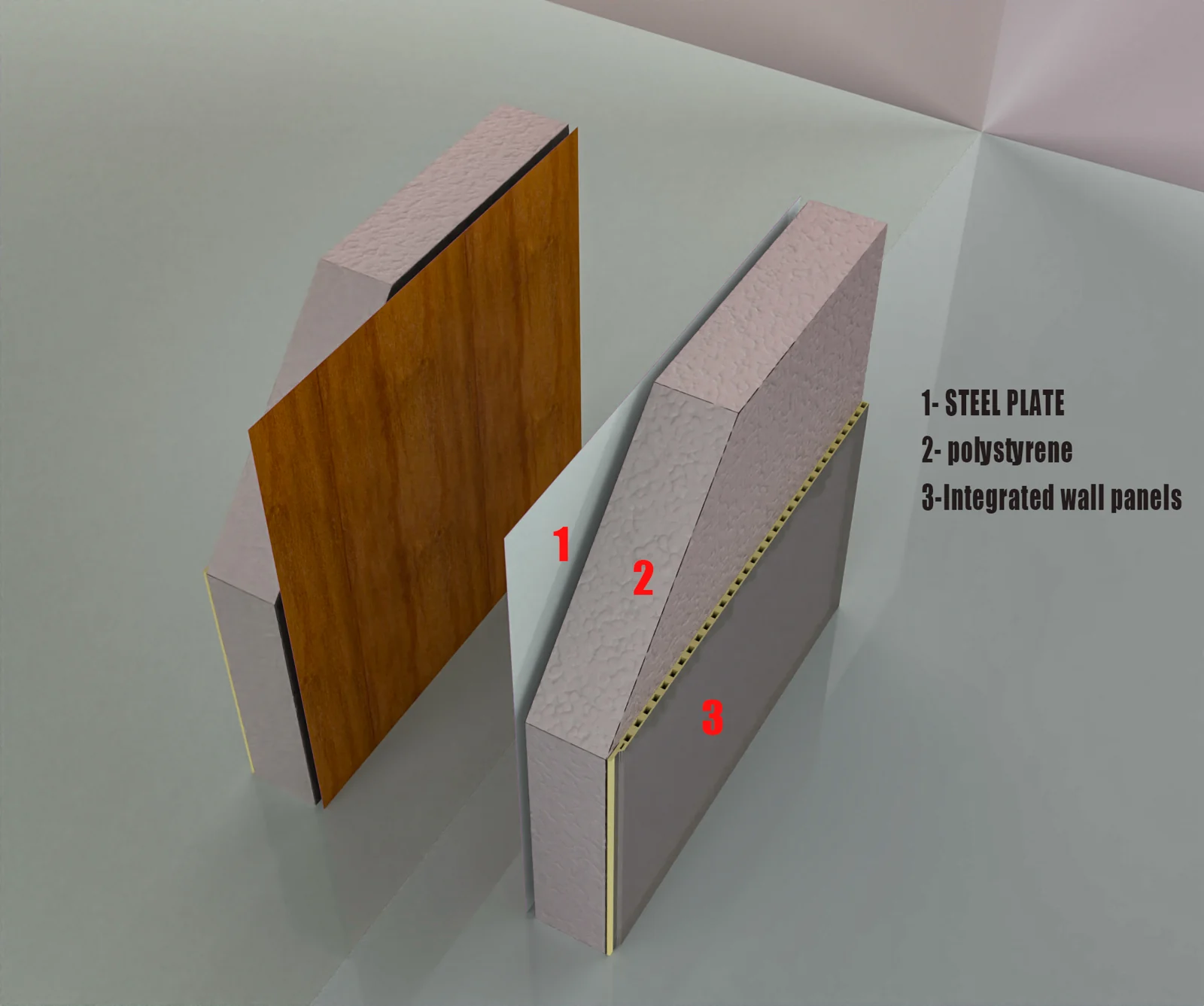
The countermeasure is a warm-side vapour barrier plus a ventilated or insulated roof build-up that keeps the inner steel surface above the indoor dew point. In practice: 100 mm PIR with a foil facing continuous over the purlins, all joints taped, and no penetrations without a sealed collar. A 50 mm panel — the common Gulf default — does not achieve this, because the inner surface temperature is governed by the total R-value across the assembly, not by the panel alone.
The vapour pressure numbers make the direction unambiguous. Outdoors on that winter night: 280 Pa. Indoors: 989 Pa. The gradient points outward and is 3.5 times the outdoor value. Nine hours later, in summer conditions, outdoor vapour pressure at 45 °C and 12 % RH is 1,139 Pa against an indoor 1,483 Pa at 24 °C and 50 % RH — still outward, but now the outdoor air is a competing source rather than a sink. A single fixed retarder position cannot be correct in both states. The build-up must be vapour-open to the outside and closed to the inside, with the closing layer continuous.
3.3 On the coast, the same detail traps water instead of excluding it
Reverse the site. Dammam in August: outdoor dew point 26 °C, indoor 24 °C at 50 % RH with a dew point of 13 °C. The vapour pressure gradient now points inward — 2,700 Pa outside against 1,483 Pa inside. Any inward-diffusing assembly puts the condensation plane inside the insulation, and the panel never dries because the outdoor dew point stays above 20 °C for four months.
The correct coastal detail is the opposite of the plateau detail: a closed-cell insulation (XPS or PIR with sealed foil) that does not permit internal condensation at all, an airtight but vapour-open internal lining, and mechanical dehumidification sized on latent load. This is the same logic that governs tropical Southeast Asia, and it is why one GCC-wide specification cannot work.
3.4 Cooling capacity is selected on dry-bulb temperature, so it is undersized
Gulf equipment schedules are routinely written as “45 °C ambient, 24 °C room.” That is a sensible-load calculation. On the coast, the load at 38 °C dry-bulb and 28 °C dew point is higher than the load at 45 °C dry-bulb and 14 °C dew point, because the latent component dominates.
As a rule of thumb for coastal Gulf sites, latent load is 40–55 % of total cooling load in July and August. A unit selected purely on the 45 °C dry-bulb condition will meet sensible demand and fail on humidity, producing a room that is cold and damp — the condition that grows mould behind furniture and corrodes electronics. Selection must be made on the design enthalpy, not the design dry-bulb, and the coil must be rated for the entering wet-bulb at that site.
3.5 Sand abrasion attacks coatings before it attacks structure
Wind-driven quartz at 20 m/s is an abrasive. On windward faces it removes the gloss layer of a standard polyester coating within two to three seasons, and once the gloss is gone the coating’s barrier function degrades quickly. The structural steel is not at risk in that timeframe; the coating system is.
For exposed Gulf sites, specify a coating system rated to at least C4 (ISO 12944) with a nominal dry film thickness of 160 µm or more, and treat the windward elevations as a separate exposure category from the leeward ones. A single C3 system applied uniformly is the most common cost-driven shortcut and the one that produces the earliest callbacks.
3.6 Seal degradation lets dust in continuously, not seasonally
Standard EPDM window seals harden under UV and repeated dust abrasion. Once a seal loses compression, the module stops being a dust barrier permanently. Because the shamal runs for weeks, the intrusion is continuous. The visible symptom — dust on interior sills — appears long after the cavity above the ceiling has already loaded.
Specify compression-set-resistant silicone or high-grade EPDM with a continuous gasket rather than a segmented one, and design the module so that the interior lining can be removed for cavity inspection without cutting the vapour barrier.
4. Engineering countermeasures, by regime
4.1 Envelope and insulation
| Regime | Wall | Roof | Vapour control layer | Notes |
|---|---|---|---|---|
| Interior plateau (Riyadh) | 75 mm PIR | 100 mm PIR, foil-faced, continuous | Warm side, continuous, taped | Winter condensation governs, not summer heat |
| Gulf coast (Dammam, Dubai, Doha) | 75 mm PIR or XPS | 75–100 mm closed-cell | Airtight internal lining, vapour-open | Dehumidification required; avoid internal condensation plane |
| Red Sea (Jeddah) | 75 mm XPS | 75–100 mm closed-cell | Airtight internal lining, vapour-open | No dry season; C5-M coating on all elevations |
4.2 Dust control
- Positive pressure. Run the fresh-air intake so the module sits at +10 to +15 Pa relative to outdoors. Every leak then exfiltrates instead of infiltrating. This is the single highest-value change and costs one small fan plus a filter box.
- Leeward intake. Place the intake on the south-east face; the shamal comes from the north-west.
- MERV 13 minimum, with a pre-filter upstream. On a Gulf site the pre-filter does most of the work and is the part that must be serviceable from outside without entering the conditioned space.
- No horizontal surfaces at the inlet. A horizontal louvre blade becomes a dust ledge. Use vertical blade or a downward-facing hood.
- Filtered relief path. Sealed modules need a controlled exfiltration path, otherwise the positive pressure collapses the first time a door closes. Use a pressure-relief damper, not an open vent.
4.3 Roof and drainage
- Roof pitch 3 % minimum with a defined low point; no flat panels with ponding risk.
- Gutter and downpipe one nominal size above the temperate default, plus a silt trap at each outlet.
- Overflow scupper 30 mm above gutter invert so a blockage spills visibly rather than backing into the envelope.
- Removable gutter strainers; specify the access route at design stage, because retrofitting roof access is disproportionately expensive.
4.4 Solar control
At 24.7 °N the June solstice noon sun is 88.7° above the horizon. A horizontal overhang sized to shade the glazing at that angle requires E/H of only 0.02 — in other words, at noon in June a horizontal overhang is doing almost nothing that a 50 mm lip would not do. The overhang’s real value comes in December, when the noon sun drops to 41.8° and the same window needs E/H ≥ 1.12 to stay shaded.
That inversion drives two decisions. First, horizontal overhangs must be sized for the winter sun, not the summer sun, which is the opposite of the temperate-climate rule. Second, because winter shading needs a 1.1:1 overhang while summer needs almost none, the practical answer is a shallow fixed overhang plus external vertical fins on east and west elevations, where the low-angle morning and afternoon sun cannot be intercepted by any horizontal device.
Roof solar absorptance matters more than wall colour in this climate. A high-reflectance roof coating (SRI ≥ 78) reduces the roof surface temperature by 15–25 K under peak sun, which directly reduces the heat conducted through the roof assembly during the hours when the indoor temperature has already peaked.
4.5 Coating and corrosion
| Zone | ISO 12944 category | Minimum DFT | Typical driver |
|---|---|---|---|
| Interior plateau (Riyadh) | C3 | 120 µm | Dust abrasion, low humidity |
| Gulf coast (Dammam, Dubai, Doha) | C4 | 160 µm | Chloride + abrasion |
| Red Sea coast (Jeddah) | C5-M | 200 µm | Year-round chloride, no dry season |
On the coast, the windward elevation should be specified one category above the general elevation. This is not a sales upsell; it reflects that abrasion and chloride deposition both peak on the face the shamal hits.
5. Landed cost, FOB Tianjin to site
The table below builds a 20 ft expandable unit at the calibrated FOB band and carries it to a delivered, installed cost. Duty and tax figures are the ones that apply to HS 9406.20 from China.
| Cost element | Basis | Riyadh (interior) | Dammam (Gulf coast) | Jeddah (Red Sea) |
|---|---|---|---|---|
| FOB Tianjin, 20 ft expandable | Calibrated FOB band | USD 12,500–14,500 | USD 12,500–14,500 | USD 12,500–14,500 |
| Ocean freight, 1 × 40HC (2 units) | Tianjin → Gulf port | USD 1,900–2,600 per HC | USD 1,900–2,600 per HC | USD 2,000–2,700 per HC |
| Marine insurance | 0.35 % of CIF | ~USD 55 | ~USD 55 | ~USD 58 |
| Import duty, HS 9406.20 | GCC common tariff 5 % | USD 725–855 | USD 725–855 | USD 730–860 |
| VAT | KSA/UAE 15 %, Jeddah 15 % | USD 2,280–2,690 | USD 2,280–2,690 | USD 2,290–2,710 |
| Inland transport to site | Port → site | USD 350–600 | USD 180–320 | USD 200–350 |
| Foundation and site works | Screw piles or raft | USD 1,600–2,400 | USD 1,600–2,400 | USD 1,700–2,500 |
| Installation and commissioning | 2-person crew, 3 days | USD 1,100–1,600 | USD 1,100–1,600 | USD 1,100–1,600 |
| Site-specific envelope upgrade | See note | USD 900–1,400 | USD 500–900 | USD 1,300–1,900 |
| Delivered and installed | USD 21,200–26,900 | USD 20,000–25,600 | USD 21,700–27,400 |
Note on the envelope upgrade line. This is the cost of the regime-specific measures in sections 4.1–4.3: the roof upgrade to 100 mm PIR with continuous warm-side barrier on the plateau; the closed-cell coastal build-up with dehumidification allowance on the Gulf and Red Sea coasts; the positive-pressure filtration set; the oversized gutter with silt traps; and the C4/C5-M coating. It is the line most often deleted at quotation stage and the one that generates the callbacks.
Duty at 5 % is the GCC common external tariff for 9406.20. Buyers importing into a free zone or under a specific industrial incentive scheme should confirm their own treatment; the 5 % figure is the general case, not a universal one.
6. Compliance and documentation
Saudi Arabia. The Saudi Building Code (SBC 201) governs thermal performance, and SBC 601 covers mechanical. For containerised accommodation on project sites, the contractor’s consultant normally requires a thermal calculation showing the assembly U-value against the SBC 201 climate zone — Riyadh and Dammam fall in different zones and therefore carry different limits. SABER registration and a Certificate of Conformity are required for regulated products at import; the module’s electrical fittings, insulation and glazing each attract their own scope. Confirm the applicable technical regulation with the importer of record before production, not after.
United Arab Emirates. Dubai Municipality and Abu Dhabi’s DMT both require a building permit for a permanent container structure; a temporary site office typically follows a lighter path but still requires the consultant’s sign-off. The UAE safety and fire code requirements for accommodation modules concern egress, fire separation and cladding reaction-to-fire, and cladding choice is a common source of rejection. Estidama (Abu Dhabi) and Al Sa’fat (Dubai) green rating systems apply to permanent buildings; for a temporary module they are usually not triggered, but the client may still request a statement.
Qatar and Kuwait. Qatar’s QCS and Kuwait’s KBC each publish their own thermal and fire requirements; both are more prescriptive on accommodation units than on plant rooms. Where the unit is a worker accommodation module, fire egress and detection requirements are typically stricter than the buyer expects.
Documentation set that prevents delays. A complete shipment for a Gulf project normally needs: commercial invoice and packing list; certificate of origin (for GCC tariff treatment); bill of lading; SABER certificate where Saudi Arabia is the destination; test reports for the insulation and cladding reaction-to-fire; electrical certification for fittings; and a foundation drawing signed by the local engineer. Missing documentation is the most common cause of port storage charges on this trade lane, and storage is charged per day per container.
7. Questions buyers ask before ordering
Is a container house suitable for a Gulf summer at all? Yes, with the caveat that the envelope and the cooling selection must be treated as one system. The failures reported by buyers are almost always envelope failures — roof condensation, undersized drainage, single-position vapour barrier — rather than a limitation of the structural form. A steel-framed module with a correctly detailed envelope and enthalpy-based cooling selection performs in the Gulf; the same module with a 50 mm panel and a dry-bulb-selected air conditioner does not.
Why does the roof drip in winter when it never rains? Because the inner roof surface falls below the indoor dew point on clear nights. Ambient 6 °C, relative humidity 30 % gives an outdoor dew point of −10.3 °C; the same night the sky is 18–26 K colder than ambient, and the uninsulated roof panel follows the sky. Indoor air at 21 °C and 40 % RH has a dew point of +6.9 °C, so condensation forms on the underside of the deck for six to nine hours. The fix is a continuous warm-side vapour barrier and enough roof insulation to keep the inner surface above the indoor dew point — 100 mm PIR rather than the 50 mm default.
How much dust actually enters, and does it matter? At exposed sites during a shamal, particulate reaches 1,000–5,000 µg/m³ against a 100–300 µg/m³ background. Whether it matters depends entirely on pressure control. A module at neutral or negative pressure infiltrates continuously through every seal and service penetration; the same module at +10 to +15 Pa exfiltrates instead, and dust entry becomes limited to the filtered intake. The cost difference is a small fan and a filter box.
Can I use the same specification for Riyadh and Dubai? No. Riyadh in winter has clear nights at 2–4 °C with an outdoor dew point near −10 °C; Dubai in August has a dew point near 26 °C. Those two conditions require opposite vapour-barrier positions. A single specification will be wrong at one of the two sites, and the failure mode differs — winter roof condensation inland, summer interstitial condensation on the coast.
What coating do I need on the coast? C5-M at a nominal 200 µm dry film thickness for the Red Sea and the exposed Gulf coast, with the windward elevation treated one category above the remainder. C3 at 120 µm is adequate inland where the driver is abrasion rather than chloride. On a coastal site a C3 system typically shows gloss loss within two to three seasons under shamal abrasion, and barrier failure follows.
Does the roof need a different pitch in a dust climate? Yes, for a reason that has nothing to do with rainfall volume. The constraint is solids transport, not water volume: silt consolidates in low-slope gutters and at outlets. A 3 % minimum pitch with a defined low point, a silt trap at each outlet and an overflow scupper 30 mm above the invert is the practical package. A flat panel is the one configuration to avoid.
How long does installation take on site? A 20 ft expandable unit is typically set, unfolded and connected in two to three days with a two-person crew plus lifting equipment, assuming the foundation and utility stubs are ready. The Gulf-specific addition is commissioning of the filtration and dehumidification, which is a half day. Site preparation and foundation work are usually the long pole, not the module.
8. Next step
If you are specifying for a Gulf site, the two questions that determine most of the cost are: which regime is the site in (interior plateau, Gulf coast or Red Sea coast), and is the module permanently occupied or intermittently used. Those two answers change the roof build-up, the vapour-barrier position, the coating category and the cooling selection, and together they move the delivered cost by several thousand dollars per unit.
Send the site coordinates and the intended occupancy pattern and we will return a specification with the envelope build-up, the coating category and a landed cost table for that specific location, rather than a generic Gulf quotation.
Fan Zhiqiang — Export Sales Manager Email: jack@huayinghouse.com Phone / WhatsApp: +86 153-0318-4505 Factory: Fucheng Huaying Integrated Housing Co., Ltd., Fucheng Economic Development Zone, Hengshui, Hebei, China
Related reading: Container House Design for Desert Heat: Saudi Arabia & UAE High-Temperature Engineering covers cooling-load selection and roof solar control in more depth. Container Houses in Saudi Arabia: 2026 Cost Guide for NEOM, Worker Camps and Residential Projects covers the commercial and permitting path for project sites. Container Houses in UAE (Dubai & Abu Dhabi) covers the UAE import and permit route, and Container Houses in Qatar covers QCS compliance and Doha shipping.