Nepal gets filed under “cold mountain country,” and that single word sends most buyers toward the wrong envelope. Kathmandu sits at 1,400 m in a bowl-shaped valley where the annual heating demand (779 degree-days at an 18 °C base) is almost exactly matched by the cooling demand (876 degree-days). Neither a Canadian cold-climate specification nor a tropical one is correct for the valley floor, and applying either wastes money in a market where a 20 ft expandable unit already carries 24.3% of its customs value in duty and VAT before it leaves the dry port.
The larger problem is not thermal at all. The valley floor is a drained lake. Boreholes in central Kathmandu pass through roughly 600 m of fluvio-lacustrine sediment, and the top 20 m is water-saturated soft clay, silt and peat of the Kalimati formation. When the ground shook in April 2015, twenty-five sites in and around the valley liquefied, and the strong-motion station at Kantipath recorded a permanent vertical displacement of 131.9 cm alongside 159.2 cm horizontally. A house that survives that is not a house with a stronger frame. It is a house whose foundation was chosen for the site.
This guide works through the four design drivers in the order they actually bind: the ground, the monsoon, the envelope, and the corrosion clock. Every figure below is either from a Nepali or international standard, or computed from the tables shown.
The ground decides the foundation, and the foundation decides the budget
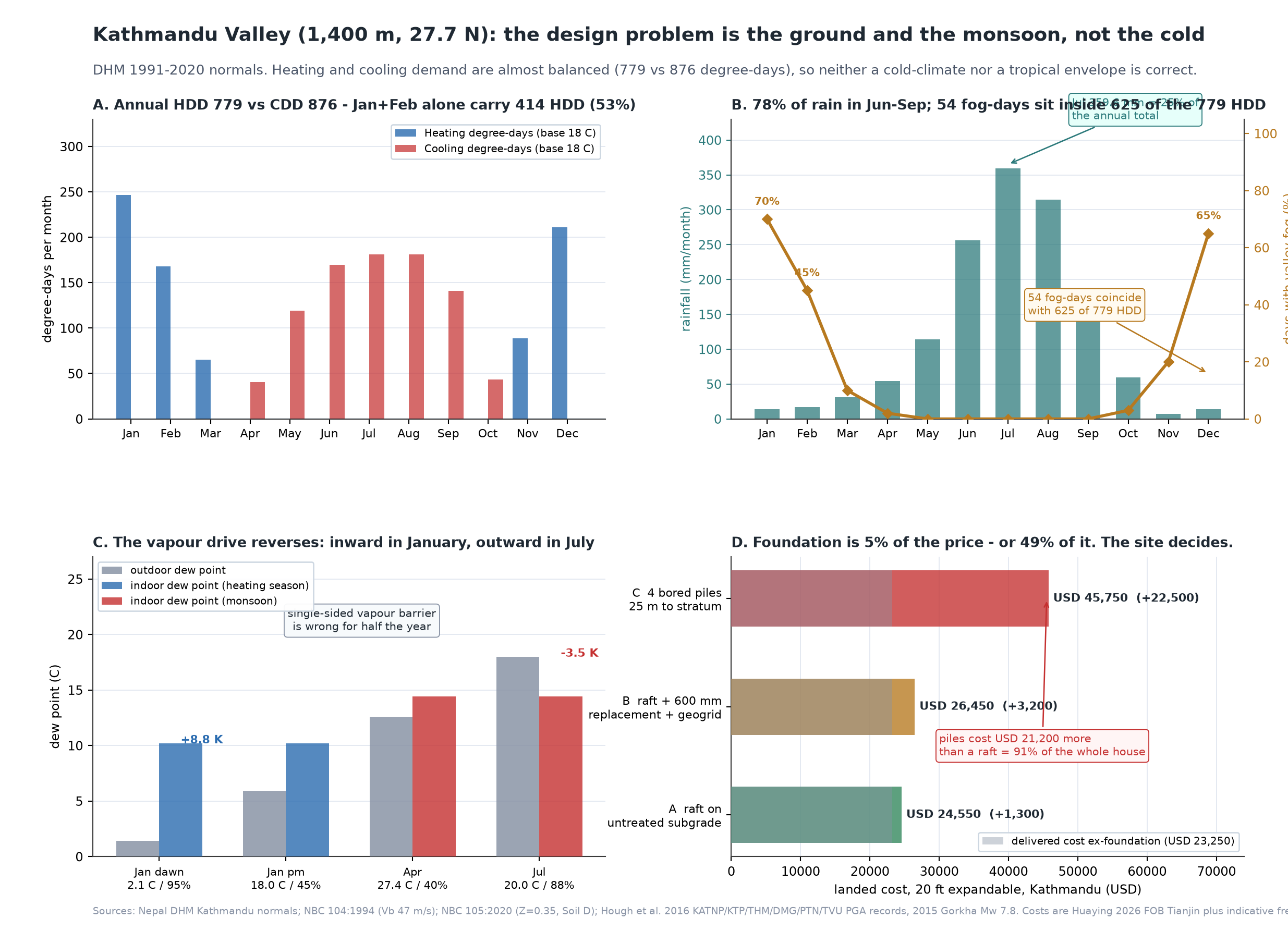
NBC 105:2020 assigns Kathmandu a seismic zoning factor Z = 0.35 — design shaking at 35% of gravity, on a 475-year return period. That number is severe, but it is not what breaks buildings. What breaks buildings is that the same code classifies the core valley municipalities (Kathmandu, Lalitpur, Bhaktapur, Madhyapur Thimi, Kageshwari Manohara, Tokha) as Soil Type D, the softest category in the code, because of the deep lakebed deposits. On Type A rock the high-demand plateau of the design spectrum ends at a period of 0.5 s; on Type D it extends to 2.0 s. Soft ground does not just amplify shaking, it stretches it.
NBC 105:2020 also requires two performance levels rather than one. The Ultimate Limit State is checked against the full design earthquake so the building does not collapse. The Serviceability Limit State is checked against a fraction of that force so the building remains usable without repair. For a single-storey container house, this distinction lands almost entirely on the foundation, because the superstructure has no reserve to redistribute differential movement.
Here is where the arithmetic gets uncomfortable. A 20 ft expandable unit deployed for living weighs roughly 4,500 kg over about 30 m2 of footprint — a dead load of 1.46 kPa. On that mass, sliding is not the governing failure mode: at the recorded 2015 horizontal PGA of 0.150–0.165 g with a vertical component of 0.186 g acting to reduce normal force, the factor of safety against sliding is 2.0–2.2. Uplift does not occur. The frame does not need to be heroic.
What does fail is the connection between a stiff steel box and ground that moves 1.3 m vertically under it. A 2.7 m wall spanning a 6 m foundation on 159 cm of differential settlement tilts 14.9°. No amount of weld detailing prevents that. The only lever is what you put under the house.
| Strategy | What it involves | Cost (USD) | Landed total (USD) | Foundation as % of total |
|---|---|---|---|---|
| A — Shallow raft | Reinforced raft on untreated subgrade, seismic tie-downs cast in | 1,300 | 24,550 | 5.3% |
| B — Raft plus ground improvement | 600 mm gravel replacement, geogrid, raft, tie-downs | 3,200 | 26,450 | 12.1% |
| C — Bored piles | 4 × 25 m bored piles to bearing stratum, pile cap, tie-downs | 22,500 | 45,750 | 49.2% |
Strategy C costs USD 21,200 more than Strategy A — 91% of the entire delivered price of the house excluding foundations. That is the real budget decision in Nepal, and it is made before a single panel is ordered. A quotation that lists only FOB and freight has not told the buyer anything useful about Kathmandu.
Strategy A is defensible on rock or on the higher terraces of the northern valley, where the Gokarna formation gives silty sand with better bearing capacity. It is not defensible on the Kalimati formation covering central Kathmandu, Lalitpur and Bhaktapur, where the 2015 liquefaction clustered and where a post-earthquake survey found that around 70% of damaged buildings in central Kathmandu had shallow foundations. The buyer’s first action should be a borehole, not a brochure comparison.
Why the vertical component of the 2015 shaking matters more than the horizontal
Most seismic discussion for light steel housing focuses on lateral force. In Kathmandu that emphasis is misplaced, and the records prove it. Across the six strong-motion stations that captured the Mw 7.8 Gorkha mainshock, the vertical peak ground acceleration exceeded the larger horizontal component at three of them:
| Station | PGA x (g) | PGA y (g) | PGA z (g) | Vertical > horizontal? |
|---|---|---|---|---|
| THM Bhaktapur | 0.150 | 0.124 | 0.183 | Yes |
| KATNP Kantipath | 0.150 | 0.165 | 0.186 | Yes |
| KTP Kirtipur | 0.153 | 0.246 | 0.123 | No |
| DMG Lainchaur | 0.178 | 0.127 | 0.206 | Yes |
| PTN Pulchowk | 0.154 | 0.136 | 0.151 | No |
| TVU Tribhuvan University | 0.192 | 0.242 | 0.150 | No |
A vertical acceleration of 0.186 g acting on a 1.46 kPa dead load removes 0.27 kPa of the normal force holding the module down. That is survivable. The consequence is subtler: vertical oscillation alternately unloads and reloads the soil beneath the slab, which is precisely the mechanism that generates excess pore water pressure in saturated silty sand. The 2015 liquefaction was not confined to riverbanks. Fifteen of the twenty-five liquefied sites were inside the valley or on its edges, and the researchers attributed the edge failures to basin-edge effects locally pushing the cyclic stress ratio above the cyclic resistance ratio.
The practical instruction for a buyer is therefore not “specify a stronger container.” It is “specify the site investigation, and specify how the module is tied to whatever the investigation finds.” Anchor design should follow the geotechnical report, not a generic hurricane detail copied from a Florida catalogue.
The monsoon, not the cold, is the envelope driver
Kathmandu receives 1,425 mm of rain a year, and 78.1% of it falls between June and September. July alone delivers 359.6 mm — 25.2% of the annual total in one month. The ratio of the wettest month to the driest is 47.9:1, which is a more extreme concentration than most tropical markets we quote for.
Three consequences follow.
First, roof drainage is a design load, not an accessory. A 30 m2 roof in July must shed roughly 348 litres per day on average, and monsoon rain arrives in intense bursts rather than spread evenly. Gutters sized on an annual average will overtop. Size on peak intensity with a blockage allowance, and specify downpipe capacity for at least twice the calculated flow.
Second, the vapour drive reverses twice a year. In January at dawn, outdoor air at 2.1 °C and 95% relative humidity has a dew point of 1.4 °C while a heated interior at 21 °C and 50% sits at 10.2 °C — vapour pushes outward, with a 8.8 K dew-point difference. In July, outdoor air at 20 °C and 88% has a dew point of 18.0 °C against a 24 °C, 55% interior at 14.4 °C — vapour pushes inward, by 3.5 K the other way. A single-sided vapour barrier, correct for half the year, traps moisture for the other half.
The correct specification for the valley floor is a moisture-variable or vapour-open assembly with a drained and ventilated cavity behind the internal lining, plus mechanical ventilation to control interior humidity in the monsoon. This is the opposite of the foil-faced PIR sandwich that works in Alberta, and it is the opposite of the unvented sealed panel often shipped by default.
Third, the fog season is the heating season. Kathmandu records valley fog on roughly 70% of January days, 65% of December days and 45% of February days. Those 54 fog-affected days coincide with 625 of the 779 annual heating degree-days — 80.3% of the entire annual heating demand. Fog matters because it removes the one free heat source the valley has. A house that relies on solar gain through south glazing performs well on the clear winter days and poorly during the fog, which is exactly when it is coldest.
Solar geometry: why a tropical eave is the wrong answer here
At latitude 27.7° N, the noon solar altitude is 85.7° at the summer solstice, 62.3° at the equinoxes, and 38.9° at the winter solstice. The overhang ratio required to shade glazing at each of those is 0.07, 0.53 and 1.24 respectively.
Read those numbers together and the design intent becomes obvious. In summer the sun is almost overhead, so almost no overhang is needed to keep it off the glass. In winter the sun is low enough to reach deep into the room under a modest eave, and that is the only significant free heat the building will get during a fog-free winter day. A deep eave sized for a tropical market — which is what a supplier reusing one detail across all destinations will send — blocks the winter gain and solves a summer problem that barely exists at this latitude.
Specify a shallow eave, larger south glazing than a tropical spec would allow, and accept that the summer cooling load is modest: annual cooling degree-days are 876, but July and August mean temperatures sit at 23.9 °C and night minima stay near 20 °C. Night flushing handles most of it.
Altitude derating: the one number that helps the buyer
At 1,400 m the standard atmosphere gives 85.60 kPa and an air density of 1.017 kg/m3 at 20 °C — 15.5% below sea-level density. NBC 104:1994 specifies a basic wind speed of 47 m/s for the plains and hills below 3,000 m, which includes the Kathmandu Valley, and directs designers to IS 875 (Part 3) for the probability, terrain and topography factors.
Applied at 1,400 m, that 47 m/s produces a dynamic pressure of 1,124 Pa rather than the 1,330 Pa it would produce at sea level. Corner cladding suction at a Cp of −1.4 comes to 1,573 Pa, or 160 kgf/m2. A house certified at 47 m/s under sea-level density assumptions therefore carries an 18% pressure margin in Kathmandu. That is a genuine and rarely mentioned advantage of the altitude, and it is worth stating plainly rather than padding the wind claim.
The same derating applies to combustion and to ventilation. Fewer air molecules per cubic metre means a fixed-volume ventilation rate delivers less oxygen and removes less moisture. Ducted systems sized by volume need roughly 18% more flow at this altitude to do the same job, and any unsealed combustion appliance needs its air supply re-checked rather than assumed.
Corrosion: the clock starts before the house is occupied
Nepal is landlocked, and inland sites are usually assigned a lower corrosivity category than coastal ones on that basis alone. The rainfall figure argues against the assumption. With 1,425 mm of annual rain concentrated into four months and an annual mean humidity near 75%, the valley floor behaves more like an inland high-rainfall site than a dry continental one.
| Corrosivity (ISO 9223) | Zinc loss (µm/yr) | Zinc 20 µm | Zinc 45 µm | Zinc 85 µm |
|---|---|---|---|---|
| C3 moderate | 0.7 – 2.1 | year 10 – 29 | year 21 – 64 | year 40 – 121 |
| C4 high | 2.1 – 4.2 | year 5 – 10 | year 11 – 21 | year 20 – 40 |
The spread between C3 and C4 is the difference between repainting at year 21 and repainting at year 11. Because the classification is site-specific and hard to overturn later, the sensible specification is a coating mass that is defensible under C4 — 85 µm of zinc, or 607 g/m2 — rather than arguing for C3 to save a few dollars per square metre. Cut edges, drill swarf and site-touched-up fixings are where the clock actually starts, and they need the same treatment as the coil.
What this adds up to, delivered
The table below carries a 20 ft expandable unit from Tianjin to a site in Kathmandu by the Kolkata–Birgunj route, which is the standard corridor for containerised cargo into Nepal.
| Cost line | Basis | Amount (USD) |
|---|---|---|
| FOB price, Tianjin | 20 ft expandable, standard specification | 13,500 |
| Ocean freight | Tianjin to Kolkata | 1,700 |
| Marine insurance | 0.3% of CIF | 46 |
| CIF value — customs base | FOB + freight + insurance | 15,246 |
| Basic customs duty | 10% of CIF, HS 9406.20 | 1,525 |
| VAT | 13% of (CIF + duty) | 2,180 |
| Kolkata port and ICD handling | Terminal, documentation | 450 |
| Overland freight | Kolkata → Birgunj → Kathmandu | 1,400 |
| Brokerage and permits | Customs broker, import paperwork | 250 |
| Assembly and utility connection | Crane or crew, water and power tie-in | 2,200 |
| Delivered, excluding foundation | 23,250 | |
| Foundation — Strategy A / B / C | See Table 1 | 1,300 / 3,200 / 22,500 |
| Total landed and installed | 24,550 / 26,450 / 45,750 |
Duty and VAT together come to 3,705 USD, or 24.3% of the CIF value. That is the number that surprises buyers who have compared Nepali prices against Chinese FOB quotes and concluded they were being overcharged. They are not. The tax wedge is unavoidable; the foundation spread of USD 21,200 is the part that is actually negotiable, and it is negotiable only through site investigation.
Regulatory and documentation checklist
Nepal’s building code framework is administered under the Nepal National Building Code, and for a permanent dwelling the relevant documents are NBC 105:2020 for seismic design, NBC 101:2020 for site planning and setbacks, and NBC 103/107 for fire safety. A container house is not exempt from these because it arrives assembled; the municipality will ask for structural documentation calibrated to the site’s soil class.
On the import side, the standard documentation set for HS 9406.20 steel modular units is a commercial invoice, packing list, bill of lading or airway bill, insurance certificate, certificate of origin where a preferential claim is being made, and the importer’s PAN registration. The most common avoidable cost is misclassification, which is treated strictly under the Customs Act; a broker familiar with prefabricated building classification is worth more than the fee difference.
Buyers comparing the Tibet road option against the Kolkata sea route should note the trade explicitly: the overland route through Kerung or Zhangmu can shorten total transit time, but raises per-kilometre freight cost, and for a single unit the Kolkata corridor is usually cheaper. At project scale of ten or more units the calculus changes and CIF Birgunj or CIF Kerung becomes worth quoting directly.
Frequently asked questions
Can a container house be built legally in Kathmandu?
Yes, as a permanent dwelling it must comply with the Nepal National Building Code, principally NBC 105:2020 for seismic design. The municipality will require structural documentation matched to the site’s soil category, which in the core valley is Soil Type D. Compliance is a documentation exercise, not a product restriction — but it requires a local engineer’s sign-off, and the subsoil classification has to come from an actual investigation.
How much does a container house cost in Nepal in 2026?
A 20 ft expandable unit at USD 13,500 FOB Tianjin lands in Kathmandu at approximately USD 23,250 before foundations. With a shallow raft the all-in figure is around USD 24,550; with ground improvement around USD 26,450; with bored piles it rises to roughly USD 45,750. The spread is driven by the site, not by the product.
Will a container house survive a Kathmandu earthquake?
The frame almost certainly will, because the failure mode is not frame strength. At 1.46 kPa dead load and 0.15–0.17 g horizontal acceleration, sliding factors of safety are around 2.0–2.2 and uplift does not occur. What fails is the connection to ground that can displace 1.3 m vertically, as recorded at Kantipath in 2015. Survival is a foundation question.
Does the altitude affect the wind rating?
Favourably. At 1,400 m air density is 15.5% below sea level, so NBC 104’s 47 m/s basic wind speed produces 1,124 Pa rather than 1,330 Pa. A unit rated at 47 m/s on sea-level density assumptions carries about 18% pressure margin in the valley. The same derating works against ventilation systems, which need roughly 18% more volumetric flow to move the same mass of air.
Do I need heating or air conditioning?
Both, but modest amounts of each, and in different seasons. Annual heating demand is 779 degree-days and cooling demand 876. January and February alone account for 414 degree-days, 53% of the annual heating total, and 54 of those days carry valley fog that removes solar gain. July and August carry most of the cooling load but night minima stay near 20 °C, so night flushing covers much of it. A single reversible unit sized on sensible load is usually sufficient.
How long before the steel needs repainting?
That depends almost entirely on the zinc coating mass and the corrosivity classification, not on the paint brand. Under C4 high corrosivity, 20 µm of zinc gives 5–10 years, 45 µm gives 11–21 years and 85 µm gives 20–40 years. Because the valley’s 1,425 mm of rain concentrated into four months is easy to underestimate, specify for C4 and treat cut edges and fixings to the same standard as the coil.
Which shipping route into Nepal is better?
For a single unit, Kolkata with overland transfer through Birgunj is normally cheaper and is the standard corridor. The Tibet road route through Kerung or Zhangmu can cut transit time but raises per-kilometre freight. For orders of ten units or more, ask for CIF Birgunj or CIF Kerung so the comparison is like for like.
Next step
If you are evaluating a site in the Kathmandu Valley, the most useful thing you can send us is the location and, if you have it, the borehole log. We will come back with the envelope specification matched to the valley’s actual climate — balanced heating and cooling, a vapour-open wall, a shallow eave — plus a laid-out cost table like Table 4 with the foundation strategy that fits your soil. If the site is on the Kalimati formation, we will tell you before you order that the foundation may cost as much as the house.
Write to jack@huayinghouse.com or message +86 153-0318-4505 with your plot location, intended use and timeline. For the wider country picture — tariff lines, permits and route options — see our Nepal container house cost and import guide, and for the compact option our 10 ft expandable price guide for Nepal.