
One country, three buildings
Argentina is usually sold to as a single market. A supplier quotes a price to Buenos Aires, the buyer assumes it applies nationally, and the first unit lands. The mistake shows up in the second order, when a buyer in Salta or Ushuaia asks why the same module performs differently.
It performs differently because Argentina spans about thirty degrees of latitude and 3,800 metres of altitude, and the three zones that matter commercially have almost nothing in common thermally. Buenos Aires is a humid temperate pampas city. Salta sits at 1,187 metres in the Andean foothills with high-altitude radiation and a dry winter. Ushuaia is at 54.8 degrees south, the coldest provincial capital in the country, with sustained wind and a snow load six and a half times that of the capital.
The engineering consequence is a counter-intuitive one, and it is the subject of this article: the climate that is hardest to build for is not the coldest one. It is the one where the heating season is long, short-wave radiation is weak, and the wind never stops — and there, the cheap part of the problem is the structure, not the envelope. The expensive part is the envelope, and most quotes leave it out.
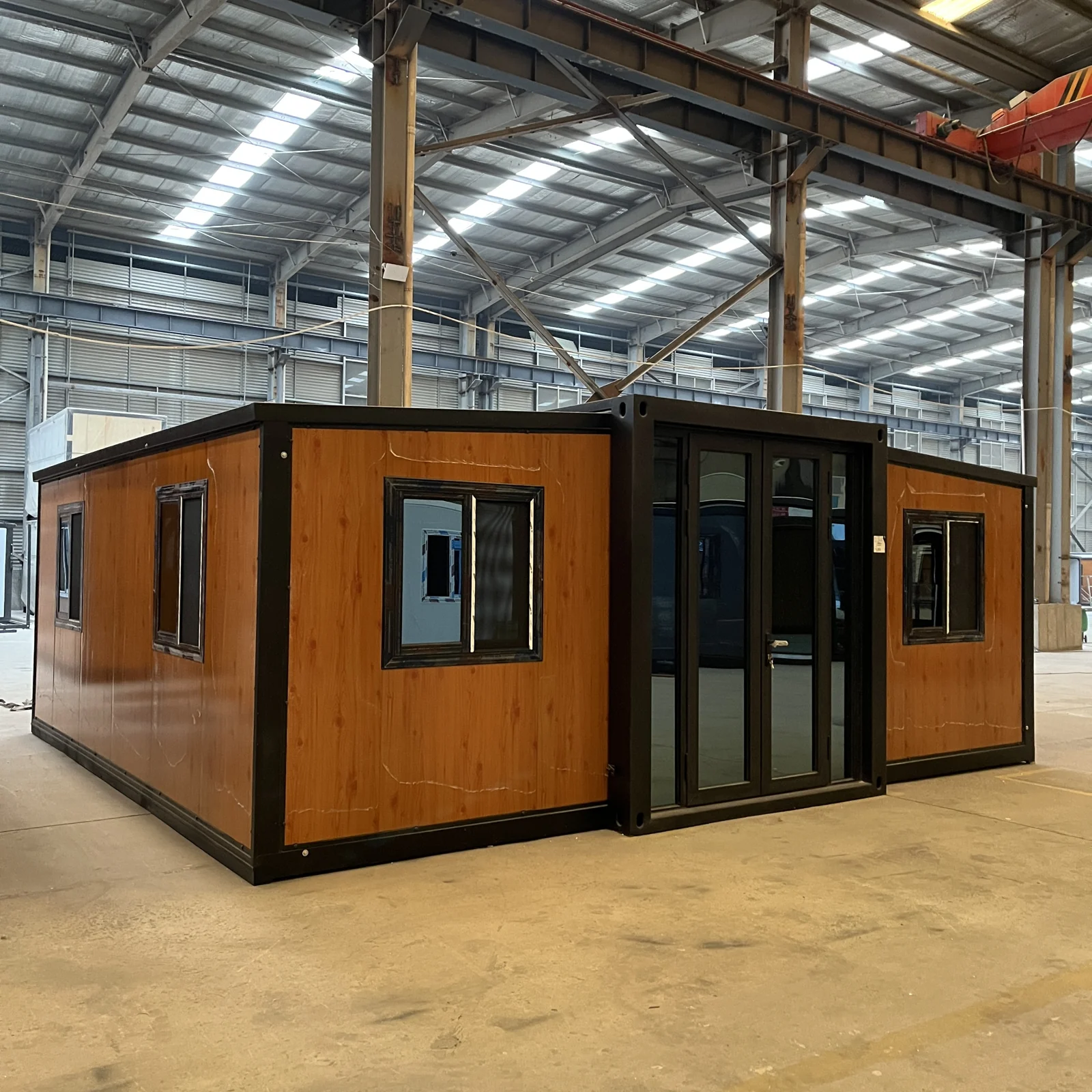
The climate data that sizes the building
Table 1 collects the design-relevant values for the three sites. Degree days are referenced to 18.3 degrees Celsius, the conventional base for this latitude band.
| Parameter | Buenos Aires | Salta | Ushuaia |
|---|---|---|---|
| Latitude / altitude | 34.8 S / 20 m | 24.8 S / 1,187 m | 54.8 S / 23 m |
| Heating degree days HDD18.3 | 885 | 997 | 4,554 |
| Cooling degree days CDD18.3 | 702 | 353 | 0 |
| HDD : CDD ratio | 1.26 : 1 | 2.82 : 1 | heating only |
| Peak moisture enthalpy (month) | 59.2 kJ/kg (Jan) | 50.6 kJ/kg (Jan) | 23.1 kJ/kg (Jan) |
| Summer noon solar altitude | 78.6° | 88.7° | 58.6° |
| Winter noon solar altitude | 31.7° | 41.8° | 11.8° |
| Mean wind speed | 3.5 m/s | 2.6 m/s | 6.5 m/s |
| Hours per year above 15 m/s | 0 | 0 | 134 |
| Design roof snow load, CIRSOC 104 | 0.21 kPa | 0.21 kPa | 1.75 kPa |
| Longest day / shortest day | 14.3 h / 9.7 h | 13.5 h / 10.5 h | 17.1 h / 6.9 h |
Read the snow row again. The ratio between Ushuaia and the capital is 8.3 to 1, and the absolute figure of 1.75 kPa is not a design abstraction: it is the load at which the roof structure either works or does not. A roof specified for the Buenos Aires value and delivered to Tierra del Fuego is not under-engineered by a margin, it is a different structure altogether.
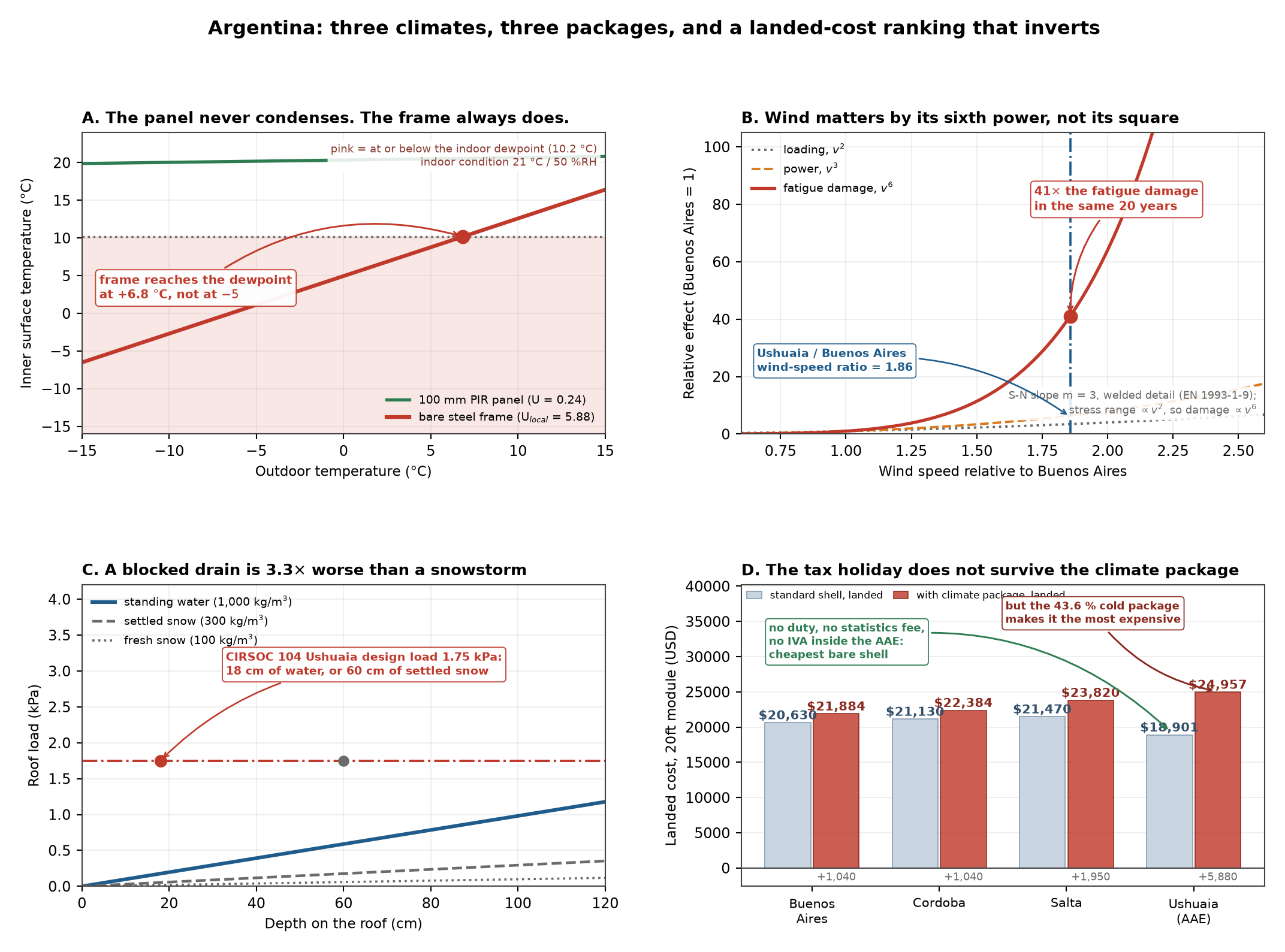
The wind row is more consequential than it looks, and the reason is arithmetic. Wind pressure rises with the square of velocity, the power available in the wind with the cube, and fatigue damage with the sixth power. Ushuaia’s mean wind is 1.86 times the capital’s. That ratio produces 3.45 times the pressure, 6.4 times the power, and 41 times the fatigue damage over the same twenty years — plus 134 hours a year of gusts above 15 m/s against effectively zero in Buenos Aires. Panel B of Figure 1 plots this directly, because the gap between a squared and a sixth-power relationship is where most specifications fail.
Five ways a standard module fails here
Before the countermeasures, the failure modes, because they are what the money is being spent to prevent.
The frame, the bridge, the sun, the drain, the salt
One: the frame condenses long before the panel does. This is the finding that reorganises everything else about cold-climate specification, and it is covered in its own section below.
Two: thermal bridging is not in the U-value. A catalogue U-value of 0.24 W/m²K describes the insulated panel. It does not describe the wall. On a 20 ft module the steel frame — posts, top rail, bottom rail — occupies 9.7 percent of the wall area, and at a local U of 5.88 W/m²K it drags the whole-wall average to 0.79 W/m²K. That is 3.3 times the nominal figure. The number on the datasheet is a property of the panel. The number that sets the heating bill is a property of the assembly.
Three: solar gain peaks when you do not need it. Ushuaia’s longest day is 17.1 hours, longer than Buenos Aires at 14.3. It arrives in December, when the mean temperature is 9.6 degrees Celsius and the building is not heating much. In June the day collapses to 6.9 hours and the noon sun barely clears 11.8 degrees. A passive-solar strategy tuned to mid-latitude assumptions delivers its maximum exactly when the demand is at its minimum.
Four: a blocked drain is worse than a blizzard. Ten millimetres of standing water weighs 0.098 kPa. One hundred millimetres of fresh snow at 100 kg/m³ weighs the same. Water cannot be shovelled off, it does not melt on a cold roof, and it finds the low point. At the Ushuaia design load of 1.75 kPa the roof is at capacity with 18 cm of water or 60 cm of settled snow — a 3.3 to 1 ratio in favour of the hazard nobody models.
Five: salinity, not temperature, sets the maintenance interval. Coastal and insular Patagonia is an ISO 12944 C4 to C5 environment. At 85 micrometres of hot-dip galvanising, C5 gives a coating life of 10 to 20 years. At 200 micrometres it is 24 to 48. The difference in specification cost is small; the difference in when the steel first bleeds rust is not.
The frame reaches dewpoint at plus 6.8 degrees
This is the single most useful number in the article, and it inverts the usual way people think about cold.
The question is not “when does the wall freeze”. The question is “when does the inside face of the structure drop below the dewpoint of the indoor air”. At 21 degrees Celsius and 50 percent relative humidity, that dewpoint is 10.2 degrees Celsius. A surface below 10.2 degrees is wet. Not damp — wet, continuously, every winter night, behind the lining where nobody looks until the mould appears.
For a steel section the surface temperature follows the outdoor temperature almost without resistance. With a local U of 5.88 W/m²K, the temperature factor fRsi works out at 0.236. Running the arithmetic: the corner post, the top rail and the bottom rail all reach 10.2 degrees Celsius when the outdoor air is at plus 6.8 degrees Celsius. Ushuaia’s mean July temperature is 1.3 degrees. The structural steel is below the dewpoint for essentially the entire heating season, and the ambient temperature at which it starts is a mild autumn afternoon.
Panel A of Figure 1 shows the two lines. The insulated panel at U = 0.24 has a temperature factor of 0.969, so its inner face tracks the indoor air within about a degree across the whole range plotted: at minus 15 degrees outside it is still at 19.9 degrees inside, a full 9.7 degrees above the dewpoint. It does not condense, and the reason is simply that the panel is the good part of the assembly. The bare frame crosses the dewpoint at plus 6.8 and never comes back.
The practical consequence is that insulation thickness on the panel is not the primary lever in cold climates. The lever is whether the steel is inside or outside the insulation, and whether a thermal break interrupts the rail-to-post path. Three configurations, three outcomes on the same wall:
| Frame configuration | Frame Ulocal | Whole-wall U | Penalty vs nominal panel |
|---|---|---|---|
| Bare steel frame, no break | 5.88 W/m²K | 0.79 W/m²K | 3.28× |
| Frame behind lining with 20 mm air gap | 3.0 W/m²K | 0.51 W/m²K | 2.11× |
| Thermally broken frame | 1.2 W/m²K | 0.33 W/m²K | 1.39× |
On a 44.2 m² wall at 4,554 heating degree days, the difference between the bare frame and the nominal panel is not cosmetic. Nominal U 0.24 would consume 1,159 kWh of heating energy over the season. The actual wall, at 0.79, consumes 3,798 kWh — 2,639 kWh more, or 228 percent. A thermally broken frame brings it back to 1,609 kWh. At a delivered energy price around 0.12 USD per kWh, the penalty is about 317 USD a year, and the fix is a spacer block.
This is the argument for spending on the frame rather than on thicker foam. Going from 100 mm to 150 mm of PIR improves the panel U from 0.24 to 0.18, a 25 percent improvement on a component that is already the good part of the assembly. Breaking the frame improves the whole-wall U from 0.79 to 0.33, a 58 percent improvement on the part that is failing.
Buenos Aires and the pampas: a moisture problem wearing a temperature costume
The capital’s numbers look forgiving. HDD 885 against CDD 702, a ratio near unity, a peak enthalpy of 59.2 kJ/kg. Nothing about that reads as difficult. The difficulty is the humidity, and specifically the fact that the heating and cooling seasons both run in humid air.
Peak moisture enthalpy arrives in January at 59.2 kJ/kg with a dewpoint of 18.6 degrees Celsius. The annual range between the January peak and the July minimum is 32.6 kJ/kg, which is the widest of the three sites. A single-mode approach — insulate for winter, open windows for summer — fails on both ends, because the summer load is dominated by latent heat and the winter problem is interstitial condensation rather than heat loss.
The pampas package is deliberately modest at 1,040 USD, 7.7 percent of FOB: a dehumidification-ready vapour control layer, 60 mm PIR with a 20 mm EPS lining, and cross-ventilation with a provision for a ceiling fan. The vapour control layer is the important line item. In a climate where the indoor dewpoint can sit at 18.6 degrees, the risk is not that the wall is too thin, it is that moisture migrating outward meets a cold surface inside the assembly and stays there.
February and March are the months buyers underestimate. March still carries 52.5 kJ/kg with 73 percent relative humidity, which is more moisture than a European July, and it is the month when a building that has been closed up for the summer first shows condensation on the north-facing lining.
Salta: altitude changes the radiation, not the temperature
Salta’s altitude of 1,187 metres produces two effects that a sea-level design does not anticipate, and neither appears on a temperature chart.
The first is ultraviolet. At that altitude the UV multiplier is about 1.13 times sea level, which accelerates the degradation of any polymer exposed to the sky — sealants, gaskets, cable jackets, and the surface of painted steel. The specification response is modest but specific: EPDM rather than NBR gaskets, and a topcoat rated for high-UV exposure rather than a standard architectural finish.
The second is the solar geometry, and it is extreme. At the December solstice the noon sun stands at 88.7 degrees — effectively overhead. The overhang depth needed to shade a south-facing window at that angle is 2.3 centimetres. At the June solstice the sun drops to 41.8 degrees and the same window needs 112 centimetres. A fixed overhang cannot serve both, which is why the heat package specifies external shading on the east and west faces rather than a roof overhang: at this latitude the low morning and afternoon sun is the problem, and the noon sun is nearly irrelevant.
There is a second-order effect worth flagging. Salta’s hottest month by mean temperature is December at 21.6 degrees, but the peak moisture enthalpy month is January at 50.6 kJ/kg, with the December value slightly lower at 50.4. The gap is small here, but the direction matters: sizing cooling on the hottest month rather than the wettest month understates the latent load, and latent load is what makes an air conditioner run all night without dropping the temperature.
The heat package is 1,950 USD, 14.4 percent of FOB: a cool roof at SRI 82, 80 mm PIR with reflective foil, external shading east and west, and high-level vents with a ridge chimney for stack ventilation. On a building with CDD 353 this is not a comfort upgrade, it is the difference between a habitable unit in January and one that requires mechanical cooling to be occupied at all.
Tierra del Fuego: where the cost ranking inverts
Ushuaia has a tax regime that looks like a gift, and it is worth understanding exactly what it does and does not cover before treating it as one.
Under Law 19.640, the Special Customs Area (Area Aduanera Especial) exempts goods entering Tierra del Fuego from import duty and from national internal taxes at the point of importation, provided the goods are destined for consumption within the area. For a prefabricated building under NCM 9406, the effect is that the 14 percent duty and the 21 percent IVA both fall away. What remains is the 3 percent statistics fee, port charges, inland transport and clearing.
Run the numbers on a 20 ft module at 13,500 USD FOB. Landed in Buenos Aires the non-recoverable cost is 20,630 USD, 1.53 times FOB. Landed in Ushuaia it is 18,901 USD, 1.40 times FOB — 1,730 USD cheaper, despite 1,100 USD more ocean freight and a longer run. This is the one place in this article where the most remote site is the cheapest, and it is entirely a tax effect rather than a logistics one.
Then the climate arrives. The cold package for Ushuaia is 5,880 USD, 43.6 percent of the base FOB: 100 mm PIR upgrade to walls and roof, triple-glazed units, thermal-break spacer blocks, a vapour control layer with taped joints, a heated vestibule as an airlock, and roof reinforcement to 1.6 kPa. Priced in, the landed cost becomes 24,957 USD, 1.85 times FOB — and the site that was 1,730 USD cheaper than the capital becomes 3,073 USD more expensive.
Panel D of Figure 1 is drawn to make that inversion visible, because it is the decision a buyer actually faces. The tax break is real. It is also smaller than the climate penalty, and the two are usually presented separately.
The full landed cost, site by site
Site-by-site chain, line by line
Table 4 is the complete chain for a 20 ft expandable module at 13,500 USD FOB Tianjin, standard shell and then with the climate package. The exchange basis is the CIF value at the Argentine port of entry.
| Cost element | Buenos Aires | Cordoba | Salta | Ushuaia (AAE) |
|---|---|---|---|---|
| FOB Tianjin | 13,500 | 13,500 | 13,500 | 13,500 |
| Ocean freight | 2,350 | 2,350 | 2,350 | 3,450 |
| Insurance | 8 | 8 | 8 | 12 |
| CIF | 15,858 | 15,858 | 15,858 | 16,962 |
| Import duty 14% (NCM 9406) | 2,220 | 2,220 | 2,220 | 0 |
| Statistics fee 3% | 476 | 476 | 476 | 509 |
| IVA 21% on CIF+duty+fee | 3,896 | 3,896 | 3,896 | 0 |
| IIBB provincial 3% | 557 | 557 | 557 | 0 |
| Port and THC | 690 | 690 | 690 | 880 |
| Inland transport | 480 | 980 | 1,320 | 170 |
| Customs clearing | 350 | 350 | 350 | 380 |
| Non-recoverable landed | 20,630 | 21,130 | 21,470 | 18,901 |
| Multiplier on FOB | 1.53× | 1.56× | 1.59× | 1.40× |
| Plus climate package | 1,040 | 1,040 | 1,950 | 5,880 |
| With package, landed | 21,884 | 22,384 | 23,820 | 24,957 |
| Multiplier on base FOB | 1.62× | 1.66× | 1.76× | 1.85× |
Three things about this table are worth stating plainly, because they are where quotes go wrong.
First, IVA is not a cost for a registered importer. A responsable inscripto credits import IVA against output tax, so the 3,896 USD in the Buenos Aires column is a cash-flow item, not a permanent one. It is nonetheless real working capital, and under RG 2937/2010 the credit is generally usable from the ninth tax period after clearance. A buyer comparing two quotes where one shows IVA and the other does not is comparing a cash requirement with a cost.
Second, the statistical fee is 3 percent, not a rounding error. It is levied on the CIF value under article 762 of the Customs Code, extended to 31 December 2027 by Decree 1140/2024, with caps that matter only above 100,000 USD per shipment. On a 15,858 USD CIF it is 476 USD, and it is not recoverable. It also enters the IVA base, so it is taxed again at 21 percent.
Third, the duty rate is a classification question before it is a rate question. NCM 9406 covers prefabricated buildings, and the subheading depends on whether the unit is presented as a complete building suitable for use as a home or as a component. The Mercosur Common External Tariff band for finished prefabricated buildings sits in the 14 to 18 percent range, and Argentina maintains a national exception list that can move a specific code. The 14 percent used here is a planning figure, and the sensitivity is worth knowing: at 0 percent the Buenos Aires landed cost falls to 18,344 USD, at 20 percent it rises to 21,610 USD. A misclassified entry is a four-figure error in either direction.
Compliance: the part that stops projects
Argentina’s commercial import regime has simplified considerably since 2023 and the technical regime has not. Both matter, and they fail in different ways.
The commercial regime, after five years of dismantling
The commercial side first. The Impuesto PAIS, which at one point added up to 17.5 percent to payments abroad, expired at the end of December 2024 and no longer applies. AFIP was abolished by Decree 953/2024 and replaced by ARCA, the Agencia de Recaudacion y Control Aduanero, effective 25 October 2024. SIRA, SIRASE and SEDI — the successive import authorisation regimes — are gone; declarations now run through the Malvina system (SIM), and under DNU 70/2023 a licensed customs broker is no longer a legal requirement, though most operations still use one because tariff classification and valuation are where the risk sits.
The technical side is where a modular housing import actually stalls. Three points deserve attention:
Electrical certification. Prefabricated units arrive with wiring, luminaires and often an air conditioner, and all of it falls under the electrical safety conformity regime administered under Resolutions 236/2024, 16/2025 and 17/2025. Since 1 October 2025 QR-code conformity marking is mandatory, and the transition period for the new regime closed on 26 February 2026. Resolution 16/2025 eases acceptance of a certificate issued by an accredited laboratory abroad, which avoids a repeat test — but it requires the certificate to exist before shipment, not after arrival.
Wood packaging. ISPM 15 treatment and marking is required for any solid wood used in crating, dunnage or blocking. A module shipped with untreated pallets can be held or fumigated at the importer’s cost. This is a 200 USD problem that becomes a 2,000 USD problem at the terminal.
Provincial gross receipts tax. IIBB is a provincial tax, not a national one, and the rate varies by province and by activity — commonly 2 to 5 percent. It is levied on the importer’s turnover in the province rather than at the border, which means a buyer comparing a Buenos Aires quote with a Salta quote is comparing two different provincial regimes. The 3 percent used in Table 4 is an indicative figure for planning, not a rate to quote as fact.
For building approval, Argentina has no single national housing code equivalent to the IRC. Each municipality issues its own permit, and CIRSOC — the Centro de Investigacion de los Reglamentos Nacionales de Seguridad para las Obras Civiles — publishes the structural actions standards that most jurisdictions adopt by reference. CIRSOC 104 is the snow load standard and the source of the 1.75 kPa figure for the Ushuaia zone. A supplier who cannot name the CIRSOC standard their roof was checked against has not done the calculation.
Frequently asked questions
Does the Tierra del Fuego tax exemption apply to a container house? The Area Aduanera Especial under Law 19.640 exempts goods destined for consumption within Tierra del Fuego from import duty and from national internal taxes at importation. A prefabricated building under NCM 9406 qualifies, subject to the destination condition. The statistics fee remains payable. The exemption must be claimed at the time of import declaration through the correct destination code; it is not refunded afterwards.
Why is a 20 ft module only 1.4 to 1.6 times FOB landed, when other countries run to 2 times? Because Argentina’s tax stack is duty plus a 3 percent fee plus IVA, and IVA is creditable for a registered importer. Countries that reach 2 times usually do so through VAT that is not recoverable, or through layered state taxes on a grossed-up base. The Argentine non-recoverable burden here is about 14 percent duty plus 3 percent fee plus 3 percent provincial — near 20 percent of CIF. The IVA is the large number and the least permanent one.
Is 100 mm of PIR enough for Ushuaia? For the panel, yes. For the wall, no. Panel U at 100 mm is 0.24 W/m²K, but the steel frame at 9.7 percent of the wall area and a local U of 5.88 pulls the assembly to 0.79 — a 3.3 times penalty that 50 mm more foam does not fix. The sequence that works is thermal break first, then thickness.
What roof load should be specified for Tierra del Fuego? CIRSOC 104 gives 1.75 kPa for the Ushuaia zone in the worst band, equivalent to 178 kg/m². Specify to that figure and check the drainage separately: 18 cm of standing water reaches the same load, and ponding is the more common of the two failures because a blocked outlet is a maintenance event rather than a weather event.
Can a standard module be upgraded on site instead of at the factory? Partly. External shading, additional insulation under the floor, and a vestibule can be added locally. A thermal break in the structural frame cannot — it is a factory decision about how the rail and post are separated. This is the one item where a buyer who skips the factory option cannot recover it later.
Does altitude in Salta require a different structural design? Not for the structure — at 1,187 metres the air density effect on wind pressure is minor. It matters for UV exposure and for solar geometry. The noon sun at 88.7 degrees in December means a roof overhang does nothing; the shading has to be vertical and on the east and west faces.
How long does customs clearance take? With a complete document set, three to seven working days at Buenos Aires is typical. The variables that extend it are classification queries, valuation challenges where the declared value sits below reference prices, and missing technical certificates. None of those are resolved at the terminal.
Next step
If you are specifying for Argentina, the useful first deliverable is not a price list. It is a one-page comparison of the three climate zones against a single module specification, showing where the shell is adequate and where the package is not optional. We can produce that for a specific site — province, altitude, and whether the unit falls inside the Special Customs Area — with the CIRSOC snow zone and the applicable NCM classification identified.
Send the site details to jack@huayinghouse.com or message +86 153-0318-4505. Include the destination province and the intended use, since the permit path and the tax treatment both turn on those two facts. For a broader view of how the modules are built, the expandable container house range carries the current specifications, and the climate design guides cover the same three-climate problem for other markets.