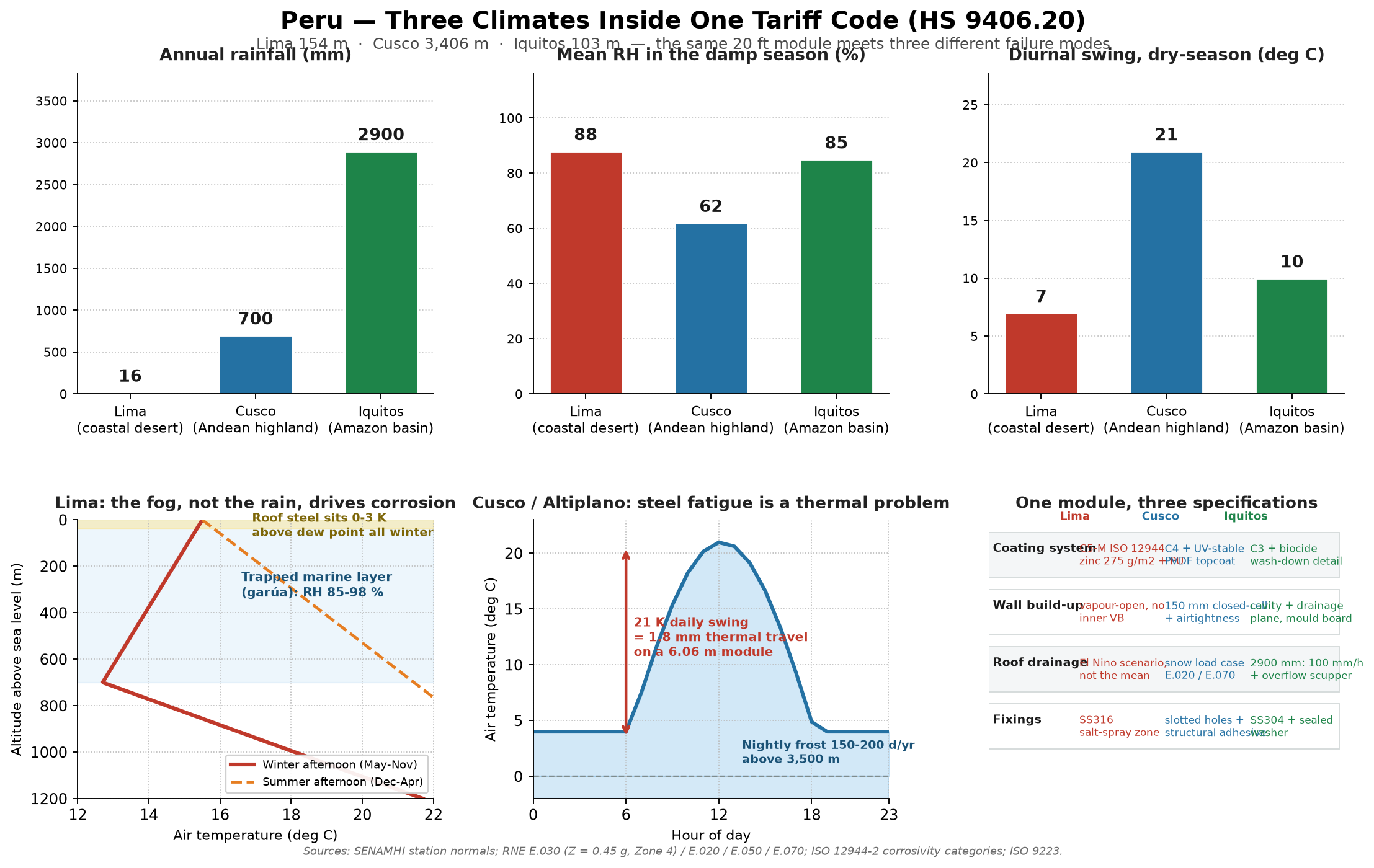
Peru is not one climate market. In a single week you can quote a 20 ft module for a fog-bound Lima suburb where it has not rained measurably in a year, for a Cusco yard at 3,406 m where the steel swings twenty degrees between noon and midnight, and for Iquitos, a city no road reaches, where 2,900 mm of rain falls on a building that arrived by barge. The module carries the same HS code to all three. What changes is the specification, the corrosion class, the foundation and the landed cost.
This guide works through those three Peruvian design cases using station data, the Peruvian national building code (Reglamento Nacional de Edificaciones, RNE), and a full FOB-to-landed cost chain. It is written for buyers and specifiers who need to know what to change in the order, not for readers looking for a general introduction to container housing.
1. Site data: three Peruvian cities, three different buildings
The figures below come from SENAMHI station normals and the standard climate references for each city. The contrast is the point.
| Metric | Lima (Callao / Ate) | Cusco | Iquitos |
|---|---|---|---|
| Elevation | 0–154 m | 3,406 m | 103 m |
| Köppen class | BWh (hot desert) | Cwb (subtropical highland) | Af (equatorial rainforest) |
| Annual rainfall | 16 mm (some years under 10 mm) | 693–1,341 mm | 2,857–2,906 mm |
| Rainy months | effectively none | Nov–Mar (afternoon convection) | all year, peak Dec–Mar |
| Damp season | May–Nov (garúa fog) | — | — |
| Mean RH, damp season | 85–92 %, peaks at 95–98 % | 60–70 % daytime | 85–90 % |
| Diurnal swing, dry season | 7 K | 20–22 K | 9–11 K |
| Sunshine hours per year | 1,230–1,240 | 2,340 | 2,196 |
| Peak UV index | 8–9 | 14 (extreme) | 9–11 |
| Seismic zone (RNE E.030) | Zone 4, Z = 0.45 g | Zone 2–3, Z = 0.25–0.35 g | Zone 1–2, Z = 0.10–0.25 g |
| Corrosivity (ISO 12944-2) | C5 (marine chloride) | C3 | C3–C4 (humidity + biological) |
Two rows in that table are routinely misread, and both change the order.
Lima’s rainfall figure is a trap, not a design input. Sixteen millimetres a year means the roof drainage calculation is almost irrelevant — you cannot size a gutter on 16 mm. The moisture load arrives as fog, not as rain, and it arrives for six months. Any specification written around Lima’s annual rainfall total will under-specify the walls and over-specify the drains, which is exactly backwards.
Cusco’s mean temperature is comfortable and its steel never stops moving. At 3,406 m with clear dry-season skies, the daily swing reaches 20–22 K. A 6.06 m steel module expands roughly 1.8 mm across that swing. Over a year of cycles this is a fatigue and fixing-slip problem, not a comfort problem, and it has nothing to do with how cold the place “feels” on average.
2. The counterintuitive finding: in Lima, the damper the climate, the less you should seal the wall
This is the single most consequential decision in Peruvian coastal design, and standard practice gets it wrong.
The reflex for a high-humidity site is to seal the envelope: heavy vapour barrier on the inside, taped joints, closed-cell everything. On the Peruvian coast that reflex produces the failure it was meant to prevent.
Here is why. Lima sits under a persistent temperature inversion for five to six months. Cold Humboldt water cools the marine air layer to about 15 °C; the air above it is warmer; the layer is trapped below roughly 700 m and cannot mix out. The result is a shallow, saturated, stable body of air sitting directly on the building. Outdoor RH runs 85–92 % for months at a time, and the dew point sits within one or two kelvin of the ambient temperature almost continuously.
In that condition the wall assembly is not drying to the outside most of the time. It is at, or near, capillary saturation on both faces. If you place a low-permeance vapour barrier on the inner face, any moisture that enters the cavity — through a service penetration, a poorly sealed window, construction moisture in the panels, or simply diffusion — has no exit path in either direction. It accumulates at the cold side. The steel frame, which is the structural element, becomes the condensation surface.
The correct detail for coastal Peru is a vapour-open wall with a controlled air barrier, ventilated cladding and a drained cavity — the same logic used in cool-humid maritime climates, applied here because the driver is fog rather than rain. In practice:
- No interior vapour barrier on the warm side. Use a vapour-retarding paint or a variable-permeance membrane, and let the assembly dry inward as well as outward.
- Continuous external air barrier, sealed at every penetration. The air barrier manages the moisture; the vapour barrier is not the tool.
- A drained and back-ventilated cavity behind the external skin, minimum 25 mm, with top and bottom ventilation openings.
- Thermal breaks at every steel-to-steel connection that crosses the insulated line, because the frame is the cold bridge and therefore the condensation site.
- Dehumidification capacity designed in from the start, sized on internal moisture load rather than on cooling load.
The same reasoning applies, more weakly, to Iquitos. The Amazon basin is hot rather than cool, so the surface is usually above the dew point during the day, but at night and during the frequent rains the assembly spends long periods near saturation with a very large biological load (mould, algae, insects). The response is similar in kind — vapour-open, drained, ventilated, with a biocide-treated external skin — but the durability driver there is biological rather than thermal.
3. The second counterintuitive finding: Iquitos has no road, and that changes the module, not the price list
Iquitos is the largest city in the world that cannot be reached by road. It is supplied by river and by air. Anything delivered there has either come up the Amazon system by barge or been flown into Coronel FAP Francisco Secada Vignetta International Airport.
Most suppliers quote Iquitos as “Lima plus inland freight” and stop. That is not how the lane works, and the difference is not a small adder.
A 20 ft expandable module ships from Tianjin to Callao as a normal container. From Callao to Iquitos there is no road freight option. The realistic routes are:
- Callao → Pucallpa by road, then Pucallpa → Iquitos by river barge. This is the main commercial corridor for containerised goods into Loreto. Transit on the river leg depends entirely on water level: in the high-water season (roughly December to May) larger barges run; in the low-water season (roughly July to October) draft is restricted and cargo is transhipped or delayed. The river leg alone can add two to four weeks.
- Direct ocean to Iquitos. Small ocean-going vessels can reach Iquitos from the Atlantic, some 3,700 km upstream, but this is a specialised booking, is slow, and is not a realistic route for a two- or three-unit order.
- Air freight to IQT. Only viable for components, not for a completed module.
The practical consequence for the order is not just cost and time. It is flat-pack discipline. A module bound for Iquitos should be specified for the smallest possible shipping cube per square metre of finished floor, with panelised walls, factory-labelled assembly sequence, fastener kits packed per wall, and a documented tool list. Every cubic metre you save on the river leg is worth more than the equivalent saving on the ocean leg, and every missing component costs weeks rather than days, because there is no local hardware store with the right part and no road to bring it in.
This is also why the Amazon order should carry a higher spare-parts ratio than a Lima order: extra cladding sheets, extra fasteners, a spare door seal set, and a spare controller if mechanical ventilation is fitted. On a coast site, a missing part is a phone call. In Loreto, it is a barge.
4. Six failure modes that recur across the three regions
These are the failures that actually appear in service, ordered by how often they are designed in.
1. Condensation on the steel frame in coastal fog. The frame is the coldest surface in the assembly and sits within 1–2 K of the dew point for months. Insulation placed on the inner face without a thermal break leaves the frame exposed on the cold side. Intermittent staining and, over several seasons, section loss at the base plate follow. This is the dominant Lima failure.
2. Solar-driven overheating in the Andean dry season, not the rainy season. Cusco’s dry season has clear skies, 2,340 sunshine hours a year and a UV index that reaches 14. A dark roof at 3,400 m gains far more than the ambient 19 °C suggests, and the interior can overheat at midday while the outside air is mild. Buyers who size for the average temperature under-specify the roof.
3. Night-time condensation inside the Andean module. The same 20 K swing that overheats the unit at noon drops the inner surface below the dew point before dawn during the wet season, when internal moisture loads (cooking, breathing, laundry) are present. The fix is ventilation and an airtight but vapour-open assembly, not more insulation.
4. Rain penetration driven by wind, not by rainfall depth, in the Amazon. Iquitos receives 2,900 mm, and much of it arrives in intense convective bursts with gust fronts. Water is driven horizontally and upward against cladding joints. A wall detailed for vertical rain will leak; a wall detailed with a drained cavity, overlapping joints and a proper head flashing will not.
5. Foundation settlement on the coastal alluvial plain. Lima’s coastal plain is alluvial and, in the eastern districts, close to the Andean foothills. Combined with Zone 4 seismicity (Z = 0.45 g), an under-designed foundation is both a settlement and a seismic problem. Container modules are light, which helps, but light structures on soft ground need a continuous perimeter footing or a properly designed screw-pile layout, not isolated pads.
6. Corrosion at fixings and cut edges, while the panels themselves survive. Coated steel panels fail first at the fastener heads, the cut edges and any field-drilled hole. This is where a C5 environment produces visible failure even when the coil coating is intact.
5. Engineering responses, region by region
5.1 Coastal desert: Lima, Callao, and the northern coast
The governing case is not rain and not heat. It is chloride-laden fog plus Zone 4 seismicity.
Corrosion protection. ISO 12944-2 classifies this environment as C5 for coastal and marine exposure. Specify hot-dip galvanised steel at a minimum 275 g/m² zinc coating, a multi-coat system on top (epoxy primer, intermediate coat, polyurethane topcoat) to a total dry film thickness of at least 240 µm, and stainless steel 316 fasteners throughout. Field-cut edges must be treated with a zinc-rich repair coating before assembly — this step is routinely skipped and is the most common cause of edge corrosion within two years.
Wall and roof. Vapour-open assembly as described in section 2, with a 25 mm minimum drained cavity and continuous external air barrier. Roof: light-coloured, high-solar-reflectance finish, because even in Lima the summer sun is strong and the cooling load is real.
Foundation and seismic. Zone 4 with Z = 0.45 g requires an anchored connection between the module and the foundation: cast-in anchor bolts or chemical anchors at a spacing defined by the engineer, plus a continuous perimeter ring beam. Do not rely on gravity alone. The light weight of the module is an advantage for seismic force (lower inertial mass) but only if the load path to the ground is continuous.
El Niño provision. The coastal desert is dry on average and flooded on occasion. The 2017 and 2023 El Niño Costero events produced rainfall and huaicos (debris flows) far outside the design envelope in districts that had no drainage at all. For any site within a few kilometres of a quebrada (dry ravine), the platform must be raised and the site drainage designed for the event, not for the mean. This is a site-selection decision, not a product decision, and it belongs in the enquiry.
5.2 Andean highland: Cusco, Puno, Arequipa, and mining camps
The governing case is thermal cycling, UV and altitude, with snow load at the highest sites.
Thermal movement. Design the cladding and the roof for movement, not for rigidity. Use slotted or oversize holes at secondary fixings, structural adhesive in combination with mechanical fixings where the cladding spans are long, and a movement joint at every panel run exceeding about 6 m. A 20 K swing on a 6.06 m steel module produces about 1.8 mm of movement; restrained, that movement becomes buckling or fastener fatigue.
Thermal performance. At 3,406 m, clear dry-season nights drive surface temperatures well below freezing. Specify 150 mm closed-cell polyurethane or PIR in walls and 180–200 mm in the roof, a continuous airtight layer, and thermally broken connections to eliminate the cold bridge at the frame. Note that altitude reduces the performance of air-source heat pumps — a point worth raising with the buyer, since it changes the heating specification.
UV. UV index 14 is the highest category on the scale. Specify a UV-stable topcoat (PVDF rather than standard polyester), UV-stabilised seals and gaskets, and avoid any polymer component with an unprotected surface. This is the failure mode that shows up in year three, not year one.
Snow. At Puno and above, snow load becomes a design case under RNE E.020 (loads) and needs to be stated by the buyer with the site altitude and the roof pitch in mind. A flat-roofed module at 3,800 m needs a different roof structure from the same module in Lima.
Seismic. Cusco sits in Zone 2–3 (Z = 0.25–0.35 g), lower than Lima but not negligible, and Andean sites add slope stability as a separate hazard. On hillside plots, the platform and retaining design matter more than the module.
5.3 Amazon basin: Iquitos and Loreto
The governing case is rainfall intensity, biological load, humidity and logistics.
Rain. Design roof drainage for 100 mm/h intensity with a safety factor and a secondary overflow path, because a blocked outlet in a 2,900 mm climate fills a gutter within minutes. Specify a standing-seam or concealed-fix roof rather than an exposed-fastener roof; every fastener penetration in an exposed-fix roof is a leak waiting for the right wind direction. Include a head flashing and a drained cavity on all windward walls.
Biological. In a constant 85–90 % RH environment, mould and algae grow on any surface that stays damp. Specify a biocide-containing exterior coating, avoid north- and south-facing shaded recesses that never dry, and design the wall so that water drains rather than sits.
Ventilation and cooling. This is the one Peruvian region where mechanical cooling is a genuine requirement and where latent load dominates. Sizing an air conditioner on sensible load alone will produce a unit that runs continuously, never reaches set point and drips. Size on total load including latent, and provide dedicated dehumidification or a balanced mechanical ventilation system with enthalpy recovery.
Logistics. Flat-pack, as described in section 3, with a documented assembly sequence and a spares kit.

6. Climate packages: what the regional adaptation actually costs
The table below prices the incremental specification for a 20 ft expandable module (15 m²) against the standard configuration. These are order-level increments, not retail prices.
| Package item | Lima / coast | Cusco / highland | Iquitos / Amazon |
|---|---|---|---|
| Frame corrosion system | C5-M: HDG 275 g/m² + 3-coat, 240 µm (USD 620) | C4 + UV-stable PVDF topcoat (USD 410) | C3–C4 + biocide topcoat (USD 460) |
| Wall assembly | vapour-open + drained cavity + thermal breaks (USD 540) | 150 mm PIR + airtightness + thermal breaks (USD 780) | vapour-open + drained cavity + mould-resistant lining (USD 520) |
| Roof | high-SRI finish + cyclone-grade fixing (USD 180) | 200 mm PIR + snow-load structure (USD 950) | concealed-fix standing seam + 100 mm/h drainage (USD 380) |
| Fixings and seals | SS316 throughout (USD 140) | SS304 + slotted holes + UV seals (USD 150) | SS304 + sealed washers (USD 120) |
| Ventilation / cooling provision | dehumidification provision (USD 260) | heat recovery ventilation (USD 340) | latent-load AC provision + enthalpy HRV (USD 720) |
| Foundation interface | Zone 4 anchor kit + ring beam (USD 480) | slope/anchorage kit (USD 380) | elevated platform + barge-handling bracing (USD 560) |
| Logistics allowance | standard (—) | standard (—) | flat-pack bracing + spares kit (USD 330) |
| Total climate package | USD 2,220 | USD 3,010 | USD 3,090 |
Two observations on this table. First, the Lima package is the cheapest of the three, which surprises buyers who assume a desert site is the easiest. It is not — the C5 corrosion system alone is the single most expensive line item in any of the three packages. Second, the Iquitos package is not dominated by the climate hardware; roughly a tenth of it is logistics bracing and spares, and that share rises sharply for larger orders where the river leg is the binding constraint.
7. FOB to landed cost: the full chain
Model: one 20 ft expandable container house, 15 m², base FOB USD 12,800 ex-Tianjin, with the regional climate package from section 6 applied.
| Cost line | Basis | Lima (Callao) | Cusco | Iquitos |
|---|---|---|---|---|
| FOB Tianjin | base 20 ft expandable | 12,800 | 12,800 | 12,800 |
| Climate package | section 6 | 2,220 | 3,010 | 3,090 |
| Ocean freight | Tianjin → Callao | 1,050 | 1,050 | 1,050 |
| Marine insurance | 0.3 % of CIF | 48 | 51 | 51 |
| CIF value | 16,118 | 16,911 | 16,991 | |
| Ad valorem duty | 0 % with China–Peru FTA certificate of origin | 0 | 0 | 0 |
| IGV (16 %) + IPM (2 %) | 18 % of (CIF + duty) | 2,901 | 3,044 | 3,058 |
| Percepción (advance IGV) | 3.5–10 % of CIF, creditable | 564 | 592 | 595 |
| Customs agent, THC, declaration | SUNAT clearance | 420 | 420 | 480 |
| Inland transport | Callao → site | 180 | 890 (to Cusco) | 3,400 (road + river to Iquitos) |
| Foundation and site works | per section 6 | 1,600 | 1,900 | 2,300 |
| Installation and hookup | 2–3 days, two technicians | 560 | 620 | 980 |
| Total landed and installed | 22,343 | 25,427 | 29,754 |
Four notes on reading this table, because the numbers behave differently from what a first-time importer expects.
The FTA is worth real money and requires real paperwork. The China–Peru free trade agreement has been in force since 2010. Under it, the large majority of Chinese industrial goods enter at 0 % ad valorem, and HS 9406.20 is in that group when a valid certificate of origin travels with the shipment and matches the goods line by line. Without that certificate, SUNAT applies the general rate, and the difference cannot be recovered retroactively. On this order the certificate is worth about USD 970 to USD 1,020 depending on destination — comparable to the entire ocean freight bill. Treat the origin document as a shipping document of the same importance as the bill of lading.
IGV is not a cost for a registered importer, but it is cash. The 18 % is made up of 16 % IGV plus 2 % municipal promotion tax (IPM), charged on CIF plus duty. A business registered with a RUC credits the IGV against the tax it collects on sales, so the economic cost is lower than the headline. The cash still leaves at clearance. Budget for the full 18 % in the landed cost and recover it later.
The percepción is a withholding, not a duty. It is an additional advance payment of IGV collected at the border. The rate is commonly 10 % on a first import and 3.5 % thereafter for established importers. It is creditable, so it is not a cost, but it is cash out at the border on the shipment where the importer has the least experience.
The Iquitos inland line is the one that decides the deal. At USD 3,400 it is more than three times the ocean freight and roughly 30 % of the FOB value. It is also the line with the widest variance, because it depends on river water level at the time of shipment. Any quotation for Loreto that does not separate the river leg from the road leg is not a quotation you can plan against.
8. Compliance and approvals in Peru
Building code. The Reglamento Nacional de Edificaciones (RNE) governs. The relevant technical standards for a container module are E.020 (loads), E.030 (seismic design), E.050 (foundations), E.060 (concrete, for the foundation), E.070 (masonry, where used) and E.090 (steel structures). E.030 divides the country into four seismic zones with site coefficients Z of 0.10, 0.25, 0.35 and 0.45 g; Lima and the central-southern coast are Zone 4. The standard permits inelastic behaviour under severe demand, which is why ductility and connection detailing carry the design rather than raw stiffness.
Municipal permitting. A module placed on a plot requires a municipal building licence (licencia de edificación) from the district municipality, and the process, timeline and documentation vary by jurisdiction. In Lima metropolitan districts the process is digitised; in smaller jurisdictions it is not. Confirm the district before quoting a delivery date, because the licence is frequently the critical path, not the shipping.
Customs and registration. Imports are declared electronically through SUNAT’s systems, and a licensed customs agent (agente de aduanas) files the declaration. A customs agent is compulsory above USD 2,000 FOB. The importer needs a RUC (tax registration) to import commercially and to recover IGV.
HS classification. Prefabricated buildings fall under HS 9406. Steel modular units are 9406.20. Note that a module shipped on a road chassis may be classified in Chapter 87 rather than Chapter 94, which changes the duty treatment; confirm the classification with the broker before the goods sail, not after.
Electrical. Peru runs 220 V at 60 Hz. Specify the electrical package for 60 Hz from the factory. A 50 Hz package will run, but motors and any frequency-dependent equipment will misbehave, and the correction on site is expensive.
9. Where these units are actually used in Peru
The three regions generate three different demand patterns, and knowing which one you are selling into changes the specification conversation.
Coastal: mining support and construction camps. The Peruvian mining sector runs camps along the coast and in the immediate foothills, where the requirement is fast deployment, air-conditioned accommodation and a specification that survives chloride fog. Volumes are larger and repeat orders are common, which justifies the C5 system on total cost of ownership rather than first cost.
Highland: exploration and operations camps above 3,500 m. Here the requirements are thermal performance, altitude-rated heating, and a structure that tolerates a 20 K daily swing. Access is usually by road but often on unsealed mountain routes, so the module must survive transport as well as service.
Amazon: oil, gas and river-logistics support in Loreto. Small volumes per site, long logistics, and a very high cost of failure. The order economics favour flat-pack, a generous spares kit and a documented assembly sequence over any saving on the module itself.
Frequently asked questions
Does a container house need a concrete foundation in Peru? It needs a designed foundation, which is not always concrete. On firm ground a continuous perimeter footing or a screw-pile system can work. In Lima’s Zone 4 the foundation must also provide the seismic anchorage, which is a structural function, not just a bearing function. RNE E.050 governs the geotechnical side and E.030 the anchorage.
Is the China–Peru FTA rate really zero for container houses? For HS 9406.20 with a valid certificate of origin, the ad valorem rate is zero under the agreement for the large majority of lines. Confirm the specific line and the certificate requirements with your broker before shipment. The 18 % IGV and IPM are not removed by the agreement and are charged regardless.
Why does the Lima package cost less than the Cusco package if Lima is the harsher environment? Because the two packages solve different problems. Lima’s cost is concentrated in corrosion protection, which is expensive per square metre but does not change the structure. Cusco’s cost is concentrated in thermal performance, airtightness and snow structure, which does change the structure and the wall build-up. Lima is the harsher corrosion environment; Cusco is the harder building.
Can a module be delivered to Iquitos fully assembled? Not economically. Iquitos has no road access; goods arrive by river barge, mostly via Pucallpa, or by air. A completed module occupies far more shipping cube than a flat-pack of the same floor area, and the river leg is charged on cube. Specify flat-pack with a labelled assembly sequence and a spares kit.
What is the realistic lead time to Lima? Ocean transit from Tianjin to Callao is typically 25–35 days direct; to Chancay, the newer deep-water port north of Lima with direct China services, it is around 23–26 days. Add production, inland transport, clearance and installation. The municipal licence is frequently the binding constraint rather than the shipping.
Do I need to change the electrical specification? Yes. Peru is 220 V at 60 Hz. Specify 60 Hz at the factory.
Next step
If you are specifying for a Peruvian site, the three inputs that change the quotation most are the district (for the seismic zone and the municipal process), the altitude (for the thermal and snow case), and the distance from Callao (for the inland leg, which dominates Loreto). Send those three with your floor area and intended use, and we will return a region-matched specification sheet with the climate package priced line by line.
Contact: jack@huayinghouse.com · WhatsApp +86 153-0318-4505 · ask for the Peru region-matched specification sheet (coast, highland or Amazon).
HUAYING — Fucheng Huaying Integrated Housing Co., Ltd. Factory-direct expandable, folding and detachable container houses. CE, ISO 3834-2 and EN 1090 certified. More than 50,000 m² across six production sites.