
# spain-dana body — 2026-10-31
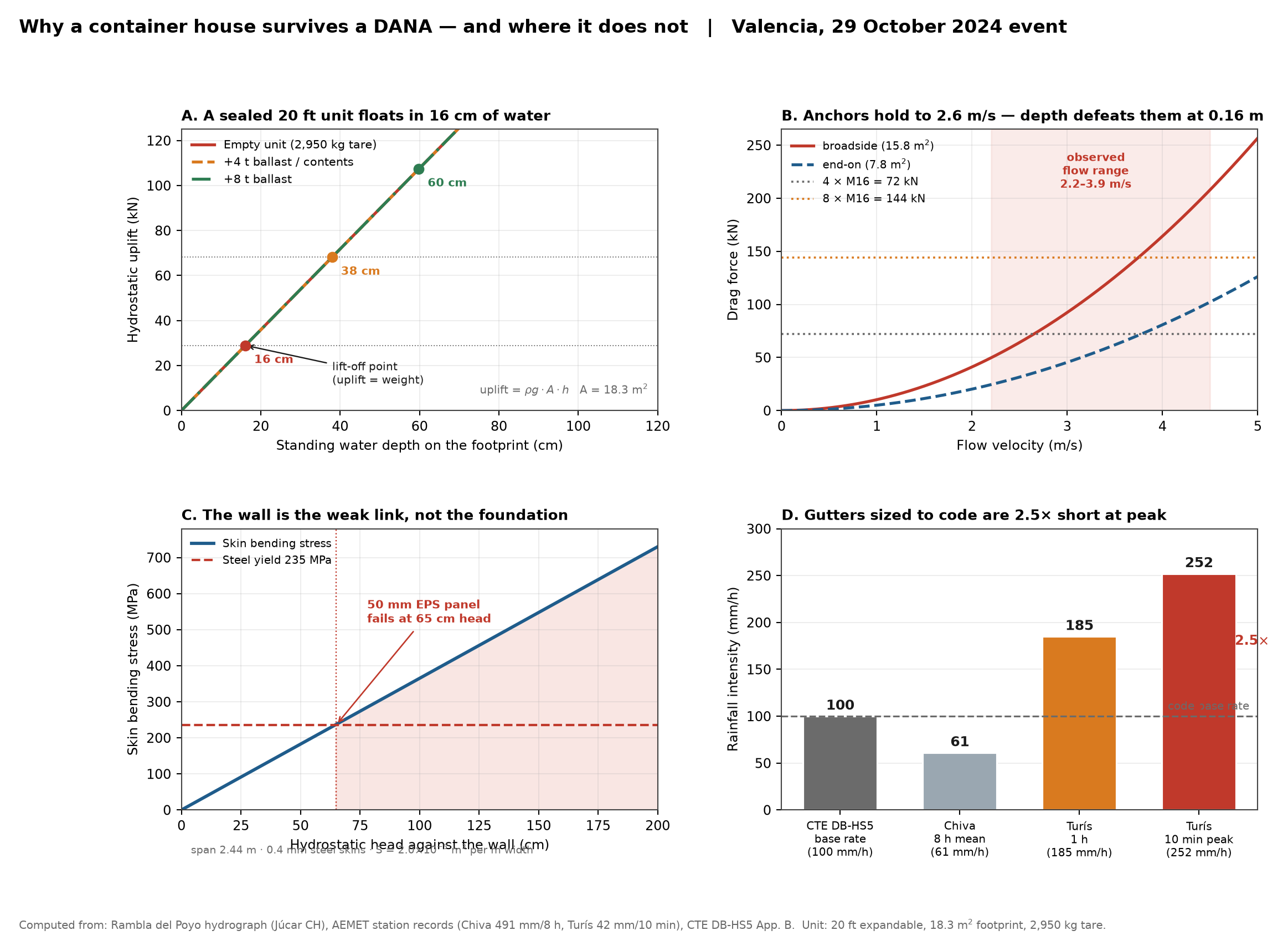
A container house in a flash flood does not get wet. It floats. A sealed 20 ft unit weighs roughly 2,950 kg and displaces 18.3 m² of water per metre of depth, which means it becomes weightless at a water depth of 161 mm — about the height of a kerb. Once it is floating it is no longer a building but a 2.9-tonne raft with six square metres of sail area, and nothing about its design assumes it will ever be in that position.
This is not a theoretical concern in eastern Spain. On 29 October 2024 the Rambla del Poyo, a dry ravine that runs south of Valencia city, went from 45 m³/s at 16:00 to 1,726 m³/s by 18:00 and peaked near 1,939 m³/s. Water stood two metres above its banks. In Chiva, 491 mm fell in eight hours — a year’s rainfall. In Turís, 42 mm fell in ten minutes. The regional death toll reached 227, and the direct economic loss was €17.5 billion. If you are buying a modular house for a plot anywhere on the Spanish Mediterranean coast, the flood question is not an edge case. It is the first question.
This guide works through the problem the way an engineer would: what the water actually does, which component fails first, what a flood-resilient specification costs, and where the regulations will simply refuse your project regardless of how well you build. Everything below is derived from the published event data and Spanish code, and the arithmetic is shown so you can check it.
1. What a DANA actually is, and why the rainfall number is misleading
DANA stands for Depresión Aislada en Niveles Altos — an isolated low-pressure pocket cut off from the jet stream. Cold air aloft parks over a Mediterranean that has spent all summer absorbing heat and, in 2024, reached a record 28.45 °C sea surface temperature on 13 August. The temperature contrast drives convection, and the moisture that feeds it is drawn from a sea that is still warm in late October. The result is rain that is not merely heavy but geographically cruel: it concentrates on small upland catchments, then arrives at the coast as a wave.
That is why the average intensity figure of the event undersells it. Chiva’s 491 mm over eight hours averages 61 mm/h — below the 100 mm/h base rate used in the Spanish building code. Read only the average and you would conclude the event was within design range. It was not. The damage was done in bursts: 42 mm in ten minutes at Turís, equivalent to 252 mm/h, which is 2.5 times the code base rate. A gutter, an inlet, or a downpipe sized to code is undersized by a factor of 2.5 exactly when it matters.
The practical consequence for a modular building is that roof drainage must be designed with a deliberate overflow path. When the primary system saturates, water has to be able to leave the roof somewhere harmless rather than find its way into the wall cavity. We specify a secondary overflow scupper set 40 mm above the gutter invert on every unit going to a Spanish coastal province, and we size the primary outlets from the 10-minute intensity rather than the hourly rate. That single change adds about €210 to a 20 ft unit.
2. Six failure modes, in the order they actually occur
Most flood guidance for buildings is written for masonry. A steel-framed modular unit behaves differently, and the sequence of failure is different too. In the Valencia event, the order below is what the forensic reports describe.
2.1 Buoyancy lift-off at 16 cm
Hydrostatic uplift equals ρ·g·A·h. For a 20 ft unit the plan area A is 18.3 m², so each centimetre of standing water produces 1.8 kN of lift. Against a 2,950 kg tare the break-even depth is 161 mm. Add four tonnes of contents and ballast and the depth rises to 380 mm — still less than knee height on an adult. To hold a unit down in one metre of standing water you would need 18,300 kg of ballast, which is 6.2 times its own empty weight and more than the floor is rated to carry.
This is the finding that reframes the whole design brief. You cannot ballast your way out of buoyancy. The only reliable strategies are to keep water away from the footprint, to elevate the floor above the flood level, or to let the unit flood deliberately so that internal and external water levels equalise and no net uplift develops.
2.2 Wall panel failure at 65 cm head
If the unit is anchored and cannot float, the water load transfers to the walls. A standard 50 mm EPS sandwich panel with 0.4 mm steel skins spanning 2.44 m between columns has a section modulus of about 2.0 × 10⁻⁵ m³ per metre of width. At 0.5 m head the skin stress is 182 MPa, below the 235 MPa yield of the steel. At 0.65 m it reaches yield. At 1.0 m it is 365 MPa — the skins buckle, the core crushes, and the panel is written off.
The design implication is counter-intuitive and worth stating plainly: for a flood-exposed site, a stronger foundation does not help. The wall is the weak link, and it fails at a lower water depth than the anchors do. Money spent on deeper piles without addressing panel capacity is money spent in the wrong place.
2.3 Anchor pull-out above 2.6 m/s
Drag on the broadside face (15.8 m², drag coefficient 1.3) reaches 41 kN at 2 m/s and 92 kN at 3 m/s. A typical four-point M16 wedge anchor set into concrete gives about 72 kN of allowable tension, so it fails in pure drag at 2.65 m/s. The observed flow range in the Poyo channel was 2.2 to 3.9 m/s. So the anchors are marginal — but only if the unit is still in contact with the ground. Once buoyancy has lifted it, the anchors are resisting uplift rather than drag and the load path is completely different.
2.4 Debris impact, which is what actually kills people
A 12 m shipping container weighs about 2,200 kg and floats. At 2 m/s it carries 4.4 kJ of kinetic energy. Absorbed over 0.3 m of deformation that is 15 kN; over 0.1 m it is 44 kN. Neither figure sounds dramatic until you remember that a floating container is a blunt instrument arriving at head height with no warning. In Valencia, 141,000 vehicles were destroyed and the majority of fatalities occurred outdoors or on ground floors. No residential structure of any construction survived direct debris loading of that magnitude.
This is the honest limit of what a modular house can do. A debris-deflection skirt helps against branches and furniture. It does not help against a shipping container. Which means site selection, not specification, is the primary safety measure.
2.5 Silt and the drainage that stops working
Flood water in Valencia carried an estimated 30% sediment by volume. Silt blocks non-return valves, fills inspection chambers, and — critically — blocks the sub-floor ventilation that a modular unit depends on to keep its underside dry. A unit that survives the flood with dry interiors can still be condemned six weeks later because the crawl space stayed wet and the floor structure rotted from below.
2.6 Corrosion in the submerged zone, arriving months later
Flood water is not clean water. Chlorides from coastal soils, sulphates, and agricultural runoff attack the galvanised coating on the chassis and the cut edges of the panels. A unit immersed to 1 m for six hours will show red rust on untreated cut edges within one season. The submerged zone needs C5-M class protection, not the C3 that is standard for inland sites.
3. The design response: five measures that work, ranked by cost-effectiveness
Ranking matters because buyers rarely have unlimited budget. The measures below are ordered by the loss they prevent per euro spent, based on the failure depths established above.
| Measure | What it prevents | Design value | Cost, 20 ft |
|---|---|---|---|
| Site elevation above the 500-year flood level | Everything | The only measure that addresses buoyancy, debris and silt at once | Site work, see §4 |
| Vented foundation with deliberate flood-through | Uplift and panel failure | Equalise internal and external water level; no net hydrostatic load | €480 ring beam + vents |
| Screw-pile foundation, 1.2 m clear | Scour, silt, and 1.2 m of depth | Raises the floor above the 100-year depth; allows water to pass underneath | €1,850 |
| 12 × M16 anchors with cast-in plates | Lateral displacement under drag | 216 kN tension capacity, effective to 2.6 m/s combined with elevation | €320 |
| C5-M corrosion class for the lower 1.2 m | Post-event write-off | ISO 12944 C5-M; hot-dip galvanised chassis plus epoxy topcoat | €390 |
The vented foundation deserves a note because it is routinely omitted. A conventional closed perimeter looks tidier and keeps animals out, but it converts the underside of the unit into a trapped air pocket. When water rises around a closed plinth, that pocket is the last place to fill, and the resulting differential pressure is exactly the uplift force computed in §2.1. Deliberate venting — sized so that the sub-floor volume fills within minutes rather than hours — removes the differential and with it most of the buoyancy problem. It is the cheapest structural measure on the list and the one most often skipped.
On solar geometry, the same site assessment that establishes flood level should establish overshadowing. Valencia sits at 39.5°N, where the noon solar altitude runs from 27.0° at the December solstice to 74.0° at June. A 0.6 m overhang protects the south glazing in summer and does nothing in December, which is the correct behaviour for a Mediterranean site — you want winter sun and summer shade from the same fixed element. Getting this wrong costs more in cooling load than the flood package costs to install, and it is decided at the same moment as the foundation.
4. Cost: what flood resilience adds to a landed price
The table below is the full chain from ex-works to a plot near Valencia, for a 20 ft expandable unit. Duty is the EU conventional rate for CN 9406.20 at 2.7%. IVA is 21% and is charged on CIF plus duty. The IVA line is a cash-flow item rather than a cost for a VAT-registered Spanish buyer, but it must be funded at the border, which is why it appears in the chain.
| Line item | Basis | Amount (EUR) |
|---|---|---|
| FOB Tianjin | 20 ft expandable, standard specification | 13,500 |
| Ocean freight | Tianjin → Valencia, 40HQ part-load | 2,400 |
| Marine insurance | 0.6% of CIF | 90 |
| CIF Valencia | 15,990 | |
| Import duty | 2.7% of CIF (CN 9406.20) | 432 |
| IVA | 21% of (CIF + duty) | 3,449 |
| Port handling and THC | Valencia | 620 |
| Inland transport | Port → plot, within 60 km | 780 |
| Customs broker | Single declaration | 180 |
| Landed, incl. IVA | 21,450 (1.59× FOB) | |
| Landed, excl. IVA | Recoverable for VAT-registered buyers | 18,002 (1.33× FOB) |
Now the flood-resilience package, priced as an increment on the FOB value:
| Flood package item | EUR |
|---|---|
| Screw-pile foundation, 1.2 m clear height | 1,850 |
| Mechanical anchors, 12 × M16 with cast-in plates | 320 |
| Continuous ring beam and uplift strap set | 480 |
| Sill height raised to +900 mm above finished floor | 260 |
| Removable debris-deflection skirt, three sides | 340 |
| Non-return drainage valves, four 110 mm outlets | 210 |
| C5-M corrosion upgrade, submerged zone | 390 |
| Total package | 3,850 (28.5% of FOB) |
Carried through the same chain, the package lifts CIF to €19,840, duty to €536, IVA to €4,279 and the landed total to €26,235 — 1.94× FOB. The absolute increase is €4,784, which is 35.4% of the base FOB because duty and IVA both apply to the increment.
Set that against the loss it addresses. A total loss of the unit is €21,450. The package costs 17.9% of one total loss. In a zone where the Consorcio de Compensación de Seguros will pay for flood damage but where the premium loading for a PATRICOVA-designated high-hazard plot can run to several hundred euros a year, the package pays for itself against a single event — and it is the difference between a claim and no claim at all, because a unit that floats into a neighbour’s plot is not always covered.
5. Regulation: where Spanish law will simply refuse the project
Spain regulates floodplain occupation through the Reglamento del Dominio Público Hidráulico, amended by Real Decreto 638/2016 to add articles 9 bis, 9 ter and 9 quáter. The structure matters more than the detail, and it is unforgiving.
The zona de flujo preferente (ZFP) is the union of the channel that carries the flood and the area where a 100-year event would produce serious damage — defined as depth above 1 m, velocity above 1 m/s, or the product of the two above 0.5 m²/s. Inside the ZFP, article 9.2 permits only activities that are not vulnerable to flooding and that do not reduce drainage capacity. New residential buildings are substantially restricted, and healthcare, education and care uses are expressly incompatible. Campsites, campsite buildings, and non-permeable enclosures are likewise excluded.
Outside the ZFP but inside the 500-year floodplain, the rules soften but do not vanish. Vulnerable uses must be avoided, and where they are permitted the building must be designed with the risk in mind — new residential floor levels must sit above the maximum water level of a 500-year event. In both zones the developer may be required to sign a declaración responsable acknowledging the risk and committing to pass that information to subsequent occupants.
Two points catch overseas buyers repeatedly. First, the maps are not the law. The SNCZI mapping system is a management tool; the restrictions in the RDPH apply by law whether or not a particular parcel has been mapped. A plot with no flood annotation is not a plot without flood risk. Second, the Comunitat Valenciana applies PATRICOVA on top of the national regime, and PATRICOVA’s hazard categories are stricter and more granular. A geo-hazard rating of 6 in PATRICOVA terms will shape what you can build regardless of what the national map shows.
The practical sequence is therefore: obtain the certificado de compatibilidad or the relevant PATRICOVA extract before you buy, not after. A modular unit is legally a building, not a vehicle. It needs a licencia de obra, it must comply with the Código Técnico de la Edificación — including DB-HS 5 for drainage, DB-HE for energy and DB-SE-AE for actions — and it must be classified under CN 9406.20 at import. Where a plot falls inside the ZFP, no amount of engineering makes a residential unit permissible; the correct answer is a different plot.
6. Site selection: the arithmetic of elevation
Because elevation is the only measure that addresses every failure mode at once, it is worth knowing what it costs in earthworks. Raising a 60 m² pad with 1:1.5 side slopes requires the following fill volumes:
| Plinth height | Fill volume | Compacted mass | Protects against |
|---|---|---|---|
| 0.6 m | 45 m³ | ~72 t | The 16 cm buoyancy threshold, with margin |
| 0.9 m | 75 m³ | ~120 t | Typical street flooding |
| 1.2 m | 111 m³ | ~177 t | The 65 cm panel-failure depth, with margin |
| 1.5 m | 152 m³ | ~244 t | Most 100-year depths on the coastal plain |
Compare that with the alternative. A screw-pile foundation giving 1.2 m of clear height costs €1,850 and requires no fill, no compaction testing, and no retaining structure. On a flat plot it is almost always the cheaper route to the same protection, and it has the additional advantage of letting water pass underneath rather than being displaced by it. Where the plot slopes, grading may win; on the Valencian plain, piles usually do.
One caution on piles: they must be designed for scour, not just bearing. Flood water at 3 m/s removes the soil around a pile to a depth that depends on the pile diameter and the angle of attack. A pile designed only for downward load can be left cantilevered and useless after the water passes. We specify an embedment depth of at least 2.5 m below the calculated scour line for any site inside a PATRICOVA hazard area.
7. Frequently asked questions
Will a container house float away in a flood?
An empty 20 ft unit floats at 161 mm of standing water depth. That is the honest answer, and it is why we do not sell a standard unit for a flood-exposed plot without either elevation or a vented foundation. A unit that is allowed to flood internally does not develop net uplift and will usually stay in place; a sealed unit will float.
Can I just add concrete ballast to stop it lifting?
You would need 18,300 kg to resist one metre of water, which is 6.2 times the empty weight of the unit and well beyond the floor loading capacity. Ballast is not a viable strategy. Elevation, venting, or anchoring combined with venting are the viable ones.
Does the flood package make the unit insurable?
It improves the position but does not determine it. The Consorcio de Compensación de Seguros covers extraordinary risk including flood for insured property, and private insurers load premiums by PATRICOVA zone. What the package changes is the damage ratio in a claim, not the eligibility. Check the plot’s hazard classification before assuming any premium.
What about the building permit if the plot is in a flood zone?
Inside the zona de flujo preferente, a new residential building will not be authorised. Outside the ZFP but inside the 500-year floodplain, it may be authorised provided the floor level sits above the 500-year water level and the project is designed for the risk. The controlling documents are the RDPH and, in the Comunitat Valenciana, PATRICOVA. Get the compatibility certificate before you commit to a plot.
How long will the steel last after a flood?
With C5-M protection on the submerged zone, the chassis and cut edges will outlast the event by decades. With standard C3 protection, red rust appears on cut edges within one season. The difference in cost is €390; the difference in outcome is a repairable unit versus a write-off.
Is a DANA the same as a gota fría?
The terms are used interchangeably in Spain. DANA is the modern meteorological term for an isolated upper-level low; gota fría, “cold drop”, is the older popular name. The mechanism is the same: cold air aloft over a warm Mediterranean, producing convection that concentrates on small catchments in autumn.
Do you deliver to Spain, and what is the lead time?
Yes. Valencia, Alicante, Murcia, Almería and the Balearics are regular destinations from Tianjin. Production is four to five weeks, ocean transit to Valencia is 30 to 34 days, and clearance is typically three to five working days with complete documentation. The certificate of origin and the commercial invoice must state CN 9406.20 explicitly, or the 2.7% rate will be replaced by a higher classification.
8. What to ask before you commit to a plot
If you take one thing from this guide, take the sequence. Ask for the PATRICOVA classification and the SNCZI extract first. Establish the 500-year water level, not the street’s recent flood history. Compare the cost of fill against the cost of a screw-pile foundation at the height that level requires. Then specify the unit — because the specification is downstream of the siting decision, not the other way round.
A modular house is genuinely well suited to the Spanish Mediterranean climate: light, fast to erect, easy to ventilate, and cheap to keep cool when the shading is right. It is not well suited to standing in moving water, and no amount of engineering changes the arithmetic of 18.3 square metres of displacement against 2,950 kilograms of steel.
We will review a plot’s hazard classification with you before quoting, and we will tell you when the answer is that the plot is wrong. Send the location and the intended use to jack@huayinghouse.com or WhatsApp +86 153-0318-4505, and ask for the flood-resilience specification sheet for the 20 ft and 40 ft expandable models. For the wider picture on Spanish import procedure, duties and installation, the Spain cost and regulation guide covers the paperwork side in detail. For heat and shading design across the Mediterranean basin, see the Mediterranean climate design guide.