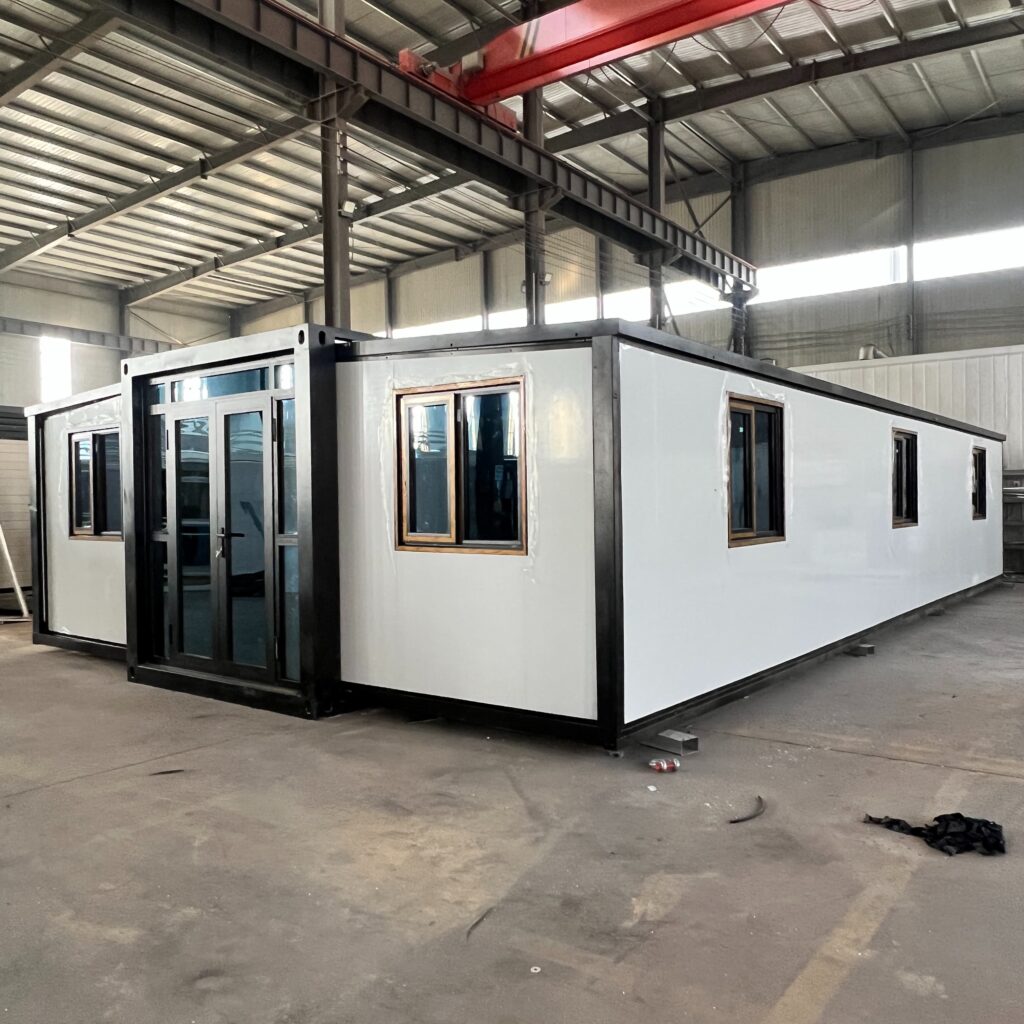
What a 10ft expandable container house actually costs in Canada
The quoted FOB price of a 10ft expandable container house is the smallest number in the transaction. By the time the unit is sitting on a prepared foundation in Ontario or British Columbia, the buyer has paid for ocean freight, import duty assessed by the Canada Border Services Agency, harmonised sales tax, port handling, inland transport, a foundation designed for frost, and the trades that connect services.
This guide sets out each of those line items so that a Canadian buyer can compare a factory quote against a local builder’s price on the same basis. It also covers the compliance questions that decide whether the unit can legally be occupied — which are usually settled at the municipal level, not the federal one.
The unit itself
Base FOB price for a single 10 ft expandable unit starts at approximately USD 6,800 to 8,500 depending on the specification package, the insulation level and the fittings selected. The expandable format means the module ships in a folded state roughly 2.4 m wide and expands on site to a living footprint of around 14 m².
The relevant point for a Canadian buyer is that the base specification is not a winter specification. The gap between the two is addressed in the cost table below.
FOB to landed cost: a worked example
The figures below assume one 10 ft unit shipped to a site in southern Ontario, with the cold-climate specification required for year-round occupation. Freight and civil works are indicative ranges and vary with access, season and distance.
| Stage | Item | Amount (USD) | Notes |
|---|---|---|---|
| FOB | Base unit, 10 ft expandable | 8,500 | Tianjin or Qingdao, factory-direct |
| FOB | Cold-climate specification | 3,620 | Thermal breaks, PIR upgrade, floor insulation, vapour control, Low-E glazing |
| CIF | Ocean freight and insurance | 1,150 | Consolidated share of a 40 ft container |
| Duty | Import duty at 6% | 727 | Assessed by CBSA on the FOB value |
| Arrival | Brokerage and documentation | 240 | Commercial entry |
| Inland | Port to site transport | 620 | Crane offload charged separately |
| Tax | HST at 13% | 1,851 | Recoverable for a registered business |
| Civil | Piers or screw piles below frost line | 3,400 | Depth over 1.2 m in southern Ontario |
| Install | Crane and assembly | 1,300 | Typically completed in one day |
| Services | Electrical and plumbing connections | 2,600 | Excludes utility trenching |
| Total | Landed and installed | 24,288 | Before utility connection fees |
Two things stand out. The climate specification is roughly 30% of the FOB price but only around 15% of the landed total, because site and services work dominates the budget. And HST is recoverable for a registered business, which brings the effective cash cost for a commercial buyer closer to USD 22,400.
Compliance: what governs a container house in Canada
| Instrument | Role | Practical effect |
|---|---|---|
| NBCC 2020 | National model code | Sets structural load cases including snow, rain-on-snow and seismic; provides climatic design data by location |
| Provincial building codes | Adopted and amended locally | Ontario, Quebec, British Columbia and Alberta each amend the national model; the provincial edition governs the permit |
| CSA A277 | Factory-built module certification | Supports acceptance of the module as a conforming building element at permit stage |
| CSA Z240 | Relocatable buildings standard | Applies where the unit is classified as relocatable rather than as a permanent dwelling |
| Municipal zoning | Local land-use control | Determines whether the unit is permitted as a dwelling, a detached unit or an ancillary structure — often the binding constraint |
The practical sequence is to confirm the zoning position first. A unit that satisfies every structural requirement still cannot be occupied if the local by-law does not permit a dwelling on that lot. Only after zoning is settled does it make sense to commission foundation design and order the module.
Import duty and tax
Duty is assessed on the transaction value of the goods, and the classification position is determined by CBSA based on the goods as presented. For a project involving several modules, obtaining a written ruling or a broker’s advance opinion before shipment is worth the effort. Provincial sales tax treatment varies — harmonised provinces apply HST, while others apply GST plus provincial tax — and the rate applied depends on the delivery point, not the importer’s address.
Winter performance: what the base price does not include
A container house performs well in a Canadian winter only if three things are handled correctly. First, the steel frame must be broken thermally at each structural node; insulation placed between frame members does not interrupt the conductive path through them. Second, the envelope must be airtight with a vapour control layer on the warm side, and mechanical ventilation must be provided so that moisture does not accumulate. Third, the foundation must extend below the frost penetration depth.
None of these are included in a basic specification. A supplier that quotes an insulation thickness without describing how the frame is broken is not quoting an equivalent product.
Frequently asked questions
How much does a 10ft expandable container house cost in Canada?
Expect roughly USD 24,000 landed and installed for a fully specified unit on a serviced lot in Ontario, of which about USD 12,100 is the delivered unit and cold-climate specification. Where the foundation and services already exist, the total falls substantially.
What import duty applies?
Duty is assessed by CBSA on the transaction value. The rate depends on the classification position, which should be confirmed with a broker before shipment rather than after arrival.
Do I need a building permit?
Yes, for anything intended as a dwelling or a permanent ancillary structure. Permit requirements are set by the municipality and vary widely. Confirm the zoning position before ordering.
Is a 10ft unit warm enough for a Canadian winter?
With thermal breaks, PIR insulation to the wall and roof, floor insulation, double Low-E glazing and mechanical ventilation, yes. Without the thermal break package specifically, the frame will continue to conduct and interior surfaces will fall below the dew point.
How long does the whole process take?
Production takes 20 to 35 days, ocean transit to a Canadian port 20 to 35 days, and customs clearance 2 to 5 working days. Foundation work and installation add 2 to 4 weeks depending on ground conditions and season.
Request a landed-cost quotation
For a firm FOB-to-landed quotation to your port or door, send your location, quantity and intended use to jack@huayinghouse.com or message us on WhatsApp at +86 153-0318-4505. We return the full breakdown so you can compare like with like against a local builder.
Related reading: the cold climate and snow load design guide for Canada sets out the engineering behind each climate measure; the complete Canada cost guide covers landed cost by province and the Canada price guide covers pricing by unit size. For the product itself, see the 10ft expandable container house specification.