
Buying five expandable homes for Australia is a project procurement exercise, not simply multiplying a catalogue price by five. Layout consistency, shipment planning, local installation and approval evidence can change both the cash budget and the delivery sequence. This guide helps a buyer request comparable offers without assuming that a lower factory figure means a lower completed project cost.
It addresses the purchase stage for a small accommodation or housing project. It does not offer a five-unit discount or a fixed shipping rate. Use it with the Australia model buying guide and obtain professional advice for the proposed use and location before committing funds.
Define one reference unit before asking for volume pricing
Start with a reference layout and a controlled list of included equipment. Record bedrooms, bathrooms, window arrangement, kitchen scope, hot-water equipment, heating and ventilation preferences. Ask the supplier to identify the model code corresponding to that scope, together with transport and deployed dimensions. A model photograph alone is not an adequate specification.
Then describe each variation. If three units need two bedrooms and two units need one bedroom, label them as distinct types in the quotation rather than saying five similar homes. A larger bathroom, revised access requirement or relocated service connection can affect drawings and installation. Keep the specification consistent across suppliers so that price comparisons reflect the same requested result.
Decide what volume savings could actually come from
Ask which items are shared across the order: design preparation, purchasing, packing or shipment arrangements. Some costs may be spread across several units; others remain unit-specific. A supplier may need separate manufacturing work for different layouts, so a mixed order is not necessarily equivalent to five identical units.
Request the unit price, order total and any batch-specific charges separately. If you intend to increase from five to twenty units later, ask whether the follow-on order uses the same configuration and documentation. Do not treat an indicative future price as a binding offer unless its validity, quantity conditions and production assumptions are written into the agreement.
Build a quotation comparison matrix
Use one row for each important requirement and one column for each supplier. Include base unit, optional fit-out, packing, shipment, inspection, delivery point, on-site work and documents. Mark an unknown item as unconfirmed instead of assigning it zero cost. Record assumptions directly beside the amount so the spreadsheet remains understandable when the quotation changes.
Separate three types of number: supplier prices, third-party quotations and budgeting allowances. They should not be presented with equal confidence. A signed contractor price for foundations is different from an early planning allowance. This distinction helps you decide which missing quotation to obtain next rather than believing a precise-looking total is already an executable budget.
Ask for the packing plan before accepting the freight estimate
For five units, request the proposed shipment configuration, packing dimensions, weights and treatment of loose components. Ask whether the freight quote is for that actual shipment or a generic container assumption. Obtain the destination port, validity date, included charges and exclusions in writing. If the packing plan changes, have the forwarder recheck the quote.
Avoid calculating units per shipment from the marketing footprint. Deployed floor area and transport dimensions describe different conditions. Additional roof components, stairs, fittings or furniture may affect packing and handling even when the basic housing model is unchanged. Confirm how each piece is identified so the site crew can match components to the correct unit.
Coordinate unloading with the site layout
Give the installer a site plan showing access roads, working areas, proposed foundations and utility routes. Ask how delivery vehicles reach the unloading position and what lifting arrangements are required. The plan should consider the entire batch: a convenient position for the first unit may obstruct access for later units.
Agree whether units will arrive together or in stages. If the site needs storage, allow for security, protection from weather and handling movements. Ask which packaging can stay in place until installation and which checks are needed immediately after arrival. Record the procedure for documenting transport damage and distinguishing it from issues discovered during assembly.
Assign responsibility at every handover
List the supplier, forwarder, customs broker, local installer, designer and buyer beside the tasks they control. Define who checks packing, receives the shipment, inspects components, prepares foundations, completes assembly and connects services. A task described as others to provide should have an identified owner and an agreed scope.
For each handover, specify the evidence of completion. This could be photographs, inspection reports, signed drawings or commissioning records. The point is to prevent a missing task from becoming a dispute after the goods arrive. Have the relevant advisers check contractual responsibilities rather than relying on assumptions carried over from a different type of purchase.
FOB to landed and installed cost: an arithmetic example
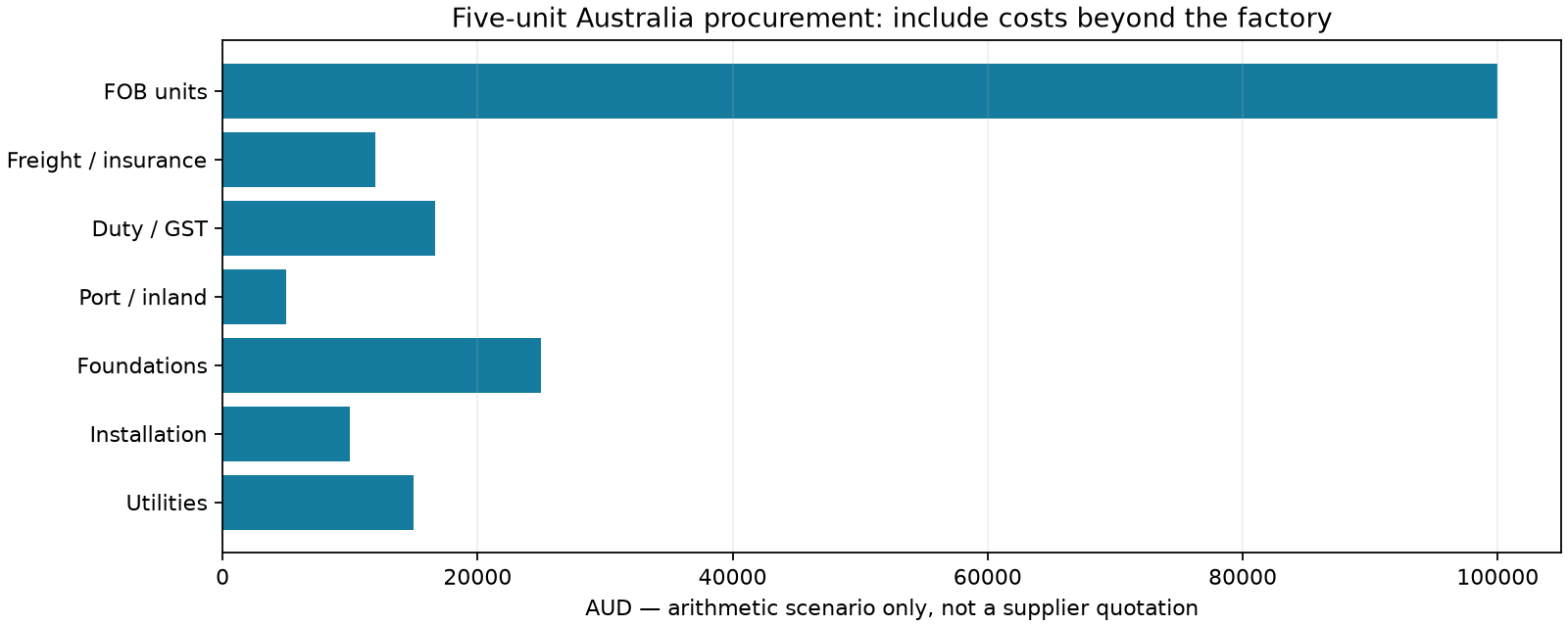
All non-tax amounts below are invented budgeting inputs, not HUAYING prices or current market averages. Amounts are AUD. Customs value is assumed equal to the FOB figure solely for this worked example. Land purchase, professional fees, approval costs, inspection charges and contingency are not priced and must be added where applicable.
| Cost stage | AUD | Basis |
|---|---|---|
| FOB / assumed customs value | 100,000 | Illustrative input; obtain written quotation |
| International freight and insurance | 12,000 | Illustrative input; obtain route-specific quote |
| Customs duty: general-rate scenario | 5,000 | 5% of assumed customs value; confirm classification |
| Import GST | 11,700 | 10% of customs value + duty + freight/insurance in this simplified example |
| Destination / inland logistics | 5,000 | Illustrative input; confirm port and delivery scope |
| Foundations | 25,000 | Illustrative input; quote against engineered site plan |
| Installation / lifting | 10,000 | Illustrative input; confirm contractor scope |
| Utility connections | 15,000 | Illustrative input; quote locally |
| Example cash outlay before unpriced items | 183,700 | Not a supplier offer or complete site budget |
ABF lists a 5% general tariff for heading 9406 categories including steel modular building units. A qualifying ChAFTA preference can change the duty outcome; it is not automatic merely because shipment leaves China. Ask a customs broker to confirm classification and origin evidence. Australia charges 10% GST on taxable importations. GST credits or deferral, where available, affect cash flow separately from the border calculation.
Sources checked 14 October 2026: ABF Chapter 94, ChAFTA origin requirements, and ABF import GST.
Australian approvals: separate supply from permission to build
Treat an imported home as a building project, not just a delivered product. Ask the relevant state or territory authority and local building surveyor to identify the applicable NCC edition, building classification, local amendments and required permits for the intended use. Do not assume an overseas test certificate establishes approval for your site.
The ABCB explains that adoption of the NCC is jurisdiction-specific. Its NCC 2022 condensation material is a useful published reference, but the edition and transition rules applicable to a 2026 project need local confirmation. Energy, structure, fire, weatherproofing, plumbing, electrical work and planning conditions must be assessed for the selected model and address.
Prepare a compliance register before paying a deposit: identify each requirement, the document needed, the organisation responsible and the point when it must be accepted. Ask your adviser which drawings must be signed locally and which product evidence can support that process. A missing approval pathway can cost more than a modest difference between factory quotations.
ABCB guidance on the NCC and jurisdictional adoption.
Compare the tax scenarios without disguising the assumptions
In the five-unit arithmetic example, the FOB input is AUD 100,000 and freight plus insurance is AUD 12,000. The 5% general-duty scenario gives AUD 5,000 duty and AUD 11,700 import GST, before the listed local costs. If a broker confirms a qualifying zero-duty preference using the same assumed values, the GST amount becomes AUD 11,200. That is a tax scenario comparison, not a promise of preferential treatment.
The difference is AUD 5,500 in this simplified example. Do not subtract it from a budget until eligibility is established. The customs value may require adjustments, and the actual cost of delivery to the relevant place of consignment matters. Ask the broker to calculate from the transaction documents rather than treating this teaching example as a customs declaration.
Keep local compliance evidence separate from border documents
A shipping document or certificate of origin serves a different purpose from engineering evidence for construction approval. Put them in separate folders and assign separate review responsibilities. A successful customs clearance does not establish that the proposed unit can be occupied at your site.
Ask local advisers which structural drawings, material evidence, installation records and services documentation are required. Have the supplier state what is available for the exact offered model. If further testing or redesign is needed, identify the timing and cost before placing the order. Avoid accepting a general statement such as suitable for Australia as a substitute for a documented project pathway.
Plan an inspection sequence that matches the build
Consider when important interfaces become inaccessible. A pre-shipment review may capture factory work, while site inspections check foundations, transport effects, assembly connections and services. Ask your advisers to set appropriate hold points. Do not rely entirely on a final walk-through if a critical connection will already be covered.
For a mixed batch, check each layout against its own approved drawing set. Label deviations and agree whether they are accepted, corrected or require further review. A systematic checklist also helps after-sales discussions because the supplier and local installer can refer to the same unit reference and inspection record instead of trying to interpret an unlabelled photograph.
Think through maintenance and future expansion
A five-unit project may grow, but its first phase should work independently. Ask how future units would connect to access routes, drainage, services and shared facilities. Leave decisions about structural links or stacked arrangements to the relevant designer. Do not assume a model can be combined simply because two units appear adjacent in a photograph.
Keep an asset record for each delivered unit, including model reference, configuration, installation date and relevant component documents. Agree how replacement parts are identified and who handles local service work. This is especially useful where layouts differ: the correct window, fitting or seal may depend on the individual specification rather than the product-family name.
FAQ: should I request FOB, port-delivered or site-delivered offers?
Ask for the scope that matches your ability to organise the remaining work. You can request alternative delivery scopes, but compare them on the same named location and explicit inclusions. An inexpensive offer that leaves essential services unpriced may be less useful for planning than a clearly itemised offer with a higher subtotal.
FAQ: can I use a small-unit price as the budget for every layout?
Only after confirming equivalent scope. Bedroom count, usable area, fit-out, service positions and shipment configuration can differ. Identify the specification of each unit type and request a separate price for changes rather than spreading a single brochure number across the entire project.
FAQ: is the example total a HUAYING quotation?
No. The figures illustrate a calculation method and include deliberately assumed inputs. They are not current freight quotations, factory prices or contractor estimates. Request actual offers and replace every allowance before deciding whether the project meets your budget.
Send a five-unit procurement brief
Send your Australian destination, intended use, preferred layouts, quantities by type and target delivery sequence to HUAYING for a project quotation. Ask for model references, floor plans, itemised scope, packing details and available documentation together. Include the installer or adviser requirements you already know.
Explore the expandable container house models and workshop product catalogue. If climate suitability is a priority, read the Australia cool-winter condensation design guide alongside your local design review. Contact jack@huayinghouse.com or WhatsApp +86 153-0318-4505.