Most of the Netherlands sits at or below sea level, on ground that is half water. Roughly 26% of the country lies below sea level and about half of it is within one metre of it, kept dry only by a continuous system of dikes, pumps and polders. For a container house buyer this changes the design problem completely: the question is not “how do I keep the rain out”, but “how do I keep the house from floating, settling and rotting.” This guide covers the three Dutch-specific failure modes first, then the engineering answers, then a full FOB-to-landed cost breakdown for 2026.
1. The Dutch hazard profile: water under the floor, not just over the roof
The Netherlands has a temperate maritime climate (Cfb): mild, humid, windy, with cool summers and frost-free winters. Heating demand is low and there is no snow-load or hurricane risk. Earthquake risk is negligible except for minor induced activity around Groningen. The real constraints are geotechnical and hydraulic:
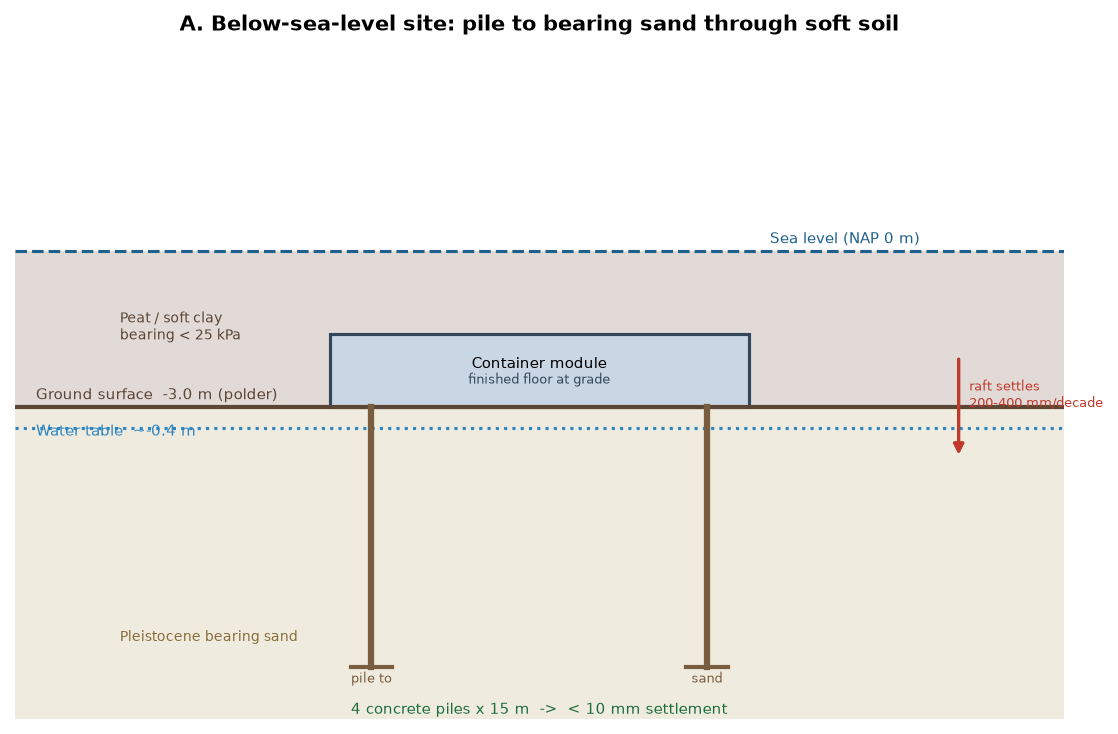
- High water table. In polder areas groundwater is held within 0.2-0.6 m of the surface, often above the base of a standard slab. A module sitting on a conventional raft is, in effect, sitting in water.
- Soft soil. Much of the western and northern country is peat and soft clay with an undrained bearing capacity below 25 kPa – a fraction of what a concrete slab needs.
- Below-sea-level siting. The lowest point (Zuidplaspolder) is -6.76 m NAP. Many buildable plots are -2 to -5 m, entirely inside the flood-defence system.
- Saline, humid air. Coastal zones push the corrosion class toward ISO 12944 C4-C5, and the year-round humidity drives condensation if vapour control is wrong.
2. Four failure modes specific to Dutch sites
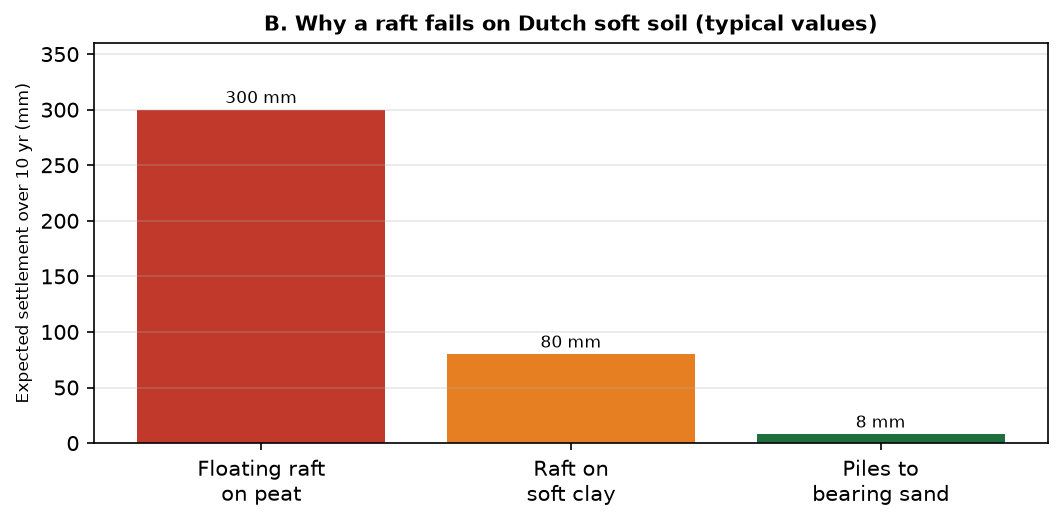
(1) Settlement and differential tilt. A raft or strip footing on peat settles 200-400 mm over a decade, and unevenly. Container modules are stiff boxes; a 150 mm difference between two corners racks the frame, jams doors and cracks joints. This is the most common and most expensive Dutch defect.
(2) Buoyant float-off during flood or high water. A sealed module displaces roughly 60-75 t of water. If a dike ring is overtopped or a pump fails, an unballasted module floats off its supports and is carried into neighbours.
(3) Rising damp and corrosion at the base. A slab poured in saturated peat wicks groundwater into the structure; steel at the base corrodes and floor insulation stays wet year-round.
(4) Condensation on cold steel. The mild-but-humid climate means interior humidity condenses on cold steel surfaces in winter, causing mould on the inside – the opposite of the tropical problem but the same root cause: missing or misplaced vapour control.
3. Design countermeasures
| # | Countermeasure | Specification for the Netherlands | Why it matters |
|---|---|---|---|
| N1 | Pile foundation to bearing sand | 4-8 precast concrete piles (or screw piles) driven to Pleistocene sand at 12-20 m; pile cap + ground beam | Eliminates settlement; the only robust answer on peat/clay |
| N2 | Ballast / hold-down for buoyancy | Concrete podium or ground anchors sized for floodwater depth at the site’s dike-ring level | Prevents float-off if the polder floods |
| N3 | Raised, ventilated floor | Module floor >= 300 mm above grade on the pile cap; ventilated void beneath | Breaks capillary rise and keeps the base dry |
| N4 | Vapour control (warm-side) | VCL on the warm interior face of insulation, with mechanical ventilation (HRV) | Stops winter condensation on cold steel |
| N5 | Corrosion system | Hot-dip galvanised frame + ISO 12944 C4/C5 coating near the coast; coated fasteners | 20+ year life in humid/saline air |
| N6 | Frost-free, shallow services | Water/waste pipes insulated and traced; no deep excavation needed (no frost heave) | Simplifies site services in mild climate |
4. Foundation cost is the Dutch differentiator
In the US or Australia a concrete slab might be 10-15% of site cost. In the Netherlands the pile foundation is frequently the single largest site line, because the alternative (a raft on peat) is not viable. Precast concrete piles to -15 m run roughly EUR 80-150 per metre installed; a typical four-pile scheme for one module lands around EUR 7,000-10,000 before the cap and beam. This is the cost item that surprises buyers who compare Dutch quotes to German or UK ones.
5. FOB to landed cost (40-ft expandable, Netherlands 2026)
| Stage | Item | Cost (USD) | Note |
|---|---|---|---|
| Factory | FOB Tianjin (40-ft expandable) | 17,500 | HUAYING ex-works |
| Sea | Ocean freight Tianjin to Rotterdam (40HQ) | 4,200 | Via Suez; peak-season surcharge applies |
| Inland | Trucking Rotterdam to site | 900 | Short hauls; NL is compact |
| CIF at Rotterdam | 22,600 | ||
| Tariff | EU duty HS 9406.20 | 610 | 2.7% (Chapter 94, prefabricated buildings) |
| Tax | Dutch VAT (BTW) 21% on (CIF + duty) | 4,874 | Reclaimable with a NL VAT number |
| Clear | Port handling, THC, broker | 850 | |
| Landed at port, cleared | 28,934 | Incl. VAT; reclaimable for businesses | |
| Site (NL-specific) | Pile foundation (4 x 15 m concrete piles) | 9,700 | The Dutch differentiator |
| Crane placement + pile cap/beam | 1,500 | ||
| Groundworks, drainage, permits | 2,000 | Polder drainage often required | |
| Utility hookup (elec/water/waste) | 2,000 | Shallow, frost-free services | |
| Turnkey delivered & founded | 44,134 | approx 2.52x FOB | |
The 21% VAT is recoverable for a registered Dutch business, so the effective private cost is closer to EUR 38,000; a non-EU private buyer pays the full amount. The pile foundation alone is 22% of FOB – the line that does not appear in most other markets’ quotes. A 20-ft unit runs roughly 30% lower on the same scheme.
6. Permits, codes and import duty
Building control follows the Bouwbesluit 2012 and the Eurocodes (NEN-EN 1990-1997), including NEN-EN 1997-1 for geotechnical design – which is precisely why a geotechnical report and pile design are mandatory on soft soil. The Omgevingswet (effective 2024) consolidates permitting into a single environmental permit (omgevingsvergunning), typically a 4-8 week review. Import enters the EU under HS 9406.20 at 2.7% Most-Favoured-Nation duty, with 21% Dutch VAT charged at import and reclaimable. Outside the primary flood defence (“buitendijks”) the rules are stricter and insurance harder to obtain, so most buyers build inside a dike ring on a pile foundation.
7. Three Dutch scenarios
Randstad polder (e.g., Zuidplaspolder, -6.7 m): full pile foundation to deep sand, ballast against float-off, raised ventilated floor – the complete N1-N6 package.
Clay/sand upland (e.g., Veluwe, +20 m): shorter piles or even a reinforced raft may suffice; corrosion and humidity still drive N4-N5.
Coastal Zeeland: add C5 corrosion coating and confirm the dike-ring flood level before sizing buoyancy ballast. Our UK ground-conditions guide covers a neighbouring soft-soil, high-water-table market, and our building-codes overview explains EU/US permitting paths.
Frequently asked questions
Can I just pour a concrete slab in the Netherlands? Only on stable sand or clay away from polders. On peat or soft clay a raft settles 200-400 mm per decade and racks the box; piles to bearing sand are the standard answer.
What does the pile foundation cost? Typically EUR 7,000-10,000 for a single module – about 22% of FOB. It is the one line that does not appear in quotes for firmer-ground markets.
Will the house float in a flood? If the polder floods, an unballasted module can. We size a concrete podium or ground anchors to the site’s dike-ring flood level so it stays put.
Do I pay the 21% VAT? A registered Dutch business reclaims it; a private buyer pays it at import. Either way it is a cash flow item at the border.
Will it get damp or mouldy? Mild, humid air causes winter condensation on cold steel. A warm-side vapour barrier plus mechanical ventilation (HRV) controls it – the reverse of tropical practice but the same principle.
What is the total delivered cost? About $44,000 turnkey for a 40-ft expandable unit (approx 2.52x FOB), dominated by the pile foundation and VAT.
Get a Netherlands-specific spec sheet
HUAYING engineers container houses to the soil, water table and dike-ring level of your exact plot. Send your postcode and a geotechnical report (or we will advise what to order), and we return a pile-foundation and flood-resilience package with a landed quote. Contact jack@huayinghouse.com or WhatsApp +86 153-0318-4505.