
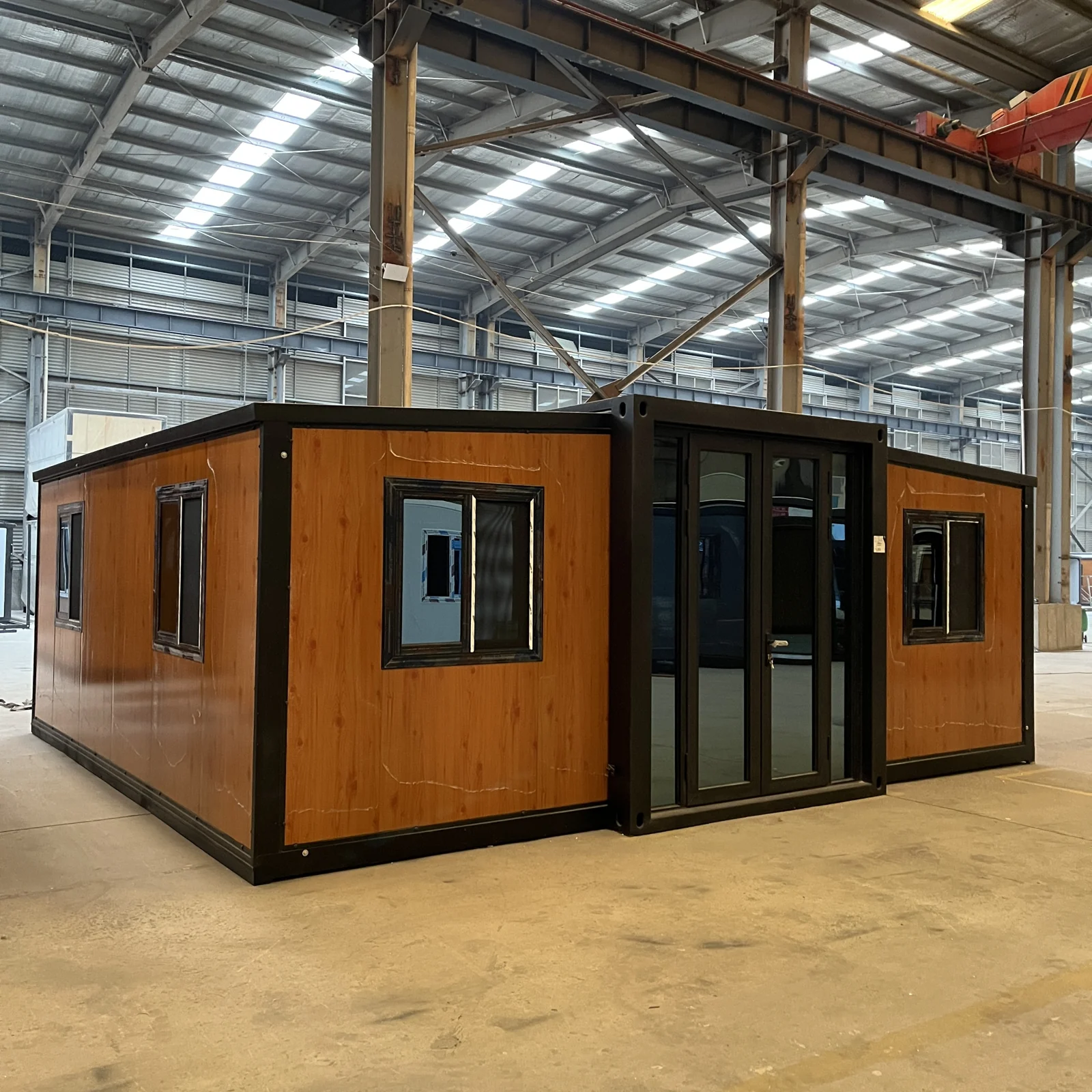
Florida sits in the most active hurricane basin in the Atlantic. A container house built for a calm inland site will fail on a Gulf or Atlantic coast not because the steel is weak, but because the openings, the roof edges, and the anchorage were never designed for a 150–180 mph wind field. This guide works through the failure modes first, then the engineering fixes, then a full FOB-to-landed cost breakdown for a compliant 40-ft unit in 2026.
1. Florida’s hazard profile: wind first, then water
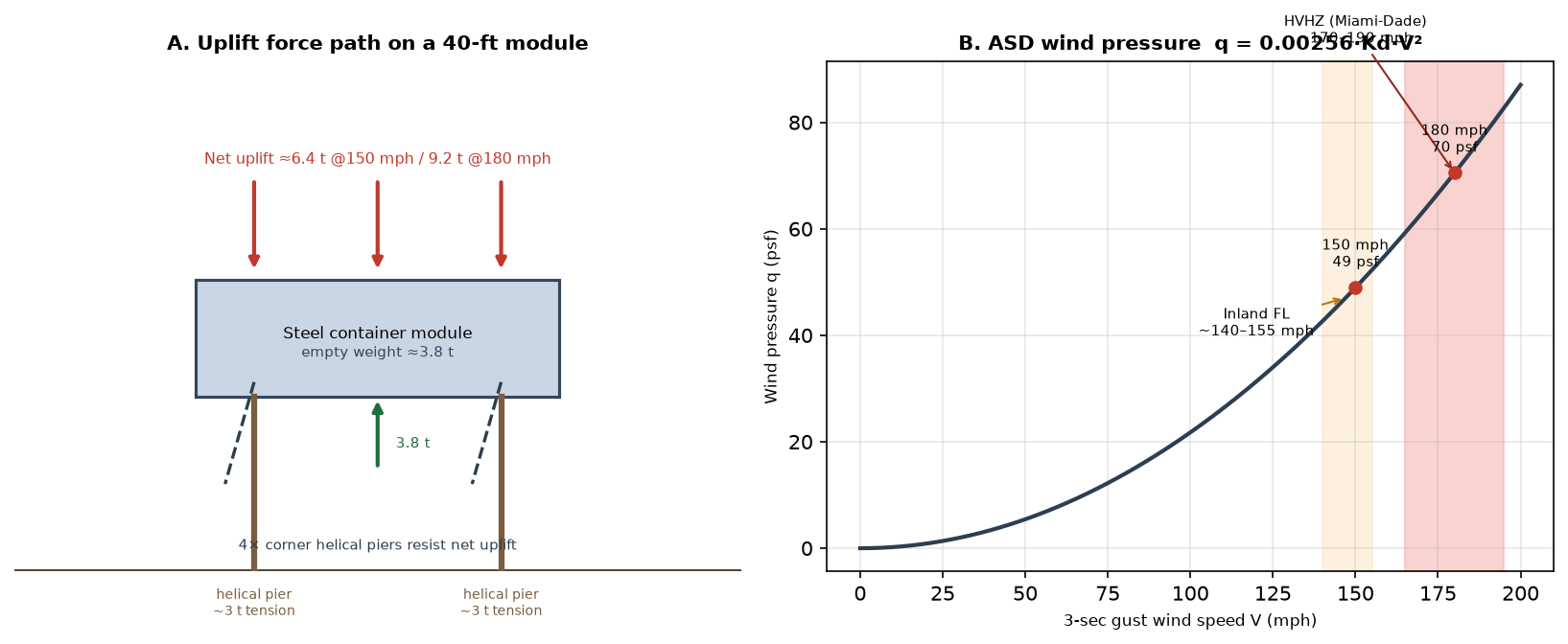
Florida’s building risk is dominated by wind. The Florida Building Code (FBC), 8th Edition (2023), adopts ASCE 7-22 and designs to the design-basis 3-second gust wind speed (Vult). Inland counties sit near 140–155 mph; the Atlantic and Gulf coastal strips, and especially the High-Velocity Hurricane Zone (HVHZ) of Miami-Dade and Broward, reach 170–190 mph. Sea-level rise and a flat peninsula also put a large fraction of sites inside a Special Flood Hazard Area (SFHA), so storm surge and rainfall flooding are the second hazard, not an afterthought.
Earthquake risk is effectively nil — Florida rests on a stable platform, so no seismic detailing is required. Corrosion is the quiet third risk: coastal salt spray pushes the environment to ISO 12944 C5-M, the harshest marine category. The design answer is therefore a hierarchy: anchor the box, protect the openings, seal the edges, coat for salt, and lift above the water.
2. Five failure modes specific to Florida hurricanes
(1) Uplift overturning. Wind passing over a low, wide box creates suction on the roof. At 150 mph the net uplift on a 40-ft module is about 6.4 tonnes; at 180 mph (HVHZ Cat-5 design) it is about 9.2 tonnes — more than twice the empty module weight of ~3.8 t. The box wants to fly; only the anchorage holds it down.
(2) Window and door breach. Once a glazed opening is punctured by wind-borne debris, internal pressurisation tears the roof off. This is the single most common total-loss mechanism in Florida hurricanes.
(3) Roof-edge peel. Standing-seam or screwed roof panels fail at the eaves and ridges first if edge metal and fasteners are not specified to the local wind pressure.
(4) Corrosion. Uncoated or thin-coated steel in C5-M conditions loses thickness and fastener integrity within a few years, quietly removing the margins the structure relied on.
(5) Flood buoyancy and debris. In a surge, a sealed module floats and shifts off its supports; enclosed lower space traps water and becomes a battering ram against the piers.
3. Design countermeasures (wind)
| # | Countermeasure | Specification for Florida | Why it matters |
|---|---|---|---|
| W1 | Foundation anchorage | 4–6 helical piers (corner + mid-long-side), each ≥3 t tension; engineered hold-down straps from corner castings to piers | Resists net uplift of 6.4–9.2 t; spread footing alone is insufficient |
| W2 | Inter-module connection | Bolt adjacent modules into one rigid mass; add cross-bracing at the roof line | A multi-box cluster resists wind far better than isolated units |
| W3 | Impact-rated openings | Miami-Dade TAS 201/203 (large/small missile) laminated glazing, or certified hurricane shutters | Prevents debris breach and the internal-pressure roof loss that follows |
| W4 | Roof edge sealing | Standing-seam roof + FBC-compliant edge metal; screws with sealed washers, no exposed fasteners at eaves | Stops the eave/ridge peel failure |
| W5 | Corrosion system | Hot-dip galvanised frame + C5-M marine coating; stainless or coated fasteners | Maintains structural margin under salt spray for 20+ years |
| W6 | Orientation & siting | Long axis parallel to prevailing hurricane track where possible; avoid exposed barrier-island tips | Reduces projected area presented to the strongest winds |
4. Flood compliance: elevate, don’t fight
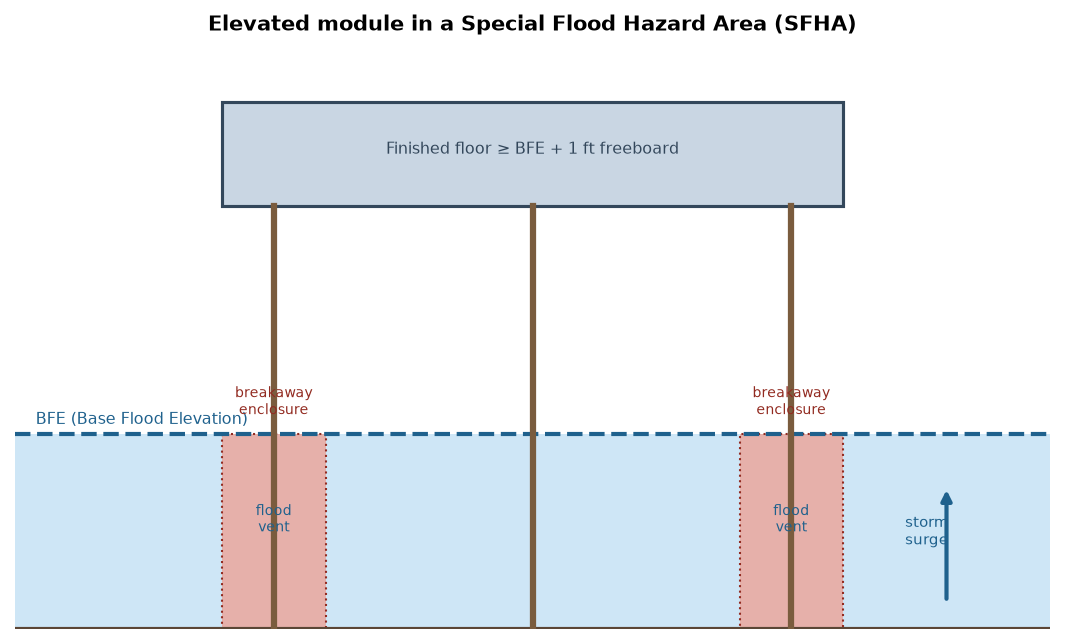
In an SFHA the cost-effective answer is almost always elevation, not flood-proofing the box. Set the finished floor at or above the Base Flood Elevation (BFE) plus at least 1 ft of freeboard, rest the module on piers, and leave any enclosed lower space as a breakaway enclosure with FEMA flood vents (2 per ~30 m²). This lets surge pass through instead of lifting the structure.
5. FOB → Landed cost breakdown (40-ft expandable, Florida 2026)
| Stage | Item | Cost (USD) | Note |
|---|---|---|---|
| Factory | FOB Tianjin (40-ft expandable) | 22,000 | HUAYING ex-works |
| Sea | Ocean freight Tianjin → Jacksonville / Port Everglades (40HQ) | 4,200 | Subject to peak-season surcharge |
| Inland | Trucking to site (FL) | 1,500 | Varies with distance from port |
| CIF subtotal | 27,700 | ||
| Tariff | US duty HTS 9406.20.00 (2.9% MFN + 25% Section 301) | 7,728 | 27.9% of CIF |
| Clear | Brokerage, ISF, port handling | 450 | |
| Landed at port, cleared | 35,878 | No US federal VAT | |
| Site | Helical-pier anchorage + elevation piers | 6,500 | Higher inside SFHA |
| Hurricane upgrade | Impact-rated glazing (Miami-Dade TAS 201/203) | 1,800 | Required in HVHZ |
| Sealed standing-seam roof + edge metal | 900 | FBC-compliant | |
| C5-M marine corrosion coating | 700 | Coastal durability | |
| Breakaway walls + flood vents (SFHA) | 1,200 | If in flood zone | |
| Anchorage straps & hardware | 600 | ||
| Turnkey delivered & compliant | 47,578 | ≈ 2.16× FOB | |
The hurricane upgrade package is roughly 23% of FOB. The single largest line after freight is the US duty: because container houses import under HTS 9406.20.00, the 27.9% combined rate (MFN + Section 301) adds about $7,700 before the unit ever reaches the site.
6. Codes, permits and import duty
Florida Building Code (FBC) 8th Edition (2023) is the governing standard, built on the 2021 IBC and ASCE 7-22. Wind design uses the design-basis 3-second gust map; the HVHZ (Miami-Dade, Broward) additionally requires a Notice of Acceptance (NOA) or Florida product approval for windows, doors and panels, tested to TAS 201/202/203. Outside HVHZ, an ICC-ES or Florida approval is accepted. Flood provisions follow FEMA’s National Flood Insurance Program minimums: elevation above BFE, breakaway walls, and flood vents in SFHA zones.
Import duty: container houses enter under HTS 9406.20.00 at 2.9% MFN plus the 25% Section 301 (List 3) surcharge — a combined 27.9%. There is no US federal VAT; Florida sales tax (~6%) applies to installed value, not to goods for resale. Local permitting varies by Authority Having Jurisdiction; some counties treat container homes as temporary or park-model structures, so confirm the path (engineered modular approval vs. site-built) with the county building department before delivery.
7. Three Florida scenarios
Panhandle (e.g., Pensacola): high wind, moderate surge — full W1–W5 anchorage, standard coastal coating, elevation only if mapped in SFHA.
Gulf coast (Tampa – Fort Myers): the Ian (2022) surge reached 10–15 ft here. Plan elevation above BFE plus freeboard, breakaway enclosure, and HVHZ-grade openings if in the coastal wind field.
Keys / Miami-Dade: full HVHZ — NOA-approved impact glazing, C5-M coating, and the highest anchorage spec. This is the most expensive but also the most forgiving-if-done-right path.
Our Jamaica Category 5 guide applies the same anchorage physics to the Caribbean wind field, and our US building-codes overview covers permitting across states. For a Florida-specific landed quote, see the USA price guide.
Frequently asked questions
Will a container house survive a Category 5 hurricane in Florida? The steel shell survives the wind; total loss comes from breached openings, peeled roof edges, or inadequate anchorage. Designed to FBC with impact glazing and engineered helical-pier hold-downs, a container module is one of the more wind-resilient small buildings available.
Do I need Miami-Dade product approval? Only inside the HVHZ (Miami-Dade and Broward). Elsewhere a Florida or ICC-ES product approval is sufficient.
How high must I elevate above flood? At or above the BFE plus at least 1 ft of freeboard if the site is in an SFHA; the module sits on piers with a breakaway lower enclosure.
What does hurricane anchorage cost? Typically ~$6,500 for helical piers plus elevation on a typical site, higher inside a mapped flood zone.
Will it rust on the coast? With hot-dip galvanising plus a C5-M marine coating and coated fasteners, the structure is rated for 20+ years in salt-spray conditions.
What is the total delivered cost? About $47,000 turnkey for a 40-ft expandable unit (≈ 2.16× FOB), including duty, anchorage and the hurricane upgrade package.
Can I get a permit and financing? It depends on the county AHJ. Budget for engineered drawings with a Florida PE stamp; some jurisdictions require modular approval rather than site-built treatment.
Get a Florida-specific spec sheet
HUAYING engineers container houses to the wind field and flood zone of your exact site. Send your coordinates and flood map, and we will return an anchorage and elevation package with a landed quote. Contact jack@huayinghouse.com or WhatsApp +86 153-0318-4505.