
A container house in New Zealand does not fail because the winter is cold. It fails because the zinc coating on the steel runs out before the mortgage does. That distinction decides the specification, and most buyers never see it, because the climate chart they are shown lists temperature and rainfall and nothing else.
The numbers below are computed from ISO 9223:2012 corrosion classes, ISO 1461 coating masses, NIWA rainfall intensities and the New Zealand Building Code durability clauses. They apply to a standard 20 ft expandable module shipped from Tianjin to a site near Rotorua, but the ratios hold anywhere in the country with a coastline or a geothermal field within reach.
What the New Zealand climate chart tells you, and what it hides
New Zealand is classified Cfb under Köppen: temperate, no dry season, warm summer. Read that classification and you conclude the building envelope is easy. Mean winter temperatures sit between 3.9 °C in Queenstown and 11.3 °C in Auckland, well above freezing, so there is no frost heave to design for and no snow load outside the alpine zones.
What Köppen does not measure is the two variables that actually destroy steel here. The first is chloride deposition, because no point in New Zealand is more than 130 km from the sea and the prevailing westerlies carry salt aerosol inland far further than most specifiers assume. The second is hydrogen sulphide, which occurs naturally across the Taupō Volcanic Zone and is present at measurable concentrations in Rotorua, Kawerau, Taupō and parts of the Bay of Plenty.
Neither variable appears on a climate chart. Both are measured, both are mapped, and both change the coating specification by a factor of five or more. That is the gap this article closes.
Failure mode 1: the zinc is consumed before the durability clause is met
Almost every expandable container house leaves a factory with Z275 sheet: 275 g/m² of zinc measured on both faces combined. That works out to 137.5 g/m² per face, and at a zinc density of 7.14 g/cm³ it is a coating 19.3 microns thick. It looks and feels substantial. Against a marine atmosphere it is not.
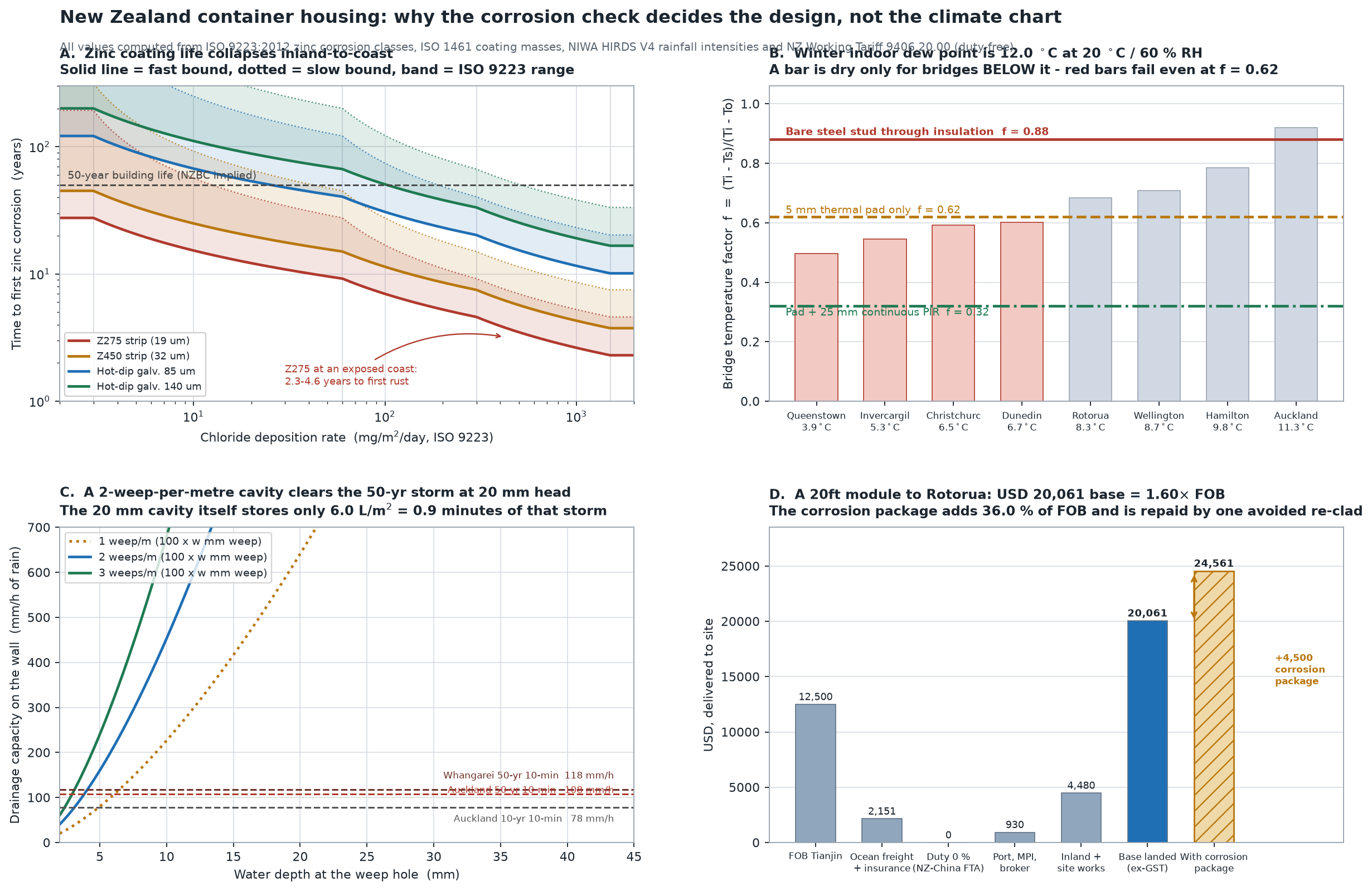
ISO 9223 assigns a corrosion category from the chloride deposition rate, and each category carries a zinc loss rate in microns per year. At an exposed coast 50 m from the high tide mark, deposition reaches roughly 420 mg/m²/day, which places the site in category C5. At C5 the zinc loss runs between 4.2 and 8.4 microns per year. Divide 19.3 by that range and the coating is gone in 2.3 to 4.6 years.
Two hundred metres inland the deposition drops to about 165 mg/m²/day and the site becomes C4, which buys 4.6 to 9.2 years. Even at one kilometre inland, still C3, Z275 gives 9.2 to 27.5 years. None of these numbers is compatible with the durability the Building Code demands.
| Coating | Zinc thickness | C3 inland | C4 coastal | C5 surf coast |
|---|---|---|---|---|
| Z275 strip (factory standard) | 19.3 µm | 9.2–27.5 yr | 4.6–9.2 yr | 2.3–4.6 yr |
| Z450 strip | 31.5 µm | 15.0–45.0 yr | 7.5–15.0 yr | 3.8–7.5 yr |
| Hot-dip galvanised, ISO 1461, 85 µm | 85 µm | 40.5–121 yr | 20.2–40.5 yr | 10.1–20.2 yr |
| Hot-dip galvanised, ISO 1461, 140 µm | 140 µm | 66.7–200 yr | 33.3–66.7 yr | 16.7–33.3 yr |
Now set those against clause B2 of the New Zealand Building Code. B2.3.1 requires structural elements to remain durable for 50 years. B2.3.2 requires weathertightness components to last 15 years. B2.3.3 allows 5 years only for items that are easily replaced, and external cladding is not one of them.
Z275 at C5 fails the 15-year weathertightness threshold by a factor of three to six. Even 85 micron hot-dip galvanising straddles the line, meeting it only if the site sits at the slow end of the C5 band. To clear 15 years at the fast bound of 8.4 microns per year you need 126 microns of zinc, which is why the 140 micron specification exists and why it is the correct default for any New Zealand coastal site.
Failure mode 2: geothermal hydrogen sulphide does not just thin the zinc, it stops it working
The Taupō Volcanic Zone produces hydrogen sulphide at concentrations that vary from barely detectable to well above 10 ppm near active vents. Rotorua town centre typically sits in the 0.02 to 0.2 ppm band, with spikes during still, cold mornings when the gas pools in the basin.
At those concentrations the sulphur deposition onto a metal surface, computed at a dry deposition velocity of 0.0015 m/s, runs from about 1.3 g/m²/year at 0.02 ppm to 33 g/m²/year at 0.5 ppm. Converting via the stoichiometry of zinc sulphide formation, that consumes 0.38 to 9.4 microns of zinc per year. That figure lands inside the ISO C5 to CX range that the standards bodies report for geothermal areas, which is a useful consistency check rather than a design calculation.
The more important effect is chemical, not dimensional. Zinc protects steel by acting as a sacrificial anode: it corrodes preferentially and its own corrosion products are conductive enough and soluble enough to keep the circuit closed. When zinc reacts with hydrogen sulphide it forms zinc sulphide, and zinc sulphide is a semiconductor with a band gap around 3.5 eV. The film is not soluble. It seals the surface.
| Parameter | Zinc oxide (normal atmosphere) | Zinc sulphide (geothermal) |
|---|---|---|
| Molar volume ratio to zinc (Pilling–Bedworth) | 1.58 | 2.60 |
| Film character | Porous, partly soluble, ion-conducting | Dense, insoluble, semiconducting |
| Effect on sacrificial protection | Continues; steel stays cathodic | Stops; circuit broken at the film |
| Visible warning before steel corrodes | White rust, obvious | Dark grey film, easily read as dirt |
This matters because the failure is silent. In a marine atmosphere the zinc announces its exhaustion with white rust, and an inspector can catch it. In Rotorua the surface turns a dull slate grey that most people read as normal weathering, and the steel beneath begins to corrode while the coating still looks present.
The engineering response is not more zinc. It is a barrier coating that does not depend on electrochemical activity at all: an 80 micron zinc-rich epoxy primer followed by a 240 micron polyurethane topcoat, which is the C5-M duplex system in AS/NZS 2312.2. The zinc-rich primer still provides cathodic protection at pinholes, but the topcoat keeps the sulphide away from it.
Failure mode 3: winter condensation happens at the thermal bridge, not at the glass
Temperate maritime climates do not have a condensation problem in the wall field. They have one at the point where a steel member crosses the insulation, because that member is at a temperature close to the outside air and the air inside the module carries moisture at 20 °C.
Take indoor conditions of 20 °C and 60 % relative humidity, which is ordinary for a heated, occupied house in winter. The indoor dew point is 12.0 °C. Any surface below that temperature collects water, regardless of how much insulation is in the wall beside it.
A bare steel stud passing through 100 mm of PIR without a thermal break has a temperature factor f of about 0.88, where f is defined as (Ti − Ts)/(Ti − To). At Rotorua’s mean winter temperature of 8.3 °C, surface temperature falls to 9.7 °C against a 12.0 °C dew point. It condenses. The same calculation at Hamilton, Wellington, Christchurch, Dunedin, Queenstown and Invercargill returns the same result. Only Auckland, at 11.3 °C outside, stays marginally dry at 12.3 °C.
| Location | Winter mean | Max bridge factor f that stays dry | Bare steel f = 0.88 | Pad only f = 0.62 | Pad + PIR wrap f = 0.32 |
|---|---|---|---|---|---|
| Auckland | 11.3 °C | 0.920 | 12.3 °C — dry | 14.6 °C — dry | 17.2 °C — dry |
| Hamilton | 9.8 °C | 0.785 | 11.0 °C — condenses | 13.7 °C — dry | 16.7 °C — dry |
| Rotorua | 8.3 °C | 0.684 | 9.7 °C — condenses | 12.7 °C — dry | 16.3 °C — dry |
| Wellington | 8.7 °C | 0.709 | 10.1 °C — condenses | 13.0 °C — dry | 16.4 °C — dry |
| Christchurch | 6.5 °C | 0.593 | 8.1 °C — condenses | 11.6 °C — condenses | 15.7 °C — dry |
| Dunedin | 6.7 °C | 0.602 | 8.3 °C — condenses | 11.8 °C — condenses | 15.7 °C — dry |
| Queenstown | 3.9 °C | 0.497 | 5.8 °C — condenses | 10.0 °C — condenses | 14.8 °C — dry |
| Invercargill | 5.3 °C | 0.545 | 7.1 °C — condenses | 10.9 °C — condenses | 15.3 °C — dry |
Read the third column as a limit, not a description. At Queenstown the limit is f = 0.497, so any bridge above that value condenses. A 5 mm neoprene pad alone, at f = 0.62, still fails there and in Christchurch, Dunedin and Invercargill. Only a continuous 25 mm PIR wrap that breaks the steel path entirely, at f = 0.32, clears every location on the list.
The consequence of getting this wrong is not visible mould on day one. It is interstitial moisture inside the wall, on the cold face of the insulation, where nobody looks. Over three or four winters that wets the mineral substrate, and if the steel is Z275 rather than galvanised, it wets a coating that is already only a few years from exhaustion. The two failure modes compound.
Failure mode 4: the drained cavity drains, but it does not store
New Zealand’s weathertightness history is well documented, and the lesson the industry took from it was that a drained and ventilated cavity behind the cladding is not optional. E2/AS1, the Acceptable Solution for external moisture, requires a 20 mm cavity with weep holes at the base of each storey. Container house suppliers who ship monolithic panels without a cavity are repeating a mistake the country already paid for once.
The part that gets less attention is the division of labour. The cavity is a drainage path, not a reservoir. A 20 mm deep cavity, with a 30 % retention factor through the fixing and framing obstructions, holds about 6.0 litres per square metre. During Auckland’s 50-year 10-minute rainfall intensity of 108 mm/h, that volume fills in 0.9 minutes.
So the cavity survives on its outlets, not on its capacity. Each weep hole 100 mm wide and 10 mm high behaves as a broad-crested weir, and one weep per metre of wall with 10 mm of head passes 0.17 litres per second. Spread across a 2.7 m wall that is 227 mm/h of rainfall, about 2.1 times the design storm. Two weeps per metre give 453 mm/h, or 4.2 times.
| Weep provision | Flow at 10 mm head | Equivalent rain on a 2.7 m wall | Margin over 108 mm/h |
|---|---|---|---|
| 1 weep/m, 100 × 10 mm | 0.17 L/s | 227 mm/h | 2.1× |
| 2 weeps/m, 100 × 10 mm | 0.34 L/s | 453 mm/h | 4.2× |
| 1 weep/m at 20 mm head | 0.48 L/s | 641 mm/h | 5.9× |
| 2 weeps/m at 20 mm head | 0.96 L/s | 1,283 mm/h | 11.9× |
The practical reading: specify two weeps per metre at the base of each panel, and make sure the flashing below them projects far enough that the discharged water clears the foundation line. Most leaks attributed to the cavity are actually leaks past the flashing, where water that drained correctly is delivered straight back onto the slab edge and capillary action returns it to the bottom plate.
The other cavity detail that matters in New Zealand specifically is the metal flashing. E2/AS1 permits a range of materials, but in a C5 chloride environment, a galvanised flashing at the base of a wall is the first component to fail and the hardest to replace. Specify aluminium or stainless, not galvanised steel, at every horizontal junction.
Failure mode 5: ultraviolet at index 12 attacks the bond line, not the gasket
New Zealand summer ultraviolet index peaks at 12.0 in Auckland, 12.5 in Queenstown and 11.0 in Christchurch, against 7.0 in London. That is a 1.7-fold difference in peak intensity and considerably more in annual dose, because the ozone layer over the southern hemisphere is thinner and the sun path at these latitudes is more direct in summer.
The industry response is usually to specify EPDM gaskets, which are indeed UV-stable as a material. The failure that occurs on site is not the gasket body disintegrating. It is the adhesive bond line between the gasket and the frame, which cracks under combined UV exposure and thermal cycling, and once it cracks the gasket becomes a wick rather than a seal.
Two details fix this and neither is expensive. First, specify a mechanically retained gasket in a metal channel rather than a bonded one, so the seal does not depend on adhesive at all. Second, specify a UV-stable silicone sealant at the external fillet, and accept that it is a 12 to 15 year component that will need replacing, which is exactly what the 15-year durability clause anticipates.
What the specification should actually say
Pulling the four failure modes together gives a specification that differs from a standard export build in five places, and only one of them is about thickness.
1. All exposed steel hot-dip galvanised to ISO 1461, 140 µm minimum
Not 85 micron, and certainly not Z275. At the fast bound of C5 the 140 micron coating clears the 15-year durability clause with margin, and at the slow bound it approaches the 50-year structural requirement. This applies to the frame, the corner castings, the base rails and every bracket.
2. C5-M duplex coating on any surface that stays visible
Zinc-rich epoxy at 80 microns plus polyurethane at 240 microns, per AS/NZS 2312.2. The galvanising protects the steel; the duplex system protects the zinc from sulphide and from chloride. In geothermal areas the duplex coating is doing more work than the galvanising.
3. Thermal break at every steel path through the envelope
A 5 mm neoprene or equivalent pad at every stud, plus a continuous 25 mm PIR wrap on the outside of the frame so the steel is inside the insulation line rather than through it. Target a temperature factor of 0.32, which is the only one of the three details tested that clears condensation at every New Zealand location in the table above.
4. 20 mm drained cavity with two weeps per metre and non-ferrous flashings
Aluminium or stainless base flashing, not galvanised. The cavity must be continuous around corners and must terminate in a flashing that discharges clear of the foundation.
5. 316 stainless fixings throughout
This is the least expensive item on the list and the one most often substituted. A 304 screw in a C5 chloride environment is a corrosion cell waiting for a wetting cycle, and the failure appears as rust staining running down a wall that is otherwise in good condition.
Cost: what the corrosion package adds, and what it prevents
The base case is a 20 ft expandable module at USD 12,500 FOB Tianjin, delivered to a site near Rotorua. Ocean freight to Tauranga is USD 2,100, marine insurance is USD 51 at 0.35 % of CIF, so CIF lands at USD 14,651.
Import duty is zero. Containers classed under HS 9406.20.00 enter New Zealand free of duty, and the New Zealand–China Free Trade Agreement preserves that rate provided a certificate of origin is issued. Goods and Services Tax applies at 15 % on the CIF value plus duty, which is USD 2,198 and is recoverable if the importer is GST-registered.
| Cost line | USD | Basis |
|---|---|---|
| FOB Tianjin | 12,500 | 20 ft expandable, standard specification |
| Ocean freight, Tianjin–Tauranga | 2,100 | Single 20 ft module, flat rack where required |
| Marine insurance | 51 | 0.35 % of CIF |
| CIF value | 14,651 | Customs valuation basis |
| Import duty | 0 | HS 9406.20.00 free; NZ–China FTA |
| GST 15 % | 2,198 | Recoverable if GST-registered |
| Port, MPI inspection, broker | 930 | THC, biosecurity lodgement, delivery order |
| Inland transport to site | 480 | Tauranga to Rotorua district |
| Site works and foundation | 2,400 | Piles, bearers, levelling |
| Installation and commissioning | 1,600 | Expansion, services connection |
| Landed, excluding GST | 20,061 | 1.60× FOB |
| Landed, including GST | 22,259 | Not recoverable for a private buyer |
The corrosion package is a separate line because it is priced separately by almost every supplier, and because buyers routinely decline it. It comprises five items.
| Corrosion package item | USD | Replaces |
|---|---|---|
| Hot-dip galvanise all exposed steel to ISO 1461, 140 um (replaces Z275) | 2,150 | Z275 strip, 19 µm zinc |
| C5-M duplex coating: zinc-rich epoxy 80 um + PU topcoat 240 um | 1,420 | Single-coat shop primer |
| 316 stainless fixings, hinges and anchor bolts | 310 | Zinc-plated or 304 fixings |
| EPDM gaskets + 20 mm drained service cavity with metal flashings | 680 | Bonded gasket, direct-fixed panel |
| Sacrificial zinc anodes, 4 per module (geothermal / surf coast) | 240 | No anodes fitted |
| Total | 4,800 | 38 % of FOB |
Adding that package raises the landed cost excluding GST from USD 20,061 to USD 24,861, or from 1.60× to 1.99× FOB. On a total of roughly USD 24,861 that is an increase of about 24 %. It is a real increase and it should be presented as one.
The comparison that matters is not the percentage. It is the alternative. A full re-clad of a 20 ft module in New Zealand, once the cladding has to come off to reach the corroded frame, quotes in the range of NZD 9,000 to 14,000. At an exchange rate of 1.65 the low end alone is USD 5,450, which is more than the package costs. And the package is bought once, in the factory, at factory labour rates.
There is a second avoided cost that is specific to importing into New Zealand. Biosecurity clearance can require methyl bromide fumigation at about USD 4,200 if soil or contamination is found on the module or its packaging, plus storage at a transitional facility at roughly USD 980 for fourteen days. The corrosion package costs USD 4,800 against that USD 4,200 exposure, a ratio of 1.14. Neither figure is a certainty, but they are both the kind of cost that arrives after the container has shipped and cannot be negotiated.
Compliance: what a New Zealand consent actually requires
A container house is a building, not a caravan, once it is fixed to land and connected to services. That has consequences that differ from most export markets.
New Zealand Building Code and the compliance pathway
Clause B1 covers structure, B2 durability, E2 external moisture and H1 energy efficiency. A building consent is required from the territorial authority before the module is placed. Off-site manufacture does not remove that requirement; it changes who inspects at which stage.
Most territorial authorities accept a modular unit with a producer statement and a fabrication inspection record, but the accepting officer will ask for the coating specification, the thermal performance calculation and the weathertightness details. Providing those three documents at consent stage is the difference between a four-week and a four-month process.
Structural standards
NZS 3604 covers timber framing and does not apply to a steel module. The relevant documents are NZS 3404 for steel structures and, for seismic demand, NZS 1170.5. New Zealand sits on the Pacific–Australian plate boundary and the seismic demand is not optional anywhere in the country, which our separate guide to NZS 1170.5 seismic and wind design for container houses covers in detail.
Energy efficiency under H1
H1 requires a minimum R-value for walls, roofs and floors that varies by climate zone. The five climate zones run from zone 1 in the far north to zone 6 in the central plateau and inland Otago. A 100 mm PIR panel achieves roughly R 4.5 in the field, which is adequate in zones 1 to 3 and marginal in zones 4 to 6 without additional lining.
Biosecurity
MPI inspects every imported module at a transitional facility. The risks are soil on the underside and untreated timber in the packaging. ISPM 15 heat treatment for all timber packing removes the second risk; a factory wash-down and photographic evidence of the base before dispatch removes most of the first.
Frequently asked questions
Is Z275 galvanised steel adequate in New Zealand?
Only in sheltered inland locations. At C3 inland it provides 9.2 to 27.5 years, which meets the 15-year weathertightness clause if the site is genuinely inland. Within one kilometre of the coast it provides 4.6 to 9.2 years, and at an exposed coast 2.3 to 4.6 years, both of which fail. The site, not the product, decides.
How much does the corrosion package cost compared with the module?
About 38 % of the FOB price, or USD 4,800 on a USD 12,500 module. It raises the landed cost by around 24 % once freight, GST and site works are included.
Does the geothermal area really require a different coating, or is that overstated?
It requires a different coating system, not a thicker one. Hydrogen sulphide converts the zinc to zinc sulphide, which is insoluble and semiconducting, so the sacrificial protection stops even though the coating mass is still largely present. The fix is a barrier topcoat that keeps the sulphide away from the zinc.
Can a container house be consented in New Zealand without a cavity?
Not practically. E2/AS1 is the Acceptable Solution and it requires a drained and ventilated cavity. A supplier proposing monolithic panels without one is asking the consent authority to accept an alternative solution, which is a slower and more expensive route with a poor track record in this country.
What thermal break is actually needed to avoid winter condensation?
A temperature factor of 0.32 or lower at every steel path through the envelope. That means a 5 mm pad at each stud plus a continuous 25 mm PIR wrap outside the frame. A pad alone gives f = 0.62, which still condenses in Christchurch, Dunedin, Queenstown and Invercargill.
How long does shipping and clearance take to Tauranga?
Roughly 24 to 30 days port to port, then 5 to 10 working days for MPI inspection and customs clearance, then 1 to 3 days inland to the Waikato or Bay of Plenty. Allow six weeks from factory dispatch to a consented site, and longer if the module arrives during peak season in December and January.
What to do next
If you are buying a container house for a New Zealand site, three pieces of information determine the correct specification and all three are available before you request a quotation. The distance from the coast decides the chloride category and therefore the coating. The altitude and climate zone decide the insulation thickness under H1. The proximity to the Taupō Volcanic Zone decides whether a duplex barrier coating is required at all.
Send us the site address and we will return a specification sheet with the coating system, the thermal break detail, the R-value for your climate zone and a landed cost calculation to your nearest port. The calculation includes freight, duty, GST, port charges, inland transport and site works, so the number you receive is the number you will pay.
Contact jack@huayinghouse.com or call +86 153-0318-4505. We will also send the corrosion calculation for your specific site, including the ISO 9223 category, the expected coating life at that category and the cost of the package against the cost of a re-clad at year ten.
Related reading: Container homes in New Zealand: 2026 complete guide to costs and regulations covers the consent pathway and price bands in full. Earthquake design to NZS 1170.5 covers seismic and wind demand. Anti-disaster container housing for New Zealand covers emergency and temporary deployment. For a comparison of the same corrosion problem under a cooler, wetter, radon-bearing ground condition, see UK container house foundations.