
Ask most suppliers what a container house in the UAE needs to survive, and they will talk about the 50°C summer heat. That answer is incomplete for the single most common UAE siting: the coast. From Dubai Marina and Jebel Ali to Abu Dhabi’s Khalifa Port and the Northern Emirates shoreline, the dominant durability threat is not temperature — it is the combination of airborne salt, high relative humidity and a steel skin that drops below the dew point nearly every coastal night. Buyers who specify a generic “desert-spec” module for a coastal plot routinely see coating failure, rust staining and corroded fixings within a few years. This guide sets out the actual corrosion mechanism, the engineering numbers behind a coastal-grade specification, and the full FOB-to-landed cost chain for a factory-direct module delivered to a coastal UAE site.
1. The climate you are actually designing for
Coastal UAE is a hot desert climate (Köppen BWh) with a maritime modification that changes everything about envelope durability. Summer afternoons reach 41.2°C on average, with records near 49.5°C — the heat part is real and well understood. What is less often stated: along the coast, relative humidity at night commonly sits at 78% or more, giving a summer dew point around 28.5°C. Rainfall is negligible (about 95 mm/yr), which is precisely why buyers assume dryness and under-specify corrosion protection.
Three site facts drive the specification. First, distance from the shoreline: salt spray deposition falls off rapidly with distance, so a module 300 m from the water sits in a genuinely more aggressive microclimate than one 5 km inland. Second, the groundwater table on reclaimed coastal land is often only 1.5 m below grade and is chloride-laden. Third, the onshore wind direction determines which facade takes the salt load — the windward face can be a full corrosivity class worse than the sheltered leeward face. A single “UAE spec” applied to every site is therefore a category error. Our approach to reading a plot’s exposure is set out in the site-selection and environment guide.
2. Insight one: condensation — not heat — starts the corrosion
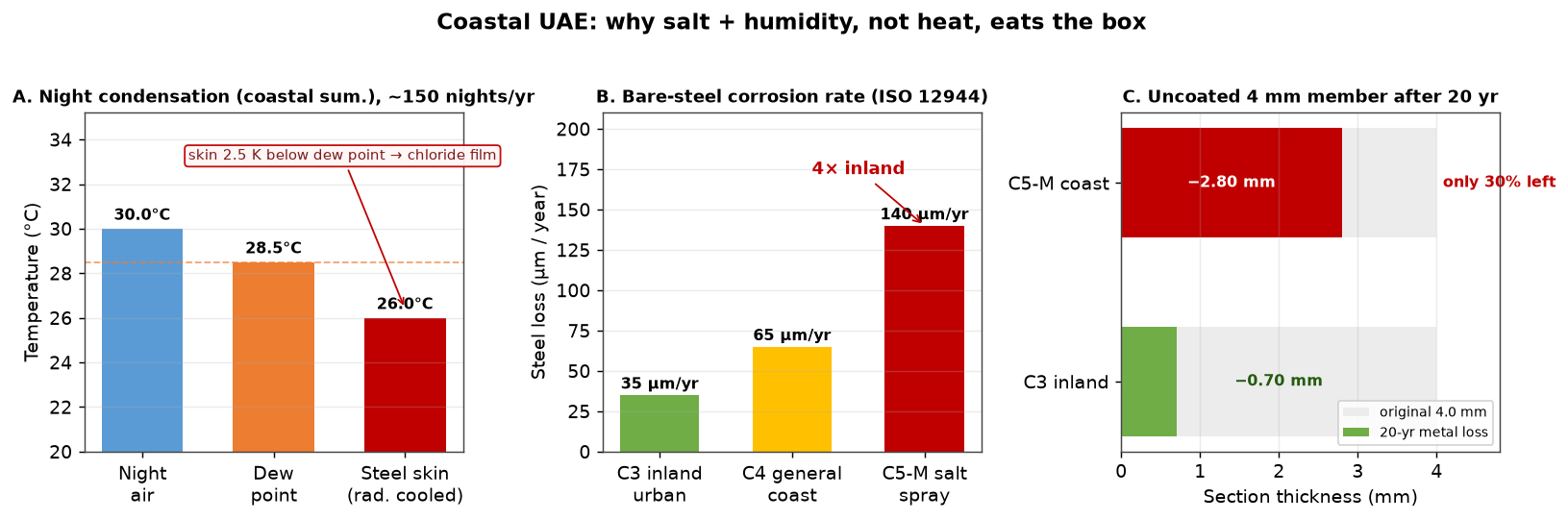
The corrosion cycle on the coast begins after sunset. On a typical summer night the coastal air is around 30.0°C with a 28.5°C dew point. Under a clear sky a steel roof and wall skin radiate heat upward and cool roughly 4.0 K below air temperature, to about 26.0°C. That is 2.5 K below the dew point, so moisture condenses on the steel. On a dry inland site this condensation would evaporate harmlessly by mid-morning. On the coast, salt spray deposited during the day dissolves in that film of water, producing a concentrated chloride electrolyte — and chloride ions are what break down the passive layer on steel and on stainless fixings.
This happens on an estimated 150 nights a year. It is a slow, cumulative mechanism with no single dramatic failure event, which is why it is missed. The practical consequence: the specification question is not “how hot does it get” but “how many hours a year is the steel skin wet and salty.” A module kept 2.5 K above the dew point through a ventilated cavity and a reflective, low-thermal-mass roof surface avoids much of this — a detail that a spec focused only on air temperature would never include.
3. Insight two: treat the coast as ISO 12944 C5-M, not C4
ISO 12944 classifies atmospheric corrosivity from C1 to C5 (with CX for extreme offshore). Published rates for bare carbon steel put general coastal exposure at about 65 µm/yr (C4), but direct coastal salt spray at 140 µm/yr (C5-M) — roughly 4.0 times an inland C3 urban environment. In a crevice, under a deposit of salt, or in the splash zone, the local rate can be 6× higher still, around 840 µm/yr. A structural member specified for C4 and installed 300 m from the shore is therefore under-designed by a full class.
The numbers translate directly into section loss. An uncoated 4 mm steel member at C5-M loses 2.8 mm over 20 years — about 30.0% of its thickness — versus only 0.7 mm inland. That is the difference between a structure that is sound at 20 years and one needing member replacement. A correctly specified coating system is the countermeasure. For a coastal UAE module we specify a full 320 µm dry-film build: surface preparation to Sa 2.5 (ISO 8501-1), Rz 40-70 um, a zinc-rich epoxy 60-80 um DFT, an epoxy MIO 80-160 um DFT, and a aliphatic polyurethane / fluorocarbon 40-60 um DFT. Verification is by 1440-hour neutral salt-spray testing (ISO 9227), the acceptance level for C5-M. Design life for that system is on the order of 25 years with normal maintenance.
Coatings are only as good as the detailing around them. Specify continuous welds rather than spot welds in salt-exposed zones to remove crevices, round sharp edges (paint thins on corners), isolate dissimilar metals with insulating washers to prevent galvanic corrosion, and use 316 stainless — not 304 — for external fixings within a few hundred metres of the water. Provide drainage so salt-laden water does not pond on flat ledges. These are small line items with an outsized effect on service life.
4. Insight three: size the air conditioner for latent load, not temperature
The second place the “desert spec” fails is cooling. Air-conditioning is usually selected on a temperature difference. On the coast that is misleading, because humidity carries most of the load. Using a standard psychrometric calculation, coastal design air at 46°C and 55% RH has a moisture content of 36.1 g/kg and an enthalpy of 139.6 kJ/kg. Inland desert air at the same 46°C but 15% RH carries just 9.4 g/kg and 70.7 kJ/kg. Against a 22°C indoor condition, the enthalpy gap the coastal unit must close is 97.1 kJ/kg — 3.44 times the inland gap.
At a typical 700 m³/h supply for a 20 ft module, that is about 21.71 kW of total cooling on the coast versus 6.31 kW inland — an extra 15.4 kW that is almost entirely latent (moisture removal). A unit selected by temperature alone will hold the air temperature but leave the interior clammy, and its coil will run wet for long hours, raising the risk of biological fouling. Selecting by latent load is the single most useful reliability decision in a coastal UAE specification. We cover the broader HVAC and dust-filtration method in the Gulf 50°C HVAC and dust guide, and the extreme-heat and shamal context in the shamal and extreme-heat design guide.
A high latent load also means the drainage path matters: condensate lines must be trapped, sloped and corrosion-resistant, and the unit needs a sealed, filtered fresh-air intake so it is not pulling salt-laden air into the coil. Pair humidity control with a correctly insulated, vapour-sealed envelope; otherwise the moisture you paid to remove re-enters through the walls.
5. Foundation and below-grade:-chloride in the groundwater
On reclaimed coastal land the groundwater is both shallow and saline. A conventional slab-on-grade poured onto such soil wicks chlorides upward by capillary action; once chlorides reach the reinforcement, the same electrochemical corrosion begins from below, hidden inside the concrete until spalling makes it visible. The countermeasure is a raised, drained assembly: a reinforced pad or short pile foundation, a waterproof membrane, a 75 mm blinding layer, and a ventilated cavity that keeps the steel superstructure above the damp zone. Where the water table is high enough to produce buoyancy on an empty tank-like volume, an uplift check is required — the same principle covered in our coastal-flood and buoyancy work.
Below-grade durability and above-grade coatings have to be specified together. A structure with a excellent C5-M paint system but unprotected pile heads and no capillary break is only half protected. Confirm the site’s groundwater level and chloride content during the site visit rather than assuming the “dry desert” default.
6. FOB → Landed cost breakdown
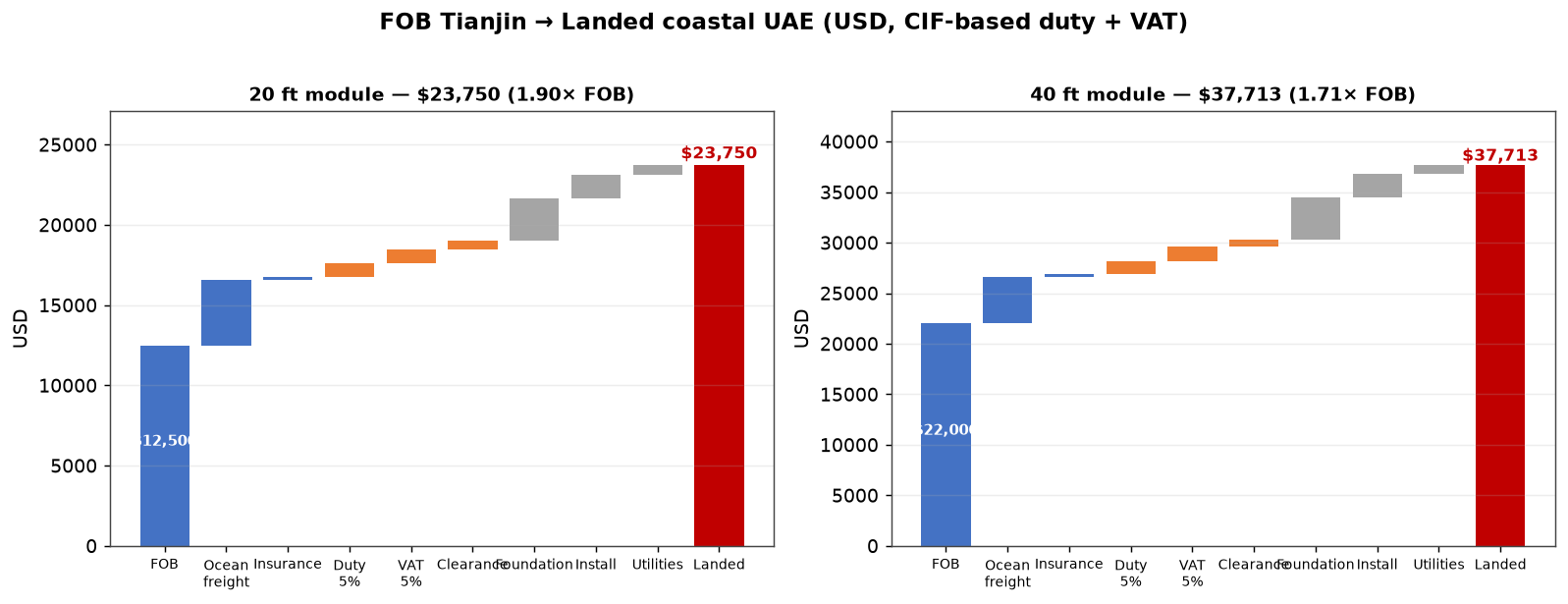
The table prices a factory-direct, coastal-grade module delivered to a prepared site in Dubai or Abu Dhabi. Duty is 5% of CIF value under HS 9406.90 (GCC Common External Tariff); UAE VAT is 5%, assessed on CIF plus duty. Values are indicative USD and must be re-quoted against the actual freight rate, exchange rate and site conditions at order time. VAT-registered businesses can generally recover import VAT; customs duty is not recoverable.
| Cost line | 20 ft (USD) | 40 ft (USD) | Note |
|---|---|---|---|
| FOB Tianjin | 12,500 | 22,000 | Expandable module, factory price |
| Ocean freight to Jebel Ali / Khalifa | 4,100 | 4,600 | 20GP / 40HQ, ~3–4 weeks |
| Insurance | 180 | 260 | Marine cargo cover |
| Import duty (5% of CIF) | 839 | 1,343 | HS 9406.90, GCC CET |
| VAT (5% of CIF + duty) | 881 | 1,410 | Recoverable if VAT-registered |
| Customs clearance + inland trucking | 550 | 700 | Port handling, broker, last mile |
| Base landed (before site works) | 19,050 | 30,313 | Tax = 10.2% of CIF |
| Raised pile/pad + waterproofing | 2,600 | 4,200 | Anti-chloride, drained cavity |
| Installation + commissioning | 1,500 | 2,300 | Assembly, AC, sealing |
| Utilities / connections | 600 | 900 | Power, water, drainage |
| Total landed (coastal-ready) | 23,750 | 37,713 | 1.9× / 1.71× FOB |
| Optional C5-M corrosion upgrade | +1,650 | +2,750 | 320 µm DFT, Sa 2.5, 316 fixings |
| Optional coastal AC upsize (latent) | +900 | +1,400 | High-ambient, dehumidification |
Note that importing through a UAE free zone (JAFZA, Dubai South, Hamriyah) defers or eliminates duty and VAT while goods remain in-zone; duty-paid mainland entry applies once units are deployed outside. The full landed-cost method is explained in our landed-cost guide.
7. Corrosion, compliance and codes
On compliance: complete prefabricated buildings are declared under HS 9406.90, carrying a 5% GCC Common External Tariff on CIF value, plus 5% UAE VAT on CIF plus duty. Building approval follows the Dubai Municipality Building Code or the Abu Dhabi Building Code, with Civil Defense fire approval. Regulated materials (electrical components, AC units, insulation, glazing) fall under the Emirates Conformity Assessment Scheme — ECAS/ESMA, now administered by MoIAT — and CE or ISO test reports speed approval. For coastal durability, specify ISO 12944 category C5-M with a 1440-hour ISO 9227 salt-spray acceptance test, and document it. Because tariffs and conformity rules change, confirm the current classification and permit requirements with a local customs broker and the relevant municipality before ordering. Our Gulf project experience covers documentation for large-scale coastal deployments.
What we have covered here is specific to the coastal front. A module destined for the Empty Quarter fringe faces extreme dry heat and dust but far less salt — that is a different specification, discussed in the desert-heat design guide. Specify against the actual address, never a country label.
Frequently asked questions
Why does a container house rust faster at the UAE coast than inland?
Because of salt plus moisture, not heat. On coastal nights the steel skin cools below the dew point, condensing moisture that dissolves deposited salt into a chloride electrolyte. That pushes bare-steel corrosion to about 140 µm/yr (C5-M), roughly 4.0× an inland environment. A desert-only spec omits the coating system that stops it.
What corrosion protection does a coastal UAE module need?
ISO 12944 C5-M: blast cleaning to Sa 2.5, a 320 µm three-coat system (zinc-rich epoxy / epoxy MIO / polyurethane or fluorocarbon), 316 stainless external fixings, sealed drained cavities, and a 1440-hour salt-spray test record. Design life is around 25 years with normal maintenance.
Does humidity really affect air-conditioning that much?
Yes. At 46°C, coastal air at 55% RH carries 36.1 g/kg of moisture versus 9.4 g/kg in 15% RH desert air. The coastal cooling load is about 3.44× the inland load — an extra 15.4 kW that is mostly latent. Size the unit for moisture removal, not just temperature.
How much does a coastal UAE container house cost landed?
A coastal-grade 20 ft module lands at roughly $23,750 and a 40 ft at $37,713, including freight, 5% duty, 5% VAT, a chloride-resistant raised foundation and installation. The C5-M corrosion pack and upsized coastal AC are itemised options.
Can I avoid the 5% import duty through a free zone?
While goods remain in a free zone such as JAFZA or Dubai South, duty and VAT are deferred or eliminated. Once the unit is deployed on the mainland, duty-paid entry at 5% applies. Most buyers choose duty-paid entry for unrestricted deployment, since the duty on a typical unit is modest.
How close to the sea is too close?
There is no hard cutoff — exposure depends on distance, wind direction and shielding. Within a few hundred metres of the shoreline and on the onshore-wind face, assume C5-M. A structural consultant can rate the specific plot; in doubt, specify the higher class, because upgrading the coating at the factory is far cheaper than recoating on site.
Get a coastal-UAE-spec quote
HUAYING builds factory-direct expandable, folding and flat-pack container houses specified for the actual site — C5-M coating systems, 316 stainless fixings, latent-load-sized coastal AC and chloride-resistant foundations decided before the module leaves Tianjin. For pricing and shipping to Dubai, Abu Dhabi or the Northern Emirates, email jack@huayinghouse.com or reach us on WhatsApp at +86 153-0318-4505. Ask for a FOB and landed quote with the corrosion spec and a site-specific foundation recommendation.