

A 20 ft expandable container home for Los Angeles: what the 27.9 % duty stack adds to the CIF price, which zoning path a permanent unit can use, and why this climate rewards coating choice more than insulation thickness.
Los Angeles is the most common destination for our 20 ft units in the United States, and the questions buyers ask are rarely about the product. They are about duty, permitting and whether the climate justifies the insulation they are being quoted. This guide answers those three questions with numbers rather than adjectives, and it corrects a figure that appears in a lot of supplier quotations: the USD 8,500 entry price is a 10 ft unit, not a 20 ft.
What the unit actually is
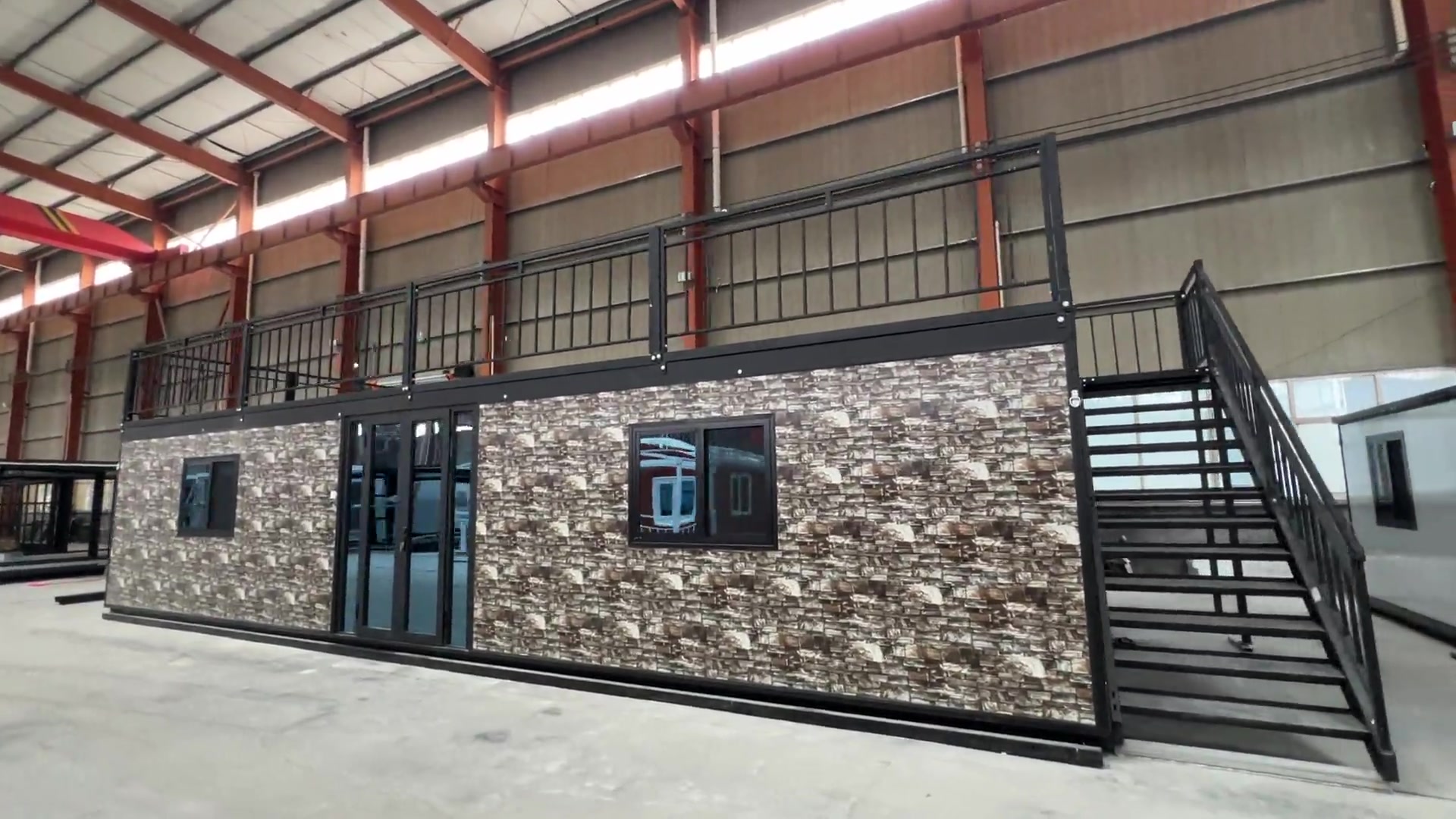
The 20 ft expandable model ships as a single sealed module on a 40HC container frame at 2 units per container, then unfolds on site to roughly 31–33 m² of net usable floor area. The folded transport height and the unfolded height are different figures; the unfolded ceiling sits at 2.48 m, and the expansion leaves a structural ridge where the two halves meet. That ridge is worth understanding before you compare quotations, because it is where the thermal bridging concentrates.
Two things follow for a Los Angeles installation. First, the planning area is not the container footprint — a 20 ft module unfolded gives about 330 sq ft, not the 160 sq ft that some listings still quote from the folded state. Second, because the module arrives complete with electrical and plumbing rough-in, the site work is a foundation and utility connection scope rather than a construction scope. That is the main reason the installed cost per square metre in Los Angeles comes out well below a stick-built accessory unit, even after the duty stack.
Why Los Angeles is not the climate most suppliers design for
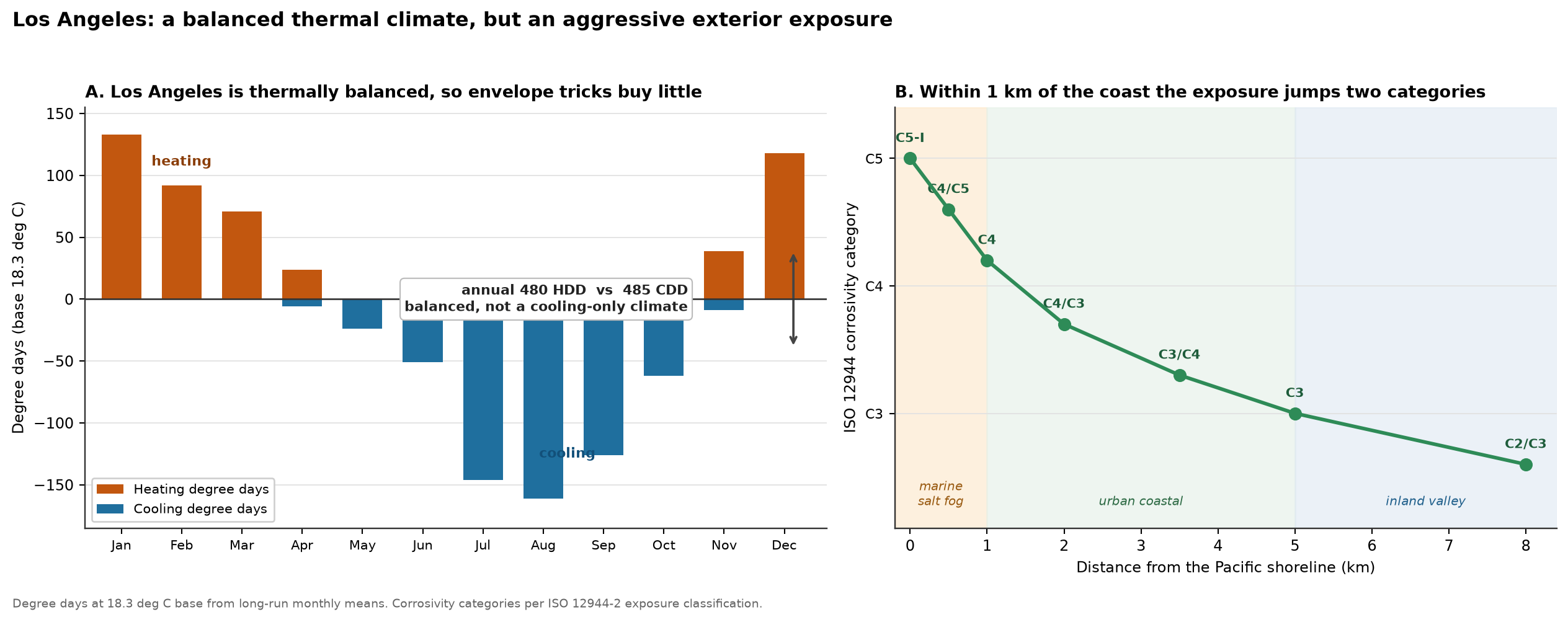
Container house insulation is usually sold by thickness, with the implicit assumption that hotter means thicker. Los Angeles does not reward that assumption. At 18.3 °C base the city accumulates roughly 480 heating degree days and 485 cooling degree days a year — almost exactly balanced, and both figures are modest. January carries the largest single load, at about 133 heating degree days, while August peaks at about 161 cooling degree days.
The practical consequence is that the envelope is not where the money should go. A 75 mm PIR wall and a 100 mm roof are adequate here; spending on 150 mm panels buys very little, because the annual temperature difference the assembly has to resist is small. What does matter is exterior durability and solar control, and both are driven by the site’s distance from the ocean rather than by its latitude.
Coating is the Los Angeles specification variable
Measured against ISO 12944 exposure categories, a site in the San Fernando Valley or the Inland Empire sits around C2 to C3. Move within a kilometre of the Pacific and the same building is in C4 to C5-I territory, because chloride deposition and salt fog dominate. Santa Monica, Long Beach and the harbour districts all fall in that band.
This is not a cosmetic distinction. A C3 system on a coastal lot shows gloss loss and early barrier breakdown within two to three seasons, and once the barrier is compromised the corrosion rate underneath accelerates faster than it would inland because the chloride is still arriving. The specification that prevents it is a nominal 160 µm dry film thickness at C4 for sites between one and five kilometres inland, and 200 µm at C5-I within one kilometre. Coastal elevations facing the water should be treated as a separate exposure category from the sheltered ones.
Ultraviolet exposure compounds this. Los Angeles sits at a UV index that routinely reaches 10–11 in summer, and the roof is the surface that takes it. A light-coloured roof with a high solar reflectance index does two things at once here: it reduces the roof surface temperature under peak sun by 15–25 K, and it slows the degradation of the coating itself. On a thermally balanced climate the reflectance matters more for coating life than for cooling load.
FOB to landed cost, Tianjin to Los Angeles
The table below models a 20 ft expandable unit delivered to a Los Angeles site. Figures are planning estimates in USD, not a quotation, and they use the correct 20 ft FOB band rather than the 10 ft entry price.
| Cost line | Basis | USD |
|---|---|---|
| FOB Tianjin, 20 ft expandable | Calibrated FOB band | 12,500–14,500 |
| Ocean freight to Los Angeles / Long Beach | 40HC shared by 2 units | 2,400–3,200 |
| Marine insurance | 0.35 % of CIF | 55–65 |
| CIF Los Angeles | 14,950–17,765 | |
| Import duty, HTSUS 9406.90 at 2.9 % | MFN rate | 435–515 |
| Section 301 List 3 | 25 % of CIF | 3,740–4,440 |
| Merchandise processing fee and harbour maintenance | Per entry | 550–700 |
| Customs broker | Per entry | 300–400 |
| Trucking, port to site | Southern California metro | 700–1,100 |
| Foundation pads and levelling | Screw piles or concrete pads | 1,500–2,400 |
| Installation and utility hookup | Unfold, connect, commission | 900–1,400 |
| LADBS permits and plan check | Case-dependent | 1,800–3,500 |
| Site preparation and utility trenching | Site-dependent | 1,500–3,000 |
| Delivered and installed | 28,900–39,300 |
Two lines in that table surprise buyers. The combined duty is about USD 4,200–4,950 on a CIF of roughly 15,000–17,800, which is 27.9 % of the CIF value — the MFN rate alone is only 2.9 %, and the Section 301 List 3 surcharge supplies the rest. And the permitting and site lines together can exceed the freight cost. A quotation that stops at the FOB price therefore understates the real budget by more than half.
Permitting in Los Angeles
California allows accessory dwelling units under state law (AB 68 and AB 881), and those provisions limit how far a local jurisdiction can restrict size, parking and setback. That does not mean a container structure is automatically approvable. The unit still has to satisfy the California Building Code, Title 24 energy requirements, and seismic and fire provisions, and Los Angeles is in a seismic design category that requires the foundation and the module-to-foundation connection to be engineered rather than specified generically.
In practice the process runs through a site-specific review with the Department of Building and Safety. Three items determine whether it goes smoothly: a stamped foundation design for the actual soil condition; a Title 24 compliance report for the envelope and glazing as assembled; and a clear statement of whether the unit is a permanent dwelling or a temporary structure, because those follow different approval paths. Buyers who present those three documents at the first submittal generally avoid the multi-round cycle that makes permitting the long pole in the schedule.
One further point on classification. Prefabricated buildings enter under HTSUS 9406.90 at a 2.9 % general rate, and that is the correct heading for a container house. A module that arrives mounted on a road-legal chassis can fall under Chapter 87 instead, which changes both the duty rate and the regulatory requirements. Confirm the classification with your customs broker against the actual shipping configuration rather than the marketing description.
Los Angeles container home questions
How much does a 20 ft expandable container home cost in Los Angeles?
The 20 ft unit is USD 12,500–14,500 FOB Tianjin. Adding ocean freight to Los Angeles or Long Beach, the 27.9 % combined duty and fee stack, permitting and site work, a realistic all-in budget is USD 28,900–39,300 depending on foundation, utility trenching and permit scope. The USD 8,500 figure that appears in many quotations is the 10 ft model.
What import duty applies to a container home entering the United States?
Prefabricated buildings classify under HTSUS 9406.90 at 2.9 % general rate. Chinese-origin goods additionally attract Section 301 List 3 at 25 %, giving an effective 27.9 % of CIF. The 0 % rate sometimes quoted applies only to goods from free-trade-agreement countries, which does not include China.
Can I place a container home on a residential lot in Los Angeles?
It depends on zoning. Los Angeles permits accessory dwelling units under state law, but the structure must still meet the California Building Code, Title 24 energy requirements, and seismic and fire provisions. A site-specific review with the Department of Building and Safety is required, and a permit is almost always needed for a permanent dwelling.
How much insulation does Los Angeles actually need?
Less than most quotations assume. At 18.3 °C base the city has roughly 480 heating degree days and 485 cooling degree days, so the annual load is balanced and modest. A 75 mm PIR wall with a 100 mm roof is adequate. The money is better spent on a C4 or C5-I coating system and a high-reflectance roof, because coastal chloride and ultraviolet exposure drive the maintenance cost here, not thermal performance.
Does the apple capsule design suit Los Angeles weather?
Los Angeles is a warm, dry, coastal climate with low rainfall but strong UV. The main requirements are solar control, a light-coloured roof coating, and corrosion protection for sites within about a kilometre of the ocean. Heating demand is minimal, so insulation can be tuned for cooling rather than winter performance.
How long does the whole process take?
Manufacturing is 15–25 days, ocean freight to Los Angeles is 18–30 days, and permitting can run from a few weeks to several months depending on the jurisdiction and the completeness of the first submittal. Budget 3–6 months from order to occupation.
Next step
For a Los Angeles quote the two details that change the number most are the distance from the coast and whether the unit is a permanent dwelling or a temporary structure. Send the site address and the intended use and we will return the coating category, the envelope build-up and a landed cost table for that specific location.
For pricing, shipping and compliance details on this unit, contact jack@huayinghouse.com or WhatsApp +86 153-0318-4505. HUAYING ships from Tianjin port and can prepare a full FOB-to-landed cost breakdown for your location.
Related reading: container house design for the California high desert covers the opposite case, where heating dominates and winter roof condensation is the primary failure mode. shamal dust and extreme heat design for Saudi Arabia and the Gulf covers coastal vapour reversal.