West Africa is routinely filed under “tropical” by suppliers who have never built there. That single word hides the design problem. Accra receives roughly 800 mm of rain a year — less than Lisbon — and receives it in two violent seasons. Lagos receives nearly twice that in one long season. Between them sits the Harmattan: a dry, dust-laden north-easterly wind drawn from the Bodélé Depression in Chad that pushes relative humidity in Kano down to 17% at mid-afternoon and coats every horizontal surface in fine mineral dust for three to four months.
A container house specified for “tropical Africa” therefore fails in a way nobody predicts. It does not rot in the rainy season. It condenses in the dry one.
This guide sets out the mechanism, the specification response, the true landed cost into Tema and Apapa, and the compliance points that decide whether your cargo clears or sits on the quay.
1. Why one climate label is the wrong starting point
Four West African sites, four different governing loads:
| Site | Annual rain | Rainy seasons | Harmattan | Governing design load |
|---|---|---|---|---|
| Accra, Ghana | ~800 mm | Two: May–Jun, Sep–Oct | Dec–Mar, in spells of days | Latent load Apr–Jun; night-sky condensation Dec–Feb |
| Kumasi, Ghana | ~1,400 mm | Two, longer | Dec–Feb, weaker | Roof drainage and mould risk |
| Lagos, Nigeria | ~1,500 mm | One long: Apr–Jul, secondary Sep–Oct | Dec–Feb, short | Latent load plus coastal chloride |
| Kano, Nigeria | ~873 mm | One: Jun–Sep | Nov–Mar, dominant for weeks | 40 °C dry-bulb peak; dust ingress; cold nights |
The consequence is practical, not academic. A specification tuned to Lagos over-glazes and under-drains in Kano. A specification tuned to Kano under-dehumidifies in Lagos by a wide margin. If you are buying for one site, buy for that site. If you are buying a batch across several sites, standardise the structure and vary the envelope package — never the reverse.
2. The counterintuitive finding: the roof condenses in the dry season
Every supplier briefing on tropical housing concentrates on the wet season. That is the wrong season for the roof.
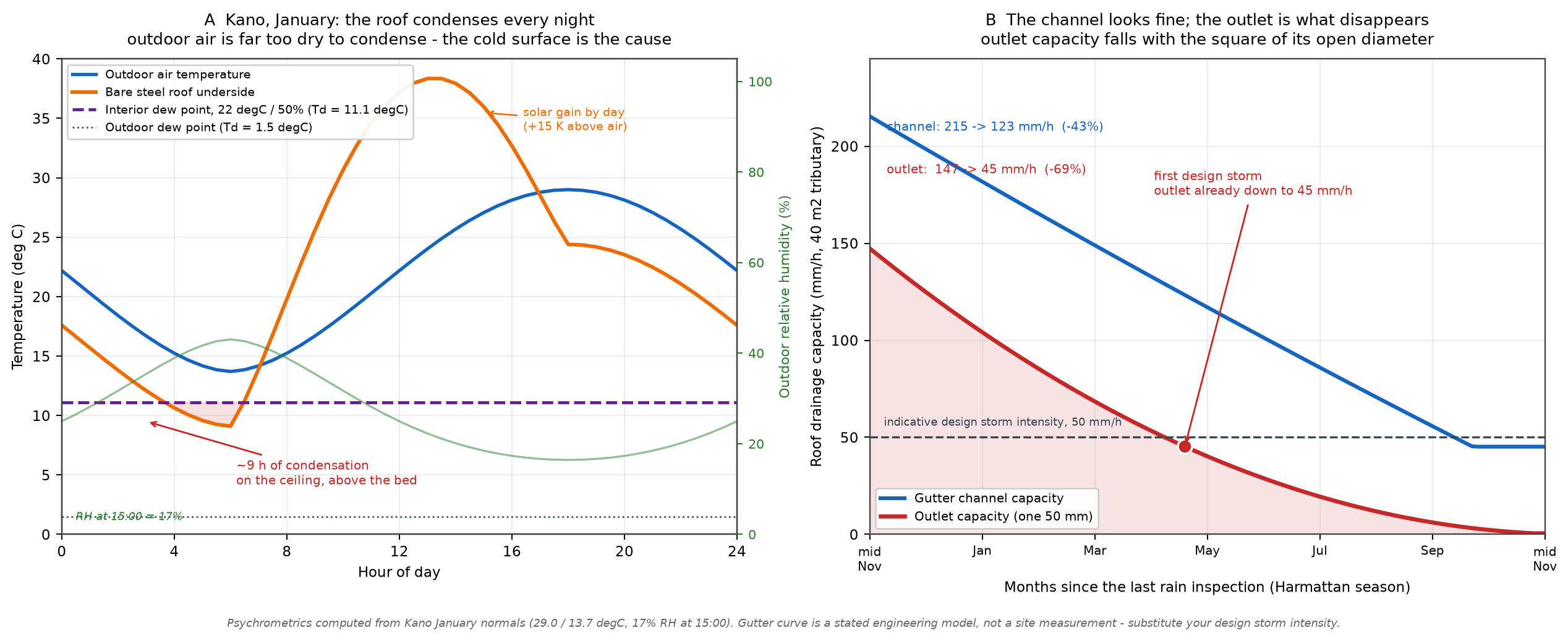
Two things happen at once during Harmattan. Outdoor air becomes extremely dry — Kano reports 17% relative humidity at 15:00 in January, dropping to 13% in February and March. And because that air is clear and dry, the exposed steel roof skin radiates freely to the night sky, so the skin temperature falls several degrees below the surrounding air temperature.
Outdoor dew point in Kano in January works out to about 1.5 °C. Outdoor air will not condense on anything. But the interior is different: occupants cooking, washing and breathing hold an interior dew point around 11 °C at a comfortable 22 °C and 50% RH. A bare steel roof underside sitting at ambient-minus-five is far below that. Condensation is not a risk in that hour — it is certain.
The model in the figure below is computed from Kano’s January normals, not sketched. It shows roughly nine hours of condensation per night, every night, for four months. The water forms on the underside of the roof, above the bed, and drips.
Now compare June. High humidity suppresses night-sky radiation, the skin stays warm, and no interstitial condensation forms at all. So the failure appears in the season everyone calls “dry” and vanishes in the season everyone worries about.
The specification consequence is not “add a vapour barrier.” A fixed vapour-tight layer must sit on the warm side of the insulation, and in West Africa the warm side alternates: outside-in during the wet season, inside-out on Harmattan nights. A barrier correct in June is on the wrong face in January. The durable answer is a vapour-open build-up with a ventilated cavity behind the roof skin, plus a thermal break that decouples the skin from the interior. Remove the cold surface and the dew point stops mattering — which is cheaper and far more robust than any membrane.
Figure A of our schematic sets out the mechanism hour by hour; panel B carries the drainage consequence described in section 4.
3. Harmattan dust is not dirt, it is a moisture reservoir
Buyers dismiss dust because it looks cosmetic. It is not.
Saharan dust reaching coastal Ghana is dominated by crustal minerals. During Harmattan, crustal particles accounted for roughly 37% of PM2.5 and 42% of PM10 mass in Accra measurements, and in Abuja the harmattan-period mean PM2.5 has been measured at 76.9 µg/m³ with peaks of 179 µg/m³ — more than five times the WHO 24-hour guideline. That dust is alkaline and mildly hygroscopic. Once deposited on a coated steel surface it does three things:
- It holds condensed moisture against the coating for hours after the air has dried, extending wet time every single day.
- It blinds the reflective topcoat the whole cooling strategy depends on, so the roof runs hotter from February onward.
- It fills gutters and outlets, and this is the mechanism that actually causes damage.
Dust-loaded steel turns a nominal ISO 12944 C3 environment into a localised C4. On the coast, where chloride deposition is already present within a few kilometres of surf, alkaline dust plus chloride is more aggressive than either alone. A 120 µm system that performs inland in China will chalk and blister on a Tema or Apapa site inside four years.
4. The gutter looks clean and the outlet is already blocked
Here is the operational trap, and it is not the one buyers expect.
Silt accumulates in the channel gradually, so the channel survives. We modelled a 150 mm half-round gutter with a 3% fall carrying a 40 m² tributary: clean channel capacity is about 215 mm/h, and after a full Harmattan it is still around 123 mm/h. That comfortably exceeds a 50 mm/h design storm. The channel is not the problem.
The outlet is. Debris packs into the throat and the capacity of a circular outlet falls with the square of its open diameter. A 50 mm outlet starting at 147 mm/h is down to about 45 mm/h at the first design storm — already below the rainfall it is required to drain, before a single drop has fallen.
Three conclusions follow, and all three are procurement questions rather than installation questions:
- Specify oversized outlets, not just oversized gutters. Two 75 mm outlets beat one 100 mm every time, because blockage is a diameter problem.
- Specify removable debris guards and a rodding eye at every outlet as standard. Cheap at the factory, near-impossible to retrofit on a finished module.
- Demand the drainage calculation as a drawing, with outlet count, diameter and spacing against your site’s design storm intensity. One 50 mm outlet per 12 m of gutter is not adequate for a two-season site.
If a supplier cannot show you that calculation, they have built a roof but not designed one. Our notes on drainage under Manila typhoon rainfall apply the same method to a much harder storm, and the approach transfers directly.
5. Two cooling peaks, and the humid one is not in the wettest month
The Harmattan inverts the usual HVAC brief, and the second inversion is the one that catches engineers.
We computed Accra’s monthly cooling load against a 25 °C / 55% setpoint using standard psychrometrics. The result is not the pattern most specifications assume:
| Month | Mean temp | RH | Humidity ratio (kg/kg) | Sensible share | Latent share |
|---|---|---|---|---|---|
| Jan | 27.3 | 77% | 0.0176 | 12% | 88% |
| Mar | 27.7 | 79% | 0.0185 | 13% | 87% |
| Apr | 27.7 | 80% | 0.0188 | 12% | 88% |
| Jun | 25.6 | 85% | 0.0176 | 4% | 96% |
| Jul | 24.4 | 84% | 0.0161 | -5% | 105% |
| Aug | 24.3 | 84% | 0.0160 | -6% | 106% |
Three findings matter, and none of them are intuitive:
Absolute humidity peaks in April, not June. Accra’s rain peaks in June, but its moisture content peaks in April, when the air is hottest and holds the most water vapour. If you size dehumidification against the wettest month, you will under-size it against the actual peak load by about 6%.
In July and August the sensible load goes negative. The mean outdoor temperature is 24.4 °C — below the 25 °C setpoint. The building does not need cooling, it needs drying. A conventional air conditioner running in these months will short-cycle, remove almost no moisture, and leave the interior cold and clammy. This is the classic West African “cold and wet” complaint, and it is a control problem, not a capacity problem.
Total load varies 1.84 to 1. Peak total enthalpy load is April at 22.9 kJ/kg of dry air; the minimum is August at 12.5 kJ/kg. A unit sized on the August figure is under-sized by 84% in April.
The practical instruction: specify cooling capacity against April’s enthalpy, and specify a dedicated dehumidification mode for July–August rather than relying on the compressor. That is almost always a variable-speed unit with an independent humidity setpoint. Our analysis of the mirror-image error — sizing on dry-bulb alone in Pakistan’s five climate zones — explains why the peaks must be evaluated separately rather than averaged.
Add one West Africa specific: the fresh-air intake needs positive-pressure filtration. Harmattan dust ingress through window seals is not a comfort issue but a maintenance issue, and every gram of dust that enters the envelope becomes a moisture reservoir on the interior lining.
6. What the West Africa climate package contains
The following is priced as an increment over a standard export specification for a 20 ft expandable unit. It is not optional decoration; each line removes a failure mode described above.
| Package item | Specification | Increment (USD) |
|---|---|---|
| Ventilated roof cavity | 100 mm air gap plus thermal-break washers | 320 |
| Reflective topcoat | SRI ≥ 78 white elastomeric | included |
| Gutter debris guards | Removable stainless mesh plus rodding eyes | 110 |
| Outlet upgrade | 2 × 75 mm per run replacing 1 × 50 mm | 70 |
| Coating system | ISO 12944 C4, zinc-rich primer, 240 µm DFT | 460 |
| Envelope sealing and filtration | MERV 8 pre-filter on fresh-air intake, taped joints | 190 |
| Total climate package | 1,150 |
The C4 coating is the largest line and the one buyers most often delete. On a coastal site it also decides whether the asset is serviceable at year eight or scrap. Inland sites in Kumasi or Ibadan can step down to C3 at 160 µm and save roughly 200 USD, provided the dust-shedding detail at the eaves is retained.
7. FOB to landed cost: Tema versus Apapa
The table below prices the same 20 ft expandable unit into both ports. Ocean freight and inland haulage are indicative for Q4 2026 and move with bunker and congestion conditions. Duty and tax are computed from the tariff structure in section 8; every figure has been recomputed rather than estimated.
| Cost line | Tema → Accra (Ghana) | Apapa → Lagos (Nigeria) |
|---|---|---|
| FOB Tianjin, 20 ft expandable | 12,500 | 12,500 |
| Ocean freight, 20 ft | 2,400 | 2,300 |
| Marine insurance | 55 | 52 |
| CIF value | 14,955 | 14,852 |
| Import duty, CET 20% of CIF | 2,991 | 2,970 |
| 7% surcharge on duty | — | 208 |
| CISS, 1% of FOB | — | 125 |
| ECOWAS levy, 0.5% of CIF | 75 | 74 |
| AU levy, 0.2% of CIF | 30 | — |
| VAT 15% + NHIL 2.5% + GETFund 2.5% | 3,610 | — |
| VAT 7.5% on duty-inclusive base | — | 1,367 |
| Total tax and levy | 6,706 | 4,745 |
| Clearing agent, port handling, ICUMS/PAAR | 850 | 900 |
| Inland haulage to site | 220 | 250 |
| Foundation: screw piles or strip footing | 1,200 | 1,200 |
| Assembly and commissioning | 900 | 850 |
| West Africa climate package | 1,150 | 1,150 |
| Landed and installed | 25,981 | 23,947 |
Two things stand out. The West Africa climate package is under 5% of the delivered total — the specification decision is cheap relative to the logistics decision, yet it is the one buyers negotiate hardest. And the same nominal 20% duty band produces a 1,961 USD difference in tax between the two countries. Section 8 explains why, and it is not a freight effect.
8. Same 20% duty, a 12.9-point different tax bill
Both countries apply the ECOWAS Common External Tariff, whose bands run 0%, 5%, 10%, 20% and 35%. Complete steel prefabricated buildings under HS 9406.20 fall in the 20% band in both. A buyer reading only the duty rate would conclude the treatment is identical. It is not.
Ghana applies VAT at 15%, NHIL at 2.5% and the GETFund levy at 2.5% — a combined 20% charge — and since the Value Added Tax Act 2025 (Act 1151) took effect on 1 January 2026, all three sit on the same taxable base, which for imports includes the customs duty. Ghana additionally levies an ECOWAS Community levy of 0.5% and an African Union levy of 0.2% of CIF on non-preferential origin goods, plus processing and examination fees. On this shipment the total tax and levy load is 44.84% of CIF.
Nigeria applies the same 20% duty, then a 7% surcharge calculated on the duty, CISS at 1% of FOB, ETLS at 0.5% of CIF, and VAT at only 7.5% on the accumulated base. On the same shipment the load is 31.95% of CIF.
That is a 12.9 percentage point gap — about 41% more tax in Ghana for an identical building at an identical declared value. The lesson for procurement is not “buy elsewhere”. It is that a single West African price list is a budgeting error. Two markets 500 km apart need two landed-cost models, and a supplier quoting one “West Africa price” has not done the work.
Note also that neither country offers a preference to Chinese origin. The ECOWAS Trade Liberalisation Scheme reaches only goods originating in ECOWAS member states with a valid Certificate of Origin; it does not reach Chinese-manufactured modules. Any quotation implying otherwise should be challenged in writing, because the assessment at the port will not honour it.
9. Compliance: the pre-shipment gate that strands cargo
Ghana. The Ghana Building Code, GS 1207:2018, is the operative standard: a 38-part, roughly 1,700-page document launched in 2018 and distributed to Metropolitan, Municipal and District Assemblies from 2019. Building permits are issued at MMDA level, not nationally. Three provisions catch imported modular units repeatedly:
- Habitable room floor area: minimum 11.0 m² per habitable room. A 20 ft module has roughly 14.8 m² gross, so internal partitioning easily creates a non-compliant bedroom. Check the layout room by room before fabrication, not after arrival.
- Glazing ratio: glazing not less than 10% of floor area for natural lighting and ventilation in each habitable room. Deep-plan modular layouts frequently fail this.
- Setbacks: typically 3.0 m front and rear, 1.5 m at the sides for residential plots. This is a site-planning constraint that can decide whether your unit fits where you intended.
The Ghana Standards Authority also operates mandatory conformity assessment for construction products, so obtain the material certificates before the container is packed.
Nigeria. SONCAP is the binding constraint. A Product Certificate must be secured before shipment and a SONCAP Certificate issued per consignment after inspection at the loading port; without it the cargo cannot be cleared at any price. The importer must also open a Form M through an Authorised Dealer Bank before the goods are ordered and generate a PAAR before the vessel arrives. State-level permits — LASBCA in Lagos, the equivalent authority elsewhere — and the National Building Code apply on top.
The practical rule: SONCAP is a factory-side obligation, not a port-side one. If your supplier books inspection after the container leaves, you own the demurrage. Build three weeks into the schedule and name the inspection agency in the purchase contract.
10. Frequently asked questions
Does a container house need air conditioning in Accra? For sleeping comfort, yes — but not sized the way most suppliers size it. Size against April’s enthalpy and add a dedicated dehumidification mode for July and August, when the outdoor temperature is below the setpoint and a conventional unit removes almost no moisture.
Why did water appear on the ceiling in January, when it never rains? That is night-sky condensation on a cold roof skin in dry Harmattan air, not a leak. Outdoor dew point in Kano in January is about 1.5 °C, so the water is coming from interior moisture meeting a cold surface. It is eliminated by a ventilated roof cavity and a thermal break, not by sealant.
Is galvanised steel sufficient for coastal Ghana or Nigeria? For the structure, yes. For the coating system over four years, no. Coastal sites need ISO 12944 C4 minimum, with a zinc-rich primer and 240 µm dry film thickness.
How often must gutters be cleaned? Twice a year at minimum, and always before the first rain of the season. Guards and rodding eyes reduce the work but do not remove it. If your maintenance plan has no gutter line item, add one.
Can I ship one container to both Ghana and Nigeria? Not practically. Nigeria requires SONCAP per consignment and a Form M tied to a specific importer, while Ghana clears through ICUMS with its own IDF and TIN. Split the shipments and budget two clearance processes.
Which port should I use for a site in northern Ghana or northern Nigeria? For Tamale or Bolgatanga, Tema plus road haulage is usually cheaper than routing through Lomé. For Kano, Apapa plus a 1,000 km haul is often beaten by routing through Cotonou and entering overland. Model both before committing, because the answer flips with fuel prices.
How much of the total cost is the climate package? On a 20 ft unit delivered and installed it is about 4.4% of the total in Ghana and 4.8% in Nigeria. Deleting it does not make the project cheaper; it moves the cost to year four, in coating failure and re-work.
11. Next step
If you are planning a project in Ghana, Nigeria or the wider Gulf of Guinea coast, send us three things and we will return a site-specific specification and landed-cost model rather than a generic quotation:
- Site coordinates or nearest town — this decides Harmattan severity, coastal chloride exposure and design storm intensity.
- Discharge port and final site — Tema versus Takoradi, Apapa versus Onne, changes the inland haulage line materially.
- Intended use and occupancy — a guard house, a site office and a residence carry different latent loads and different obligations under GS 1207:2018.
Write to jack@huayinghouse.com or WhatsApp +86 153-0318-4505. We manufacture in Fucheng, Hebei across more than 50,000 m² and six production sites, and we ship to Tema and Apapa regularly. For a full import walkthrough including port documents and clearance sequence, start with our Ghana cost guide or the Nigeria Lagos delivery and landed cost guide. If your site selection is still open, the site and environment guide sets out the ground conditions that matter more than the building itself.