
Why the tropical climate is a different problem from ordinary summer weather
Most “hot climate” guidance for container houses is written for dry heat or Mediterranean conditions — a hot afternoon followed by a cool, dry night. Malaysia is not that. The climate here is equatorial: high temperature and high humidity that do not let up, with rainfall delivered in concentrated bursts rather than spread evenly across the year.
Three characteristics drive every design decision.
First, the humidity never drops. Relative humidity in Kuala Lumpur, Penang and Johor Bahru typically sits between 75% and 90% year-round, and it stays high at night. In a dry desert, night air allows a building to reject accumulated heat. In Malaysia there is no such reset. The dew point — the temperature at which moisture condenses out of the air — is often above 24°C. That number matters enormously for a steel building: any surface cooler than the dew point will collect liquid water.
Second, rainfall is intense and seasonal. Peninsular Malaysia receives roughly 2,400–2,900 mm of rain per year, and East Malaysia (Sabah, Sarawak) can exceed 3,000 mm. But the annual total is less important than the intensity. Convective storms deliver 60–100 mm in an hour, and the Northeast Monsoon (November–February) can produce multi-day downpours on the east coast of the peninsula, Sabah and Sarawak. Roof drainage and site grading must be designed for these peaks, not for the average.
Third, the sun is high every day. At 3°N (Kuala Lumpur), the noon sun reaches roughly 87° above the horizon at the equinoxes and passes almost directly overhead twice a year. As explained in our desert heat engineering guide, a near-vertical sun means horizontal roof overhangs do almost nothing — the heat load arrives through the roof and from low-angle east and west sun at the start and end of the day. In a tropical climate the response is vertical shading, deep roof insulation and a very light-coloured roof surface, not deep eaves.
The result, in a badly specified unit, is a container house that is uncomfortably hot on sunny days, damp and musty during the monsoon, and showing rust streaks along the frame within two to three years.
The failure modes we see in Southeast Asian container house projects
Before choosing a specification, it helps to know how tropical units actually fail. These are the recurring problems in the region.
1. Interstitial condensation inside the wall build-up. This is the single most damaging and least understood failure. In a hot, humid climate the water vapour in the outdoor air is at high pressure. If a vapour-permeable wall lets that moisture diffuse inward while the air-conditioned interior keeps the inner steel skin cold, the moisture condenses inside the insulation layer — out of sight, where it corrodes the steel frame and soaks the insulation. Within a few years the insulation performance collapses and the structure rusts from the inside. Insulation without a correctly placed vapour control layer is not neutral in the tropics; it is actively harmful.
2. Roof leaks that only appear in the monsoon. Corrugated steel roofs fail at the fastener points and at panel laps. In a tropical climate, thermal cycling and monsoon wind-driven rain find every weak seal. A pitch that is adequate in a temperate climate is often not adequate for 100 mm/hour rainfall.
3. Water pooling and base erosion. A unit placed directly on the ground, or on a slab without grading, collects rainwater around the base. Standing water against the steel, combined with tropical humidity, accelerates corrosion at exactly the points most difficult to inspect.
4. Termite and rising-damp damage. In Malaysia, ground contact and trapped moisture create conditions favourable to termites and fungal growth. Any timber or wood-based component in contact with the ground or exposed to trapped moisture is a liability.
5. Salt-air corrosion in coastal areas. A large share of Malaysian container house demand is coastal or island-based — resort accommodation, beach glamping, island resorts. Chloride in sea air combined with high humidity is the single most aggressive combination for structural steel. Standard painted finishes fail quickly; only higher corrosion classes survive.
6. Overcooling that wastes energy and causes dampness. Sizing air conditioning for the air temperature rather than the latent (moisture) load is a common error. In the tropics a substantial share of the cooling load is dehumidification, not temperature reduction. Undersized equipment runs continuously, fails to control humidity, and leaves a clammy interior.
Design responses: the measures that actually change performance
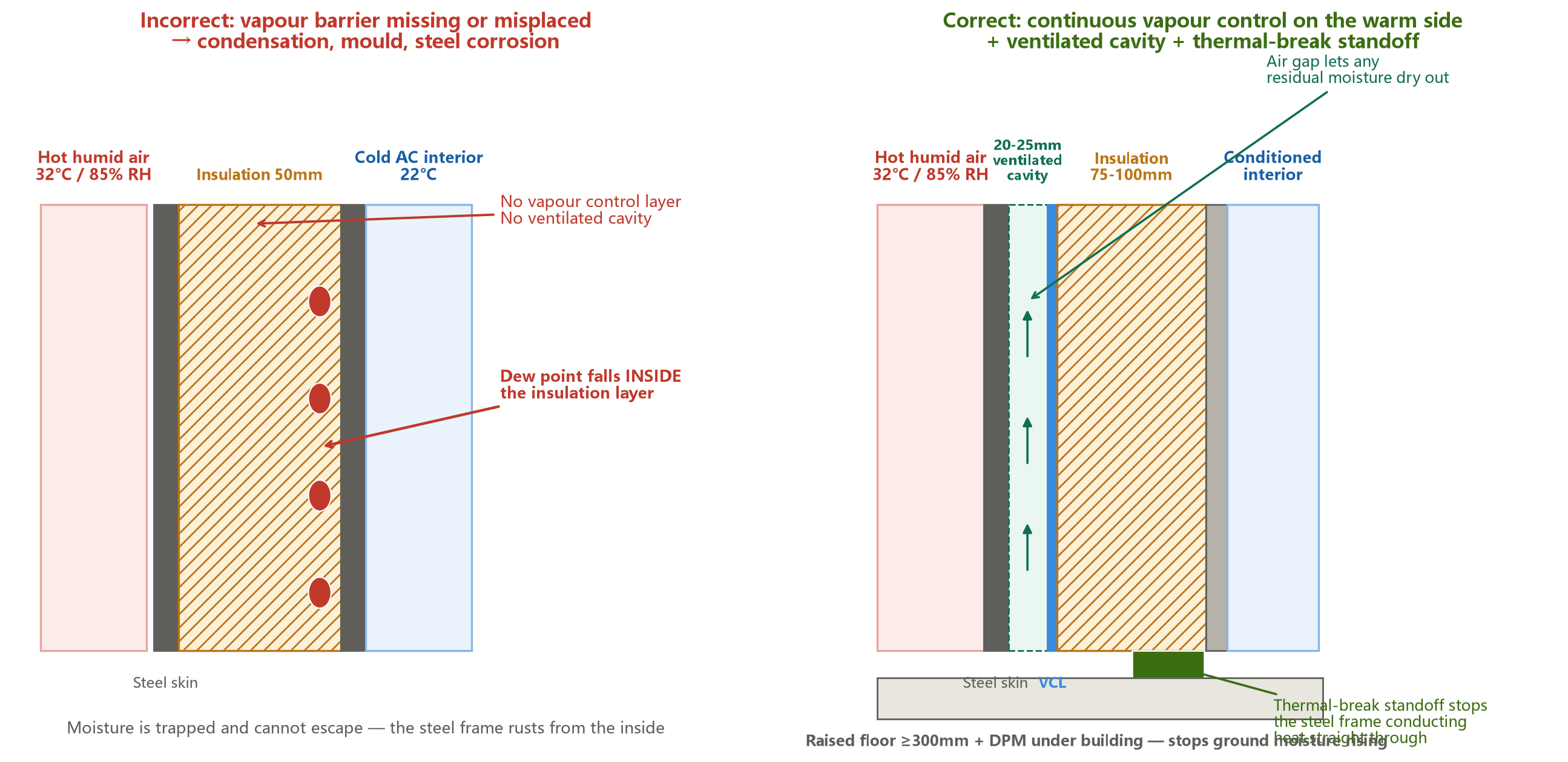
Principle diagram: the left-hand build-up has no vapour control layer, so the dew point falls inside the insulation and the steel frame rusts from within. The right-hand build-up places a continuous VCL on the warm side, adds a ventilated cavity, and uses a thermal-break standoff.
The envelope: vapour control before extra insulation
The instinct when a building is hot is to add more insulation. In the tropics, getting the vapour strategy right matters more than the R-value.
The correct sequence, from outside to inside, is: steel skin → ventilated cavity → vapour control layer (VCL) → insulation → interior lining. The VCL belongs on the warm, humid side of the insulation, so that outdoor moisture is stopped before it reaches the cold plane. A 20–25 mm ventilated cavity behind the outer skin allows any residual moisture to dry outward instead of being trapped.
Equally important is thermal bridging. Where the steel frame, floor joists or window frames penetrate the insulation, heat and cold travel straight through, creating local cold spots below the dew point. These appear as damp patches and rust blooms on interior surfaces. A thermal-break standoff — a non-conductive pad or strip between the structural steel and the interior lining — breaks that path at comparatively low cost.
Roof: pitch, colour and drainage
Roof response in a tropical climate has three parts.
Pitch. Allow ≥10° for double-pitch roofs in monsoon-exposed areas, and never less than 5° for a single-pitch roof in sheltered locations. A steeper pitch sheds intense rainfall quickly and reduces the time water sits on the panel laps.
Colour and insulation. A light-coloured, high-reflectance roof finish cuts solar heat gain substantially and, importantly in this climate, reduces the temperature difference that drives condensation. Combine it with 75–100 mm of roof insulation and pay particular attention to continuity at the ceiling plane.
Drainage. Gutters and downpipes must be sized for 50-year storm intensity, not average rainfall. Add overflow scuppers so that if a gutter or downpipe blocks during a downpour, water escapes to the outside rather than backing up under the roof sheets and into the building. Enlarge gutters and downpipe diameters relative to a temperate specification, and fit leaf guards — tropical vegetation blocks gutters quickly.
Foundation and site: keep the floor off the ground
Raise the floor. A clearance of at least 300 mm between the ground and the underside of the unit provides ventilation beneath the structure, breaks the path for rising damp, and removes the sheltered, damp habitat termites prefer. It also makes the base inspectable.
Grade the site away from the building. Slope the surrounding ground at ≥2% away from the unit, and install a gravel French drain or blind drain on the uphill side to intercept surface water. In flood-prone areas, raise the pad further and consider anchoring rather than a fixed slab, so the unit can be relocated.
Use a damp-proof membrane under the building footprint. This stops ground moisture from evaporating upward into the ventilated void.
Corrosion protection: match the class to the location
Corrosion protection should be selected by exposure, not by habit.
| Location | Corrosion category | Recommended protection |
|---|---|---|
| Inland, sheltered | C3 | Hot-dip galvanised frame + epoxy primer + topcoat |
| Coastal within 1 km of sea | C5 | Hot-dip galvanising ≥85 µm + high-build epoxy + polyurethane topcoat |
| Direct sea spray / island resort | C5-M | As above plus stainless fasteners and regular inspection cycle |
| Salt-air + high humidity | C5 | Note that chloride and humidity together are far more aggressive than either alone |
Stainless steel fasteners are worth the premium in coastal projects; standard plated fasteners are the first thing to fail and the hardest to replace.
Windows, doors and ventilation
Address the low-angle sun with vertical shading — fins, side screens or adjustable louvres on east and west elevations — rather than deep horizontal overhangs, which do little when the noon sun is overhead. Use double-glazed units with a low-emissivity coating, and specify EPDM gaskets on all door and window openings; in a climate that receives 2,400 mm+ of rain, gasket quality determines whether the opening stays dry.
Provide cross-ventilation wherever passive comfort is intended: inlet openings low on the windward side and outlet openings high on the leeward side. A continuous ridge vent further helps hot air escape. Where air conditioning is installed, a mechanical ventilation with heat recovery (HRV) or a dedicated dehumidification strategy is required — a tightly sealed, air-conditioned unit in the tropics needs controlled ventilation, not a permanently closed envelope.
Cooling: size for latent load
Air conditioning in Malaysia must be sized for total load — sensible plus latent. Undersized equipment will run continuously without removing sufficient moisture, leaving a cold but clammy interior. Specify inverter units, and where possible pair them with ceiling fans to allow a higher setpoint (each 1°C of raised setpoint reduces energy use). In island and off-grid locations, this interacts with the solar system sizing discussed in our off-grid container homes guide.
Termite and biological resistance
Keep all timber-based elements clear of ground contact, use metal or cementitious interior linings in damp zones, and treat any timber framing. With a raised floor, a perimeter inspection gap and the measures above, termite risk is manageable — but it must be designed for, not assumed away.
Cost implications: what the tropical specification adds
The table compares a generic specification against a Malaysia-ready tropical specification, with indicative cost impact on the delivered unit.
| Item | Generic spec | Tropical-ready spec | Typical cost impact |
|---|---|---|---|
| Wall insulation | 50 mm EPS | 75–100 mm PIR + thermal-break standoff | +USD 420–680 |
| Vapour control | Not specified | Continuous VCL, warm side | +USD 180–260 |
| Ventilated cavity | Not specified | 20–25 mm cavity behind outer skin | +USD 150–250 |
| Roof finish | Standard coated steel | High-reflectance light finish | +USD 120–200 |
| Roof insulation | 50 mm | 75–100 mm, continuous at ceiling | +USD 260–420 |
| Roof pitch & drainage | Single pitch, standard gutter | ≥10° double pitch, enlarged gutter + overflow scuppers | +USD 380–620 |
| Corrosion protection | C3 painted | C5 hot-dip galv + epoxy + PU topcoat | +USD 700–1,150 |
| Foundation | Direct slab | Raised ≥300 mm void + DPM + perimeter drain | +USD 900–1,500 |
| Openings | Standard glazing & seals | Low-E double glazing + EPDM gaskets | +USD 450–780 |
| Ventilation | None | Cross-vent + ridge vent (or HRV if AC) | +USD 250–900 |
| Indicative package total | +USD 3,810–6,760 |
Figures are indicative per unit and confirmed per order. On a landed basis, this package typically represents 12–18% of the delivered cost of a 20ft unit — and is the difference between a building that needs repainting and re-sealing within three years and one that performs for its design life.
For full import duty, tax and installed cost figures for the Malaysian market — 0% import duty under ACFTA with Form E, sales and service tax treatment, and the UBBL approval path — see our complete Malaysia cost guide.
How this shapes specification decisions in practice
The practical takeaway for buyers in Malaysia and Southeast Asia is that a container house is not simply a steel box with insulation added. In a tropical climate the building envelope has to manage moisture first and heat second, and it has to do so continuously for decades.
Three decisions carry most of the risk:
- Where the vapour control layer sits. Get this wrong and the unit corrodes from the inside, invisibly, while the insulation gradually stops working.
- How the roof drains at peak intensity. Average rainfall figures are the wrong design input; 50-year storm intensity is the right one.
- Which corrosion class the location requires. A unit suitable for inland Selangor is not suitable for Langkawi or Semporna.
Each of these is a factory specification decision, not a site fix. They need to be settled before the order is placed, which is why the quotation stage matters more in the tropics than in almost any other climate.
Frequently asked questions
Why does my container house feel damp even though the air conditioning is running?
Almost always one of two causes: the equipment is sized for temperature rather than total load and so cannot remove enough moisture, or the wall build-up has no vapour control layer, allowing moisture to diffuse inward and condense. In the tropics both are common. Check the AC sizing against latent load first, then review the envelope.
Do I need a vapour barrier in Malaysia?
Yes. In a hot, humid climate a vapour control layer on the warm side of the insulation is essential, not optional. Without it, outdoor moisture migrates into the insulation and condenses at the cold plane, corroding the steel frame from the inside.
What roof pitch is appropriate for Malaysian rainfall?
Allow ≥10° for a double-pitch roof in monsoon-exposed areas. Below 5° on a single-pitch roof, intense rainfall will not clear the panel laps quickly enough and the risk of leakage rises sharply.
How far off the ground should the unit sit?
At least 300 mm of ventilated clearance. This prevents rising damp, provides termite inspection access, and allows air to circulate beneath the structure. It costs comparatively little and prevents a category of problem that is extremely difficult to fix later.
Will a standard painted finish survive on the coast?
Not for long. Coastal sites within about 1 km of the sea, and any island or sea-spray location, require a C5 corrosion system: hot-dip galvanising plus high-build epoxy and a polyurethane topcoat, with stainless fasteners. Standard paint systems will show rust within a few years in these conditions.
Can a container house cope with the humidity without air conditioning?
Yes, with a design that prioritises passive comfort: raised floor, cross-ventilation with low inlets and high outlets, a ridge vent, vertical shading on east and west elevations, a light-coloured highly insulated roof, and a correctly detailed vapour-controlled envelope. Air conditioning then becomes a supplement for the hottest hours rather than a necessity. If AC is installed, it must be sized for the latent load.
How long does a properly specified tropical unit last?
With a C5 corrosion system, a correct vapour strategy and a raised floor, a steel container house in Malaysia can reasonably be expected to perform for its design life. The failures documented above are overwhelmingly the result of specifications copied from temperate markets without adjustment.
Next steps
If you are planning a container house project in Malaysia, Indonesia, the Philippines, Thailand or anywhere in tropical Southeast Asia, the specification conversation should start with climate, not with price per square metre. Send us your site location — inland or coastal, and how far from the sea — and we will prepare a climate-adjusted specification and a line-by-line landed cost breakdown.
Contact: jack@huayinghouse.com | WhatsApp +86 153-0318-4505
HuaYing is a factory-direct manufacturer of expandable, folding and detachable container houses, exporting from Tianjin to more than 50 countries. Engineering documentation, corrosion class certificates and factory test reports are available on request.