
Container houses in Hungary 2026: FOB prices from USD 6,900 with full landed cost to Budapest via Koper, Rijeka or Trieste — 2.7% EU duty on HS 9406, 27% Hungarian VAT (the highest in the EU), EN 1090-1 CE marking, and the climate detail that catches most importers out: a 47-degree annual swing in noon sun altitude that makes a single eave depth impossible.
Need a quotation for a Hungarian site? Email jack@huayinghouse.com or call/WhatsApp +86 153-0318-4505. We supply FOB and CIF prices, an EN 1090-1 Declaration of Performance pack, and a landed-cost sheet for your gateway port within one working day.
Why Hungary Is a Different Problem from Western Europe
Hungary is landlocked. That single fact changes the whole import calculation before a single number is quoted.
A container house bound for Germany or the Netherlands arrives at a seaport and travels a short inland leg. A container house bound for Hungary lands in a neighbouring country and then crosses a border by road or rail. The practical gateways are Koper (Slovenia), Rijeka (Croatia) and Trieste (Italy) — all roughly 500 to 700 km from Budapest — or the northern route through Hamburg with onward rail. Koper and Rijeka usually win on total cost for Budapest and the western half of the country; Trieste competes for the south-west.
There is a second, structural reason Hungary behaves differently: it sits in the Carpathian Basin, insulated from the moderating influence of the Atlantic by the surrounding mountain ring. The result is a sharper continental climate than Germany’s — colder winters, hotter summers, and larger day-to-night temperature swings. The Alföld, the Great Hungarian Plain covering most of the east, sees summer temperatures above 35 °C and winter temperatures below −15 °C. Hungary’s national record low is far below that.
That combination — landlocked logistics plus a wide-swing continental climate — is what this guide addresses.
Container House Models Suited to the Hungarian Market
| Model | Area when expanded | Typical use in Hungary |
|---|---|---|
| 10ft expandable | 19–20 m² | Garden office, workshop, site cabin, small granny annex |
| 20ft expandable | 35–40 m² | Studio or one-bedroom home, guest unit, holiday let |
| 40ft double-wing expandable | 70–74 m² | Two-bedroom family home, permanent residence |
| 20ft folding container house | 14–15 m² | Rapid-deployment accommodation, rental fleet |
For permanent residential use, Hungarian buyers tend to favour the 20ft and 40ft expandable models because the flat-pack envelope travels efficiently and the site works are minimal. For agricultural and weekend use — a large share of the Hungarian market — the 10ft and folding models dominate on price.
Hungarian Building Regulations for Container Homes
Hungary is an EU member state, so imported prefabricated buildings must satisfy EU product law as well as national building law. There are two separate gates.
EU level: EN 1090-1 and the CE Mark
Under the Construction Products Regulation (EU) No 305/2011, structural steel and aluminium components placed on the EU market for load-bearing use must comply with the harmonised standard EN 1090 and carry a CE mark. The standard has three parts:
- EN 1090-1 — conformity assessment and CE marking of components
- EN 1090-2 — technical requirements for steel structures
- EN 1090-3 — technical requirements for aluminium structures
Steel container house frames fall inside the scope of EN 1090-2. The manufacturer maintains a Factory Production Control (FPC) system and issues a Declaration of Performance (DoP) and CE marking. The FPC system covers welded joints (WPS and WPQR records), welder qualification to EN ISO 9606, welding coordination to EN ISO 3834, material certificates to EN 10204, and corrosion protection typically specified to EN ISO 12944.
Execution class matters more than most buyers realise. EN 1090 defines four execution classes — EXC1 to EXC4 — and the class is set by the *designer or structural engineer*, not by the fabricator. EXC2 is the default for ordinary building structures. Higher classes bring stricter weld inspection, more documentation and a lower tolerance for defect. When you order, ask which execution class is specified, because it directly affects cost.
The European Commission has adopted a replacement regulation, Regulation (EU) 2024/3110, updating the CPR framework. Manufacturers should track the transition, as some obligations differ from the original regulation.
National level: building permit and energy compliance
Hungary’s national building requirements are set out in the OTEK (Országos Telepítési és Építési Követelmények) and supporting MSZ EN standards, administered locally by the járási hivatal (district office) with the local építéshatóság (building authority). The two documents a container house buyer should plan around are:
- The building permit or notification regime. Small accessory structures below a threshold floor area benefit from a simplified bejelentés (notification) route rather than a full engedély (permit). The threshold and the classification of a container house as *fix* or *mobil* determine which route applies — the boundary is drawn on foundation type and whether the unit is designed to be moved.
- The energy assessment. Hungary implements the EU Energy Performance of Buildings Directive. A residential building must demonstrate compliance with a calculated energy assessment, and the certificate issued is the energiahatékonysági tanúsítvány (energy certificate). For a container house this is where the thermal envelope specification stops being a matter of comfort and becomes a matter of admissibility.
Practical note: the classification question — whether a unit is a movable structure or a permanent building — drives both the permit route and the energy obligation. Settle it with the local building authority before the order, not after arrival.
CE-marked components and national certification
Exporting manufacturers typically hold CE / EN 1090-1 certification. Where a Hungarian project requires an additional national conformity step, ÉMI (Építésügyi Minőségellenőrző Innovációs Nonprofit Kft.) is the body most often consulted for building product assessment. Request the certificate pack early — it is a prerequisite for the plan review, not a finishing document.
The Climate Problem Nobody Warns You About
This is the part of the Hungarian brief that separates a competent specification from a copy-pasted one.
Hungary is a heating-dominated country. Winter design temperatures fall to around −15 °C in the Alföld during Siberian cold snaps, January means sit between −1 and −1.5 °C, and snowfall occurs on roughly 20 to 30 days per year. The instinct is therefore to specify maximum insulation and treat cooling as an afterthought.
That instinct produces a building that fails in July.
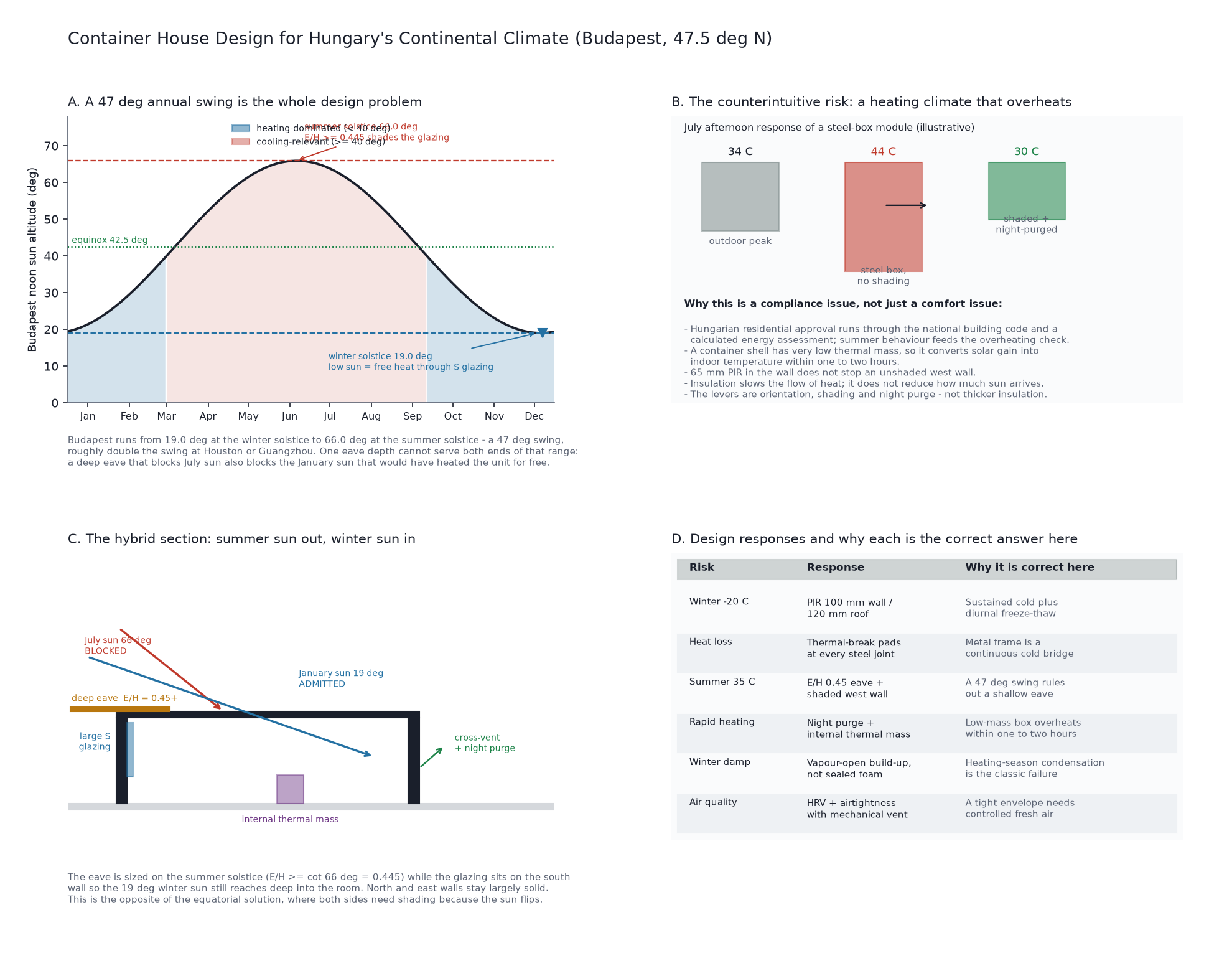
Budapest sits at 47.5° north. The noon sun altitude runs from 66.0° at the summer solstice to 19.0° at the winter solstice — a swing of 47 degrees, roughly double the swing at Houston, Guangzhou or Dubai. In a hot country, the sun is high all year and a fixed horizontal overhang behaves predictably. In Hungary, the same overhang has to perform two contradictory jobs:
- In July, it must block a sun that is 66° above the horizon.
- In January, it must admit a sun that is only 19° above the horizon.
A single eave depth cannot do both. A deep eave that shades the summer sun also shades the winter sun that would have heated the unit for free. A shallow eave lets the winter sun in and lets the summer sun cook the building.
Required overhang for full summer shading: E/H ≥ cot 66.0° = 0.445. In plain terms, a window 1.2 m high needs an eave projecting at least 0.53 m.
A second consequence is easy to miss. Steel-shell container houses have very low thermal mass. Where a brick-and-concrete house absorbs solar gain slowly and releases it after sunset, a steel box converts incoming radiation into indoor temperature within one to two hours. An unshaded west-facing wall in Dallas or Budapest reaches a surface temperature well above air temperature in the afternoon, and the interior follows.
The counterintuitive conclusion: in a heating climate, the primary summer failure mode is not inadequate insulation — it is unrestricted solar gain. Insulation slows the passage of heat. It does not reduce how much sun arrives.
Design Specification for Hungarian Conditions
| Risk | Design response | Why this is the correct answer |
|---|---|---|
| Winter lows to −15 °C | PIR 100 mm wall, 120 mm roof, floor insulated | Sustained cold plus repeated freeze-thaw, not short spikes |
| Continuous heat loss | Thermal-break pads at every steel-to-steel joint | A steel frame is a continuous cold bridge; insulation alone does not break it |
| Condensation in the heating season | Vapour-open build-up, not a sealed foam layer | Warm moist indoor air meets a cold steel surface; the assembly has to allow drying |
| Glazing performance | Double-glazed low-E units with a warm-edge spacer | Reduces heat loss and raises the inner pane surface temperature above dew point |
| Summer overheating | E/H ≥ 0.445 eave on the south face, shaded west wall | Sizing on the summer solstice is the only value that works at both ends of the swing |
| Rapid afternoon heat build-up | Cross-ventilation plus night purge | Low-mass shell releases its heat quickly once the outdoor air cools |
| Fresh air in a tight envelope | HRV (heat recovery ventilation) with airtight construction | A well-sealed envelope needs mechanical ventilation to control humidity and CO₂ |
| Snow load | Roof designed for the local ground snow load | Hungary is not an extreme snow region, but a flat roof still needs a stated load case |
Orientation matters more in Hungary than almost anywhere
Because the annual swing is so wide, orientation is doing more work than insulation. The correct arrangement is:
- South glazing, large. The 19° winter sun reaches deep into the room; this is genuinely free heat.
- Deep south-facing eave, sized to 0.445.
- North and east walls largely solid — they lose heat in winter and gain nothing useful in summer.
- West wall shaded or minimised. Low afternoon sun arrives when the building is already warm.
- Internal thermal mass (a tiled floor, a masonry heater surround, a water tank) where the client wants temperature stability without mechanical cooling.
This is the inverse of the equatorial solution, where shading is required on both faces because the noon sun flips from north to south twice a year.
Complete Cost Breakdown: FOB to Landed in Hungary
All figures in USD. Assumes one 20ft expandable unit with standard fit-out, shipped from Tianjin to Koper (Slovenia) with onward road haulage to Budapest — the most common cost-competitive routing for central Hungary.
| Cost item | Basis | Amount (USD) |
|---|---|---|
| Container house, 20ft expandable, standard fit-out | Ex-works Tianjin | 12,500 |
| Inland haulage, factory to Tianjin port | Per unit | 250 |
| Export documentation and clearance | Per shipment | 120 |
| Ocean freight, Tianjin to Koper | Per unit, 40HQ share | 2,300 |
| Marine insurance | 0.3% of CIF | 46 |
| CIF Koper | 15,216 | |
| EU import duty, HS 9406 (CN 9406.20 steel prefab) | 2.7% MFN of CIF | 411 |
| Import VAT base | CIF + duty | 15,627 |
| Hungarian import VAT (ÁFA 27%) | 27% of CIF + duty | 4,219 |
| Customs broker and clearance | Per shipment | 450 |
| Inland haulage, Koper to Budapest | Road, 600 km | 1,450 |
| Port handling at Koper | Per unit | 280 |
| Foundation / concrete pad | Per unit | 1,600 |
| Offloading and on-site positioning | Per unit | 400 |
| Utility connections, drainage | Per unit | 1,200 |
| Total landed and installed in Hungary | 25,617 |
Two line items dominate the total and both are recoverable or avoidable.
The ÁFA at 27% is the largest single tax item, and it is the highest standard VAT rate in the EU. It is *not* a permanent cost for a VAT-registered Hungarian business: import VAT is reclaimed as input tax on the next return, provided the buyer holds the customs entry document. For a private buyer it is a genuine cost. Cash flow is the real issue — the full 27% is payable at clearance, months before any reclaim lands.
The duty depends entirely on the eight-digit code your broker files. Complete prefabricated buildings of iron or steel are classified under CN 9406.20 at a 0% rate; the residual subheading 9406.90 (prefabricated buildings of other materials) carries the 2.7% third-country rate, while 9406.90.31 (iron or steel) also shows 2.7% in the published tariff. The same physical shipment can therefore clear at 0% or at 2.7% depending on how the broker classifies it. On a CIF value of USD 15,216 the difference between 0% and 2.7% is USD 411 per unit — worth confirming before the goods sail, not after.
Structural components are not a cheaper route. Some suppliers ship units as panels and structural steel under CN 7308 to spread the consignment. This rarely lowers the landed cost, complicates the CE and Declaration of Performance documentation, and can create a problem at plan review if the authority wants evidence that the delivered product is a complete building.
Freight consolidation
A single 20ft unit does not fill a 40-foot high-cube container efficiently. Combining two or three units in one booking reduces the per-unit ocean cost substantially. For Hungarian buyers ordering several units for a farm, a staff compound or a small rental project, consolidation is usually the single largest saving available, larger than any negotiation on unit price.
Shipping a Container House to Hungary: Step by Step
- Confirm the gateway and the routing. Koper or Rijeka for central and western Hungary; Trieste for the south-west; Hamburg with onward rail as the northern alternative. Each changes the inland leg materially.
- Confirm the tariff classification in writing. Ask your broker to state the eight-digit CN code and the resulting duty rate before booking. Get it in writing.
- Obtain a Hungarian EORI number. An EORI beginning with
HUis required for any Hungarian importer. It is free and usually issued within a few working days. - Assemble the CE documentation. The EN 1090-1 Declaration of Performance, FPC certificate and material certificates travel with the goods and are needed for both clearance and plan review.
- Check ISPM-15 compliance on all wooden packing. Wood pallets and crates must be heat-treated and stamped, or EU border inspection can reject them.
- Plan the VAT cash flow. The 27% ÁFA is payable at clearance. If the buy-side is a VAT-registered business, confirm the reclaim mechanism and the document trail with the accountant in advance.
- Settle the permit classification early. Whether the unit is treated as movable or permanent determines the notification route, the permit route and the energy obligation.
- Sequence the foundation works. Hungarian ground freezes in winter. Pad or screw-pile works should complete before the cold arrives, or be scheduled for the spring.
Hungary Compared with Its Neighbours
| Item | Hungary | Germany | Austria | Romania |
|---|---|---|---|---|
| Standard VAT | 27% | 19% | 20% | 21% |
| EU duty, HS 9406 (CN 9406.20) | 0% | 0% | 0% | 0% |
| Ocean gateway | Koper / Rijeka / Trieste | Hamburg / Bremerhaven | Koper / Trieste | Constanța |
| Landlocked | Yes | No | Yes | No (Black Sea) |
| Winter design temperature | Around −15 °C | −12 to −15 °C | −15 to −18 °C | −15 to −20 °C |
The pattern to note: Hungary’s VAT rate is the outlier, and its gateway options are all inland-haulage-heavy. Austria is the closest comparison on both counts — landlocked with Koper or Trieste as the natural gateway. Romania has the advantage of a Black Sea port at Constanța but colder winter design temperatures in the interior.
For a buyer comparing across the region, the honest summary is that Hungary’s product cost and duty position are competitive, and its tax and inland-logistics position is the most expensive in the group.
Frequently Asked Questions
What is the import duty on a container house into Hungary?
Complete prefabricated steel buildings are classified under CN 9406.20 at a 0% EU duty rate. The residual subheadings under 9406.90 carry the 2.7% third-country (MFN) rate. There is no EU–China free trade agreement, so no preferential rate applies. Confirm the eight-digit code with your broker in writing before shipment.
How much is Hungarian import VAT?
27%, the highest standard rate in the EU. It is charged on the CIF value plus customs duty, not on the goods value alone. The EU’s €150 duty *de minimis* does not exempt VAT — import VAT applies from the first euro. From 1 July 2026 the €150 duty exemption itself was replaced by a flat €3 per item on consignments up to €150, running until 2028.
Can a Hungarian business reclaim the 27% import VAT?
Yes. A VAT-registered Hungarian business reclaims import VAT as input tax on its next VAT return, provided it holds the customs entry document as evidence. It is a cash-flow cost rather than a permanent one — but the full amount is payable at clearance first.
Do container houses need CE marking to enter Hungary?
Structural steel components used for load-bearing purposes need EN 1090-1 conformity, a Declaration of Performance and CE marking under the Construction Products Regulation (EU) No 305/2011. Products without CE marking can be refused at clearance or rejected at project acceptance.
Do I need a building permit for a container house in Hungary?
It depends on classification. Small accessory structures may fall under the simplified bejelentés (notification) route, while a permanent dwelling needs a full permit through the local building authority. The deciding factors are floor area, foundation type and whether the unit is designed to be movable. Confirm the classification with the local építéshatóság before ordering.
What is the coldest temperature a Hungarian container house should be designed for?
Plan for around −15 °C in the Alföld during Siberian cold snaps. Hungary’s winter is not extreme by Nordic standards, but repeated freeze-thaw cycles and high winter humidity (80–84% in January) make condensation control more demanding than the temperature alone suggests.
Why is overheating a problem in a country with cold winters?
Because Budapest’s noon sun altitude swings from 66.0° in June to 19.0° in December. A light steel shell with low thermal mass converts solar gain into indoor temperature within one to two hours, and an unshaded west wall drives that further. Insulation slows heat transfer but does not reduce how much solar radiation enters. Shading, orientation and night purge are the effective levers.
How long does shipping to Hungary take?
Ocean transit from Tianjin to Koper is typically 28 to 38 days, depending on the service and the season. Add customs clearance, the 500–700 km inland leg to Budapest, and on-site works. A total of eight to twelve weeks from order to installation is a reasonable planning assumption.
Can I get an EN 1090-1 Declaration of Performance from you?
Yes. We supply the Declaration of Performance, the Factory Production Control certificate and material certificates as a document pack with the shipment. Tell us the execution class specified for your project when you request the quotation, because it affects both the specification and the price.
Ready to price a Hungarian project?
Send your location, intended use, floor area and power supply details to jack@huayinghouse.com, or message +86 153-0318-4505 on WhatsApp. You will receive an itemised FOB and CIF quotation, the EN 1090-1 document pack, and a landed-cost sheet for Koper, Rijeka, Trieste or Hamburg — so the comparison is made on delivered cost, not on factory price.
Continue Reading
- Container House Cold Climate & Snow Load Design: Canada Winter Guide — the same winter problems pushed to Nordic severity
- Container House Design for Temperate Maritime Climates: UK Overheating and Part O — how another European market regulates the overheating that insulation alone cannot fix
- Container Houses in Germany: Complete 2026 Cost Guide — 19% VAT and the Hamburg gateway, for comparison
- Container Houses in Ireland 2026: Complete Cost Guide, Planning Permission & Import Duties — another EU market with a full duty and VAT walkthrough
- How to Calculate the Real Landed Cost of an Expandable Container House — the method used in the cost table above