
Bangladesh is a small country with three building problems that peak in three different seasons. In the coastal belt a hurricane-season storm surge, not the wind, decides whether a structure survives. In the north-east, the water that floods a site falls in a neighbouring country. In the centre, the ground itself is still settling. A container house specification written for one of these will be wrong for the other two, and the failure will not appear on the drawing — it will appear in the first monsoon, or the first cyclone warning.
This is the reason catalogues that sell a single “tropical” module underperform in Bangladesh. The variables that matter here are not latitude and not average temperature. They are local rainfall intensity, storm-surge level, seismic zone, and how much the ground is moving. The three reference cities used in this guide are Dhaka (inland), Sylhet (north-east, the wettest district in the country) and Chattogram (coastal, cyclone landfall belt).
Below is what each of those sites actually demands, what the climate package costs as separate line items, and the full landed cost on a factory-direct unit. Prices are in USD, ex-factory Tianjin, as of October 2026.
Quick reference — what changes across Bangladesh
| Design parameter | Dhaka (inland) | Sylhet (north-east) | Chattogram (coastal) |
|---|---|---|---|
| Köppen class | Tropical wet and dry (Aw) | Tropical monsoon (Am) | Tropical monsoon (Am) |
| Annual rainfall | ~2,100 mm | ~4,100 mm | ~2,800 mm |
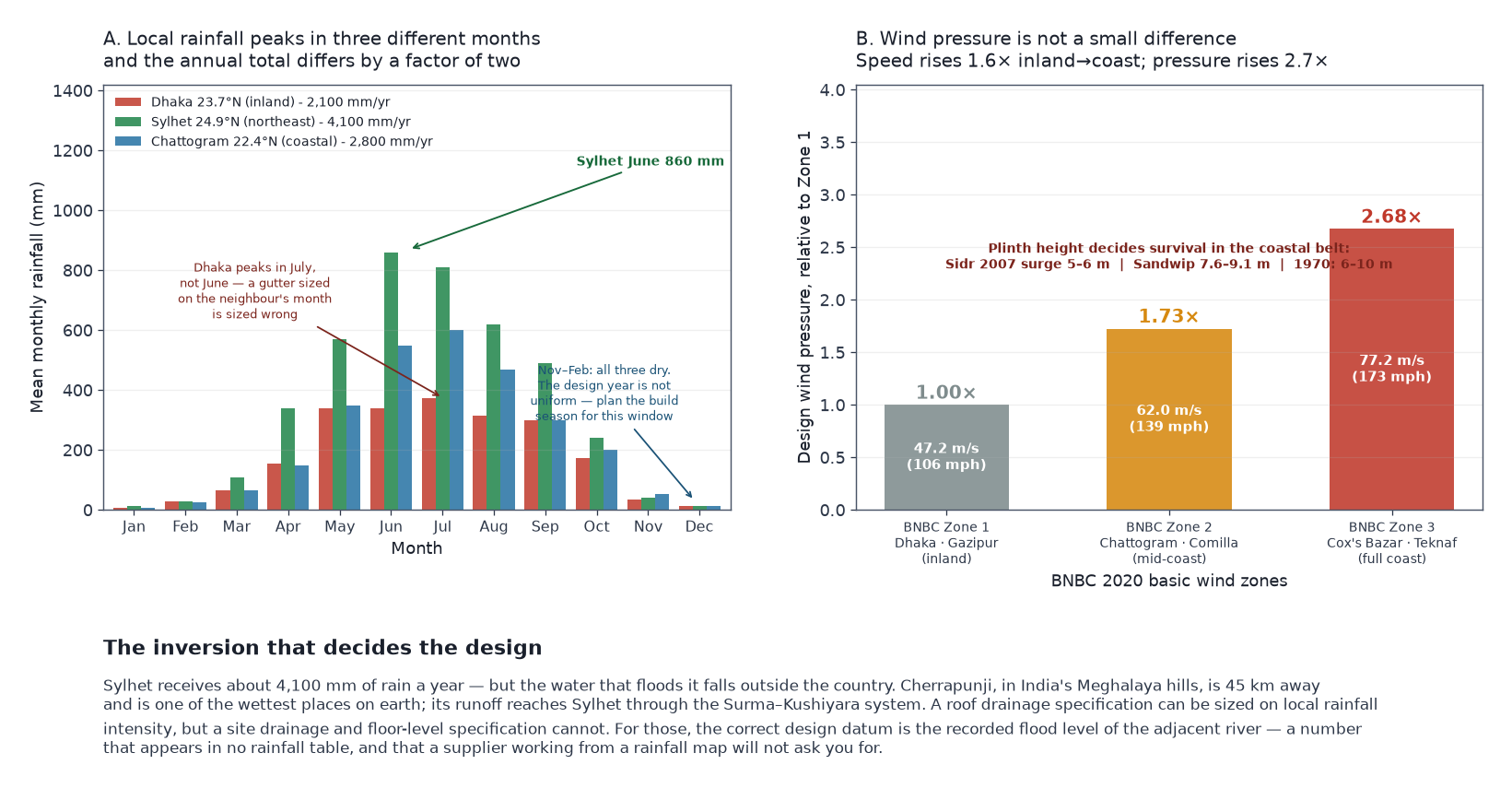
| Wettest month | July (~370 mm) | June (~860 mm) | July (~600 mm) |
| BNBC 2020 basic wind speed | ~47 m/s (Zone 1) | ~47–62 m/s (Zone 2–3) | ~62–77 m/s (Zone 2–3) |
| Seismic zone (BNBC 2020) | Zone 2–3 | Zone 4 (highest) | Zone 2–3 |
| Storm surge (recorded) | Not applicable inland | Not applicable inland | 5–9 m on the exposed coast |
| Governing hazard | Monsoon rain, urban flood | Rainfall, upstream flash flood, seismic | Cyclone wind, surge, salt |
| Corrosion exposure | C3–C4 | C3–C4 | C4–C5 (marine) |
| Design first question | Where does storm water go? | What is the recorded flood level? | How high is the plinth? |
1. Site data: three Bangladeshi cities, three hazard calendars
These are long-term normals and code values; check them against your own plot, because the coastal belt varies sharply within a short distance, and the north-east topography creates local effects that a district average hides.
| Parameter | Dhaka | Sylhet | Chattogram |
|---|---|---|---|
| Latitude | 23.72°N | 24.90°N | 22.35°N |
| Köppen classification | Aw | Am | Am |
| Mean annual temperature | ~25.3 °C | ~24.5 °C | ~25.3 °C |
| Warmest month (mean high) | April, 34–37 °C | April, 32–34 °C | April–May, 32–34 °C |
| Coolest month (mean low) | January, 12–14 °C | January, 12–14 °C | January, 13–15 °C |
| Relative humidity range | 63–87 % | 70–90 % | 67–87 % |
| Annual rainfall | ~2,100 mm | ~4,100 mm | ~2,800 mm |
| Wettest month | July | June | July |
| Wettest month total | ~370 mm | ~860 mm | ~600 mm |
| Driest months | Nov–Feb | Nov–Feb | Nov–Feb |
| Noon sun, highest | 89.7° (about 21 May / 24 Jul) | 88.5° (about 18 May / 27 Jul) | 88.9° (about 20 May / 25 Jul) |
| Noon sun, lowest (Dec solstice) | 42.8° | 41.7° | 44.2° |
| Dominant soil | Alluvial, soft in the eastern belt | Hill soils and basin deposits | Sandy coastal and deltaic |
Two figures in this table do more work than the rest. The first is the spread in annual rainfall: Sylhet receives roughly twice what Dhaka receives, and concentrates an extraordinary 860 mm into a single month. The second is the winter noon sun altitude of about 42°, which is low enough that in December the northern wall of a unit in Dhaka takes a genuine solar load — a fact that surprises buyers who assume a tropical country has no seasonal solar variation worth designing for.
2. Solar geometry: why the shading ratio Inverts between seasons
Bangladesh sits at 22–25°N, which means the sun is very nearly overhead in late May and stands about 42° above the horizon at noon in late December. The practical consequence is that a horizontal eave which shades perfectly in June achieves almost nothing in December, and a fixed louvre set for the summer sun leaves the winter wall fully exposed. The eave-to-window-height ratio required for full shading at the December noon sun is about 1.0–1.1, against about 0.005 in late May — in other words, in May no practical overhang shades anything, and in December a deep overhang is the only thing that works.
The design response is not to try to satisfy both with one fixed device. It is to rely on roof albedo and a ventilated roof cavity for the near-vertical summer sun, where overhangs are useless, and to use adjustable or seasonal shading on the north and west walls for the low winter sun. A costed version of this appears in section 5.
3. The six failure modes that actually occur
3.1 Water arriving from outside the site
This is the single largest gap between a generic specification and a Bangladeshi one. Roof drainage can be sized on local rainfall intensity, because the rain falling on the roof is local. Site drainage and floor level cannot, because the water that floods these plots frequently falls upstream. Sylhet receives roughly 4,100 mm a year, but Cherrapunji in India’s Meghalaya hills — about 45 km away and one of the wettest places on earth — drains into the same Surma–Kushiyara system. Historical records for the region list significant floods in 1998, 2004, 2007, 2010, 2015, 2017, 2019 and 2022. A supplier working from a rainfall map will not ask the buyer for the one number that governs design here: the recorded flood level of the adjacent river.
3.2 Wind uplift treated as a wind-speed question
A light steel module is governed by uplift rather than by its own weight, and BNBC 2020 basic wind speeds rise sharply from the inland zone to the coastal belt — from roughly 47 m/s at Dhaka to about 62 m/s in the mid-coastal zone and around 77 m/s at Cox’s Bazar. Because pressure varies with the square of speed, that is not a 60 % increase in load; it is roughly a 2.7-fold increase. Units quoted on an inland specification and installed near the coast are under-anchored by a factor that is invisible in the sales documents.
3.3 Storm surge, which no wind rating addresses
On the exposed coast the wind rating is the second question. The 1970 cyclone produced surges of 6–10 m and killed an estimated 300,000 people; Cyclone Sidr in 2007 made landfall with winds near 240 km/h and surges of 5–6 m, and recorded surge heights reached 7.6–9.1 m at Sandwip. No container house survives being submerged to that depth, and no wind rating is relevant to the problem. What matters is plinth height above the local surge level, and whether the site is exposed enough to justify accepting that the unit must be evacuated rather than defended.
3.4 Corrosion from a combination of salt and persistent humidity
Coastal Bangladesh combines high humidity with wind-borne chloride and, in the delta, saline intrusion into the groundwater. A coating system selected for inland humidity fails early in that environment, because chloride deposition accelerates the corrosion process well beyond what relative humidity alone would predict. The same applies to buried fixings, on a site where the water table rises twice a day and carries salt.
3.5 Soft and settling ground
A large part of the country’s built-up area sits on soft alluvial or reclaimed ground. Point-loaded pad footings that settle unevenly transfer distortion into a rigid steel frame, and a rigid frame under differential settlement cracks at the joints rather than accommodating the movement. This is a foundation problem, not an envelope problem, and it is the item most often missing from an imported quotation.
3.6 Seismic demand concentrated in the north-east
BNBC 2020 places Sylhet, Mymensingh and the north-east in the highest seismic zone, Zone 4, while much of the centre and coastal belt sits in Zones 2–3. A light steel module has a genuine advantage here, because seismic force is proportional to mass and a container is far lighter than a masonry building of the same floor area, and because steel frames are ductile. But the advantage only materialises if the module is positively anchored and the openings are braced; a unit standing on its own weight is not an earthquake-resistant building, it is an unsecured object.
4. Engineering responses by region
4.1 Coastal belt (Chattogram, Cox’s Bazar, Khulna) — design for surge first
In the coastal belt the decision sequence is the reverse of a temperate project. Plinth height comes first, because it determines whether the unit is above the surge line; wind anchorage comes second; corrosion protection third.
- Set the plinth height from the recorded surge level for your upazila, not from the standard foundation detail. Bangladesh Water Development Board records give surge heights per location; Sandwip, for example, saw 7.6–9.1 m in 2007. Where the site is inside the embankment, the protected level applies; where it is outside, the difference can be several metres.
- Anchor to a designed foundation with cast-in bolts and hold-down plates sized to the Zone 2–3 design pressure. Do not rely on the unit’s own weight, and do not accept a concrete-block anchor as a substitute.
- Increase wall-panel fastener density and verify the panel-to-frame connection for both positive and negative pressure. Consider a continuous structural tie between adjacent modules where units are clustered.
- Specify C5 or C4 coating with hot-dip galvanised steel for the exposed coast, and assume chloride exposure for anything buried. Review the specification at the fasteners and cut edges, which are the first points of failure.
- Provide impact protection on openings where the site is within a few kilometres of the coast. A debris strike that breaks a window pressurises the interior and is a common precursor to roof loss.
- Design for evacuation as well as survival. Where the computed surge is above the achievable plinth height, the honest specification is a unit that can be secured, disconnected and evacuated on warning, with services arranged so that this is quick.
4.2 North-east (Sylhet) — design for the flood level and the seismic zone
Two design drivers dominate here, and they are unrelated to each other: exceptionally heavy rainfall combined with an upstream catchment, and the country’s highest seismic zone.
- Obtain the recorded flood level for the plot before ordering anything. This is the single most valuable piece of information for a Sylhet site, and it is not derivable from a rainfall table. Where the plot floods, an elevated structure on an engineered foundation or a compliant ground-floor arrangement may be the only viable option.
- Size roof drainage on local intensity, but size site drainage on the catchment. The June peak of about 860 mm justifies a steep roof, large gutters, a coarse debris screen and an overflow path that cannot be blocked. Site perimeter drainage has to cope with water arriving from elsewhere, which is a different calculation.
- Raise the finished floor above the flood level and ventilate the resulting void. Where the void is enclosed, ensure it can drain and does not become a moisture reservoir.
- Apply the Zone 4 detail set: positive anchorage, braced openings, and regular plan geometry. Histories record major earthquakes affecting the region, most recently in 1918, and Sylhet lies within a seismically active province.
- Design the ground for hill-wash and slope runoff. The surrounding terrain carries water quickly; a cut or filled plot needs drainage designed for it, not for the rainfall that lands on the roof.
4.3 Central belt (Dhaka, Gazipur, Narayanganj) — design for the rain season and the ground
- Assume the site will be saturated for part of the monsoon unless drainage says otherwise. Flash flooding is common in the Dhaka area, and a plot that looks firm in February can be standing water in July.
- Use a load-spreading foundation on soft ground, and obtain a geotechnical check before finalising the foundation design. Much of the central belt is alluvial, and parts of it are filled or reclaimed land.
- Shade the roof, not the walls. With the summer sun effectively overhead, roof albedo and a ventilated cavity do far more than wall thickness. Use adjustable shading for the December sun on the north and west faces.
- Control condensation as a system. A permanently high latent load across most of the year means dehumidification should be part of the design with a dedicated condensate drain, rather than a portable unit added later.
- Detail the roof as a priority, not an accessory. The July peak near 370 mm makes a steep pitch, generous gutters and an unblockable overflow the highest-value items on the specification.
5. Climate upgrade packages: what each region actually costs
The table prices the upgrades the site data says are required, not a generic bundle. Items are additive to the base unit and quoted in USD.
| Upgrade | Purpose | Dhaka (central) | Sylhet (north-east) | Chattogram (coastal) |
|---|---|---|---|---|
| Steep roof pitch (10°+) + oversized gutters and downpipes | Monsoon intensity, 370–860 mm peaks | 420 | 520 | 460 |
| Coarse debris screen + unblockable overflow path | Peak-month blockage | 180 | 240 | 200 |
| Ventilated roof cavity + high-albedo cool roof (SRI ≥ 78) | Near-vertical solar gain | 540 | 500 | 510 |
| Adjustable shading to north / west faces | 42° December noon sun | 310 | 300 | 300 |
| Thermal break + PIR infill | Reduced heat path through frame | 420 | 420 | 440 |
| C4 coating + hot-dip galvanising | Inland humidity corrosion | 310 | 310 | — |
| C5 coating + hot-dip galvanising, sealed fasteners | Salt spray on the exposed coast | — | — | 480 |
| Dedicated dehumidification with condensate drain | Year-round latent load | 360 | 340 | 370 |
| Raised floor, ventilated crawl space | Monsoon saturation, ground moisture | 420 | 480 | 500 |
| Load-spreading / interconnected foundation | Soft alluvial ground, differential settlement | 610 | 700 | 620 |
| Enhanced uplift anchorage to Zone 2–3 pressure | Cyclone uplift on a light module | — | 420 | 640 |
| Impact-resistant openings / shutters | Wind-borne debris | — | — | 560 |
| Zone 4 seismic detail set (anchorage + braced openings) | BNBC 2020 highest seismic zone | — | 520 | — |
| Climate package total | 3,570 | 4,750 | 5,080 |
Two points about this table. First, the most expensive location is the coastal one, but the cost is not primarily in the envelope — it is in the foundation, the anchorage and the impact protection, all of which are structural. Buying a cheaper unit for a coastal site usually does not save money; it just moves the cost from the specification sheet to the insurance claim. Second, Sylhet and Chattogram carry costs that Dhaka does not, and neither of those costs can be removed by choosing a different model — a seismic zone and a recorded surge level are properties of the site, not of the product.
6. FOB to landed cost: the full chain
Model: one 20ft expandable container house, 15 m², base FOB 12,800 USD ex-Tianjin, with the climate package for the destination region applied. Bangladesh levies up to six charges in sequence, and because VAT and the advance levies are calculated on a base that already includes duty, the effective rate is much higher than the headline numbers suggest. The table below shows the cascade.
| Cost line | Basis | Dhaka | Sylhet | Chattogram |
|---|---|---|---|---|
| FOB Tianjin | base 20ft expandable | 12,800 | 12,800 | 12,800 |
| Climate package | per section 5 | 3,570 | 4,750 | 5,080 |
| Ocean freight | Tianjin to Chattogram | 980 | 1,120 | 950 |
| Marine insurance | 0.3 % of CIF | 52 | 56 | 56 |
| CIF value | 17,402 | 18,726 | 18,886 | |
| Landing charge | 1 % of CIF | 174 | 187 | 189 |
| Assessable value | CIF + landing charge | 17,576 | 18,913 | 19,075 |
| Customs duty (CD) | 25 % of assessable value | 4,394 | 4,728 | 4,769 |
| Regulatory duty (RD) | 3 % of assessable value | 527 | 567 | 572 |
| VAT | 15 % of (assessable + CD + RD) | 3,375 | 3,631 | 3,662 |
| Advance income tax (AIT) | 5 % of assessable value | 879 | 946 | 954 |
| Advance tax (AT) | 7.5 % of (assessable + CD) | 1,648 | 1,773 | 1,788 |
| Customs clearance and terminal handling | broker, THC, declaration | 420 | 450 | 470 |
| Inland transport | Chattogram to site | 260 | 340 | 200 |
| Foundation and floor level | per section 5 | 600 | 700 | 900 |
| Installation and utility hookup | 2–3 days, two technicians | 560 | 560 | 560 |
| Total landed and installed | 30,239 | 32,608 | 32,950 |
Read this table carefully before comparing it with a domestic quotation, because two of the lines behave differently from the way a first-time importer expects. VAT and the two advance levies are not pure costs for a registered commercial importer: input VAT can generally be credited against output VAT, and AIT is offset against the annual income tax return. The genuinely non-recoverable import charges are customs duty and regulatory duty, which for the Dhaka case come to about 4,921 USD against a total tax and duty figure of about 10,823 USD. That distinction matters when you are deciding whether to import or build locally, and it is the line most often misread in a landed-cost comparison.
A note on preferential treatment. China and Bangladesh are both parties to the Asia-Pacific Trade Agreement (APTA), and Bangladesh operates a preferential tariff scheme for APTA member countries. However, the preferential rate that appears in Chinese tariff tables is China’s rate on Bangladeshi goods, not Bangladesh’s rate on Chinese goods, and the two directions do not carry the same product coverage. Do not assume a preferential rate applies to this HS line without confirming it against the Bangladesh Customs Tariff Schedule and the operative SRO for the year of shipment. The same caution applies after Bangladesh’s graduation from Least Developed Country status on 24 November 2026, which changes Bangladesh’s access to other markets and is a separate matter from the duty payable on an inbound shipment. Verify the classification and the current SRO with your clearing agent before the container is loaded, because an assumed preference that turns out not to apply is absorbed entirely by the buyer.
7. Compliance and approvals
Building regulation. The governing document is the Bangladesh National Building Code (BNBC 2020), which sets wind and seismic load requirements and is derived in its wind provisions from the ASCE 7 approach. Two things matter for a container house project. First, BNBC 2020 divides the country into basic wind speed zones, and the coastal belt — Chattogram, Cox’s Bazar, Khulna — sits materially higher than the inland zone; this changes purlin spacing, bracing layout and anchor-bolt design, not just a single number on a drawing. Second, BNBC 2020 places the north-east in the highest seismic zone, and multi-storey construction there requires ductile detailing rather than strength design alone. For a single-storey module the seismic requirement is normally satisfied by positive anchorage and braced openings, but it must be shown, not assumed.
Foundations and soil. Soft alluvial ground across the Dhaka, Narayanganj and coastal industrial belts frequently requires pile foundations for conventional construction. For a light module, a continuous or interconnected foundation that spreads load is usually sufficient, but the decision must follow a geotechnical assessment of the specific plot rather than a default detail, because filled and reclaimed land behaves differently from undisturbed alluvium.
Import and licensing. Commercial importers require a valid Import Registration Certificate (IRC) from the Office of the Chief Controller of Imports and Exports, with company registration, a trade licence, a TIN and a bank account. Declarations are lodged through the ASYCUDA World system and cleared through a licensed C&F agent at Chattogram, which handles the great majority of the country’s container traffic. Where the goods trigger a mandatory standard, the Bangladesh Standards and Testing Institution (BSTI) may require testing, so confirm whether your HS line is on the mandatory list before shipment.
Tax structure. Bangladesh applies a multi-tier system: customs duty (CD) in the 0–25 % range, regulatory duty (RD), supplementary duty (SD) for defined goods, VAT at a standard 15 %, advance income tax (AIT) and advance tax (AT). The legal framework is the Customs Act 2023 and the VAT and Supplementary Duty Act 2012 as amended by the annual Finance Act. For prefabricated buildings under HS 9406 the main components are CD, RD, VAT, AIT and AT; the rates applied in section 6 are the operative commercially-realistic values and should be re-verified against the current schedule, because tariff lines and SROs are revised annually with the budget.
Electrical and fire. Site power quality varies, particularly outside the major cities, so specify protection accordingly and confirm whether an earth-leakage device is required. For commercial or works-camp occupancy, check the fire-safety requirement for the occupancy class before ordering, because it can change the internal lining and the exit arrangement.
8. Where these units are actually used
In the coastal belt the strongest demand comes from industrial and port-adjacent accommodation, works camps and site offices where the anchorage and plinth specification are the deciding factors rather than the unit price. Around Dhaka and Gazipur the dominant use is worker accommodation at garment and light-engineering plants, where the load is monsoon drainage, condensation control and a floor level that does not flood. In the north-east, the market is flood-resilient accommodation where an elevated structure on an engineered foundation is the whole point. Container units also suit the many projects in Bangladesh where the building has to be operational within weeks rather than seasons — and in a country where the build season is effectively the four dry months, that matters more than it does in a temperate market.
9. Frequently asked questions
Can a container house withstand a Bangladeshi cyclone?
It can withstand the wind, and it cannot withstand the surge. Wind loads are manageable with positive anchorage sized to the BNBC 2020 zone, dense panel fastening, impact-resistant openings and a bolted structural tie between modules. Storm surge is a different problem: Sidr produced 5–6 m on the exposed coast and Sandwip recorded 7.6–9.1 m, and no practical plinth height defends against that. The correct approach on the exposed frontal coast is to size the plinth above the local surge level where the site permits, and otherwise to design a unit that can be secured and evacuated on warning.
Which BNBC seismic zone applies to my site, and does it change the design?
BNBC 2020 places Sylhet, Mymensingh and the north-east in Zone 4, the highest, while much of the centre and the coastal belt sits in Zones 2–3. For a single-storey module the practical difference is the anchorage and bracing detail: a Zone 4 site needs positive anchorage and braced openings, and an irregular plan is best avoided. The design advantage of a container is that it is light, and seismic force is proportional to mass, so a steel module starts from a good position — but only if it is tied down.
Sylhet gets 4,100 mm of rain a year. How do I spec the roof?
Size the roof for local rainfall intensity and the site for the catchment. On the roof, that means a steep pitch, oversized gutters and downpipes, a coarse debris screen and an overflow path that cannot be blocked by a single leaf pile, because a June peak near 860 mm will test all four. For the site, roof sizing is not the right calculation at all: the flooding in Sylhet is driven substantially by runoff from the Meghalaya hills crossing the border through the Surma–Kushiyara system, so the design datum is the recorded flood level of the adjacent river, not the rain gauge on site.
How much of the import tax is actually unrecoverable?
For a registered commercial importer, the genuinely non-recoverable import charges are customs duty and regulatory duty. VAT at import can generally be credited against output VAT, and advance income tax is offset against the annual income tax return. On the Dhaka example in this guide, CD and RD together come to about 4,921 USD, against a total tax and duty figure of about 10,823 USD before clearance and installation. That gap is the reason a landed-cost comparison drawn straight from the duty total is misleading.
Does the APTA preferential rate apply to my shipment?
Do not assume so. China and Bangladesh are both APTA parties and Bangladesh operates a preferential scheme for APTA members, but the preferential rate published in Chinese tariff tables is China’s rate on Bangladeshi goods, which is not the same as Bangladesh’s rate on Chinese goods, and the product coverage differs by direction. Confirm the rate for your exact HS line against the Bangladesh Customs Tariff Schedule and the SRO in force for the year of shipment, and have your clearing agent verify it before the container is loaded. An assumed preference that does not apply is absorbed entirely by the buyer.
Is a container house a good choice on soft ground near Dhaka?
The module is a good choice; the foundation is where the project succeeds or fails. A light steel module imposes a much lower load than conventional construction, which reduces the foundation problem but does not eliminate it, because the risk on soft alluvial or reclaimed ground is differential settlement rather than bearing failure. Use a continuous or interconnected foundation that spreads load and absorbs movement, and base the design on a geotechnical assessment of the actual plot. Pad footings copied from a standard detail are the most common cause of trouble on this type of ground.
10. Next step
Send us the district, the plot elevation and — for a flood-prone or coastal site — the recorded flood or surge level for the locality, together with a photograph of the ground. We will confirm whether the governing design case for your site is storm surge, flood level, seismic zone or corrosion, return a specification with the climate package priced as separate lines so you can see what each requirement costs, and check the current tariff treatment for your HS line with you before you commit.
Contact: jack@huayinghouse.com · WhatsApp +86 153-0318-4505 · ask for the Bangladesh region-matched specification sheet.
Read next: Container Houses in India 2026: Importing Expandable Homes for the regional import and compliance picture. Container House Design for Tropical Humidity: Malaysia & Southeast Asia for the humidity-control counterpart. Container House Design for Extreme Rainfall: Manila Typhoon Season for drainage and roofing detail. Container House Design for Tropical Monsoon Climates: Thailand for the monsoon envelope, and 40ft Expandable Container House Nepal 2026 Price Guide for the neighbouring South Asian seismic market.
HUAYING manufactures expandable, folding and detachable container houses at six production sites in Hebei Province, China, with more than 50,000 m² of production space, exporting since 2003.