
Brazil is usually filed under a single climate label: tropical. That label is wrong for roughly two-thirds of the country’s population, and it is expensive to design against. A house specified for Manaus will fail in Curitiba, and a house specified for Curitiba will be unliveable in Manaus. The difference is not a matter of degree. Between the two cities the ratio of heating demand to cooling demand moves from zero to 2.9.
This guide sets out the actual numbers for six Brazilian population centres, then follows the money: what a prefabricated house costs once Brazilian federal and state taxes are applied. The tax section matters more than most buyers expect, because Brazil’s state VAT is calculated on a base that already contains itself.
What the climate data actually shows
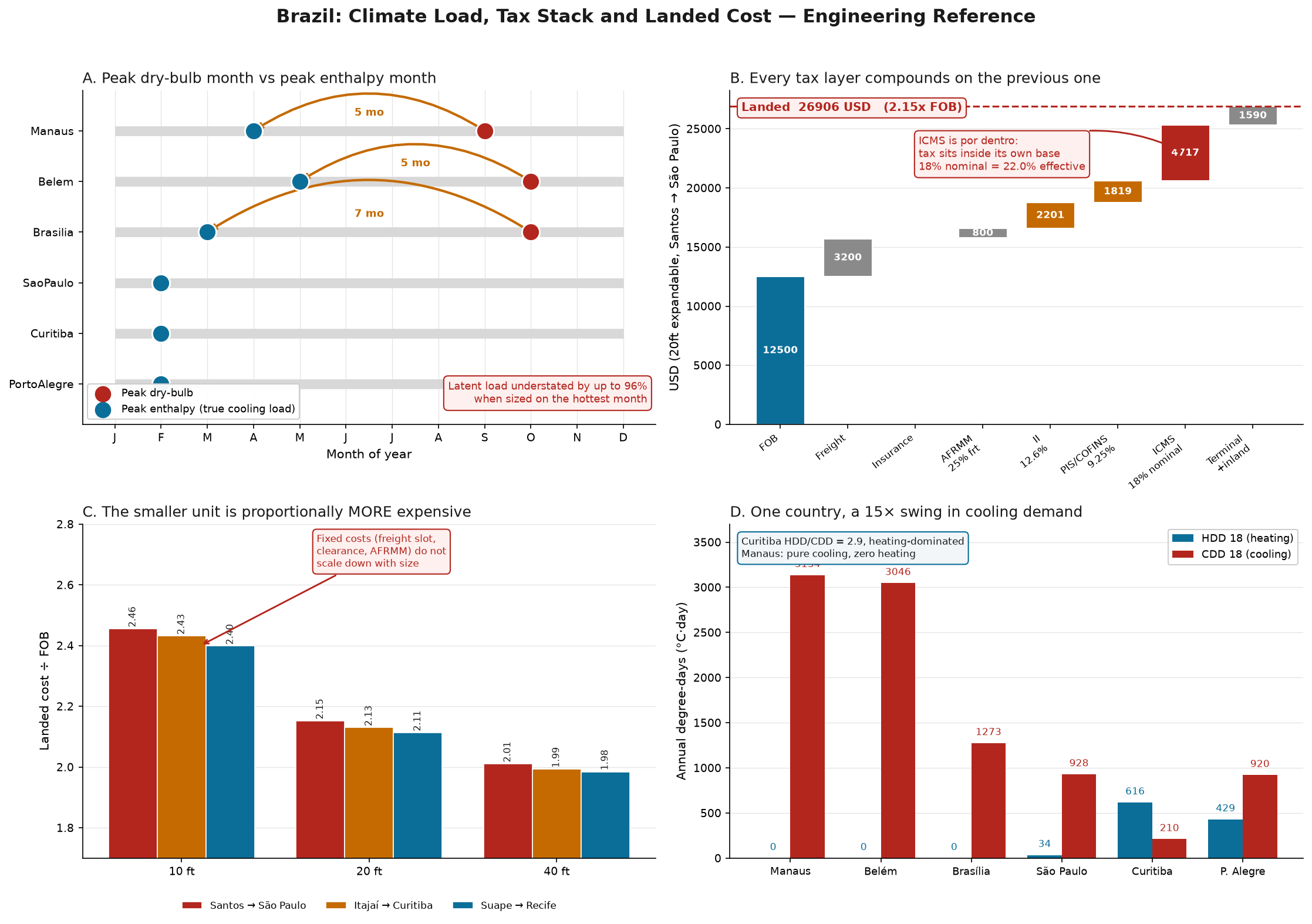
We used INMET 1991–2020 climate normals for six cities: Manaus, Belém, Brasília, São Paulo, Curitiba and Porto Alegre. For each we calculated annual heating and cooling degree-days at an 18 °C base, monthly enthalpy of the outdoor air, dew point, and noon solar altitude.
The first result overturns the single-label assumption. Cooling degree-days range from 3,134 in Manaus to 210 in Curitiba — a factor of fifteen. Heating degree-days go from exactly zero in Manaus and Belém to 616 in Curitiba.
| City | Latitude | HDD18 | CDD18 | HDD : CDD | Coolest month | Warmest month |
|---|---|---|---|---|---|---|
| Manaus | 3.1° S | 0 | 3,134 | 0.00 | 26.0 °C | 27.3 °C |
| Belém | 1.5° S | 0 | 3,046 | 0.00 | 25.9 °C | 26.8 °C |
| Brasília | 15.8° S | 0 | 1,273 | 0.00 | 19.5 °C | 23.2 °C |
| São Paulo | 23.6° S | 34 | 928 | 0.04 | 17.2 °C | 23.2 °C |
| Curitiba | 25.4° S | 616 | 210 | 2.93 | 13.2 °C | 20.2 °C |
| Porto Alegre | 30.0° S | 429 | 920 | 0.47 | 13.7 °C | 24.7 °C |
Curitiba is the outlier that breaks the national label. With 616 heating degree-days against 210 cooling, it is a heating-dominated climate at 25° south — closer in thermal behaviour to upland Portugal than to the Amazon. Any specification that treats “Brazil” as tropical will under-insulate Curitiba by a wide margin.
Failure mode 1: sizing air conditioning on the hottest month
This is the most consequential error in Brazilian residential HVAC, and it is invisible in the usual design process. The standard approach is to find the hottest month, take its dry-bulb temperature, and size the unit against it. On the coast, that produces an undersized system.
Cooling load has two components. Sensible load follows dry-bulb temperature difference. Latent load follows the moisture content of the air, which tracks enthalpy, not temperature. In the Amazon the two peak in different months.
In Manaus the hottest month is September at 27.3 °C. But the highest moisture content occurs in April, at 26.2 °C. April is 1.1 K cooler and carries 1.34 g/kg more water vapour. Sized on September, the latent load is understated by 17.5 percent. In Belém the gap is 12.5 percent.
Brasília is where the error becomes large. Its hottest month is October at 23.2 °C; its wettest, most humid month is March at 22.1 °C. Sizing on October understates the latent load by 96 percent — effectively double. A unit selected from the October peak will hold temperature and fail to control humidity through the March wet season, which is when mould risk is highest.
Failure mode 2: treating the dry season as the easy season
A second assumption fails in the centre-west. Brasília has three months below 40 mm of rainfall — June, July and August — with June at 8 mm. Designers reasonably conclude that the dry season needs no moisture management. The opposite is true for the building fabric.
June to September in Brasília also delivers the natural comfort window: outdoor dry-bulb between 18 and 26 °C and outdoor moisture content below the indoor target. It is the only such window in our six-city sample outside São Paulo’s single August. Those four months are when a house can be ventilated rather than conditioned.
They are also the months when night-time radiant cooling drives the underside of an uninsulated steel roof below the indoor dew point. In July, Brasília’s outdoor dew point is 9.4 °C against an indoor dew point of 10.2 °C at 21 °C and 50 percent relative humidity. The margin is 0.8 K. A bare steel deck radiating to a clear sky loses roughly 5 K below ambient, so the underside sits well below the indoor dew point and condenses — every clear night for four months. The moisture then drips onto occupants and into the ceiling cavity.
Failure mode 3: assuming a vapour barrier has one correct side
Most guidance on prefabricated steel housing is written for one of two climates: cold continental, where the vapour control layer goes on the warm side; or hot-humid, where it goes on the outside. Brazil contains both, and the transition is not announced anywhere on a map.
Manaus and Belém sit in permanent hot-humid conditions: the annual dry-bulb range is 1.3 K and 0.9 K respectively. Vapour drive is inward for most of the year, so the control layer belongs on the external face and the assembly must be able to dry inward.
Curitiba and Porto Alegre reverse this for part of the year. Curitiba’s July mean is 13.2 °C at 81 percent relative humidity — an outdoor dew point of 10.0 °C. With indoor conditions at 21 °C and 50 percent, the vapour drive runs outward through the wall for several months. A single fixed vapour barrier installed for tropical conditions will trap moisture inside the assembly during the southern winter.
The practical resolution for a prefabricated steel house is an assembly that is vapour-open on both faces, with a capillary-breaking insulation layer and mechanical ventilation sized for the wet season. This costs more than a single barrier and a bag of insulation, but it is the only configuration that survives both ends of the country.
Failure mode 4: a fixed overhang for a country with two solar geometries
Solar noon altitude at the June solstice ranges from 36.5° in Porto Alegre to 65.1° in Belém. At the December solstice the southern cities climb to 83–90°, while Belém reaches only 68°. The swing between the two solstices is 46.9° in the south and 2.9° in the north.
| City | Noon altitude 21 Jun | Noon altitude 21 Dec | Swing | Lower of the two | Overhang E/H needed |
|---|---|---|---|---|---|
| Manaus | 63.5° | 69.7° | 6.2° | 63.5° | 0.50 |
| Belém | 65.1° | 68.0° | 2.9° | 65.1° | 0.46 |
| Brasília | 50.8° | 82.3° | 31.6° | 50.8° | 0.82 |
| São Paulo | 43.0° | 89.9° | 46.9° | 43.0° | 1.07 |
| Curitiba | 41.1° | 88.0° | 46.9° | 41.1° | 1.15 |
| Porto Alegre | 36.5° | 83.4° | 46.9° | 36.5° | 1.35 |
The overhang ratio in the last column is what a north-facing wall needs, expressed as projection E divided by window head height H, to shade the glass at the lower of the two solstice altitudes. Porto Alegre needs 1.35 — a projection 35 percent deeper than the window is tall. That is structurally and visually impractical on a prefabricated unit.
Near the equator the problem inverts. Belém needs only 0.46, because the sun is never low. A fixed overhang works there and is cheap. So the same product cannot be sold with one shading solution across Brazil: the north wants a small fixed overhang, the south wants adjustable external shading or a rejected west/east exposure.
Failure mode 5: ignoring the rain direction
Annual rainfall ranges from 1,345 mm in Porto Alegre to 3,000 mm in Belém. But annual total is the wrong design variable. Belém’s wettest month delivers 420 mm, and its driest still delivers 120 mm — it never dries out. Brasília’s wettest month delivers 255 mm and its driest 8 mm.
The distinction drives drainage design. Belém and Manaus need continuously open drainage with no reliance on seasonal drying; blockage tolerance and overflow capacity dominate. Brasília and São Paulo need drainage designed for intense convective bursts after months of dry accumulation of dust and leaf litter in gutters, which is a different failure mode — the first storm of the season finds the outlets blocked.
A single gutter specification across both regions will fail in one of them. Porto Alegre, with a monthly rainfall coefficient of variation of 0.10, is the one city where a uniform design is defensible, because its rainfall is genuinely even through the year.
Cost increment: what climate adaptation actually adds
The following table isolates the climate package — the difference between a base prefabricated unit and one specified for the local climate — as a percentage of the FOB price. It excludes freight, tax, foundation and installation.
| Climate zone | Representative city | Climate package content | Added cost (USD) | % of FOB |
|---|---|---|---|---|
| Equatorial humid | Manaus, Belém | Double vapour-open wall, dehumidification provision, high-flow drainage, mould-resistant lining | 1,850 – 2,400 | 14.8% – 19.2% |
| Tropical savanna | Brasília | Roof-deck anti-condensation layer, 50 mm PIR, night ventilation, blocked-outlet drainage | 1,250 – 1,700 | 10.0% – 13.6% |
| Subtropical highland | São Paulo, Curitiba | 75 mm PIR, thermal-bridge break at slab, outward-drying wall, external adjustable shading | 1,700 – 2,300 | 13.6% – 18.4% |
| Temperate south | Porto Alegre | 100 mm PIR, insulated frame, winter condensation control, deep south overhang | 2,100 – 2,800 | 16.8% – 22.4% |
Note the direction of the numbers. The most expensive climate package is not the Amazon — it is the temperate south, because heating-dominated climates demand insulation on every surface rather than ventilation and dehumidification strategy. Buyers who assume “tropical Brazil is the hard one” budget in the wrong direction.
The tax layer: why the landed cost is twice the FOB price
Brazil’s import tax structure compounds. Each levy is calculated on a base that includes the previous ones, and the state VAT includes itself. This is not a presentation issue — it changes the marginal cost of every design decision.
For the full compliance and permitting sequence, including the municipal approval routes in São Paulo, Rio de Janeiro and Brasília, see our Brazil container house cost and regulations guide.
Prefabricated steel buildings classify under NCM 9406.90.20, which carries a 12.6 percent import duty (II) and zero IPI following Gecex Resolution 852/2026. Industrialised goods of other materials fall under 9406.90.90 at 16.2 percent. The classification is worth confirming with a Brazilian customs broker before shipment, because it determines every downstream tax.
| Cost element | Basis of calculation | Amount (USD, 20ft, Santos → São Paulo) |
|---|---|---|
| FOB Tianjin | — | 12,500 |
| Ocean freight | Per container slot | 3,200 |
| Marine insurance | 0.5% of FOB + freight | 78 |
| CIF value | Customs base | 15,778 |
| AFRMM | 25% of ocean freight | 800 |
| Import duty (II) | 12.6% of customs base incl. AFRMM | 2,201 |
| IPI | 0% for NCM 9406.90.20 | 0 |
| PIS / COFINS | 9.25% of CIF + II + IPI | 1,819 |
| ICMS grossed-up base | (CIF + AFRMM + II + PIS/COFINS + fees) ÷ 0.82 | 26,206 |
| ICMS | 18% of grossed-up base (São Paulo) | 4,717 |
| SISCOMEX fee | Per declaration | 40 |
| Terminal handling, clearance, storage | Port charges | 850 |
| Inland transport | Santos → São Paulo | 700 |
| Landed at site | — | 26,906 |
Total tax and freight burden is 9,538 USD, or 60.4 percent of the CIF value. The multiplier from FOB to landed is 2.15.
The ICMS mechanism deserves attention because it is where most estimates go wrong. A naïve calculation applies 18 percent to the pre-tax total. Brazil calculates it “por dentro”: the tax is part of its own base, so the pre-tax total is divided by (1 − 0.18) before the rate is applied. The effective rate against the pre-ICMS amount is 21.95 percent, not 18. On this unit the difference is 858 USD.
The size trap: smaller units carry a higher landed multiplier
Buyers frequently assume that a smaller unit is proportionally cheaper. In Brazil the opposite holds, and it is a fixed-cost effect rather than a pricing decision.
| Size | FOB | CIF | Tax and freight | Landed (Santos → São Paulo) | Multiplier | Tax as % of CIF |
|---|---|---|---|---|---|---|
| 10 ft | 8,500 | 11,758 | 7,527 | 20,875 | 2.46 | 64.0% |
| 20 ft | 12,500 | 15,778 | 9,538 | 26,906 | 2.15 | 60.4% |
| 40 ft | 22,000 | 26,934 | 15,717 | 44,241 | 2.01 | 58.4% |
A 10 ft unit costs 2.46 times its FOB price to land; a 40 ft costs 2.01 times. The cause is that a folded 10 ft unit still occupies a full 20 ft container slot, still attracts a full customs declaration, a full SISCOMEX fee and a full clearance charge, while carrying less than half the value of a 40 ft. Fixed costs do not scale down.
For a buyer comparing a 10 ft and a 20 ft for the same site, the correct comparison is landed cost per square metre, not FOB per unit. The 10 ft is frequently the more expensive choice per square metre once Brazilian taxes are applied.
Route sensitivity: the port and state you clear through
| Route | Size | Landed (USD) | Multiplier |
|---|---|---|---|
| Santos → São Paulo (ICMS 18%) | 20 ft | 26,906 | 2.15 |
| Itajaí → Curitiba (ICMS 17%) | 20 ft | 26,626 | 2.13 |
| Suape → Recife (ICMS 18%) | 20 ft | 26,418 | 2.11 |
| Santos → Brasília (ICMS 18%, 1,150 km inland) | 20 ft | 28,106 | 2.25 |
The spread between the cheapest and most expensive route is 1,688 USD on an identical unit — 6.3 percent of the landed cost. Itajaí with Santa Catarina’s 17 percent ICMS is the cheapest of the three ports, but only when the destination is in the south. Shipping to Santos and trucking to Brasília adds 1,200 USD of inland transport, which dominates the state-tax difference.
One further point on marginal cost: each additional percentage point of import duty raises the landed cost by 233 USD on this unit, not the 175 USD the duty alone would suggest. The amplification factor is 1.33, created by the ICMS gross-up and the PIS/COFINS cascade. Every tariff negotiation is worth 33 percent more than the headline rate implies.
Compliance: what a Brazilian buyer must actually obtain
Prefabricated housing in Brazil is governed by ABNT standards and municipal permitting, and the compliance path differs from the European or Australian route.
NBR 15575 is the residential performance standard covering structural, fire, acoustic, thermal and durability performance. A prefabricated unit must be documented against it, and the thermal performance sections interact directly with the climate package above — a unit that meets NBR 15575 minimums in Curitiba will not meet them in Manaus with the same wall build-up.
NBR 6123 governs wind loading and is the standard that matters for coastal sites. Southern coastal Santa Catarina and Rio de Janeiro both require site-specific wind analysis, not a generic product rating.
Municipal permitting runs through each municipality’s Código de Obras. São Paulo requires an Alvará de Construção and classifies container units as edificação pré-fabricada; Brasília’s approval route is more restrictive because of the city’s heritage status; mining and agribusiness sites in Pará, Minas Gerais and Mato Grosso operate under more permissive worker-accommodation rules.
Import documentation requires an import licence (LI) registered in SISCOMEX before shipment, a certificate of origin, and — critically — confirmation of the NCM classification in advance. Misclassification penalties reach 50 percent of the tax due plus interest, which on this unit would exceed the entire climate package cost.
Frequently asked questions
Is a container house suitable for the Amazon climate?
Yes, but not with a standard specification. Manaus has zero heating degree-days and 3,134 cooling degree-days, with a moisture content that requires dehumidification capacity rather than cooling capacity as the primary design driver. The climate package adds 14.8 to 19.2 percent to the FOB price. A unit specified for São Paulo will fail in Manaus through condensation and mould within the first wet season.
Why is my air conditioning running but the house still feels damp?
Almost certainly because the unit was sized on dry-bulb temperature. In Brasília, sizing on the October temperature peak understates the March latent load by 96 percent. The system removes sensible heat adequately and leaves moisture in the air. The remedy is a unit selected on peak enthalpy, with explicit dehumidification capacity, not a larger unit selected on temperature.
Which port should I ship to?
Clear through the port nearest the final site. Itajaí carries Santa Catarina’s 17 percent ICMS and is the cheapest of the three ports we modelled at 26,626 USD landed for a 20 ft unit, but shipping to Itajaí for a Brasília site adds enough inland freight to erase the advantage. Santos to Brasília lands at 28,106 USD. The port decision should follow the site, not the headline tax rate.
Is a 10 ft unit cheaper than a 20 ft?
In FOB terms yes, in landed cost per square metre rarely. The 10 ft unit lands at 2.46 times FOB against 2.01 for a 40 ft, because a folded 10 ft still consumes a full container slot and a full set of clearance charges. Compare landed cost per square metre before deciding.
What is the import duty on a prefabricated steel house?
NCM 9406.90.20 carries 12.6 percent import duty and zero IPI following Gecex Resolution 852/2026. Prefabricated buildings of other materials under 9406.90.90 pay 16.2 percent. Note that the Mercosur–EU preferential rates applied from May 2026 do not extend to Chinese-origin goods, so a Chinese-manufactured unit pays the full MFN rate.
Does the state VAT really add more than its headline rate?
Yes. ICMS is calculated por dentro: the tax is included in its own base. An 18 percent nominal rate in São Paulo produces an effective 21.95 percent burden against the pre-ICMS amount. On a 20 ft unit that difference is 858 USD. Any landed-cost estimate that applies the nominal rate to the pre-tax total will understate the total by roughly that amount.
How many months a year can the house be naturally ventilated?
In Brasília, four — June through September, when outdoor temperature sits between 18 and 26 °C and outdoor moisture content is below the indoor target. In São Paulo, one month. In Manaus, Belém, Curitiba and Porto Alegre, none. Those four Brasília months are also the months when an uninsulated roof deck condenses on its underside every clear night, so natural ventilation and condensation control must be designed together.
Next step
If you are specifying a prefabricated house for a Brazilian site, the two decisions that drive cost are the climate zone and the clearance route, and they are independent of each other. Send us the site municipality and the destination state and we will return a landed cost calculation for that specific pair — including the ICMS rate that applies, the inland leg, and the climate package the site actually needs.
Contact: jack@huayinghouse.com / +86 153-0318-4505