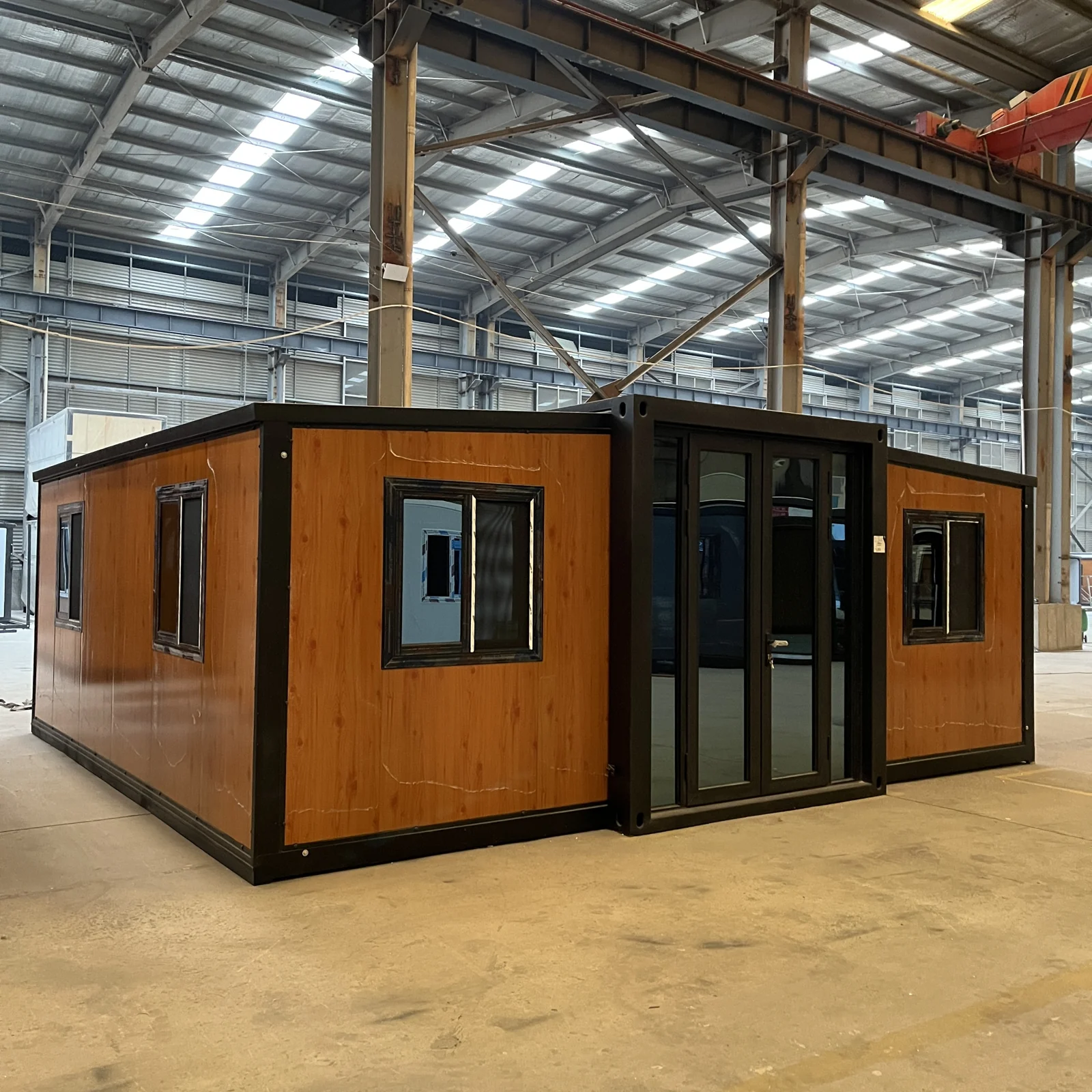
A container house delivered to Beirut and a container house delivered to the Cedars (2,000 m up in the Mount Lebanon range) are, on paper, the same steel box. In practice they face three different climates packed into a country 50 km wide. The coast is humid Mediterranean; drive 30 km inland and east and you are in snow country with winter lows near -10°C; and the whole country sits on the Dead Sea Transform, the fault system that produced the 2023 Turkey-Syria earthquakes 200 km to the north. Specifying one “Lebanon” container house for all three is the most common mistake buyers make. This guide sets out the actual numbers so the spec matches the site.
1. The climate you are actually designing for
Lebanon is small enough that buyers assume one specification covers it. It does not:
- Coast (Beirut, Tripoli, Sahel). Csa/Csb Mediterranean: hot, dry summers but wet, humid winters. Beirut’s January mean is about 13°C with relative humidity routinely 70-80%. The dominant failure mode is winter condensation and mold, not summer heat.
- Mountains (Bcharre, the Cedars, Zahle, 1,000-2,000 m+). Cold continental: winter lows of -5 to -10°C, real seasonal snow (1-3 m), and a far higher seismic coefficient than the coast.
- Seismic. Lebanon lies on the Levant (Dead Sea Transform) fault system. The 2023 Turkey-Syria sequence (Mw 7.8) was a direct reminder that the region carries significant hazard. Local peak ground acceleration is roughly 0.15-0.35g, higher in the mountains and inland north.
2. Failure mode 1 – the humidity you don’t see (coast)
The error is to treat Lebanon like the dry Gulf and under-specify vapour control. The coast is humid in winter, and a thin steel container envelope with discontinuous insulation sweats on the inside of the steel. The numbers:
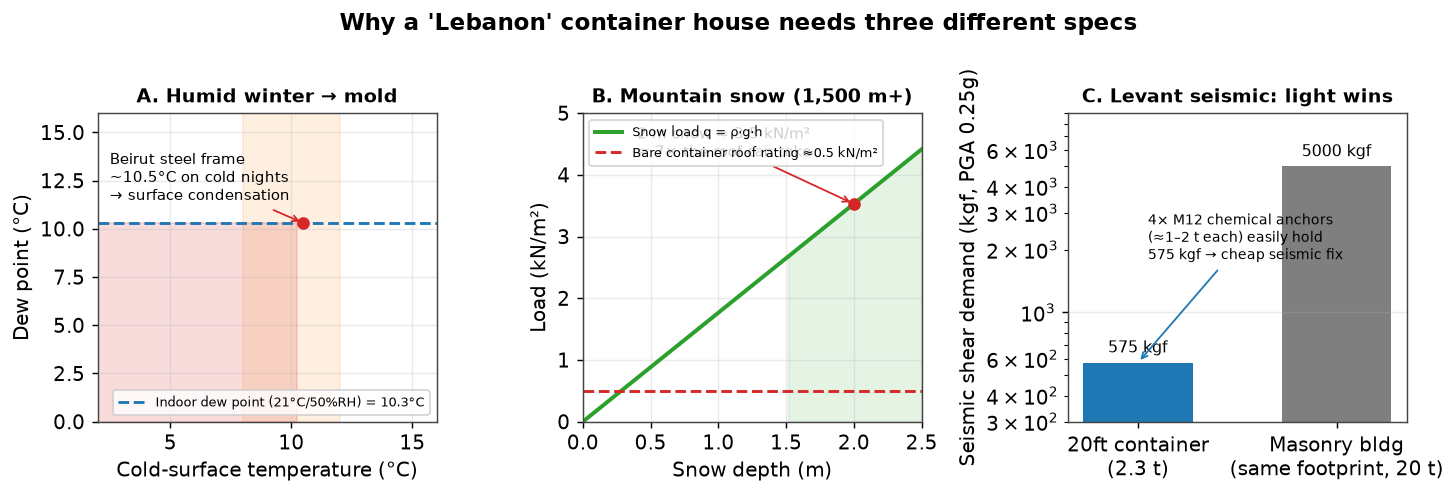
- Beirut in January: outdoor air ~13°C at 75% RH → dew point ≈ 9°C.
- Indoor comfort target 21°C at 50% RH → indoor dew point ≈ 10.3°C.
- On a cold night the steel frame surface drops toward the outdoor temperature. At ~10.5°C the steel is below the indoor dew point → visible condensation forms on the frame and in any cold bridge.
The fix is continuous insulation that breaks the thermal bridge (no exposed steel studs inside), a vapour control layer on the warm side, and mechanical ventilation so indoor humidity does not climb. This is the same discipline our Mediterranean climate guide for Spain and Portugal lays out, applied to a more humid-winter, more seismic market.
3. Failure mode 2 – mountain snow load (inland)
Buyers in the mountains often keep the flat factory roof “because containers are flat”. At 1,500 m and above, Lebanese winter snow reaches 1-3 m. Snow load is not small:
- Snow density in Lebanese mountain conditions is roughly 180 kg/m³.
- Load q = ρ·g·h. At 2 m depth: 180 × 9.81 × 2 / 1000 ≈ 3.5 kN/m².
- A bare container roof deck is rated for roughly 0.5 kN/m² live load – about one-seventh of a 2 m snow pack.
The correction is a pitched roof addition or a reinforced, snow-rated roof structure, plus roof drains that will not ice shut. Skipping this is the difference between a winter cabin and a collapsed one.
4. Failure mode 3 – Levant seismic: light weight is the advantage
Here the container house has a genuine edge over masonry, and the math is the reason. Seismic demand scales with weight. A 20ft container weighs about 2.3 t empty:
- Horizontal seismic shear V ≈ W × PGA / g. At PGA 0.25g and W = 2,300 kg: V ≈ 575 kgf.
- A same-footprint masonry building at ~20 t would demand about 5,000 kgf – roughly nine times more.
So a 20ft unit needs only a few chemical anchors to resist overturning – four M12 anchors, each rated 1-2 t in shear, comfortably hold 575 kgf. The lightness that worries people about wind is exactly what makes the unit cheap to anchor against earthquakes. The methodology is the same we used for the Himalayan seismic design in Nepal and the New Zealand earthquake anchoring guide.
5. Failure mode 4 – coastal ground, water table and corrosion
Much of Lebanon’s developable coast – Beirut, Tripoli, the sahel – is flat, reclaimed in places, with a high water table and seasonal wadis that flash-flood from the mountains. Two consequences:
- Floating. An empty 20ft container encloses about 33 m³; fully submerged it is pushed up by roughly 33 t of buoyancy against an empty weight of 2.3 t. It floats instantly if groundwater rises. Foundations must tie the unit down below the water table, not just sit it on grade.
- Corrosion. The coast is a C4-C5 chloride environment. Spec hot-dip galvanising plus a C5-rated coating, not the standard industrial primer.
Site selection and ground conditions are covered in our container-home site-selection and environment guide.
6. Engineering countermeasures (summary table)
| Site condition | Specification | Why |
|---|---|---|
| Coastal humid winter | Continuous PIR insulation, broken thermal bridges, warm-side vapour layer, HRV ventilation | Stops interior condensation and mold at 70-80% winter RH |
| Mountain snow (1,000 m+) | Pitched or snow-rated reinforced roof; ice-free drains | 2 m snow ≈ 3.5 kN/m² vs 0.5 kN/m² roof rating |
| Levant seismic | 4× M12 chemical anchors; light gauge framing; flexible services | Light weight → ~575 kgf demand, cheap to anchor |
| Coastal ground | Tie-downs below water table; C5 corrosion coating; raised floor | Prevents floating and chloride corrosion |
7. FOB to landed cost, Lebanon (Tianjin → Beirut)
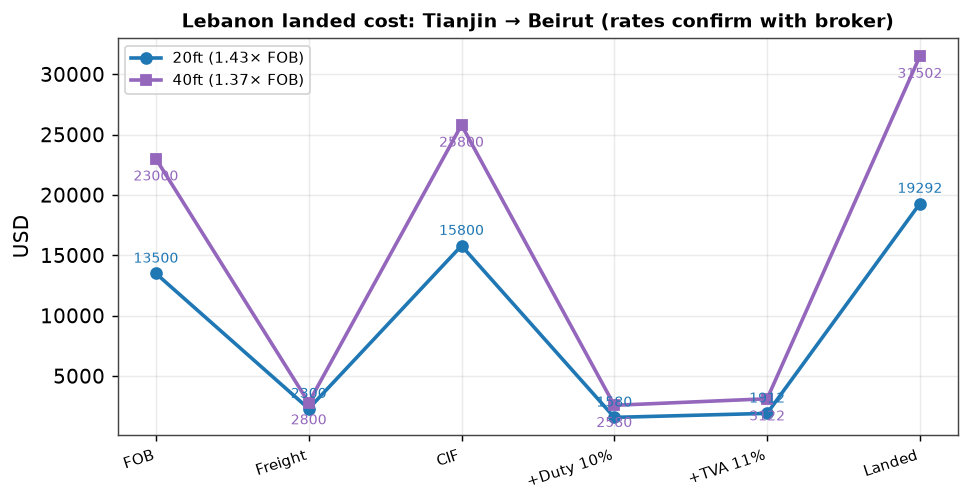
Representative 2026 figures for a factory-built expandable unit. Lebanon’s tariff schedule has been revised repeatedly since the 2019 financial crisis, so treat the 10% duty and 11% TVA below as planning figures and confirm both with a Beirut customs broker before contracting. Port of entry is Beirut.
| Item | 20ft (USD) | 40ft (USD) |
|---|---|---|
| FOB Tianjin (factory) | 13,500 | 23,000 |
| Ocean freight + insurance to Beirut | 2,300 | 2,800 |
| CIF (landed at Beirut port) | 15,800 | 25,800 |
| Import duty (HS 9406, ~10%*) | 1,580 | 2,580 |
| TVA / VAT (11% on CIF+duty) | 1,912 | 3,122 |
| Landed, Beirut | 19,292 | 31,502 |
| Landed multiple vs FOB | 1.43× | 1.37× |
*Lebanese customs duty on prefabricated buildings (HS 9406.00) is commonly assessed near 10%, but rates have changed several times since 2019 – verify the current rate with your broker. The mountain snow and seismic upgrades above are separate line items, not included in the base landed cost.
8. Compliance and certification
- Building code. Lebanon adopted the Lebanese Building Code (LBC); in practice many projects and engineers still reference the Egyptian code ECP 199/2012 for seismic and the Eurocodes (EN 1990-1998) for structural and snow loads. Confirm which applies with your structural engineer.
- Seismic. Design to the applicable code at the local PGA (coast ~0.15-0.20g, mountains higher). The light container weight keeps the anchoring bill low.
- Snow. For mountain sites, size the roof to EN 1991-1-3 (Eurocode snow load) for the local altitude and exposure.
- Corrosion. Coastal sites require C5-rated coating systems (ISO 12944).
- Import. HS 9406.00, duty ~10% (confirm), TVA 11%; arrange conformity and a Beirut broker before shipping.
Frequently asked questions
Do I need different specs for Beirut versus the mountains?
Yes. The coast needs humidity and corrosion control; the mountains (1,000 m+) need snow-rated roofing and a higher seismic coefficient. A single flat-roof coastal spec will fail in the mountains.
Will a container house survive a Lebanon earthquake?
Its low weight is an advantage: seismic demand is proportional to mass, so a 20ft unit needs only a few chemical anchors to resist overturning. The key is proper anchoring to a founded base, not the box itself.
Why does my coastal container get mold in winter?
Humid Mediterranean winters (70-80% RH) plus a thin, thermally bridged steel envelope cause interior condensation when the steel drops below the indoor dew point (~10°C). Continuous insulation and a vapour layer fix it.
Is the 10% import duty certain?
No. Lebanon’s tariff schedule has been revised repeatedly since 2019. Treat 10% as a planning figure and confirm the current HS 9406 rate with a Beirut customs broker before you contract.
Does the empty container really float?
Yes. An empty 20ft box encloses about 33 m³ and is pushed up by ~33 t of buoyancy against 2.3 t of weight. On a high-water-table coastal site it must be tied down, not just placed on grade.
What coating do I need on the coast?
A C5-rated system (ISO 12944) over hot-dip galvanising, because the Lebanese coast is a chloride-rich C4-C5 environment that rapidly attacks standard industrial primer.
Get a Lebanon-spec container house
HUAYING builds factory-direct expandable, folding and flat-pack container houses spec’d to the actual Lebanese site – coastal humidity and C5 corrosion control, mountain snow-rated roofing, and Levant seismic anchoring – all decided before shipping. Email jack@huayinghouse.com or reach us on WhatsApp at +86 153-0318-4505 for a FOB and landed quote to Beirut. For the commercial side – prices, shipping and import steps – see our Lebanon factory-price and import guide; for the climate and code method see our Mediterranean design guide and the seismic methodology we apply across earthquake zones.