The search “container house foundations” is one of the most common ways buyers arrive at this site – and one of the most often answered with the wrong page. A foundation is not a generic part you bolt on; the right choice is set by the ground, not the box. A slab that is ideal on stable temperate soil will heave in a cold climate, float in a floodplain, or settle into reclaimed land. This guide pulls the foundation decision across climate zones into one place, so you can match the method to the site before you pour anything.
1. Why the foundation depends on the climate
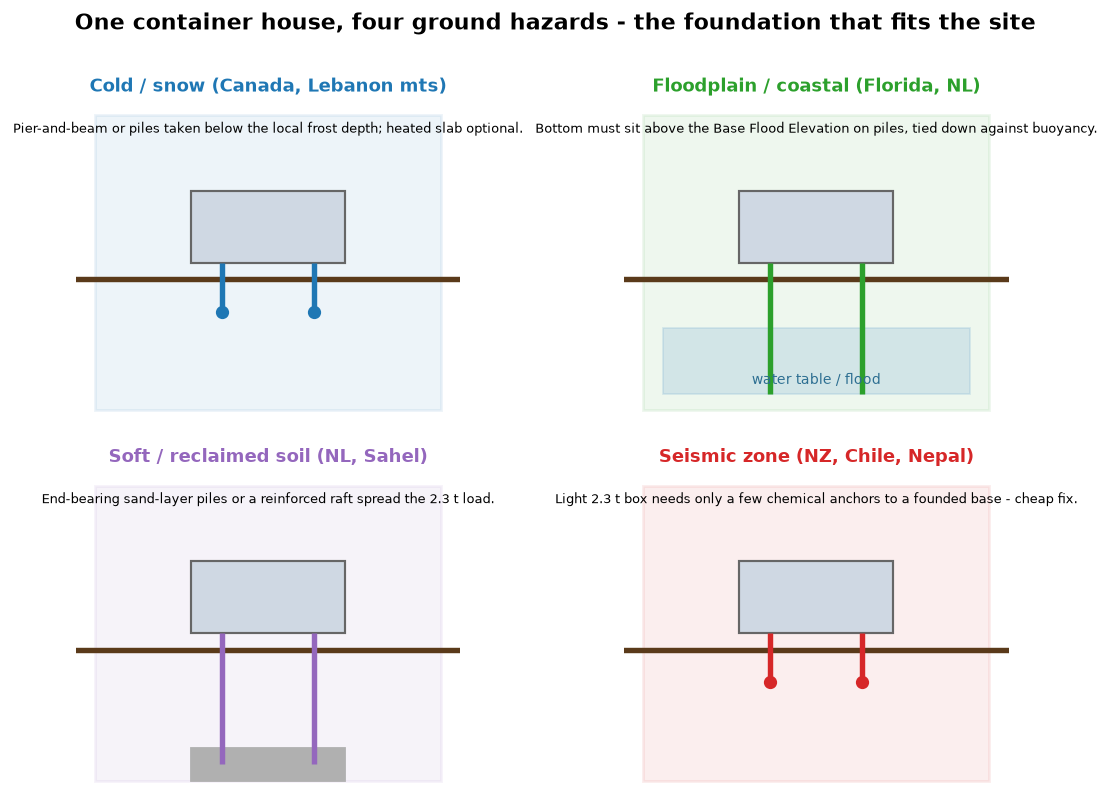
A factory-built container weighs about 2.3 t empty and sits on a small footprint, so it is gentle on the ground – but it is also light enough to be pushed around by frost, water and earthquakes. Four hazards drive the choice:
- Frost heave. In cold climates the ground freezes to a depth of 0.5-1.5 m. Water in the soil expands and lifts anything resting on it.
- Flood floatation. An empty box is buoyant. On a high water table or in a flood zone it floats unless tied down.
- Soft or compressible soil. Reclaimed land, fill, or high water tables cannot take point loads without spreading them.
- Seismic demand. The light box needs only minimal anchoring – but it must be anchored to something founded.
2. The four foundation families
| Method | Use it when | How it works |
|---|---|---|
| Grade beam on piers / footings | Stable, well-drained temperate soil; no frost or flood risk | Concrete footings carry the corner and edge loads; a shallow beam ties them. Cheapest on good ground. |
| Reinforced raft slab | Soft, compressible or variable soil | One thick reinforced slab spreads the 2.3 t load over the whole footprint, avoiding point settlement. |
| Driven or screw piles | High water table, floodplain, or need for cheap seismic anchoring | End-bearing piles reach competent soil below the weak layer; also tie the unit down against buoyancy and overturning. |
| Adjustable steel feet / ground screws | Temporary, low-frost, light-use sites | Mechanical supports level the unit without concrete; reversible and fast. |
3. Climate-to-foundation matrix
| Climate / site | Foundation | Key rule |
|---|---|---|
| Cold / snow (Canada, mountain Lebanon) | Piers or piles taken below local frost depth; heated slab optional | Footings must sit below the frost line or the slab heaves. |
| Humid / tropical (Malaysia, Brazil) | Raised floor 300 mm+ on piers, ventilated, termite-protected | Keep the steel off damp ground; ventilate the under-floor. |
| Floodplain / coastal (Florida, Netherlands) | Piles with the occupied floor above the Base Flood Elevation, tied down | Buoyancy beats weight – anchor it, don’t just place it. |
| Soft / reclaimed soil (NL, Sahel) | End-bearing sand-layer piles or reinforced raft | Spread or transfer the load to competent soil. |
| Seismic zone (NZ, Chile, Nepal, Lebanon) | Few chemical anchors to a founded base | Light 2.3 t box → ~575 kgf demand; anchoring is cheap. |
The flood and seismic rules are the ones buyers most often get wrong. On coastal and earthquake sites the mistake is treating the container like a heavy building; in fact its low weight is the advantage, provided it is tied to a founded base. Our Florida hurricane foundation note and the Nepal seismic design guide work through the numbers, and the Netherlands geotech guide covers soft-soil piling.
4. Representative on-site foundation cost
These are on-site costs only (not the container, not shipping). They vary with local labour and concrete prices, but the ordering is stable:
| Method | Typical USD per unit | When it is the right call |
|---|---|---|
| Gravel pad + ground screws | 800 – 1,500 | Good ground, temporary or light use |
| Concrete pier / footing grade beam | 1,500 – 3,000 | Stable temperate soil |
| Screw / driven piles (flood or seismic) | 2,500 – 5,000 | High water table, flood zone, or anchoring need |
| Reinforced raft slab | 3,000 – 6,000 | Soft or compressible soil |
| Ballast frame (no excavation, flat-pack) | 400 – 900 | Hard, level ground; wind-ballast only |
The pile and raft options cost more up front but they are the difference between a unit that stays put and one that floats, heaves or settles. Our site-selection and environment guide explains how to read a plot before you choose.
5. Compliance you cannot skip
- Geotech report. Any site with soft soil, a high water table, or a slope needs a soil test before the foundation is designed – not after.
- Frost depth. Cold-climate jurisdictions set a minimum footing depth by code; match it.
- Flood zone. In regulated floodplains the finished floor must clear the Base Flood Elevation; check the local flood map.
- Seismic tie-down. Even a light unit must be anchored per the local seismic code; the anchor schedule is small but mandatory.
- Building approval. The foundation is part of the permitted structure – it goes through the same code review as the box (see our Australia building-code overview for how code review works in practice).
Frequently asked questions
Can I just put the container on the ground?
On hard, level, well-drained ground with no frost or flood risk, a ballast frame or pads can work. Anywhere with soft soil, frost, or water, you need a real founded base or it will move.
Does a container house need deep foundations?
Not usually. Its low weight means shallow piers or a raft are often enough – unless the soil is weak, the site floods, or the frost is deep, in which case piles or below-frost footings are required.
Why does my coastal container float?
An empty 20ft box encloses about 33 m³ and is pushed up by ~33 t of buoyancy against 2.3 t of weight. On a high water table it must be tied down on piles, not placed on grade.
Is a raft slab better than piles?
For soft, uniform soil a raft spreads the load cheaply. For very weak soil, floodplains, or where you need anchoring, piles that reach competent soil are the safer choice.
Do I need a geotech report?
If the soil is anything other than obviously competent and dry, yes. It is far cheaper than fixing a settled or floated unit later, and it is usually required for the permit.
Get a site-spec container house foundation plan
HUAYING ships factory-direct expandable, folding and flat-pack container houses worldwide, and the foundation is part of the site package we spec with you – frost depth, flood level, soil and seismic demand included. Email jack@huayinghouse.com or reach us on WhatsApp at +86 153-0318-4505 with your plot details for a FOB and landed quote. For the ground-decision method read our site-selection guide, and for climate-specific structure see the seismic, flood and soft-soil references.