
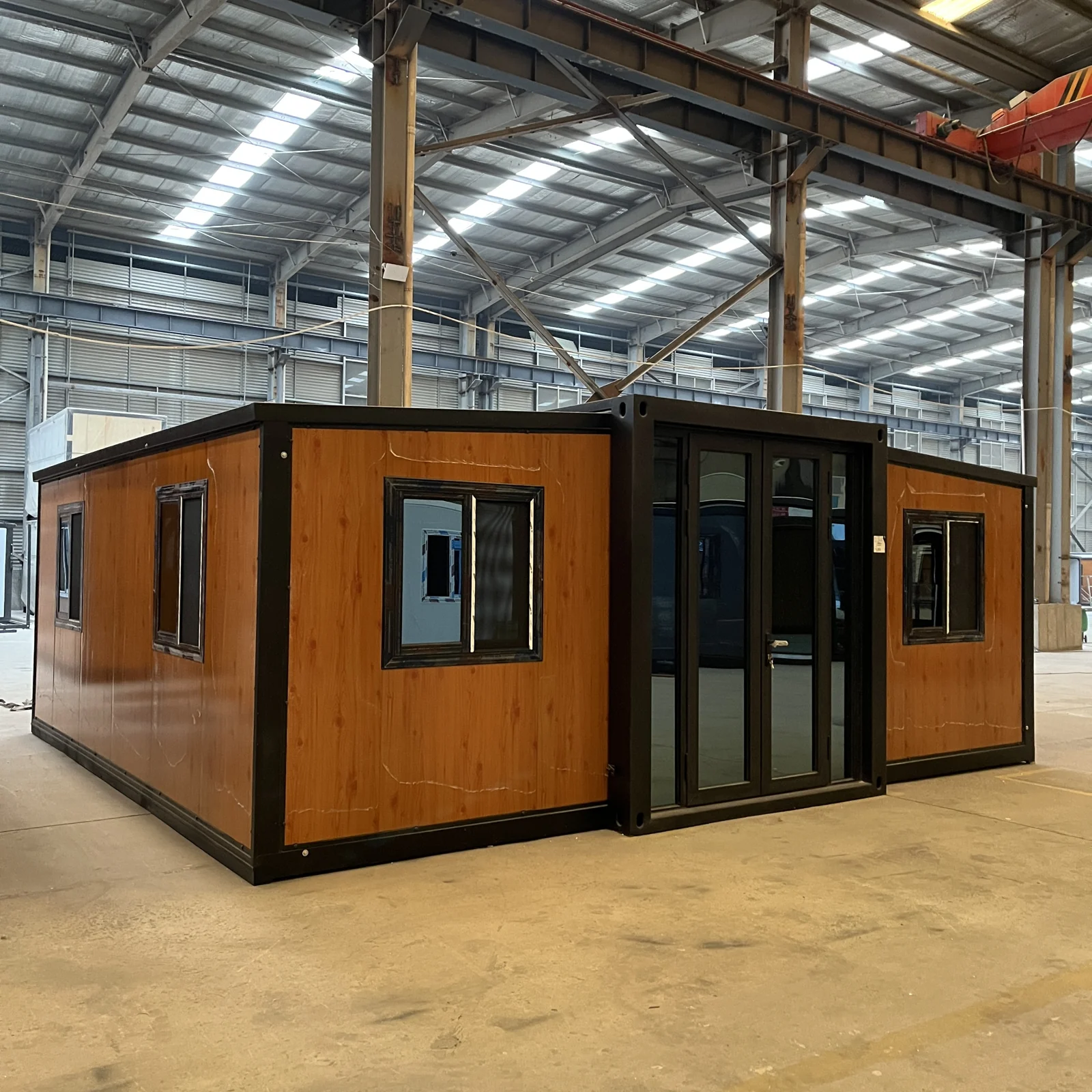
Ulaanbaatar is the coldest national capital on earth. Its January mean is about -21.6°C, nights regularly reach -30°C, and the record low is -44°C — while July averages +22.7°C. That is an 80 K swing between recorded extremes. Buyers who specify a container house for Mongolia usually reach for the same playbook used in Canada or Scandinavia: add thick insulation, specify a heavy snow-rated roof, and assume the biggest cost is freight. Almost every one of those assumptions is wrong for this market. This guide sets out the actual engineering numbers and the real cost chain for a factory-direct module shipped overland from Tianjin to Ulaanbaatar.
1. The climate you are actually designing for
Ulaanbaatar sits at 47.9°N and 1,351 m above sea level in the Tuul River valley, hemmed in by mountains. It is classed as cold semi-arid (Köppen BSk) bordering subarctic, and it is the world’s coldest capital. The numbers that matter for a steel module:
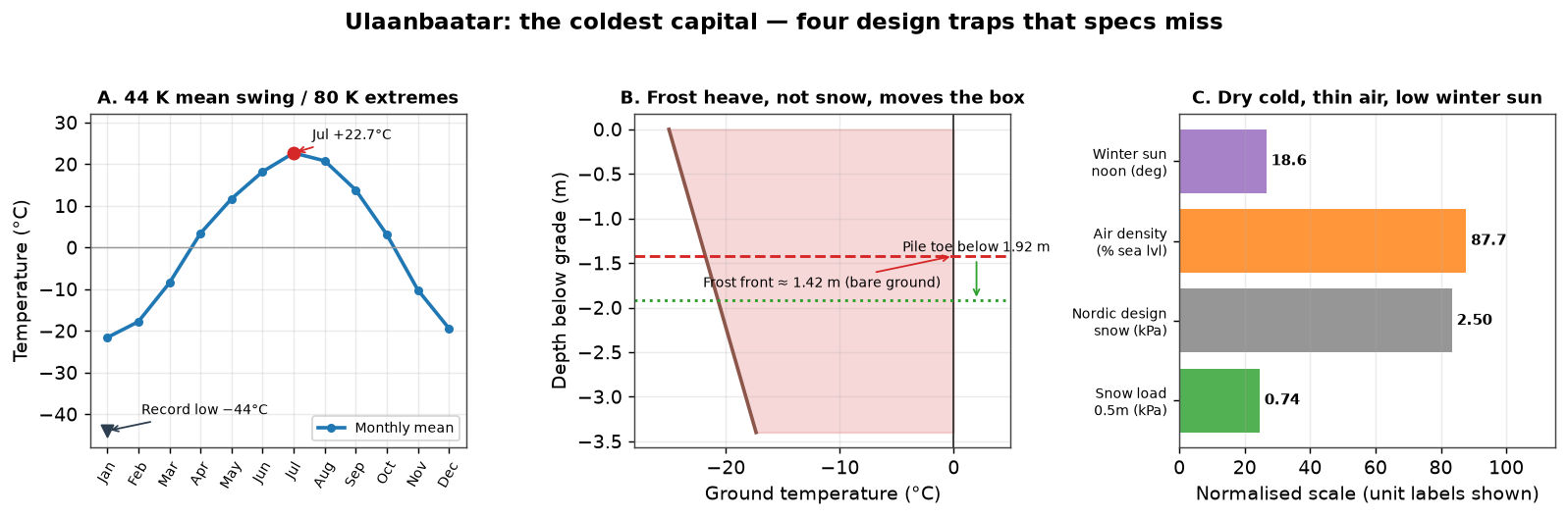
- Temperature. January mean -21.6°C, mean daily low -26.5°C, record -44°C; July mean +22.7°C, record +36°C. A temperature inversion traps cold air in the valley, so the coldest readings come just before sunrise.
- Rainfall. Only about 216 mm a year, most of it June–September. This is a dry climate — the design problem is not water, it is cold and ground movement.
- Ground. Ulaanbaatar lies in a zone of discontinuous permafrost. Whether a given plot is frozen year-round depends on aspect and shading, which makes two sites a few hundred metres apart genuinely different foundation problems.
- Altitude. At 1,351 m the air density is about 87.7% of sea level. Combustion appliances derate by roughly 12.3%, and UV is stronger — both affect a module’s services and exterior coatings.
- Seismic. National mapping places the capital in intensity zone 6 (MSK-64). This is moderate, not extreme, but it still dictates anchorage detailing.
2. Insight one: frost heave, not snow, is what moves the box
The instinct for a “-40°C country” is to design for snow. That is the wrong load case here. Ulaanbaatar’s 216 mm annual precipitation is less than a fifth of coastal Vancouver’s, and a 0.5 m cover of dry continental snow (about 150 kg/m³) produces only 0.736 kPa — against 2.0–3.0 kPa design snow loads in Nordic or Canadian snow country. A heavy snow-rated roof is largely wasted money here.
The real threat is below grade. Using the Stefan equation with a freezing index of about 4,700 °C·days and frozen silt, the frost front reaches roughly 1.42 m on bare ground over a winter. When moisture migrates to that freezing front it forms ice lenses and the soil heaves; on thaw it loses bearing capacity. A shallow slab poured on undisturbed ground will be lifted and then left unsupported. This is why Ulaanbaatar’s traditional ger dwellings deliberately do not penetrate the soil — the local building form had already solved the permafrost problem centuries before modern codes.
The engineering answer is a pile foundation with the toe set below the frost front plus a safety margin — about 1.92 m embedment for the bare-ground case — combined with a ventilated crawl space so heat from the module does not thaw the soil beneath it. Get this wrong and no amount of wall insulation helps: the box cracks at the connections long before it gets cold inside.
3. Insight two: at -44°C, breaking the thermal bridge beats adding insulation
Heat loss is U × A × ΔT. The ΔT here is brutal: 21°C indoors against -44°C outside is 65 K, about 2.5× a temperate winter design condition of -5°C. On a 78 m² expanded envelope, a conventional steel-stud wall with 100 mm PIR but continuous steel studs (U≈0.55 W/m²K) loses about 2.79 kW at design temperature. Add thermal-break pads at the studs and raise the roof to 120 mm PIR (U≈0.28) and the loss falls to 1.42 kW — a 49.1% reduction, roughly 1.37 kW of continuous heating demand, for a small fraction of the cost of simply adding another 50 mm of insulation everywhere.
The mechanism is simple: insulation slows heat flow through the cavity, but a continuous steel member conducts heat straight through it and, on the cold inner face, drops below the dew point and condenses. In a high ΔT climate the bridge dominates. Break the bridge first, then add R-value.
Two more cold-climate details matter. First, at high airtightness you need mechanical ventilation with heat recovery (HRV) — otherwise CO₂ builds up and windows sweat. Second, a heated or insulated floor assembly is non-negotiable: a cold floor radiates heat away from occupants even when the air temperature reads 21°C. Our detailed cold-climate method is set out in the Canada cold-climate and snow-load guide, and the altitude effects overlap with the continental-climate analysis and the seismic anchorage methodology.
4. Insight three: this is a rail market, not a sea-freight market
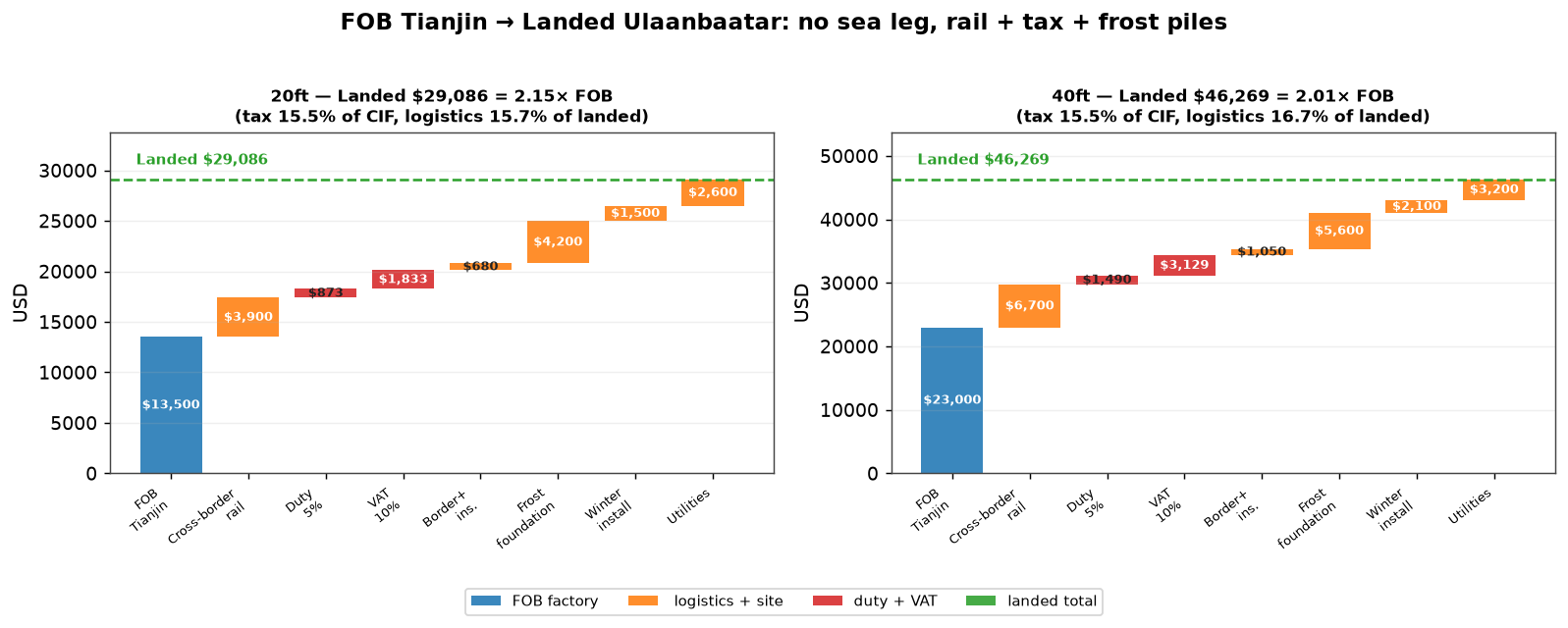
Mongolia is landlocked between China and Russia. There is no port leg in the landed-cost chain: a module leaves the Tianjin factory by rail, crosses at the China–Mongolia border (Erenhot / Zamyn-Üüd, where the gauge change happens), and continues to Ulaanbaatar. That single fact reshapes the cost model. For a 20 ft module the cross-border rail move is about $3,900, while duty (5% MFN on HS 9406) and VAT (10%) together add $2,706. In other words logistics is a larger share of landed cost than tax — the opposite of sea-shipped markets such as Brazil or Australia where the tax stack dominates.
5. FOB → Landed cost breakdown
The table below prices a factory-direct module delivered to a prepared Ulaanbaatar site. Values are indicative USD and must be re-quoted against the actual rail tariff, exchange rate and site conditions at order time.
| Cost line | 20 ft module (USD) | 40 ft module (USD) | Note |
|---|---|---|---|
| FOB Tianjin | 13,500 | 23,000 | Factory price, expandable module |
| Cross-border rail + insurance | 3,960 | 6,800 | Tianjin → Erenhot → Ulaanbaatar, gauge change |
| Import duty (5% MFN) | 873 | 1,490 | HS 9406 prefabricated buildings |
| VAT (10%) | 1,833 | 3,129 | Applied to CIF + duty |
| Border handling / clearance | 620 | 950 | Customs, inspection, local delivery |
| Base landed (before site works) | 20,786 | 35,369 | |
| Anti-frost pile foundation | 4,200 | 5,600 | Toe below 1.92 m frost line |
| Winter installation allowance | 1,500 | 2,100 | Heat, enclosures, short winter daylight |
| Utilities / connections | 2,600 | 3,200 | Power, water, heating hookup |
| Total landed (climate-ready) | 29,086 | 46,269 | 2.15× / 2.01× FOB |
| Optional cold-climate upgrade pack | +3,100 | +4,400 | 120 mm PIR, thermal breaks, HRV, heated floor, Low-E |
Tax is 15.5% of CIF here — moderate by global standards — while rail and site works are the real cost drivers. The full breakdown method is explained in our landed-cost guide.
6. Corrosion, compliance and codes
Ulaanbaatar’s climate is dry, so atmospheric corrosion is far milder than in coastal or tropical markets — a standard C3 coating system is usually sufficient, with C4 only for industrial microclimates. The stronger durability concern is the freeze–thaw cycle attacking exposed fasteners and any trapped moisture in the envelope, so specify sealed connections and a drained cavity.
On compliance: imported modules are declared under HS 9406 (prefabricated buildings). China and Mongolia both apply WTO MFN treatment, giving a 5% duty rate; the general (non-MFN) rate is 10%. Import VAT is 10%, assessed on CIF plus duty. Building approval follows Mongolian national norms (MNS / BNbD) and the capital’s zoning authority; seismic detailing should reference the zone-6 requirement, and cold-region thermal performance should be documented to a recognised standard such as the methods in our climate-adaptability reference. Because codes and customs practice change, confirm the current tariff line and any building-permit requirements with a local customs broker and the Ulaanbaatar authorities before ordering. The Germany snow-load and overheating guide shows how we document thermal compliance for cold European markets.
7. A note on “one spec for all of Mongolia”
Mongolia spans roughly 42°N to 52°N and includes high mountains, steppe and the Gobi desert. The design above targets Ulaanbaatar — high-altitude, semi-arid, discontinuous permafrost. A unit destined for the southern Gobi faces extreme summer heat and dust instead, and one for the northern aimags faces deeper continuous permafrost and heavier snow. Treat each site on its own climate and ground data. We spec every module against the actual address, not a country label.
Frequently asked questions
How much does a container house cost in Mongolia?
A 20 ft climate-ready module lands at roughly $29,086 and a 40 ft at $46,269, including rail freight, 5% duty, 10% VAT, anti-frost piles and winter installation. The optional cold-climate upgrade pack adds 3,100–4,400 USD.
Is snow load the main structural concern in Ulaanbaatar?
No. With only 216 mm of annual precipitation, a 0.5 m snow cover yields about 0.736 kPa — well below Nordic design loads. Frost heave and the freeze–thaw weakening of foundations are the dominant ground risks.
Can a container house handle -44°C?
Yes, if specified correctly: thermal breaks at steel studs, 100–120 mm PIR, double Low-E glazing, an insulated heated floor, HRV ventilation and a foundation below the 1.42 m frost front. A standard tropical-spec module cannot.
Is there sea freight to Mongolia?
No — Mongolia is landlocked. Modules move by rail from Tianjin through the Erenhot/Zamyn-Üüd border crossing (with a gauge change) to Ulaanbaatar. This is why logistics, not tax, is the largest cost component.
What about gas appliances at altitude?
At 1,351 m the air is about 87.7% of sea-level density, so combustion appliances derate roughly 12.3%. We size heating equipment for the design temperature and altitude together, and offer all-electric heat-pump options where gas supply is unreliable.
Get a Mongolia-spec quote
HUAYING builds factory-direct expandable, folding and flat-pack container houses specified for the actual site — anti-frost pile foundations, thermally broken envelopes, HRV and winter installation planning decided before the module leaves Tianjin. For pricing and shipping to Ulaanbaatar, email jack@huayinghouse.com or reach us on WhatsApp at +86 153-0318-4505. Ask for a FOB and landed quote with the rail schedule and a site-specific foundation recommendation.