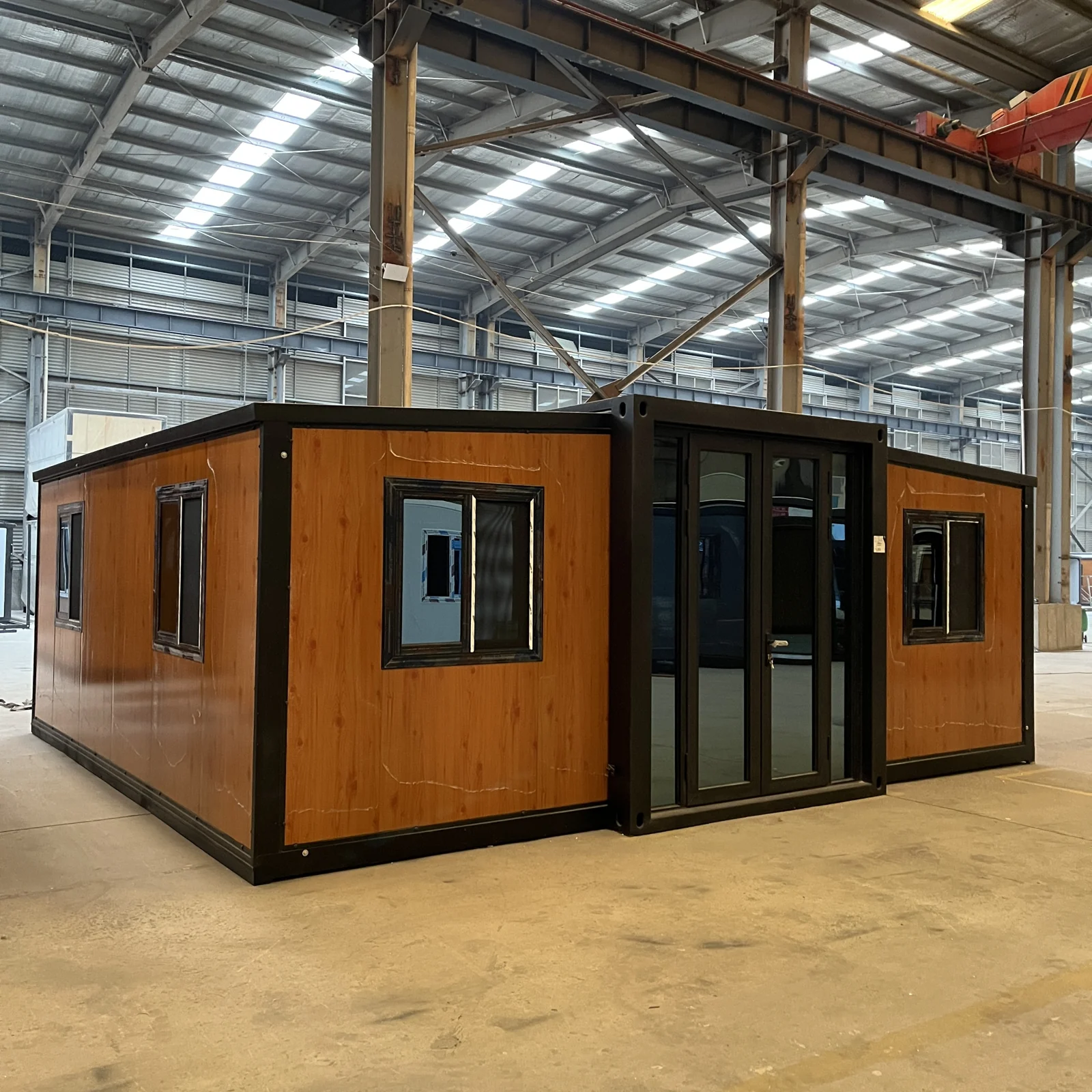
Most “climate” guides for container houses talk about heat, cold or hurricanes. Bolivia asks a different question: what happens to a steel box at 4,000 metres above sea level, where the air is thin, the sun is twice as harsh, and the ground moves? La Paz (3,650 m) and El Alto (4,050 m) are the two highest capital-city metros on earth. Building there is not a temperature problem — it is an altitude problem, and it changes the engineering in four ways most buyers never anticipate.
1. Why altitude — not temperature — is the design variable
Bolivia is landlocked, so every module arrives by sea to a Chilean or Peruvian port (Arica or Matarani) and is hauled over 1,000 km of mountain road across passes above 4,000 m before it reaches La Paz. That single logistics fact already shapes the cost (Section 5). But the physical altitude does the stranger things:
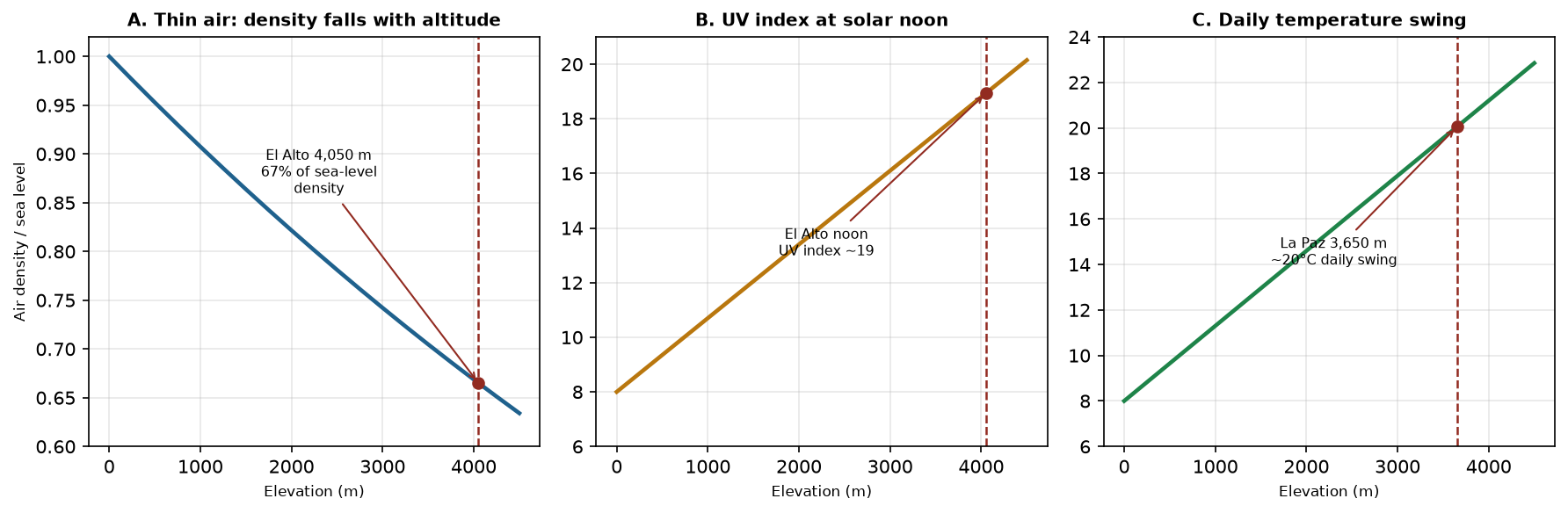
- At 4,050 m the air holds only 67% of the density it has at sea level. Combustion and heat-exchange equipment are designed for sea-level air.
- Solar UV at solar noon in El Alto reaches a UV index around 19–20 — roughly double the 8–10 you get at sea level.
- The Altiplano swings 18–25°C between day and night, every day of the year, because the thin dry air cannot hold heat after sunset.
2. Six failure modes specific to the Bolivian Altiplano
(1) Thin-air combustion and carbon monoxide. A naturally-aspirated LPG or diesel heater, or a generator, is calibrated to sea-level oxygen. At 4,000 m it loses roughly a third of its output and, worse, burns incompletely — raising CO risk in a sealed winter cabin. The fix is not “a bigger heater”; it is an altitude-rated or electric system.
(2) UV destruction of seals and coatings. Standard EPDM window gaskets and acrylic top-coats are formulated for temperate UV. At a UV index of 19 they chalk, harden and crack in 1–2 years instead of a decade. This is the most common “my container leaked after one winter” complaint in the Andes.
(3) Thermal-cycling fatigue. A 20°C day–night swing means the steel and its fixings expand and contract every 24 hours. Self-tapping screws work loose, and rigid silicone sealant eventually tears at the joint. The box is mechanically fine — the connections fatigue.
(4) Freeze–thaw of trapped moisture. Daytime meltwater that enters a poorly drained wall cavity refreezes at night, expanding and cracking the assembly from inside. A vapour-open interior with a drained cavity is the only durable answer.
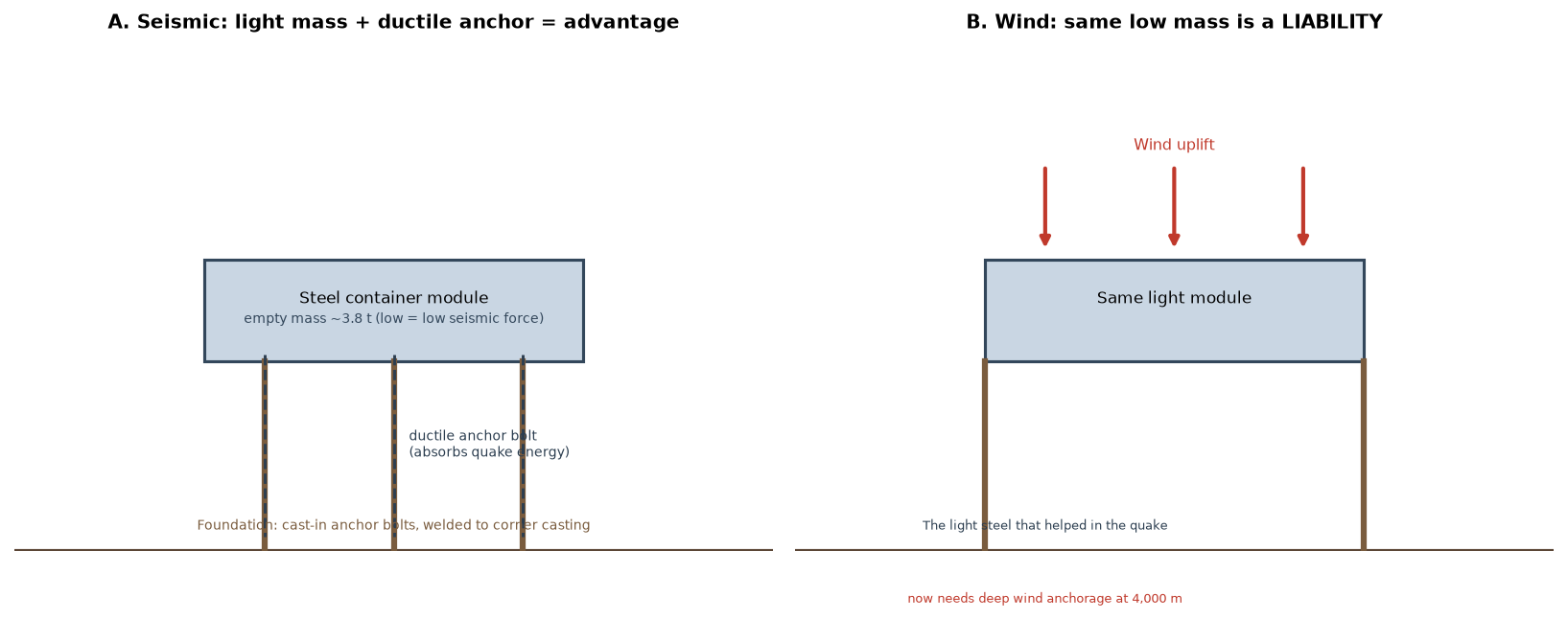
(5) The wind–quake duality. A container’s low mass is a seismic advantage (less force, F = m·a) but a wind liability (less weight to resist uplift). The same lightness that protects it in a quake makes it want to lift in an Altiplano wind.
(6) Seismic demand. Bolivia sits on the sub-Andean thrust. La Paz falls in a high seismic zone with a peak ground acceleration around 0.30 g — and until November 2023 the country had no national seismic code at all.
3. Engineering countermeasures for altitude
| # | Countermeasure | Specification for Bolivia | Why it matters at altitude |
|---|---|---|---|
| A1 | Heating & power | Altitude-rated or electric heating; sealed-combustion units only, with CO alarms | Natural-draft gas loses ~33% output and risks CO at 4,000 m |
| A2 | UV-resistant seals | Carbon-black EPDM or silicone gaskets; PVDF-coated (or marine-grade) steel skin | Standard seals chalk and fail in 1–2 years under UV index ~19 |
| A3 | Thermal-cycling joints | Spring washers on all fixings; flexible (not rigid) sealant at panel joints | 20°C daily swing loosens screws and tears rigid sealant |
| A4 | Drained, breatheable wall | Vapour-open interior lining; drained cavity; no trapped moisture | Prevents internal freeze–thaw cracking |
| A5 | Seismic anchorage | Cast-in anchor bolts welded to corner castings; ductile connection to foundation (per NBDS-2023) | La Paz PGA ~0.30 g; ductility absorbs quake energy |
| A6 | Wind anchorage | Deep helical or cast piers; the light module is tied down, not just set on pads | Low mass that helps in quakes must be held against uplift |
4. FOB → Landed cost breakdown (Bolivia, 2026)
Because Bolivia is landlocked, “landed” means ocean to a Pacific port plus a long high-altitude overland haul. The overland leg — not the ocean — is what makes a Bolivian unit expensive relative to a coastal market.
| Stage | Item | 10-ft (USD) | 20-ft (USD) | 40-ft (USD) |
|---|---|---|---|---|
| Factory | FOB Tianjin (ex-works) | 9,000 | 13,500 | 22,000 |
| Sea | Ocean Tianjin → Arica (Chile), 40HQ-equiv | 2,400 | 2,800 | 3,200 |
| Road | Overland Arica → La Paz (~1,100 km, 4,000 m passes) | 2,400 | 2,800 | 3,200 |
| handling | Terminal, documentation, insurance | 550 | 680 | 800 |
| CIF at Bolivian port of entry | 14,350 | 19,780 | 29,200 | |
| Tariff | Import duty (Andean CET, assume ~10%; verify with Aduana Bolivia) | 1,435 | 1,978 | 2,920 |
| IVA | Bolivian VAT 13% on (CIF + duty) | 2,052 | 2,819 | 4,176 |
| Landed, cleared | 17,837 | 24,577 | 36,296 | |
| Altitude | UV seals, electric heat, thermal-break, seismic anchor package | 1,800 | 2,400 | 3,200 |
| Site | Foundation & anchorage | 900 | 1,200 | 1,500 |
| Turnkey delivered & compliant | 20,537 | 28,177 | 41,000 | |
| Multiple of FOB | 2.28× | 2.09× | 1.86× | |
The smaller the unit, the higher the multiple — fixed ocean-and-road handling does not shrink, so a 10-ft module lands at 2.28× FOB versus 1.86× for a 40-ft. Bolivia’s 13% IVA (the rate is charged “por dentro”, so the effective burden on the net price is about 14.94%) applies to CIF plus duty; the assumed 10% import duty follows the Andean Community CET for prefabricated structures and should be confirmed with the Aduana Nacional de Bolivia for the specific HS 9406.20 classification.
5. Codes, permits and import duty
NBDS-2023 (Norma Boliviana de Diseño Sísmico), approved by Ministerial Resolution 271 on 27 November 2023, is Bolivia’s first-ever national seismic design standard, built from CTBTO seismic records at station PS06 in La Paz. It defines eight seismic zones; La Paz and El Alto sit in the highest bands (PGA up to ~0.30 g in Zone 4). Any foundation anchorage for a container home in these cities should be checked against NBDS-2023, not against an ad-hoc rule of thumb.
Import duty: prefabricated buildings under HS 9406.20 are subject to the Andean Community Common External Tariff. Rates are commonly in the 0–10% band; we model 10% as a conservative landed-cost driver and recommend confirming the exact rate with Bolivian customs before quoting. IVA is 13% (Ley N° 843), currently levied on a tax-inclusive base.
Local permits vary by municipio. La Paz and El Alto municipalities govern their own building approvals; a container home is typically treated as a prefabricated or modular structure and needs the municipal licence (licencia municipal) plus, in seismic zones, structural drawings consistent with NBDS-2023.
6. Four Bolivian scenarios
La Paz / El Alto residential: full A1–A6 package — electric heating, UV seals, seismic anchorage. Highest compliance bar in the country.
Mining camp (Potosí, Oruro highlands): altitude and freeze–thaw dominate; standard tropical specs will fail within a season. Prioritise A2/A3/A4.
Eco-lodge (Lake Titicaca, 3,800 m): tourism-grade finish plus the altitude thermal package; the daily swing makes a thermal break non-negotiable for guest comfort.
Lowland Santa Cruz: a different climate entirely — humid subtropical, no altitude effects, but add tropical moisture management. The same catalogue needs a different specification below 1,000 m.
For the underlying cost mechanics, see our FOB-to-landed cost guide. The seismic logic is the same physics we apply in our Nepal Himalayan guide and our New Zealand NZS 1170.5 guide; the UV-seal problem is the opposite of what we fight in the Saudi/UAE desert heat guide, where the enemy is heat gain rather than UV breakdown.
Frequently asked questions
Can a normal gas heater be used at 4,000 m? Not safely. At 67% air density a naturally-aspirated unit loses about a third of its output and burns incompletely, raising carbon-monoxide risk in a closed cabin. Use an altitude-rated or electric system with CO alarms.
Why do seals fail so fast in Bolivia? Solar UV at El Alto reaches a noon index around 19–20 — about twice sea-level intensity. Standard EPDM and acrylic coatings chalk and crack in 1–2 years; carbon-black EPDM, silicone and PVDF-coated steel last.
Is a container house safe in a Bolivian earthquake? Its low mass is a seismic advantage, and ductile anchor bolts to the foundation absorb quake energy. La Paz sits near 0.30 g PGA under the new NBDS-2023, so anchorage must be engineered, not improvised.
Why is delivery so expensive? Bolivia is landlocked. Every unit crosses the Pacific to Chile or Peru, then travels ~1,100 km over 4,000 m passes by road. The overland leg — not the ocean — drives the Bolivia premium.
What does a 40-ft unit cost delivered? About $41,000 turnkey and compliant (≈ 1.86× FOB), including the altitude package, seismic anchorage, 10% assumed duty and 13% IVA.
Do I need a permit? Yes — a municipal licence in La Paz/El Alto, with structural drawings consistent with NBDS-2023 for the seismic zone. Confirm the path with the municipio before delivery.
Get a Bolivia-specific spec sheet
HUAYING engineers container houses to the altitude, UV and seismic reality of your exact Bolivian site — not a sea-level template. Send your location and elevation, and we return an altitude package with a landed quote. Contact jack@huayinghouse.com or WhatsApp +86 153-0318-4505.