A container house does not arrive with a foundation, and in the United States the foundation is the line item that most often doubles a buyer’s initial budget estimate. It is also the one part of the project that cannot be value-engineered after the unit lands, because the permit is issued against it. This guide sets out what each legal option costs in 2026, which one the site actually allows, and where buyers get caught.
The figures below are for a single 20 ft expandable unit. They assume a level site with reasonable access, and they exclude electrical, water and sewer connections. Your state, county and city will change both the number and the paperwork.
Three numbers decide the foundation, not preference
Before anyone quotes a foundation, three site-specific numbers have already narrowed the choice. The first is frost depth: in Minnesota or Colorado the local frost line can sit below 40 inches, and a shallow pad that works in Arizona will heave there. The second is design wind speed under ASCE 7, which in coastal Florida or exposed coastal Texas turns the question from “can it carry the load” into “can it stay on the ground”. The third is soil bearing capacity, and expansive clay across parts of Texas and Colorado is the usual reason a cheap pad turns into a repair.
Ask for those three values in writing before you compare quotes. A contractor who quotes without them is quoting a product, not a site.
What each option costs installed
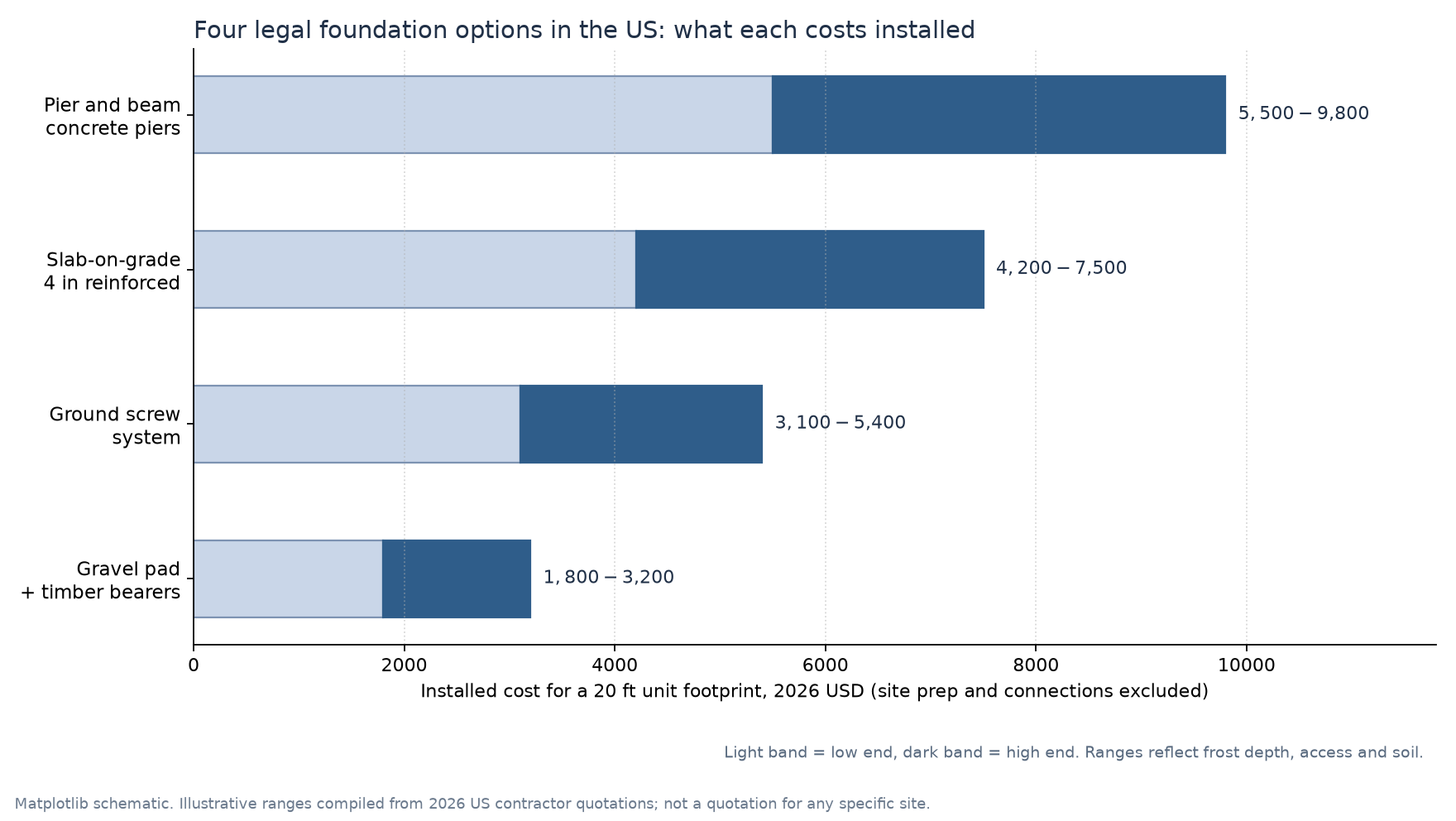
The table below is the short version. The chart after it shows the same ranges visually, because the spread between low and high end is usually about access and soil, not about the foundation type itself.
| Option | Installed cost, 20 ft unit | Where it works | Where it fails |
|---|---|---|---|
| Gravel pad with timber bearers | $1,800 – $3,200 | Dry, frost-free states; temporary or rental deployments | Frost heave, wind uplift, any site that needs a permit for a permanent dwelling |
| Ground screw or helical pile system | $3,100 – $5,400 | Slopes, high water tables, sites where concrete cannot be poured | Rock within the first metre, and jurisdictions that do not recognise engineered screw systems |
| Slab-on-grade, 4 in reinforced | $4,200 – $7,500 | Frost-free or shallow-frost states, flat sites, permanent dwellings | Frost-susceptible ground without a frost-protected detail, and flood zones |
| Pier and beam, concrete piers | $5,500 – $9,800 | Most of the US; keeps the steel base out of ground moisture | Poorly planned pier spacing that does not land under the container floor beams |
What actually goes wrong on US sites
Frost heave lifts a pad that was never designed for it. A gravel pad is level the day it is built. In a state with a 36 inch frost line, the same pad can move several inches in a single winter, and the container racks because one corner rises while the others do not. The fix is either to get below frost depth with piers, or to use a frost-protected shallow foundation with the insulation detail that IRC R403.3 permits.
Wind uplift is treated as an afterthought. A container is a light, high-surface-area box. Under ASCE 7 at an exposure C or D site, uplift can exceed the dead weight of the unit, which means the foundation is holding the building down rather than holding it up. Anchors, tie-downs and pier reinforcement have to be specified against the local design wind speed, not picked from a catalogue.
Expansive clay moves the pier, not the building. In parts of Texas the top metre of clay swells and shrinks with the season. Piers that stop in the active layer heave with it. The engineering answer is to extend piers below the active zone and to keep surface water away from the footprint, which is cheaper than repairing a twisted floor later.
Pier spacing ignores the container floor beams. The unit’s floor loads run along specific beams. Piers placed on a tidy grid rather than under the beams create point loads the floor was never designed for. Ask for the pier layout drawing and check it against the unit’s beam positions before concrete is poured.
Ground moisture wicks into the steel base. A slab that stays damp transfers moisture into the base plate, and the insulation cavity behind it becomes a condensation trap. A capillary break, a vapour barrier and a raised base detail cost very little at construction and a great deal to retrofit.
Flood zones need an elevation certificate, not a better pad. In a Special Flood Hazard Area the question is the lowest floor elevation relative to the base flood elevation. No foundation type solves that; the unit has to be raised, and the certificate has to be produced before the permit is issued.
FOB to landed cost, including the foundation
Buyers who compare a Chinese FOB quote with a US contractor quote are usually comparing two different scopes. The table below takes one 20 ft expandable unit from the factory gate to an installed, permitted site in the US, with the foundation included.
| Cost line (USD) | Amount | Basis |
|---|---|---|
| FOB Tianjin, 20 ft expandable, standard specification | 14,200 | Factory quotation, November 2026 |
| Ocean freight, Tianjin to Long Beach | 3,600 | 40 ft high cube, single unit |
| Marine insurance | 53 | 0.3 percent of FOB plus freight |
| CIF Long Beach (customs value) | 17,853 | Base for duty and Section 301 |
| Customs duty, HS 9406, 2.9 percent | 518 | On CIF value |
| Section 301 additional duty | 4,463 | 25 percent on the applicable HTS line; exclusion status must be checked per entry |
| Merchandise processing fee, 0.3464 percent | 62 | Statutory minimum and maximum apply |
| Harbor maintenance fee, 0.125 percent | 22 | On the value of the cargo |
| Terminal handling, broker and ISF filing | 850 | Port and customs broker charges |
| Inland drayage to site | 1,200 | Depends on distance from port |
| Pier and beam foundation, 10 piers | 5,500 | Installed, mid-range for a level site |
| Setting, anchoring and commissioning | 1,400 | Crane or telehandler, one day |
| Total landed, founded and installed | 31,868 | 2.24x FOB |
Two observations follow. Duty and Section 301 together are the largest single block after the unit itself, at roughly 4,980 dollars, and they are calculated on CIF rather than FOB, so a cheap freight rate reduces the tax bill as well. The foundation, at 5,500 dollars, is about 17 percent of the total: bigger than the freight, and the only line in the table that is quoted by a US contractor rather than a Chinese one.
Permits: which rulebook applies
A container house shipped as a building unit is generally reviewed as a modular or prefabricated structure under state modular programmes and the IRC or IBC as adopted locally, not as a manufactured home. That distinction matters: HUD’s 24 CFR 3280 applies to manufactured homes, and a unit built to that standard is not automatically acceptable where the local authority expects a state modular approval with a design professional’s stamp.
In practice, expect to supply four things: the state modular or engineering approval for the unit, the foundation design stamped for the local frost depth and wind speed, the anchor and tie-down schedule, and an electrical and plumbing sign-off by local licensed trades. Texas routes modular approvals through TDLR, California through HCD, and many other states have an equivalent industrialised building programme. Confirm the route with the local building department before the unit ships, because reversing a wrong approval after arrival is expensive.
Four US scenarios
High desert, California. Frost depth is shallow and the risk is wind and dust rather than heave. A slab or pier system with a sealed base detail works; what matters is anchoring for the design wind speed and keeping the interior dust-tight. See our California high desert design guide.
North Texas clay. Expansive soil plus occasional deep frost in the northern counties. Piers below the active zone, with positive drainage away from the footprint, are the standard answer. Our Texas buying guide covers the local approval path.
Coastal Florida. Wind uplift and flood elevation dominate the design; the foundation is secondary to the anchoring and the elevation certificate. Our Florida hurricane design and landed cost guide sets out the wind and flood requirements.
Mountain Colorado. Deep frost plus snow load. Frost-protected shallow foundations are permitted but need the insulation detail done exactly; otherwise piers to frost depth are simpler to defend at plan review.
Frequently asked questions
Do I need a foundation for a container house in the US?
For a permanent dwelling, yes, and it has to be designed for the site. A temporary or agricultural placement may be allowed on a gravel pad, but that is a local zoning decision, not a structural one. Ask the building department which occupancy the unit will be permitted under.
Can I use a slab-on-grade everywhere?
No. In frost-susceptible states a slab needs a frost-protected detail or footings below the frost line, and in flood zones a slab may not satisfy the elevation requirement at all.
How much should I budget for the foundation?
Between 1,800 and 9,800 dollars installed for a single 20 ft unit in 2026, depending on type, frost depth, soil and access. Across the whole project, plan on 10 to 20 percent of the landed cost.
Does the supplier provide the foundation design?
No. The factory supplies the unit and its structural certification; the foundation is designed by a local engineer against local frost depth, wind speed and soil report. Any supplier who offers to design the foundation remotely, without those three inputs, is guessing.
Get a US-specific specification sheet
Send the site address, the intended occupancy and the local frost depth if you have it, and we will return the unit specification, the anchor schedule and a landed cost sheet matched to your port of entry. Email jack@huayinghouse.com or message +86 153-0318-4505 on WhatsApp. For the full cost method behind this article, see our landed cost calculator guide.
Definitions: FOB, free on board at Tianjin. CIF, cost insurance and freight at the US port. Landed, cleared, founded and installed at site. Tariff rates and exclusion status change; confirm the current HTS line with a licensed customs broker before contracting.