
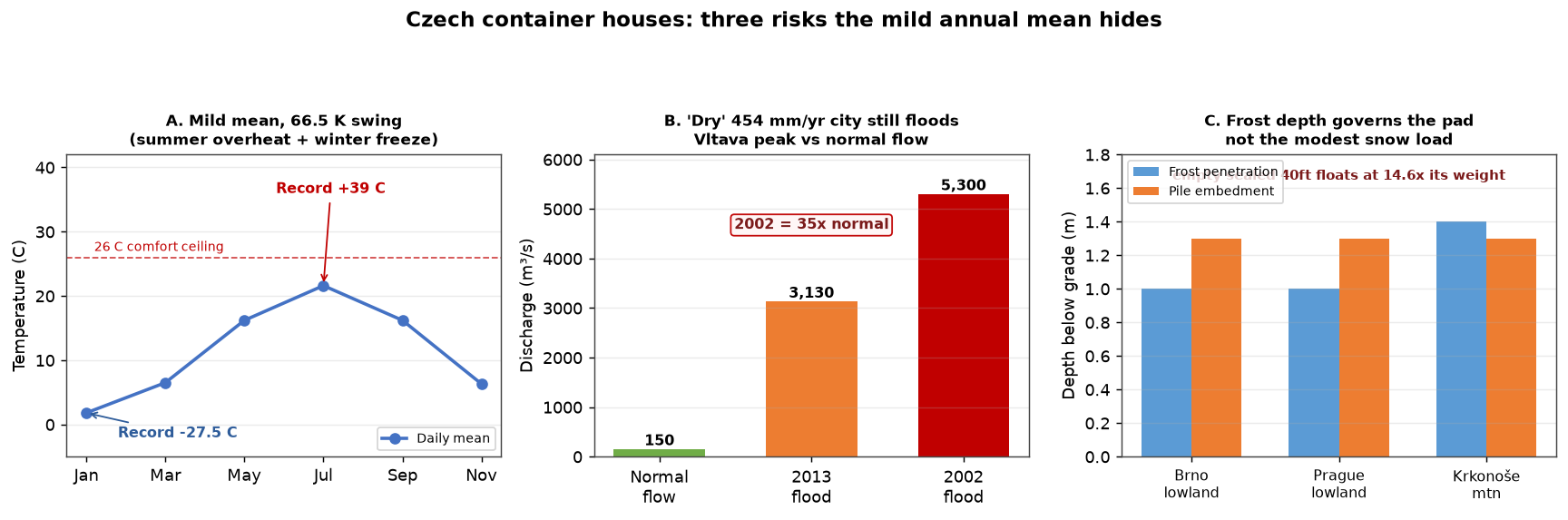
Czechia is often described as a mild, temperate country, and on paper that is true: Prague’s daily mean is about 1.8°C in January and 21.6°C in July. That comfortable average is precisely the problem. It hides an annual swing of 66.5 K between a record 39.0°C summer and -27.5°C winter, a flood history that has put central Prague underwater twice in twenty years, and a frost line deep enough to heave an inadequately founded module. A container house specified from the annual mean alone will overheat in July, sit too shallow in winter, and — if placed on a floodplain — float. This guide sets out the three risks the average conceals, the engineering numbers that answer them, and the complete FOB-to-landed cost of a factory-direct unit delivered to a Czech site.
1. The climate: a temperate mean, a continental reality
Prague sits on the Cfb/Dfb boundary. The WMO 1991–2020 normals give a January daily mean of 1.8°C (daily minimum -0.5°C) and a July mean of 21.6°C, with roughly 454 mm of rain and 1,717 hours of sunshine a year. Brno and the south Moravian lowland run a little warmer and drier; the Krkonoše range on the northern border is a different world — -5.0°C January means, 1100 mm of orographic precipitation and the country’s highest snow loads. Annual rainfall of 454 mm is genuinely semi-dry by Central European standards (0.65× a typical 700 mm city), which is why the flood risk below surprises buyers. Specifying a single “Czech climate” package is a category error; our method for reading an individual plot is in the site-selection and environment guide.
2. Insight one: summer overheating, not winter cold, is the overlooked failure
Ask a Central European buyer what a container house must survive and the answer is almost always winter. The more expensive mistake is summer. At 39.0°C ambient under full sun, a dark steel skin can reach about 72.0°C, and an unvented module interior follows to around 52.0°C — far above the 26.0°C comfort ceiling. Insulation slows that heat gain but does not remove it; a highly insulated, well-sealed box can trap summer heat just as effectively as it retains winter warmth. The answer is a three-part summer package: a cool-roof coating with a high solar reflectance index (SRI ≥ 78) that cuts the skin temperature by roughly 22.0 K, a ventilated roof cavity that carries absorbed heat away before it reaches the ceiling, and cross-ventilation or mechanical cooling sized for the real latent and sensible load.
Solar geometry does part of the work for free. At Prague’s 50.1°N latitude the summer-solstice noon sun reaches 63.3°, so a fixed overhang with E/H ≥ 0.5 keeps direct sun off the glazing through the warm months. In winter the noon sun falls to just 16.5° — low enough to pass beneath that same overhang and deliver useful passive gain through south-facing glass. This is the classic “shade summer, admit winter” geometry, and it is the same principle used in the Mediterranean climate design guide, applied here at a more northerly latitude where winter sun is scarcer and therefore more valuable.
3. Insight two: a “dry” city that floods — the Vltava problem
Prague receives only 454 mm of rain a year, yet the Vltava flooded the historic centre in 2002 and again in 2013. The reason is catchment, not local rainfall: the river drains roughly 28,000 km² of Bohemia, and the 2002 event combined saturated ground with heavy rain upstream to produce a peak discharge of 5,300 m³/s at Prague — about 35 times the normal flow of 150 m³/s. The 2013 flood still reached 3,130 m³/s. A buyer who designs site drainage from the local rain gauge will systematically underestimate this.
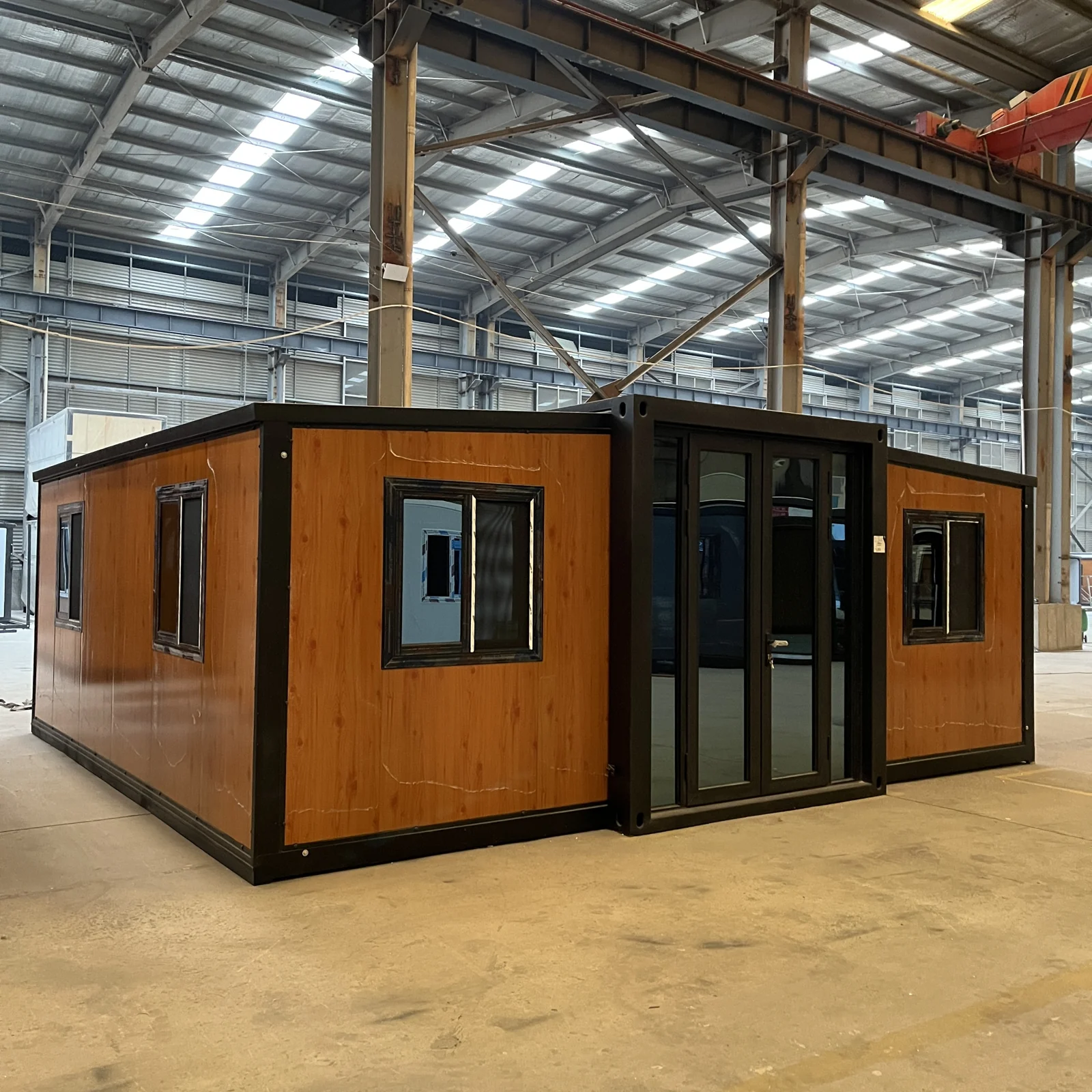
The second overlooked number is buoyancy. An empty, sealed 40 ft module weighs about 2.3 t but displaces roughly 33.6 m³ of water — it can float at about 14.6× its own weight. On a floodplain, a light steel module that is not positively anchored or raised above the design flood level will lift, drift and foul neighbouring structures. The correct response is a flood-risk check against the national flood map, a finished-floor level above the design flood elevation, and anchors designed for the uplift case — the same discipline applied to the coastal flooding cases in the Netherlands below-sea-level guide.
4. Insight three: frost depth, not snow load, governs the foundation
Central European snow loads are modest by Nordic standards. With a 30° pitched roof (μ = 0.8), EN 1991-1-3 gives a Prague roof load of only 0.8 kPa and a Brno load of 0.64 kPa; even the Krkonoše mountains reach 2.4 kPa, about 3.0× Prague. On the expanded 35.4 m² roof of a 40 ft module that is roughly 28.3 kN in Prague versus 85.0 kN in the mountains.
The governing constraint in the lowland is instead frost penetration, about 1.0 m in an average winter (1.4 m in the mountains). Water in the soil expands about 9.0% on freezing and can lift a shallow pad by 60 mm or more, twisting the module and opening the envelope at the corners. Pads and piles are therefore taken to at least 1.3 m below grade — below the frost line, not merely below topsoil — with a compressible slip layer where frost-heave soils are present. Our cold-climate snow-load design guide covers the same frost-and-heave logic at a more severe northern-European exposure.
5. Corrosion: rural C3, industrial C4
Outside the industrial corridors, Czechia is a C3 atmosphere (about 1.3 µm/yr bare-steel loss) and a 160 µm coating system is adequate. The industrial belt around Prague, Ostrava and the north-western basin reaches C4 (about 3.8 µm/yr, 2.9× rural), where a 240 µm system with a documented salt-spray record is the sensible specification. The same distinction applies to the seismic check: Czechia is low-seismicity under ČSN EN 1998-1, so ordinary positive anchorage is sufficient except in western Bohemia, where a site-specific check is warranted. The Lebanon snow-and-seismic guide shows how a light module is secured at a far higher hazard level.
6. FOB → Landed cost breakdown
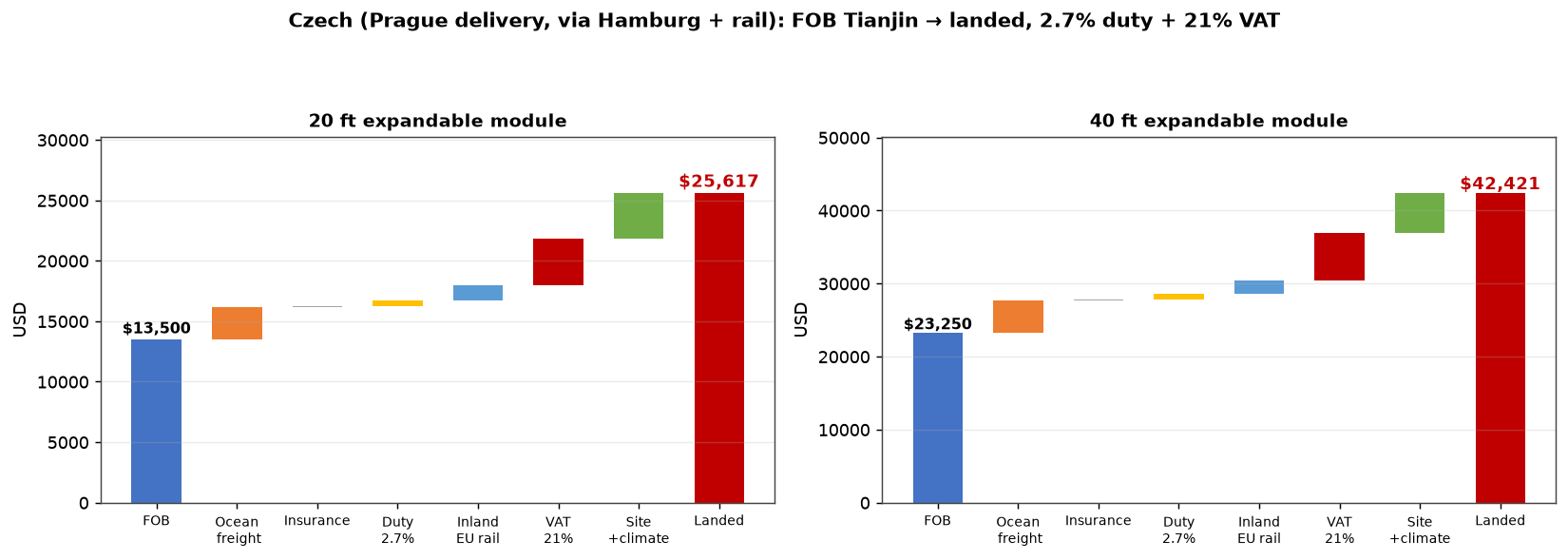
The table prices a factory-direct, climate-ready module delivered to a prepared site near Prague. Czechia is landlocked, so units enter through Hamburg or Piraeus and move inland by rail or road. Duty is 2.7% of CIF under HS 9406.20 (EU TARIC), and Czech standard VAT (DPH) is 21%, assessed on CIF plus duty plus inland freight. Values are indicative USD and must be re-quoted against the actual freight rate, exchange rate and site conditions at order time. VAT-registered businesses can generally recover import VAT; customs duty is not recoverable. The full method is set out in the landed-cost guide.
| Cost line | 20 ft (USD) | 40 ft (USD) | Note |
|---|---|---|---|
| FOB Tianjin | 13,500 | 23,250 | Expandable module, factory price |
| Ocean freight to Hamburg / Piraeus | 2,700 | 4,400 | 20GP / 40HQ, ~4–5 weeks |
| Insurance | 85 | 140 | Marine cargo cover |
| Import duty (2.7% of CIF) | 440 | 750 | HS 9406.20, EU TARIC |
| Inland EU freight (port → Prague) | 1,250 | 1,900 | Rail/road, landlocked destination |
| Customs clearance | 320 | 420 | Broker, port handling |
| VAT (21% of CIF + duty + inland) | 3,842 | 6,481 | Recoverable if VAT-registered |
| Base landed (before site works) | 22,137 | 37,341 | Tax = 26.3% of CIF |
| Foundation (piles to 1.3 m frost depth) | 1,100 | 1,550 | ČSN EN 1997-1 |
| Installation + commissioning | 1,100 | 1,600 | Assembly, sealing, HVAC |
| Climate package | +1,600 | +2,350 | 150 mm PIR, cool roof, frost piles, ventilation |
| Total landed (climate-ready) | 25,937 | 42,841 | 1.92× / 1.84× FOB |
The climate package — 150 mm PIR (U<=0.25), SRI>=78 cool roof, frost-rated piles to 1.3 m, low-temp seals, summer ventilation package — converts a generic module into one that is comfortable in a 39.0°C summer and secure through a 1.0 m winter frost. It is the line most often omitted from a headline price and most often missed after the first season.
7. Compliance, codes and documents
Czechia applies the Eurocodes through Czech national annexes (ČSN EN 1990–1998): ČSN EN 1991-1-3 for snow loads with the national snow map, ČSN EN 1997-1 for geotechnical and frost-depth design, ČSN EN 1998-1 for seismic design, and ČSN 73 0540-2 for thermal protection — the last increasingly specified to passive-house performance by Central European buyers. Fully prefabricated buildings are declared under HS 9406.20 with 2.7% EU duty and 21% VAT; the structure carries CE marking under CPR 305/2011, with EN 1090 for the steel frame. Electrical and insulation components should carry CE test reports to speed approval. Because tariff classifications and national annexes are revised, confirm the current duty rate, snow and frost zone, and permit requirements with a local customs broker and design engineer before ordering. Our Hungary EU-compliance cost guide covers the neighbouring-market documentation path, and the Kenya highlands guide shows the altitude framework reused across climates.
Frequently asked questions
Is a Czech container house a winter or a summer design problem?
Both, and summer is the one buyers miss. The annual mean of about 11.5°C conceals a 66.5 K swing to 39.0°C. Insulation, a cool roof, a ventilated cavity and controllable shading are needed for July just as much as PIR, low-temperature seals and a frost-depth foundation are needed for January.
Will a container house float in a Prague flood?
An empty sealed 40 ft module can float at about 14.6× its own weight, so on a floodplain it will unless anchored or elevated. Check the national flood map, keep the finished floor above the design flood level, and design anchors for uplift. The local rainfall figure of 454 mm is not a guide to river-flood risk — the Vltava drains a very large upstream catchment.
What foundation depth do I need?
In the lowland, frost penetration of about 1.0 m governs, so pads or piles are taken to at least 1.3 m below grade. Snow load is modest (0.8 kPa on a 30° Prague roof) and only becomes controlling in the Krkonoše mountains, where it reaches 2.4 kPa.
How much does a Czech container house cost landed?
A climate-ready 20 ft module lands near Prague at roughly $25,937 and a 40 ft at $42,841, including freight, 2.7% duty, 21% VAT, foundation, installation and the climate package. VAT is generally recoverable for registered businesses; duty is not.
How deep should the roof overhang be?
At Prague’s 50.1°N latitude, an overhang with E/H ≥ 0.5 shades the glazing at the 63.3° summer noon sun, while the 16.5° winter sun still passes beneath it for passive gain. South-facing glass with an adjustable shading layer gives the most consistent year-round result.
Is the industrial-area coating really necessary?
Only where the site is in a C4 atmosphere. Rural and residential Czechia is C3 and a 160 µm system is adequate; the industrial belt around Prague, Ostrava and the north-west reaches C4 (2.9× the corrosion rate), where a 240 µm system is the sensible choice.
Get a Czech-spec quote
HUAYING builds factory-direct expandable, folding and flat-pack container houses specified for the actual site — cool roofs and ventilated cavities for a 39.0°C summer, 150 mm PIR and low-temperature seals for winter, piles below the 1.0 m frost line, flood-aware foundations and anchorage, and C4 coating where the air calls for it, all decided before the module leaves Tianjin. For pricing and shipping to Prague, Brno, Ostrava or anywhere in Czechia, email jack@huayinghouse.com or reach us on WhatsApp at +86 153-0318-4505. Ask for a FOB and landed quote with the flood, frost and summer-overheat recommendations for your exact plot.