
Hurricane-Resistant Container Houses in Jamaica 2026: Category 5 Anchorage, Landed Cost & Parish Permits
Hurricane Melissa crossed Jamaica on 28 October 2025 as a Category 5 system. The island’s own assessment, delivered to Parliament afterwards, was blunt: most of the destruction occurred in structures built without engineering input, and Jamaica’s formal building code had not been rewritten since 1908. A revised national code now requires new construction to withstand Category 5 conditions.
That changes the question a container house buyer in Jamaica has to answer. It is no longer whether the unit is cheaper than block construction. It is whether you can show an engineer that this unit, anchored on your site, satisfies the code your parish will enforce.
This guide works through what that means in practice: the wind loads, the failure modes, the design responses, the landed cost, and the compliance path.
1. Jamaica climate data at a glance
Jamaica sits at roughly 17.7–18.5°N, squarely inside the Atlantic hurricane belt. Three climate variables drive container house design here.
Wind. The Caribbean Uniform Building Code (CUBiC) and its successor framework set basic wind speeds that, for exposed coasts, are among the highest in the region. Jamaica’s own post-Melissa review concluded that the national design baseline must be Category 5 resistance. For a coastal site, design wind speeds commonly fall in the 145–165 mph (233–265 km/h) 3-second-gust range. Exposure category matters as much as the number: a hillside in Portland Parish is not the same as a sheltered valley in St Elizabeth.
Solar geometry. At 18.1°N the noon sun is close to vertical for much of the year. Kingston’s noon solar altitude runs from about 48° in December to about 85° in June, with the sun passing almost directly overhead around 8 May and 5 August. At low latitude a horizontal roof overhang sheds very little radiation; the useful shading surfaces are the east and west facades and the roof itself.
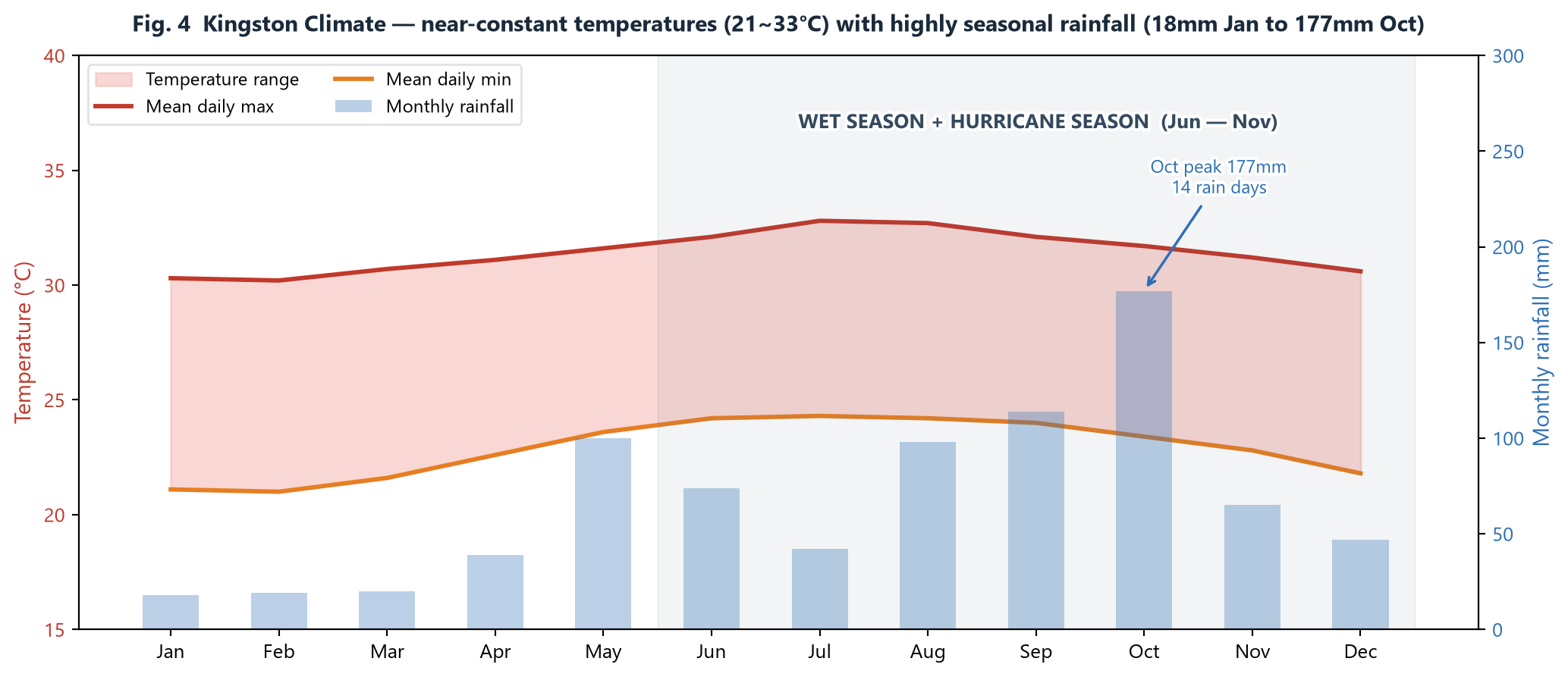
Rainfall and humidity. Jamaica has a bimodal rainfall pattern with peaks around May–June and September–November, and relative humidity above 70% for most of the year. Kingston averages roughly 800–900 mm annually, while the Blue Mountains and the north-east coast receive well over 2,000 mm.
2. Five failure modes specific to hurricane-exposed sites
Failure modes on a container house in a hurricane zone differ from those on a small house in a temperate climate. In order of how often they appear in post-storm inspections:
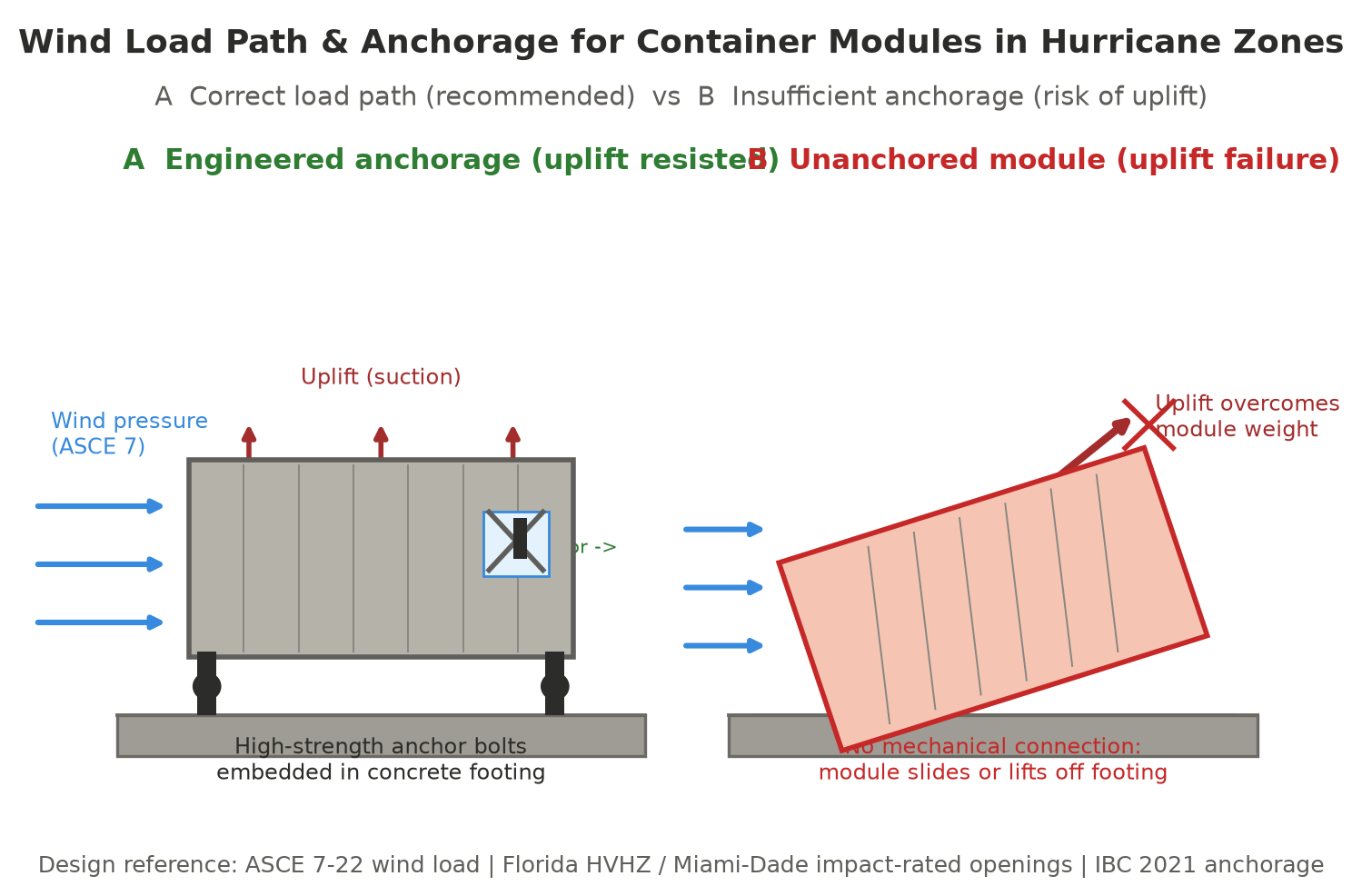
1. Uplift at the module-to-foundation connection. An empty 20ft container weighs about 2.2–2.4 tonnes. Under a Category 4 gust, net uplift on the roof and windward face can reach or exceed that figure. The structure does not fail because the steel is weak; it fails because nothing holds it down. This is the most common reason a container structure is displaced rather than merely damaged.
2. Roof edge and ridge loss. Wind pressure peaks at roof edges, corners and ridges, typically at 1.5 to 2.5 times the pressure on the field of the roof. Screw-fastened edge trim and ridge caps are the first components to open. Once the edge lifts, the roof becomes a pressurised surface and failure propagates inward.
3. Opening failure from wind-borne debris. A container wall will resist a palm frond. It will not resist a roofing sheet or a masonry block travelling at 60–80 mph. Glazing and doors fail first, the envelope becomes internally pressurised, and the load on the roof multiplies.
4. Corrosion of fixings, not panels. Coastal humidity and salt spray attack fasteners, hinges and section joints long before they attack the steel shell. ISO 12944 places exposed coastal Jamaica in a C4–C5 corrosivity category. The consequence is structural: a corroded anchor bolt loses capacity quietly.
5. Undersized drainage. In the September–November peak, intense short-duration rainfall overwhelms gutters sized on annual averages. Water backs up under the roof sheets, reaches the wall panel joints, and starts an interior corrosion cycle that is expensive to reverse.
3. Design responses that actually change performance
Anchor the module, and design the anchor for uplift, not just bearing. The connection between the container corner castings and the foundation is the critical load path. For a Category 4–5 exposure, a typical specification is four M24 (or 5/8″–3/4″) high-strength anchor bolts per module, embedded a minimum of 300 mm into a reinforced concrete footing, with a cast-in twist or a mechanical anchor that develops full tensile capacity. Corner twist-locks designed for transport are not an anchorage system: they locate the box, they do not hold it down. Expect to see an engineer’s uplift calculation, not a supplier’s assurance.
Treat the roof edge as a structural element. Specify continuous edge restraint rather than intermittent screws, reduce fixing spacing at edge and corner zones to roughly half the field spacing, and use a sealed ridge detail with a concealed clip rather than an exposed screw line. This is a low-cost change with an outsized effect on survivability.
Specify impact-rated openings where required. Where the code or the insurer requires it, glazing should be impact-rated to a recognised large-missile standard, or protected by permanently fixed shutters. The trade-off is honest: impact glazing costs more and reduces light transmission, but it removes the internal-pressurisation failure chain that destroys roofs.
Connect modules to each other in multi-box builds. Two containers bolted together are substantially more wind-resistant than two standing alone, because the pair resists overturning as a longer lever arm. Combined builds should be mechanically locked at the corner castings, with the joint detailed so it does not become a water path.
Match corrosion protection to the exposure. Use hot-dip galvanised or stainless fixings throughout, re-seal cut edges, and specify a coating system to ISO 12944 C4 or C5 depending on distance to the sea. Coastal Jamaica warrants C5; inland parishes and higher elevations can justify C4.
Size drainage on peak intensity and increase roof pitch. Gutters and downpipes should be sized on short-duration peak rainfall with a freeboard margin, not on annual averages. A pitched roof with a deeper overhang discharges water clear of the wall panels and reduces the volume reaching the joints.
Site the unit off the ground and out of the wind funnel. Elevating the unit 300–450 mm on piers serves three purposes at once: it keeps the floor above flood water, it reduces termite access, and it lets wind pass under the module instead of stalling against a solid wall and adding to the overturning force. On a ridge or in a valley gap, orient the long axis roughly parallel to the dominant wind direction to cut the projected area.
4. FOB to landed cost breakdown
The table below models a 20ft expandable container house with hurricane specification, shipped Tianjin to Kingston. Figures are indicative USD for planning, not a quotation.
| Cost line | Basis | USD |
|---|---|---|
| FOB Tianjin (20ft expandable, hurricane spec) | factory | 9,800 |
| Ocean freight, Tianjin to Kingston | 40HQ share | 2,400 |
| Marine insurance | ~0.35% of CIF | 45 |
| CIF Kingston | 12,245 | |
| Import duty (CARICOM CET, HS 9406) | 20% of CIF | 2,449 |
| General Consumption Tax (GCT) | 15% of (CIF + duty) | 2,204 |
| Standard Compliance Fee (BSJ) | 0.3% of CIF | 37 |
| Environmental Levy | 0.8% of CIF (from May 2026) | 98 |
| Stamp duty | flat, where CIF exceeds J$5,500 | 1 |
| Customs administrative fee | per entry | 250 |
| Licensed customs broker | required at CIF of US$5,000 or more | 150 |
| Port handling and wharfage | Kingston Wharves | 400 |
| Inland transport Kingston to parish | 20–120 km | 450 |
| Foundation, reinforced pad and piers | site-dependent | 1,500 |
| Installation and utility hookup | 700 | |
| Total landed and installed | approx. 20,484 |
Two observations follow. First, taxes and levies amount to roughly USD 5,000, about 40% of the CIF value, so any landed comparison that quotes only FOB is misleading. Second, foundation and site work is the largest single line after the unit itself, and it is also the line that determines whether the unit survives a storm. Under-spending there is the most expensive mistake available.
Hurricane specification: incremental cost
| Upgrade | Function | Added USD |
|---|---|---|
| Engineered uplift anchorage and reinforced footing | Resists overturning and uplift | 450 |
| Impact-rated glazing | Prevents debris breach and internal pressurisation | 320 |
| Roof edge, corner and ridge restraint upgrade | Prevents roof edge lift-off | 180 |
| Wall panel and cross-bracing fixings | Resists in-plane racking | 140 |
| ISO 12944 C5 coastal coating system | Corrosion protection | 380 |
| Roof over-deck and shading | Reduces solar gain | 260 |
| Total | 1,730 |
The full upgrade package adds roughly 9% to the landed cost and addresses every one of the five failure modes above. For a coastal parish, it is the difference between a structure that is insurable and one that is not.
5. Permits, code and compliance in Jamaica
Building approval. Permanent siting of a container house requires approval from the relevant parish council, the Kingston and St Andrew Corporation in the KSA or the parish council elsewhere, and, for larger or environmentally sensitive developments, involvement from the National Environment and Planning Agency (NEPA). Applications normally include site plans, structural drawings and evidence of code compliance. Treat this as an 8–16 week process and start it while the unit is in transit.
Code baseline. The Building Act 2018 and the Caribbean Uniform Building Code (CUBiC) form the current framework, with a revised national code implementing a Category 5 hurricane design requirement. For sites in coastal or flood-prone zones, expect stricter scrutiny of roof fixing, connection detailing and foundation design.
Import mechanics. Jamaica Customs clears commercial cargo through ASYCUDA World on an electronic Single Administrative Document (eSAD). Shipments with a CIF value of US$5,000 or more must be cleared by a licensed customs broker. You need a Taxpayer Registration Number (TRN) registered before the vessel arrives; applying after sailing is the most common cause of avoidable demurrage at Kingston.
Duty and tax. Prefabricated buildings under HS 9406 attract the CARICOM Common External Tariff at 20%, with GCT at 15% on the duty-inclusive value. The Standard Compliance Fee (0.3% of CIF) and the Environmental Levy (0.8% of CIF from May 2026) are additional. Duty relief exists for approved projects, including tourism developments, but must be granted before the goods arrive.
Shipping timeline. Production takes 15–25 days and sea freight from Chinese ports to Kingston 30–45 days, giving a realistic 50–70 day order-to-installation window.
6. Where container houses work in Jamaica
The strongest use cases are the ones where a permanent block build is slow, expensive or impractical: tourism accommodation in Negril, Ocho Rios and Treasure Beach, where a hurricane-rated unit can be tested against the short-term rental market before a larger investment; guest and staff cottages on family land where the site is already owned and the permitting path is simpler; agricultural support structures that must be relocatable; construction site offices that move with the project; and resilience stock, where units are pre-positioned inland and redeployed after a storm event.
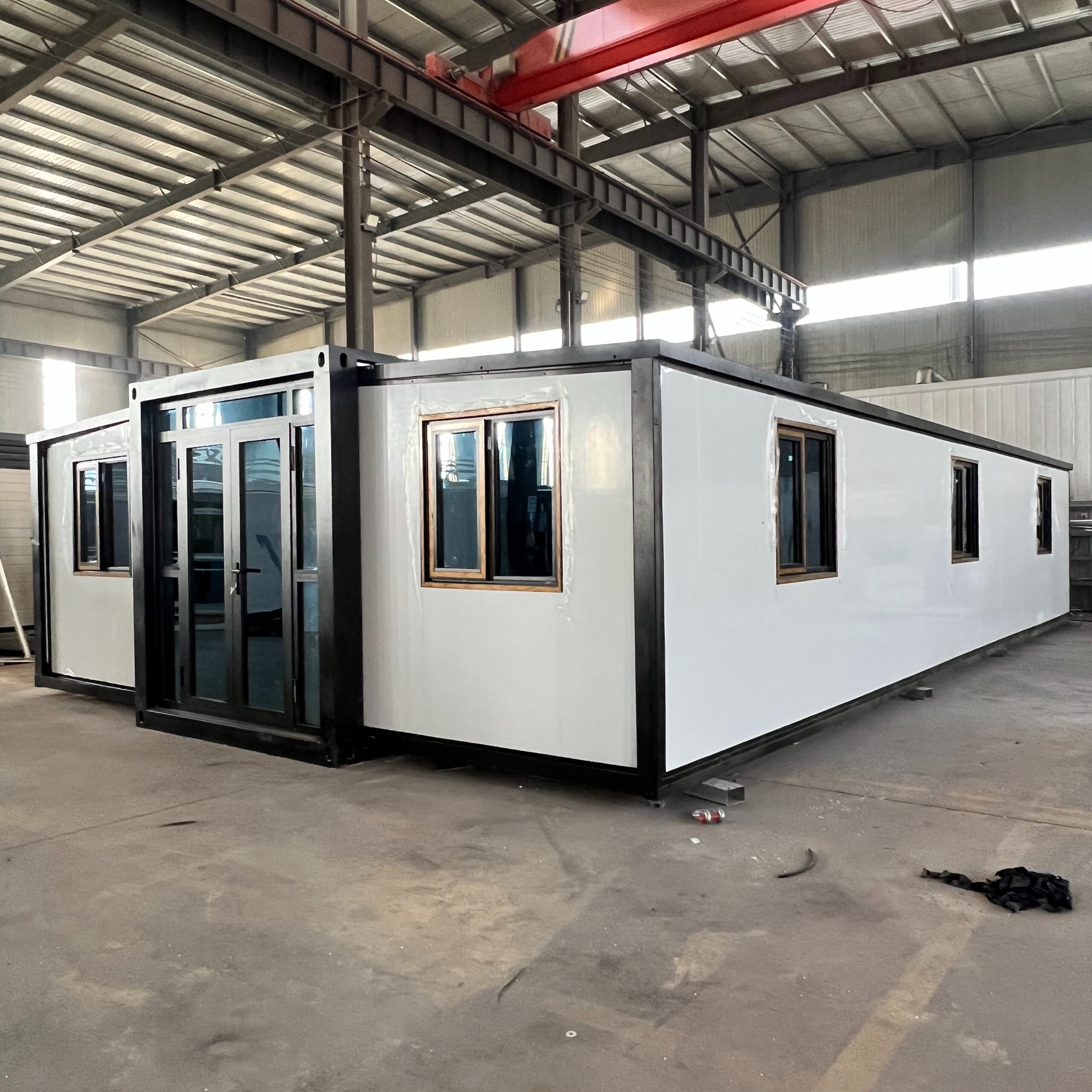
In each case the same discipline applies: the factory supplies a tested envelope, and a local engineer certifies that the envelope is anchored to your site in a way that satisfies the code.
FAQ
Can a container house survive a Category 4 or 5 hurricane in Jamaica?
The steel shell can, if three things are true: the unit is anchored to a foundation designed for uplift, the roof edge and openings are detailed for high wind, and the installation is signed off by an engineer. The shell alone is not the determining factor; the anchorage is.
What import duty applies to container houses in Jamaica?
Prefabricated buildings under HS 9406 attract a 20% CARICOM CET rate on CIF value, with GCT at 15% on the duty-inclusive amount, plus a Standard Compliance Fee of 0.3% of CIF and an Environmental Levy of 0.8% of CIF from May 2026. Confirm the classification with a licensed broker before shipping.
How long does shipping take from China to Jamaica?
Production is 15–25 days and ocean freight to Kingston is 30–45 days depending on the sailing. Plan for 50–70 days from order confirmation to installation, plus 8–16 weeks for parish approval if it has not already started.
Do I need planning permission to place a container house in Jamaica?
Yes, for permanent siting. Parish council approval is required, with NEPA involvement for larger or sensitive developments. A local architect or engineer should prepare the submission.
How much does the hurricane specification add to the price?
Roughly USD 1,730 on a 20ft expandable, or about 9% of the landed cost. That covers uplift anchorage, impact-rated glazing, roof edge restraint, panel fixings and a C5 coastal coating system.
Will a container house rust quickly on the coast?
Not if the coating system and the fixings are specified for a C4–C5 environment and the wall panel joints are sealed. The failure that matters is corroded anchorage, not the visible panel surface, which is why galvanised or stainless fixings are not optional on coastal sites.
Is it cheaper than building with block?
On structure alone, usually yes. On total installed cost, the honest answer depends on your site. Foundation and site work is the largest variable, and in rocky or steep parishes it can approach the cost of the unit itself.
Next steps
Send us your parish, your site survey or coordinates, and whether the land is coastal, hillside or inland. We will prepare a CIF Kingston or CIF Montego Bay quotation with the hurricane specification, import duty, GCT, port handling and inland delivery shown line by line, together with the uplift anchorage detail your engineer will need for the parish submission.
Contact jack@huayinghouse.com or WhatsApp +86 153-0318-4505.
Related reading: Container House Wind & Hurricane Design: Florida and US Gulf Coast Guide · Container Homes in Jamaica: 2026 Price Guide · Container House Design for Extreme Rainfall: Manila · Hurricane-Proof Container Homes in Puerto Rico