
Vietnam is 1,650 km from north to south, and over that distance the building problem changes completely — twice. A house that performs well in Hanoi will overheat in Can Tho and will be under-anchored in Da Nang. A specification written for the Mekong Delta will let a Hanoi buyer down in February, when the indoor air is colder damp than the outdoor air and the walls run with condensation.
This is not a nuance. It is the reason imported container-house catalogues fail in Vietnam: a single “tropical” specification is sold for a country that contains a humid subtropical winter, a typhoon corridor, and an equatorial delta. The three reference cities used here are Hanoi (21.0°N), Da Nang (16.1°N) and Can Tho (10.0°N).
What follows is the design consequence of each, an honest cost for the climate package that each location actually needs, and the landed cost on a factory-direct unit. Prices are in USD, ex-factory Tianjin, as of October 2026.
Quick reference — what changes as you move south
| Design parameter | Hanoi 21.0°N | Da Nang 16.1°N | Can Tho 10.0°N |
|---|---|---|---|
| Köppen class | Humid subtropical (Cwa) | Tropical monsoon (Am) | Tropical savanna (Aw) |
| Annual range of monthly means | ~13 °C | ~8 °C | ~3 °C |
| Cold season | Real: 6–10 °C nights, damp | Brief: 19–22 °C | None |
| Dec-solstice noon sun | 45.5° | 50.5° | 56.5° |
| Sun directly overhead | Never | Twice (about 10 May, 3 Aug) | Twice (about 17 Apr, 26 Aug) |
| Wettest month | August (~320 mm) | October (~610 mm) | September (~290 mm) |
| Annual rainfall | ~1,680 mm | ~2,120 mm | ~1,700 mm |
| Dominant hazard | Damp cold, mould | Typhoon, storm surge | Tidal flood, subsidence |
| Corrosion driver | Humidity | Salt spray + wind-driven rain | Humidity + saline groundwater |
| Ground condition | Firm alluvium | Sandy coastal | Soft, subsiding delta |
1. Site data: three Vietnamese cities, three regimes
Check these against your own plot before ordering; the coastal strip in central Vietnam in particular varies sharply within a few kilometres.
| Parameter | Hanoi | Da Nang | Can Tho |
|---|---|---|---|
| Latitude | 21.03°N | 16.05°N | 10.03°N |
| Days in December | ~11 h | ~11.3 h | ~11.6 h |
| Mean Jan daily high / low | 19.5 / 14.0 °C | 25.0 / 19.0 °C | 31.0 / 22.0 °C |
| Mean Jul daily high / low | 33.0 / 26.5 °C | 34.0 / 26.5 °C | 31.5 / 25.0 °C |
| Winter mean RH | 85–90 % over Feb–Apr | 80–85 % | 70–75 % |
| Design wind (QCVN 02:2022, indicative) | Zone II–III | Zone III – IV (typhoon landfall) | Zone II |
| Seismic (QCVN 02:2022, indicative) | Low–moderate | Low–moderate | Low |
| Ground risk | Minor flood in delta fringe | Coastal erosion, surge | Subsidence, tidal flooding |
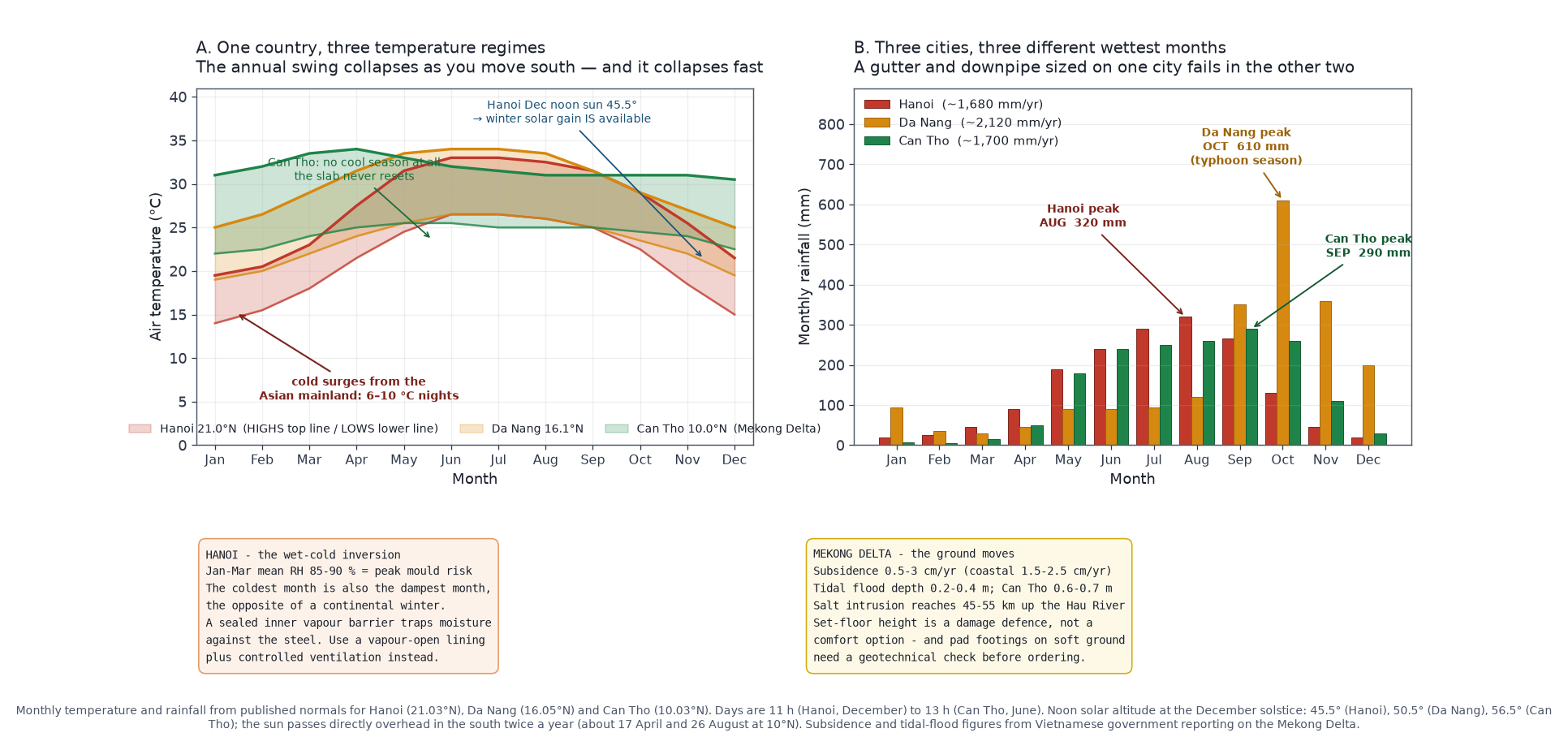
Two figures on this table deserve emphasis. The first is the collapse of the annual temperature swing: thirteen degrees in Hanoi, three in Can Tho. That single number decides whether the building needs a heat-retaining, condensation-managed envelope (north) or a permanently dehumidified, shade-first envelope (south). The second is the October rainfall peak in Da Nang — 610 mm in one month, higher than the annual rainfall of many capital cities and roughly double Hanoi’s wettest month.
2. Solar geometry: shading works in the north and fails in the south
Shading design depends on the ratio of the vertical to the horizontal shadow a wall casts, which is a function of the noon sun altitude. At the December solstice that altitude is 45.5° in Hanoi, 50.5° in Da Nang and 56.5° in Can Tho. Converted to the shadow-to-eave ratio (the length of shadow per unit of overhang on a south-facing wall), that is 0.98, 0.82 and 0.66 respectively.
In Hanoi a modest 0.6 m overhang throws a 0.59 m shadow in midwinter while the June sun is high enough that the same overhang shades almost nothing. That is exactly the behaviour you want from a fixed eave: it admits low winter sun and rejects high summer sun. It is the classical temperate solution and it works.
In Can Tho the same 0.6 m overhang casts only 0.40 m of shadow in the cool-season months when the delta actually needs relief, and the sun passes directly overhead twice a year — around 17 April and 26 August — when a horizontal overhang shades nothing at all. Horizontal shading is therefore a poor investment in the south. The southern design priority shifts to high-albedo roof surfaces, a ventilated roof cavity, and vertical screens on the east and west faces, which catch the low morning and evening sun that a horizontal eave can never intercept.
This is the mechanism behind the counter-intuitive result: the cheap, traditional shading device is cost-effective in the north and close to useless in the south. Buying the same specification for both is not a compromise; it is a waste at one end and a comfort failure at the other.
3. Six failure modes that come from a single-specification approach
3.1 A sealed vapour barrier in Hanoi traps moisture against the steel
Hanoi’s coldest months are also its most humid. Air between 85 % and 90 % relative humidity arrives with the northeast monsoon from February to April, and the local drizzle the Vietnamese call mưa phùn keeps surfaces wet for days at a time. This is the opposite of a continental winter, where cold air is dry. If a specifier applies the standard cold-climate detail — a sealed inner vapour barrier on the warm side of the insulation — the barrier is on the wrong side of the dew point for most of the year. Moisture that enters the wall from the humid interior or from a leak cannot dry inward, so it accumulates against the cold steel liner. The result is corrosion from the inside of the panel, which is invisible until it is structural.
3.2 A summer-ventilation spec is left on all year in Hanoi
A tropical design vents the building to purge heat. In Hanoi’s damp season, continuous uncontrolled ventilation delivers a stream of 88 % relative humidity air onto surfaces that are cooler than the dew point, which is how a container house ends up with mould on the ceiling in a month with almost no rain. Ventilation in the north must be controllable and coupled to a humidity trigger, not fixed open.
3.3 A northern eave depth is specified for Da Nang and the roof leaks
Da Nang receives about 610 mm in October alone, typically as a sequence of typhoon and tropical-depression events with near-horizontal driving rain. Eaves that were sized on monthly averages, or on the annual total, will be overwhelmed. In this corridor, the eave depth must be sized on the storm intensity and its wind-driven component, not on the mean, and the roof-to-wall junction needs a continuous secondary drainage plane behind the primary seal. A gutter calculated as annual rainfall divided by 365 is the most common design error we see on central-Vietnam projects.
3.4 Everything designed for summer, nothing for 6–10 °C nights
Hanoi’s December and January nights fall to 6–10 °C during a strong cold surge, occasionally lower in the mountains, and buildings without heating track the outside temperature closely. Container modules are steel boxes with high thermal conductivity, so an unheated unit is genuinely cold at night. The southern misconception that “Vietnam has no winter” produces units that are unusable for two months a year in the north.
3.5 Pad footings placed directly on subsiding delta ground
Most of the Mekong Delta is settling at 0.5 to 3 cm per year, and coastal areas at 1.5 to 2.5 cm per year, with some locations exceeding 2.5 cm. A point-loaded pad footing that settles unevenly transfers distortion into a rigid steel frame, and a rigid frame under differential settlement cracks at the joints. Seasonal tidal flooding compounds the problem: the average flood depth in the delta is now 0.2–0.4 m, and parts of Can Tho and Vinh Long have recorded 0.6–0.7 m.
3.6 Salt spray and saline groundwater treated as ordinary humidity
Coastal central Vietnam combines wind-driven salt spray with persistent high humidity. A coating system selected from an inland humidity table will fail early, because chloride deposition accelerates the corrosion process far beyond what relative humidity alone predicts. The same applies to a delta site where saline intrusion has reached the groundwater and the water table rises twice a day.
4. Engineering responses by region
4.1 North (Hanoi) — design for the damp cold, not for snow
The northern envelope must manage two loads that a temperate designer would separate: a modest heating load, and a large and persistent moisture load. The correct assembly is vapour-open to the inside and protected on the outside, so that the wall can dry inward during the humid season while the insulation still resists heat loss on a cold night. Practically, that means:
- A continuous thermal break across the steel frame. The frame itself is the principal heat path; a 60 mm polyurethane or 100 mm mineral-wool infill achieves very little if the studs are unbroken.
- Insulated shutters or heavy curtains on the glazing. At 6–10 °C nights, comfort per dollar is better from reducing the window heat loss than from increasing the heater size.
- A small, correctly ventilated heating appliance, not a large one. Size it for a 13 °C design swing and a fast heat-up, and keep combustion appliances outside the sleeping space.
- Mould-resistant internal linings — magnesium-oxide board or a moisture-resistant gypsum board with an anti-mould coating — not cheap timber veneer, which is a food source for mould in this climate.
- A controllable extract system with a humidity sensor, so ventilation follows the moisture load instead of running continuously.
Fixing Hanoi’s wet-cold inversion
The counter-intuitive fix is the direction of the vapour control layer. In a dry continental climate the layer goes on the warm (inner) side. In Hanoi the wall must be able to dry inward during the humid season, because the outside is wetter than the inside for months at a time. Specify the assembly accordingly and record which way it dries on the drawing. Getting this backwards is the single most expensive mistake in northern Vietnam, because the corrosion it causes is inside the panel.
4.2 Central (Da Nang) — design for wind and for the October peak
Central Vietnam is a typhoon landfall corridor. Between 1951 and 2024 the Da Nang–Quang Ngai coastline recorded dozens of direct landfalls and many more near-misses, and the rainfall record shows the consequence: a wet-season peak concentrated into September to November.
- Anchorage against uplift. A light module is governed by wind uplift rather than by its own weight. Anchor to a properly designed foundation with cast-in bolts and hold-down plates, sized to the local design wind pressure, and do not rely on the unit’s mass.
- Envelope pressure checking. Increase the fastener density on wall panels and verify the panel-to-frame connection for the local design pressure, both positive and negative.
- Secondary drainage. Provide a continuous secondary drainage plane and a generous overflow path at the gutter, so that a blocked outlet in a 600 mm month does not back water into the wall.
- Eaves sized on storm intensity. Add roughly 1.5 times the local vertical-rain eave depth to cover the wind-driven component in this corridor.
- Impact-resistant openings. Where the site is within a few kilometres of the coast, protective shutters or rated glazing prevent a wind-borne debris strike from pressurising the interior and lifting the roof.
- Connection between modules. Where units are joined, lock them into a single structural system; a bolted cluster resists wind far better than the same units standing free.
4.3 South (Can Tho and the delta) — design for the ground and the water
In the delta the dominant risk is not the building but what it sits on. Ground settlement, tidal flooding and saline intrusion are all active processes, and the design response is a foundation and level strategy rather than an envelope strategy.
- Raise the finished floor level. Set the floor well above the local tidal-flood depth, with the resulting crawl space ventilated. In the delta a raised floor is a damage-control measure, not a comfort preference.
- Use a stiff, load-spreading foundation. On soft ground, use a continuous or interconnected foundation that spreads load, and obtain a geotechnical check before ordering. Sand and groundwater extraction are actively managed under Vietnamese government policy precisely because they accelerate settlement, so a site that sat well ten years ago may not today.
- Assume saline groundwater. Salt intrusion now penetrates 45–55 km up the Hau River during the dry season. Specify below-ground fixings and any buried steel for chloride exposure, not for fresh-water exposure.
- Shade first, insulate second. Because the southern sun is near-vertical, spend the envelope budget on roof albedo and a ventilated cavity rather than on wall thickness.
- Permanent dehumidification. Treat humidity control as a system with a dedicated unit and a condensate drain, not as a portable appliance the buyer buys later.
5. Climate upgrade packages: what each region actually costs
The table below prices the upgrades that the site data says are required, not a generic bundle. Items are additive to the base unit and are quoted in USD.
| Upgrade | Purpose | Hanoi (north) | Da Nang (central) | Can Tho (south) |
|---|---|---|---|---|
| Thermal break + PIR or mineral-wool infill | Frame heat path, cold nights | 620 | 420 | 380 |
| Vapour-open internal lining + anti-mould board | Wet-cold condensation control | 480 | — | 260 |
| Insulated shutters / heavy curtains | Night heat loss | 340 | — | — |
| Humidity-triggered extract system | Damp-season ventilation | 390 | — | 330 |
| High-albedo cool roof (SRI ≥ 78) | Near-vertical solar gain | 260 | 310 | 330 |
| Ventilated roof cavity | Radiant heat rejection | 280 | 280 | 290 |
| Extended eaves for wind-driven rain | October storm peak | — | 450 | — |
| Secondary drainage plane + overflow | Blocked-outlet safety | — | 380 | — |
| Impact-resistant openings / shutters | Debris strike, uplift | — | 560 | — |
| Enhanced uplift anchorage | Wind uplift on light module | — | 520 | — |
| C4/C5 coating + hot-dip galvanising | Chloride corrosion | 310 | 480 | 420 |
| Raised floor, ventilated crawl space | Tidal flood, ground moisture | — | — | 540 |
| Interconnected load-spreading foundation | Differential settlement | — | — | 610 |
| Dedicated dehumidification | Latent load, all year | — | 310 | 360 |
| Climate package total | 2,680 | 3,710 | 3,520 |
Two points about this table. First, the most expensive location is not the hottest one. Da Nang carries the highest upgrade cost because wind and storm-rain requirements are structural, whereas heat is largely managed by surface properties. Second, the southern package is dominated by the ground rather than the envelope: 1,150 USD of the Can Tho total is foundation and floor level, which is the item most often omitted from an imported quotation and then discovered on site.
6. FOB to landed cost: Hanoi, Da Nang and Can Tho
Model: one 20ft expandable container house, 15 m², base FOB 12,800 USD ex-Tianjin, with the climate package for the destination region applied. Duty is shown both with and without an ACFTA Form E certificate of origin, which is the single largest controllable line in the calculation.
| Cost line | Basis | Hanoi | Da Nang | Can Tho |
|---|---|---|---|---|
| FOB Tianjin | base 20ft expandable | 12,800 | 12,800 | 12,800 |
| Climate package | per section 5 | 2,680 | 3,710 | 3,520 |
| Ocean freight | Tianjin to Hai Phong / Da Nang / Cat Lai | 880 | 760 | 920 |
| Marine insurance | 0.3 % of CIF | 48 | 52 | 52 |
| CIF value | 16,408 | 17,322 | 17,292 | |
| Base import duty (MFN, HS 9406.20/9406.90) | 15 % of CIF | 2,461 | 2,598 | 2,594 |
| with ACFTA Form E | 0 % | 0 | 0 | 0 |
| VAT | 10 % of (CIF + duty) | 1,887 | 1,992 | 1,989 |
| with Form E (VAT on CIF only) | 1,641 | 1,732 | 1,729 | |
| Customs clearance and terminal handling | broker, THC, declaration | 420 | 450 | 470 |
| Inland transport | port to site | 260 | 180 | 220 |
| Foundation and floor level | per section 5 | 600 | 600 | 1,150 |
| Installation and utility hookup | 2–3 days, two technicians | 560 | 560 | 560 |
| Total landed and installed (no Form E) | 23,076 | 24,822 | 25,795 | |
| Total landed and installed (with Form E) | 20,615 | 22,230 | 23,001 |
The ACFTA certificate of origin is worth about 2,461 USD in duty on the Hanoi shipment, and because VAT is charged on CIF plus duty, removing the duty also reduces the VAT base. The combined saving is roughly 2,707 USD. China and Vietnam are both parties to the ASEAN–China Free Trade Area, and the instrument is Form E, not Form F. Three conditions decide whether it works in practice:
- The certificate must satisfy the ACFTA origin rule — either wholly obtained, or a regional value content of at least 40 % of the FOB value, or the applicable change in tariff classification.
- The HS code and the goods description on the certificate must match the invoice, packing list and customs declaration exactly. Mismatch is the most common reason a Form E is rejected at the Vietnamese port.
- The goods must move directly from China to Vietnam under customs control; any transhipment needs proof that no processing took place.
Request the Form E at order stage, not after the container is loaded. It cannot be created retroactively without a chain of declarations, and in practice a missed certificate is a missed saving.
7. Compliance and tax
Import and tax. Imports to Vietnam are declared electronically to the General Department of Vietnam Customs, normally through a licensed customs broker. Prefabricated steel buildings classify under HS 9406.20 (modular building units of steel) or 9406.90 depending on the exact configuration, and the MFN rate for the 94062090 line is 15 %. The standard VAT rate is 10 % and is applied to the CIF value plus duty; note that the temporary reduced rate that applied to parts of the economy does not extend to the metal-products group, so the 10 % figure is the operative one for this product. VAT registered businesses can generally reclaim import VAT as input tax, which makes the effective cost neutral for a registered buyer and a real cost for a private individual.
Building regulation. Design data come from QCVN 02:2022/BXD, the national technical regulation on natural physical and climatic data for construction, which is the source of the design wind and seismic maps. Structural design follows the Vietnamese loading standard TCVN 2737, and construction permitting is handled by the provincial Department of Construction for permanent dwellings, or more simply for temporary structures such as site offices and works camps. Where the unit is to be occupied permanently, expect a foundation drawing and a structural submission to be required, and note that the seismic requirement is low across most of Vietnam but not zero — design to the zone factor for the specific province rather than to a national default.
Fire and electrical. Vietnamese practice follows the national electrical installation rules for domestic supply, and site-supplied power can vary in voltage and frequency quality, especially outside major cities. Specify protection accordingly and confirm whether the site requires an earth-leakage device. For commercial or works-camp use, check the local fire-safety requirement for the occupancy class before ordering, since it can change the internal lining and exit arrangement.
8. Where these units are actually used
In the north, the strongest demand is for worker accommodation and site offices at industrial parks, where the damp-cold season makes an un-insulated steel box unusable and mould becomes an inspection issue. In the centre, container units are widely used for coastal hospitality, resort support buildings and disaster-recovery housing, where the anchorage and impact specifications are the deciding factors rather than the price. In the delta, the dominant use is flood-resilient agricultural support and temporary accommodation, where the raised floor and load-spreading foundation do the work.
9. Frequently asked questions
Why do I need a different container house in Hanoi than in Ho Chi Minh City?
Because the design driver is not the average temperature, it is the annual temperature swing and the seasonal humidity pattern. Hanoi’s annual swing is about 13 °C with a damp cold season from December to March, which demands a vapour-open, heat-retaining envelope. Can Tho’s swing is about 3 °C with no cool season, which demands shading, roof albedo and permanent dehumidification. One specification cannot serve both without failing at one end.
Is Hanoi really cold enough to matter for a container house?
Yes. December and January nights fall to 6–10 °C during a strong cold surge, and because air humidity is 85–90 % at the same time the cold feels considerably sharper than the number suggests. An unheated steel module tracks the outside temperature closely, so without a thermal break, insulated shutters and a small heater the unit is uncomfortable for roughly two months a year.
What is mua phun and why does it affect the building?
Mưa phùn is the fine persistent drizzle that hangs over northern Vietnam from roughly February to April, when a moist air mass replaces the dry continental air. It keeps surfaces wet, pushes relative humidity above 85 % for days at a time, and is the reason mould and condensation, not rain penetration, are the northern failure modes. It also means the wall must be able to dry toward the interior, which reverses the usual cold-climate vapour-barrier rule.
How does Da Nang differ from the rest of Vietnam?
Da Nang sits in a typhoon landfall corridor, and its rainfall is concentrated into a very short season: October alone averages about 610 mm, delivered largely as tropical-depression and typhoon events with near-horizontal driving rain. That drives three requirements that do not appear elsewhere in the country: anchorage sized against wind uplift, eaves and secondary drainage sized on storm intensity rather than monthly averages, and impact-resistant openings near the coast.
Can a container house be built on Mekong Delta land?
Yes, with the right foundation and floor level. Most of the delta is subsiding at 0.5–3 cm per year, tidal flooding now reaches 0.2–0.4 m in places and 0.6–0.7 m in parts of Can Tho, and dry-season salt intrusion travels 45–55 km up the Hau River. The response is to raise the finished floor level above the local flood depth, use an interconnected load-spreading foundation to resist differential settlement, and specify below-ground fixings for chloride exposure. A geotechnical check before ordering is money well spent.
How much does the ACFTA Form E certificate actually save?
On the 20ft example in this guide, about 2,461 USD of import duty, plus roughly 246 USD of VAT that is no longer charged on the duty component, for a combined saving of about 2,707 USD. The certificate must meet the ACFTA origin rule, must match the invoice and declaration exactly, and must accompany goods moving directly from China to Vietnam. It has to be arranged before shipment.
10. Next step
Tell us the province, the plot elevation and whether the unit is for permanent occupation or a works camp, and send a photograph of the ground. We will confirm the envelope direction for the north, the anchorage and eave depth for the centre, or the floor level and foundation approach for the delta, and return a specification with the climate package priced as separate lines so you can see exactly what each requirement costs. The Form E origin file is prepared at order stage.
Contact: jack@huayinghouse.com · WhatsApp +86 153-0318-4505 · ask for the Vietnam region-matched specification sheet.
Read next: Container Houses in Vietnam 2026: 20ft & 40ft Expandable Price Guide for the full import and pricing picture. Container House Design for Tropical Monsoon Climates: Thailand for the regional counterpart to the central-Vietnam case. Container House Design for Extreme Rainfall: Manila Typhoon Season for drainage and roofing detail. Container Houses in Guam: 2026 Complete Guide for the typhoon-code comparison, and Container House Design for Equatorial Climates: Indonesia & Singapore for the equatorial end of the spectrum.
HUAYING manufactures expandable, folding and detachable container houses at six production sites in Hebei Province, China, with more than 50,000 m² of production space, exporting since 2003.