
Ecuador is the only country where a buyer can stand on the equator in shirt sleeves at 6 am and need a jacket by 8 pm — and where a second site 270 km away runs 30 °C with 87 % humidity all year. The two sites are Quito, at 2,850 m in the Andes, and Guayaquil, at sea level on the Pacific. Both sit within 2.2 degrees of the equator. Both have the same sun. They need different buildings.
That is why a “tropical container house” specification imported from a Southeast Asian catalogue fails in Ecuador, and why a “highland” specification copied from a European catalogue fails too. The design variable here is not latitude. It is elevation.
This guide sets out what changes between an Andean site and a coastal site, which upgrades are genuine requirements, and what a factory-direct unit costs landed in each case. Prices are in USD, ex-factory Tianjin, as of October 2026.
Quick reference — what elevation changes in Ecuador
| Design parameter | Sea-level assumption | Andean reality (2,500–3,200 m) |
|---|---|---|
| Noon sun altitude | varies seasonally | 90° twice a year, never below 66.6° |
| Seasonal temperature swing | 10–20 °C | 1.5–2.5 °C (essentially none) |
| Day–night (diurnal) swing | 6–9 °C | 9–11 °C — larger than the annual swing |
| Air pressure | 101.3 kPa | 71.6 kPa at 2,850 m (−29 %) |
| Split-AC rated capacity | full | −10 to −15 % (air density −24 %) |
| UV index (clear sky) | baseline | +25 to +30 % |
| Coastal corrosion class | C3/C4 | C4 inland; C2 at 2,850 m (dry, low chloride) |
| Heating demand | some | none (frost is rare); night comfort is the issue |
| Seismic factor Z (NEC-SE-DS) | 0.35–0.50 (coast) | 0.25–0.40 (highlands) |
1. Site data: two Ecuadorian cities, one equator
The figures below drive specification. Elevation and distance from the Pacific move them materially, so check the numbers against your own plot. Quito is used as the highland reference; Guayaquil as the coastal reference; Cuenca and Manta bracket them.
| Parameter | Quito (0.18°S, 2,850 m) | Guayaquil (2.17°S, ~5 m) | Design consequence |
|---|---|---|---|
| Köppen class | Subtropical highland (Cfb / ETH) | Tropical savanna (Aw) | Two different envelopes, same country |
| Noon sun altitude, highest | 90° (about 21 Mar and 23 Sep) | 90° (about 21 Mar and 23 Sep) | Horizontal eaves barely shade anything |
| Noon sun altitude, lowest | 66.6° (June solstice) | 64.4° (June solstice) | No “let winter sun in” strategy exists |
| Day length | 12 h ± 8 min, year-round | 12 h ± 8 min, year-round | No daylight-saving design window |
| Mean daily high | 18–19 °C | 29–32 °C | Highland: no cooling plant. Coastal: full cooling plant |
| Mean daily low | 9–10 °C | 21–24 °C | Highland: night comfort is the driver |
| Mean relative humidity | 60–75 % | 80–88 % | Coastal latent load dominates |
| Annual rainfall | about 946 mm | about 924 mm | Similar total, opposite distribution |
| Wettest month | April (161 mm) | February (260 mm) | Drainage sized on the peak month |
| Driest month | August (14 mm) | August (1 mm) | A real dry season on both sites |
Two facts on this table deserve emphasis. First, the annual rainfall totals are almost identical — 946 mm in Quito against 924 mm in Guayaquil — yet the distribution is opposite: Quito’s rain is spread across a single October–May season with a sharp June–September dry, while Guayaquil concentrates about 715 mm into the January–April window. Second, the coastal site is cooler in the dry season than the highland site is warm in the wet season, which is why a single “tropical” label describes neither.
Because Ecuador straddles the equator the traditional housing logic of the northern hemisphere does not apply. There is no “north-facing” or “south-facing” house in the usual sense: at Quito the sun passes overhead twice a year and spends half the year in the northern sky and half in the southern. The practical consequence is that shading must work on both long faces, which pushes design away from horizontal overhangs and towards high-albedo roofs, ventilated cavities and east–west vertical screens.
2. The inversion that catches most designers: swing ratio
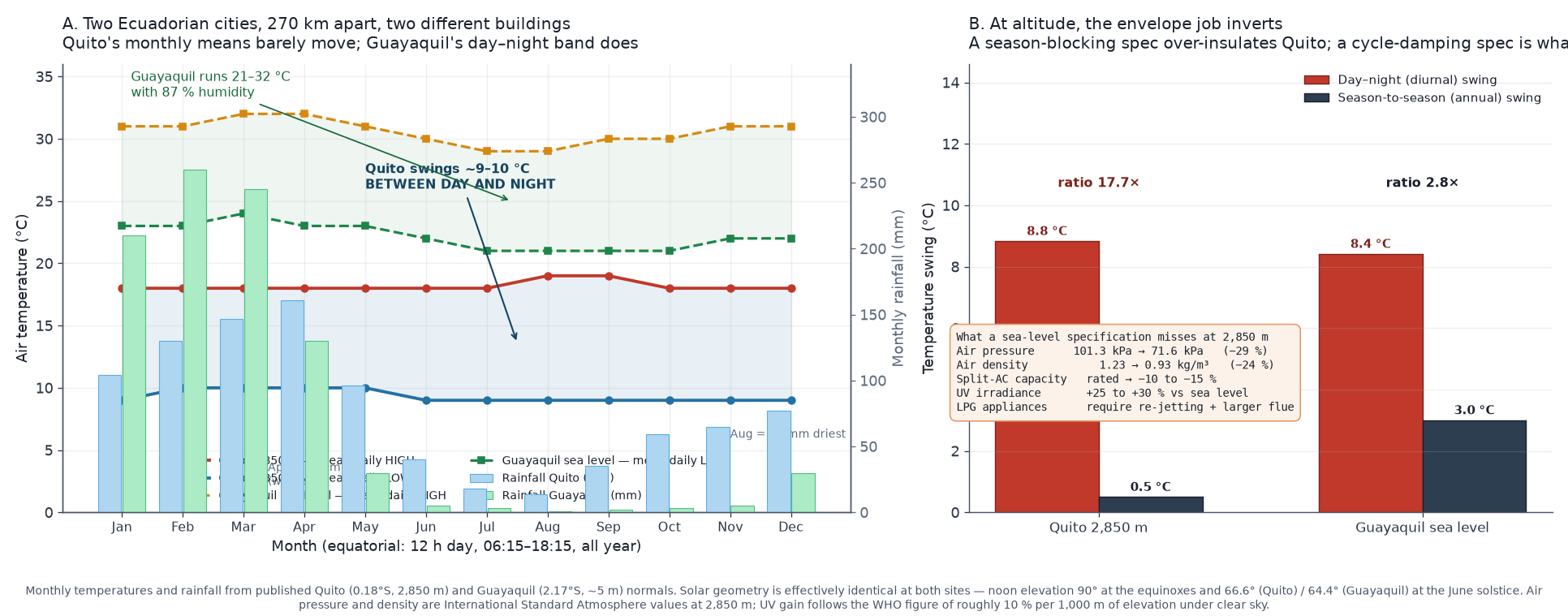
Standard thermal-envelope design in Europe and North America is sized on the season-to-season swing: you insulate heavily so that the winter cold does not reach the interior. That logic assumes the annual swing dominates the daily one.
At Quito it does not. The mean of the daily maximum and minimum is essentially flat across the year — the warmest month and coolest month differ by roughly 2 °C. What moves is the day–night range, which averages about 9 °C and reaches 15 °C on clear dry-season nights when radiative cooling under a thin high-altitude atmosphere is strongest. The ratio of diurnal swing to seasonal swing at Quito is roughly 4.5 to 1; at Guayaquil it is about 1.4 to 1.
The design consequence is specific. A Quito unit does not need a thick winter coat. It needs enough thermal mass and night insulation to ride out a 9 °C nightly drop without the interior falling below comfort, and it needs shading and ventilation to shed the midday solar gain that arrives through a near-vertical sun. Over-insulating a Quito module to a Canadian or Nordic U-value wastes money and, in the humid-warm months, increases the risk of interstitial condensation because the assembly stays colder than the air around it.
3. High-altitude physics that a sea-level specification ignores
Altitude is not only a climate input; it is an equipment input. At 2,850 m the International Standard Atmosphere gives an air pressure of about 71.6 kPa and an air density of about 0.93 kg/m³, both roughly a quarter below sea level. Four practical effects follow, and each one costs money if discovered after delivery rather than at order.
Cooling capacity derating. A split-system air conditioner moves a fixed volumetric flow, but the mass flow of refrigerant and air falls with density, so net capacity drops by 10–15 % at Quito’s altitude before any climate adjustment. If a unit is ordered on a sea-level capacity table, a 3.5 kW machine performs closer to 3.0 kW. That is rarely fatal in the highlands — most Andean sites cool more than they heat — but it matters for data rooms, clinics and any high-occupancy space where the load is fixed.
Combustion appliance re-jetting. LPG water heaters and cooking appliances rated at sea level over-gas at altitude, producing a rich flame, soot and higher carbon monoxide. A highland unit needs smaller injectors and a larger flue, and the appliance must carry the correct altitude rating. This is a safety requirement, not a comfort preference.
UV intensity. Clear-sky UV rises by roughly 10 % for every 1,000 m of elevation, so a 2,850 m site receives around 25–30 % more UV than the coast at the same sun angle. That is a materials issue: window seals, EPDM gaskets, coatings and any plastic external fitting degrade faster unless they are UV-stabilised. It is also an interior issue, because unprotected glazing at this altitude will overheat a room on a clear midday even when the outside air is only 19 °C.
Pressure-related airtightness. A module sealed and tested at sea level will behave differently at altitude, and the pressure differential across the envelope during a strong diurnal temperature change is larger. Sealing details should be specified with the site elevation in the order, not assumed.
4. Two design packages, not one
Package H — Andes highlands (Quito, Cuenca, Ambato, Riobamba). The priority is diurnal buffering rather than seasonal insulation. Specify a moderate wall and roof R-value, added floor insulation because the ground at 2,850 m is cold at night, a ventilated roof cavity to reject the near-vertical midday sun, high-albedo exterior surfaces, and double-glazed low-E windows sized to admit equator light while blocking UV. Night insulation — insulated shutters or cellular blinds — gives more comfort per dollar than additional wall thickness. Heating is a small, correctly re-jetted appliance, not a full system.
Package C — Pacific coast (Guayaquil, Manta, Esmeraldas). The priority is latent load — moisture, not temperature. Specify C4–C5 corrosion protection within a few kilometres of the coast, a vapour-control layer on the warm side of the insulation, an elevated floor with cross-ventilation beneath to stop rising damp and termite access, a steeper roof with enlarged gutters sized on the February peak, anti-mould interior linings and fully gasketed openings. Cooling capacity should be selected on the total load, including the latent fraction, because at 87 % relative humidity a machine sized only on sensible gain will run continuously and still feel clammy.
A site between the two — a mid-elevation valley at 1,200–1,800 m, or the Amazon lowlands — sits between these packages. Send coordinates and we will advise which items to include and which to drop.
5. Seismic demand: the Pacific ring of fire, and Ecuador’s code
Ecuador lies on the eastern edge of the Pacific ring of fire, where the Nazca plate subducts beneath the South American plate, and it hosts both a coastal megathrust and a dense set of crustal faults. The 2016 Pedernales earthquake (M7.8) killed more than 660 people and destroyed tens of thousands of buildings, and it drove the current revision of the seismic code.
The governing standard is the Norma Ecuatoriana de la Construcción, NEC-SE-DS, which defines the seismic hazard factor Z by zone. Coastal Guayaquil sits in a high-hazard zone with Z around 0.35–0.40 g; Quito is in the high zone at roughly 0.25–0.40 g depending on the microzonation; the coast can exceed 0.50 g in the saturated zone VI. Design PGA for standard structures runs 0.25–0.40 g, higher for essential facilities. Ductility detailing is covered by NEC-SE-HM.
For a container module three characteristics work in your favour: the structure is light, so the seismic force (mass times acceleration) is low; the steel frame is ductile rather than brittle; and factory welding quality is more consistent than site work — a real advantage in a market where the recognised weakness is code enforcement rather than code content. Three items must still be engineered: anchor bolts and tie-downs designed for the uplift that light modules generate; a steel shear panel or cross-bracing on any face where a door or window removes the diaphragm; and rigid inter-module connections if units are stacked or joined. Plan regularity matters too: avoid L- and T-shaped footprints, because the torsional response amplifies.
6. Landed cost: Andes versus coast
The two tables below carry one identical 20 ft expandable unit from the factory gate to a finished foundation. The only differences are the destination and the design package. Both assume a Form F certificate of origin is obtained under the China–Ecuador Free Trade Agreement.
6.1 Andes highlands — Quito inland depot
| Cost line | Basis | MFN duty (USD) | Form F / FTA (USD) |
|---|---|---|---|
| FOB price, Tianjin | 20 ft expandable, standard spec | 12,800 | 12,800 |
| Ocean freight | Tianjin to Guayaquil | 1,450 | 1,450 |
| Marine insurance | 0.3 % of CIF | 43 | 43 |
| CIF value | 14,293 | 14,293 | |
| Import duty (arancel) | HS 9406, MFN vs 0 % under FTA | 1,429 | 0 |
| FODINFA | 0.5 % on CIF | 71 | 71 |
| IVA (VAT) | 15 % on CIF + duty + FODINFA | 2,369 | 2,155 |
| ISD (outgoing-currency tax) | 5 % on the remittance abroad | 640 | 640 |
| Customs clearance and port handling | broker, THC, documentation | 520 | 520 |
| Inland transport | Guayaquil to Quito, 420 km, ~7 t | 780 | 780 |
| Foundation | concrete pad and piers, cut/fill on slope | 1,050 | 1,050 |
| Installation and utility hookup | 2–3 days, two technicians | 550 | 550 |
| Highland design package (H) | from section 4 | 1,620 | 1,620 |
| Total landed and installed | 23,322 | 21,679 |
6.2 Pacific coast — Guayaquil and Manta
| Cost line | Basis | MFN duty (USD) | Form F / FTA (USD) |
|---|---|---|---|
| FOB price, Tianjin | 20 ft expandable, standard spec | 12,800 | 12,800 |
| Ocean freight | Tianjin to Guayaquil | 1,450 | 1,450 |
| Marine insurance | 0.3 % of CIF | 43 | 43 |
| CIF value | 14,293 | 14,293 | |
| Import duty (arancel) | HS 9406, MFN vs 0 % under FTA | 1,429 | 0 |
| FODINFA | 0.5 % on CIF | 71 | 71 |
| IVA (VAT) | 15 % on CIF + duty + FODINFA | 2,369 | 2,155 |
| ISD (outgoing-currency tax) | 5 % on the remittance abroad | 640 | 640 |
| Customs clearance, INEN certificate | broker, THC, conformity file | 690 | 690 |
| Inland transport | port to coastal site, 30–120 km | 280 | 280 |
| Foundation | pad, piers, 300 mm void against rising damp | 900 | 900 |
| Installation and utility hookup | 2–3 days, two technicians | 550 | 550 |
| Coastal design package (C) | from section 4 | 2,240 | 2,240 |
| Total landed and installed | 23,462 | 21,819 |
The Form F certificate of origin is worth about 1,429 USD in duty on this shipment. Because IVA is calculated on CIF plus duty, eliminating the duty reduces the VAT base as well, so the total saving is 1,643 USD (1,429 duty plus 214 of IVA on the reduced base). That benefit is conditional: the certificate must be requested before the goods are loaded, the HS code on the certificate must match the customs declaration, and the goods must satisfy the FTA origin rules. Ecuador’s FTA with China entered into force on 1 May 2024, with roughly 60 % of tariff lines going to zero immediately and the remainder phasing down. Confirm the Form F with the factory at quotation stage, not after booking.
7. Compliance checklist for Ecuador
Import and tax. Customs is administered by SENAE, and every commercial import is declared electronically through ECUAPASS by a licensed agente de aduana; self-filing is not available for normal commercial cargo. The importer needs an RUC tax number, and the consignee on the bill of lading must match the importer of record. On top of duty and IVA there is the 0.5 % FODINFA child-development levy on CIF, and the ISD tax on currency remitted abroad, at the 5 % general rate in 2026.
Standards and conformity. The Ecuadorian standards body is INEN. Electrical and mechanical goods, including container-house electrical fit-out components, may require an INEN conformity certificate before import. Wooden packaging must be ISPM-15 heat-treated or fumigated and visibly stamped — untreated pallets remain a common cause of held containers. Declare the goods in Spanish with gross and net weight per item.
Building. The construction code is the NEC, with NEC-SE-DS covering seismic design and NEC-SE-HM covering structural member strength and detailing. Local municipal permits apply at the canton level, and coastal sites in flood or tsunami-exposure zones carry setback requirements. A foundation plan and a structural certificate are normally required for a permanent dwelling.
8. FAQ
Will a container house overheat at 2,850 m when it is only 19 °C outside?
Yes, and it is the most common complaint on highland sites. The near-vertical midday sun delivers intense irradiance through glazing even when air temperature is mild, and the thin atmosphere provides less filtering. A ventilated roof cavity, high-albedo surfaces and properly sized overhangs on the east and west faces solve it; wall thickness does not.
Does a Quito unit need heating?
Only a small, correctly re-jetted appliance for night comfort, because the day–night drop averages about 9 °C and reaches 15 °C on clear dry-season nights. There is no winter to heat against — the annual temperature swing is roughly 2 °C. Insulated shutters often give better comfort per dollar than a larger heater.
Is the coast or the highlands harder on steel?
The coast, decisively. Salt-laden air within a few kilometres of the Pacific drives C4–C5 corrosion protection and regular washing of marine-grade fittings. A 2,850 m inland site is dry, low-chloride and closer to C2, so standard hot-dip galvanising plus a good coating system is adequate.
Can I install a normal split air conditioner at altitude?
You can, but it will deliver 10–15 % less cooling than its sea-level rating because air density falls with pressure. Size it on site elevation, not on the catalogue. The same applies to LPG appliances, which must be re-jetted with a larger flue for safety.
How safe is a container house in an Ecuadorian earthquake?
The light steel structure is an advantage: seismic force is mass times acceleration, and a module weighs a fraction of an equivalent masonry building. Compliance means anchoring for uplift, adding a shear panel where a wall opening has removed the diaphragm, and tying modules together if joined. Design to NEC-SE-DS with the correct Z factor for the site’s zone.
What documentation should the factory provide?
A Form F certificate of origin for the FTA duty reduction, the commercial invoice and packing list in Spanish, an ISPM-15 stamp on wooden packaging, and technical drawings for the INEN conformity file where electrical components are involved. Request all of these at order stage; none can be issued retroactively once the container has cleared.
9. Next step
Send us your site coordinates and elevation, a photograph of the plot, and whether you are building for permanent occupation or a works camp. We will match the design package to the site, size the cooling and shading to the local sun and altitude, and return a specification with the FOB and landed figures for your destination. High-altitude derating, salt-exposure class and seismic zone are decided at order, and they are difficult to add afterwards.
Contact: jack@huayinghouse.com · WhatsApp +86 153-0318-4505 · ask for the Ecuador altitude-matched specification sheet.
Read next: Container House Design for Equatorial Climates: Indonesia & Singapore — the latitude-driven counterpart to this elevation-driven case. Container Home Site Selection and Environment Guide for choosing and orienting the plot. Container Houses in Brazil: Complete Cost Guide for the regional compliance frame.