
Bulgaria is a convenient label on a map and a misleading specification on a building. In fewer than 700 kilometres the country runs from the humid Danube plain and the cold-air basin of Sofia to the maritime Black Sea coast and the deep seasonal snow of the Rila mountains. A module that performs well in Burgas can have an under-designed roof in Sofia and an under-specified envelope in the Danube corridor. This guide sets out the four design climates, the failure modes that actually shorten service life in each, the engineering numbers behind a robust specification, and the complete FOB-to-landed cost chain for a factory-direct unit delivered to a Bulgarian site.
1. Four climates inside one border
Bulgaria sits at the meeting point of continental, Mediterranean and alpine influences. The Danube plain (Vidin, Ruse, 45 m) is a Dfb corridor with -1.2°C January means, 40.5°C summer records and 560 mm of annual rain. The Sofia basin (550 m) is colder in winter and pools cold air, reaching -29.5°C. The Black Sea coast (Burgas, Varna) is the outlier: 2.6°C January, mild by comparison but with a marine salt load. The Rila mountains above 1600 m carry the longest snow cover in the Balkans, with a ground snow load of 2.7 kPa. Choosing a specification from the country name alone is therefore a category error. Our method for reading a specific plot is in the site-selection and environment guide.
2. Insight one: freeze–thaw, not absolute cold, kills the envelope
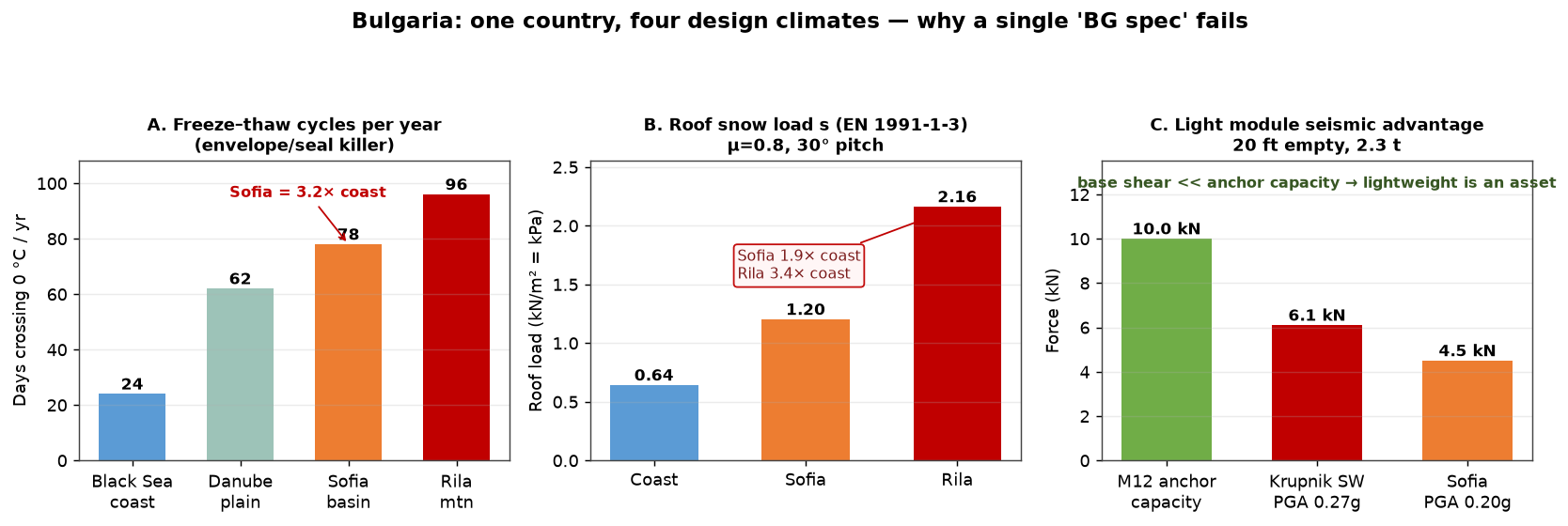
Buyers specify insulation against the lowest temperature on the thermometer. In Bulgaria the more damaging number is the number of times the envelope crosses zero. Sofia records about 78 freeze–thaw cycles a year — 3.25 times the 24 cycles on the coast, and the Danube corridor is close behind at 62. Each cycle drives water in a seal, coating or porous board through a 9.0% volume change on freezing. A single cycle is harmless; eighty cycles a year for a decade is a fatigue test that standard sealants were never designed for. Below about −20°C ordinary silicone sealant also loses elasticity, which is why a low-temperature grade (rated to −30°C or better) is specified for Sofia and the Danube but is unnecessary on the coast.
The practical consequence is a specification that a temperature-only brief misses: a continuous vapour control layer to keep moisture out of the wall build-up, drained cavities so water cannot sit, low-temperature sealants, and a roof surface that sheds meltwater quickly. A module kept dry inside its envelope does not care how cold it gets; a module with trapped moisture fails from the inside out. This is the same mechanism we address in the cold-climate snow-load design guide, applied here to Bulgaria’s particularly high cycle count.
3. Insight two: one roof cannot serve Sofia and the coast
Under EN 1991-1-3 the roof snow load is s = μ × Ce × Ct × sk. Taking a 30° pitched roof (μ = 0.8) with normal exposure and thermal coefficients, the Sofia ground snow of 1.5 kPa gives a roof load of 1.2 kPa, whereas the coast’s 0.8 kPa gives only 0.64 kPa — Sofia is 1.88 times the coast, and Rila reaches 2.16 kPa. On the expanded 35.4 m² roof of a 40 ft module that is roughly 42.5 kN of snow in Sofia versus 22.7 kN on the coast, and 76.5 kN in Rila.
Specifying a coastal roof for a Sofia site is the single most likely structural error in a Bulgaria order. The countermeasure is a roof frame checked to the site’s national annex snow map, steeper pitch or reduced span where possible, and a clear instruction to the buyer to remove accumulated snow after exceptional storms. We size the roof structure to the actual address, not to a country label — the same discipline applied to the mountain snow cases in the Netherlands and alpine-load study and the Lebanon snow-and-seismic guide.
4. Insight three: in a seismic zone, light weight is an asset
Bulgaria is moderately seismic. Under the 2007 Earthquake Resistant Design Code (aligned with Eurocode 8) the reference peak ground acceleration is about 0.2 g in Sofia and up to 0.27 g in the south-west Krupnik zone, the epicentre of the 2012 Mw 5.6 earthquake; the coast is comparatively quiet at 0.05 g. For a container module the seismic force is simply mass times acceleration. An empty 2.3 t 20 ft unit produces a base shear of only about 4.5 kN in Sofia and 6.1 kN in the south-west — far below the 10.0 kN tensile capacity of a single M12 chemical anchor. The light steel module is therefore easier to secure than a traditional masonry building of the same footprint.
That advantage only holds if the anchorage is actually designed: positive mechanical ties to a reinforced pad or pile cap, ductile connections, and no reliance on dead weight alone. Our Bolivia altitude-and-seismic guide works through the same lightweight principle at a higher hazard level.
5. Corrosion: the coast is C4, the interior is C3
Away from the sea, Bulgaria’s atmosphere is a moderate C3 environment (about 1.3 µm/yr bare-steel loss). The Black Sea coast, with airborne chloride and year-round humidity, reaches C4 (about 4.2 µm/yr) — roughly 3.2 times inland. For an inland order a 160 µm dry-film coating system is adequate; a coastal unit should move to a 240 µm system with a 720-hour neutral salt-spray record, 316 stainless external fixings near the water, and sealed, drained cavities. Specifying the inland coating for a Burgas plot saves little at the factory and costs a recoat within a decade.
6. FOB → Landed cost breakdown
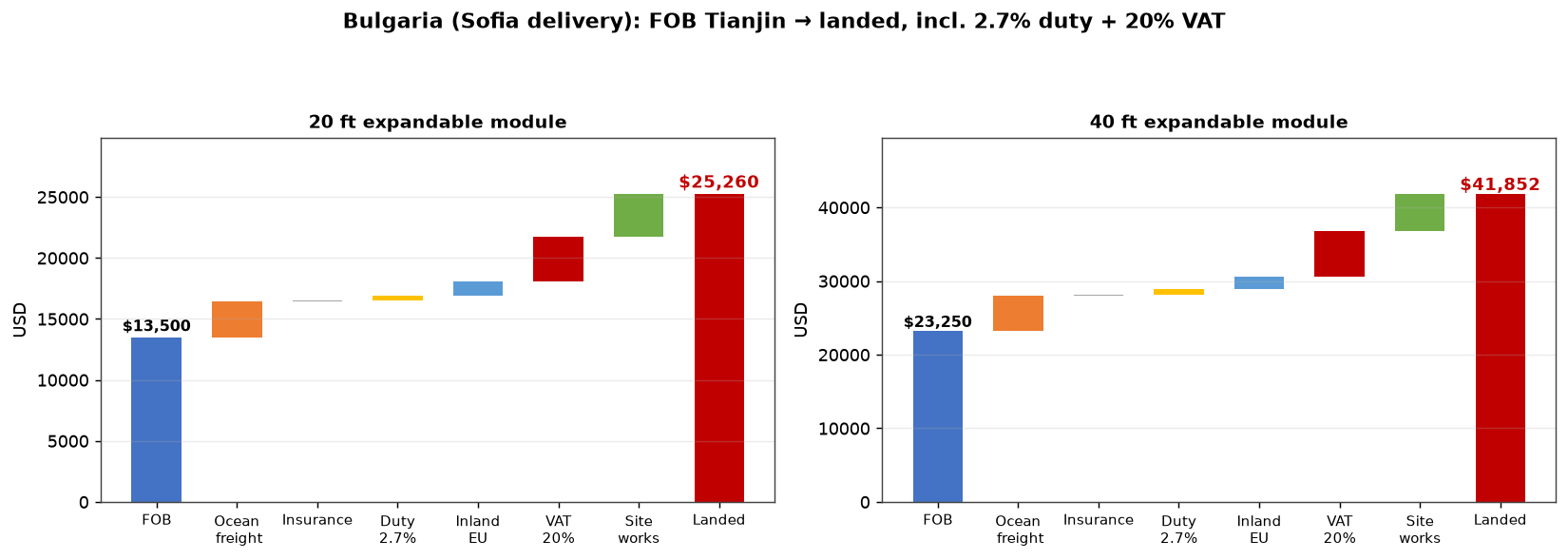
The table prices a factory-direct, winter-grade module delivered to a prepared site near Sofia. Bulgaria has no direct deep-sea node for central delivery, so units enter through Constanta (RO) or Piraeus (GR) and move inland by rail or road. Duty is 2.7% of CIF under HS 9406.20 (TARIC), and Bulgarian standard VAT is 20%, assessed on CIF plus duty plus inland freight. Values are indicative USD and must be re-quoted against the actual freight rate, exchange rate and site conditions at order time. VAT-registered businesses can generally recover import VAT; customs duty is not recoverable. The full method is explained in the landed-cost guide.
| Cost line | 20 ft (USD) | 40 ft (USD) | Note |
|---|---|---|---|
| FOB Tianjin | 13,500 | 23,250 | Expandable module, factory price |
| Ocean freight to Constanta / Piraeus | 2,900 | 4,700 | 20GP / 40HQ, ~4–5 weeks |
| Insurance | 85 | 140 | Marine cargo cover |
| Import duty (2.7% of CIF) | 445 | 758 | HS 9406.20, EU TARIC |
| Inland EU freight (port → Sofia) | 1,150 | 1,750 | ~650 km rail/road |
| Customs clearance | 320 | 420 | Broker, port handling |
| VAT (20% of CIF + duty + inland) | 3,680 | 6,204 | Recoverable if VAT-registered |
| Base landed (before site works) | 22,080 | 37,222 | Tax = 25.0% of CIF |
| Foundation (frost depth ≥1.2 m pad/pile) | 950 | 1,350 | EN 1997, below frost line |
| Installation + commissioning | 1,100 | 1,600 | Assembly, sealing, AC |
| Winter package | +1,450 | +2,100 | 150 mm PIR, low-temp seals, snow-rated roof |
| Total landed (winter-ready) | 25,580 | 42,272 | 1.89× / 1.82× FOB |
The winter package — 150 mm PIR roof/wall (U<=0.25), low-temp sealants to -30C, EN1991-1-3 snow-rated roof, vapour control layer — is the line that turns a generic module into a Bulgarian one. It is optional on the coast and close to mandatory in Sofia, the Danube corridor and Rila.
7. Compliance, codes and documents
Bulgaria applies the Bulgarian National Building Code together with the Eurocodes: EN 1991-1-3 for snow loads (with the national snow map), EN 1998-1 / the 2007 Earthquake Code for seismic design, and EN 1997 for geotechnics. Fully prefabricated buildings are declared under HS 9406.20 with 2.7% EU duty and 20% VAT; the structure carries CE marking under CPR 305/2011, with EN 1090 for the steel frame. Electrical and insulation components should carry CE test reports to speed approval. Because tariff classifications and national annexes are revised, confirm the current duty rate, snow zone and permit requirements with a local customs broker and design engineer before ordering. Our Hungary EU-compliance cost guide covers the neighbouring-market documentation path.
Frequently asked questions
Is a container house in Bulgaria a winter or a summer design problem?
It is both, which is why a single specification fails. The Danube plain and Sofia see 40.5°C to 38.0°C summer highs but also -29.5°C winter lows, so the envelope needs both solar control and serious insulation. The coast is milder in winter but adds salt. Design for the address, not the country.
What roof snow load should I specify near Sofia?
Using EN 1991-1-3 with a 30° pitch (μ = 0.8), the Sofia ground snow of 1.5 kPa gives a roof load of about 1.2 kPa — 1.88 times the 0.64 kPa on the coast and well below the 2.16 kPa in Rila. Confirm against the national annex for the exact municipality.
How much does a Bulgaria container house cost landed?
A winter-grade 20 ft module lands near Sofia at roughly $25,580 and a 40 ft at $42,272, including freight, 2.7% duty, 20% VAT, foundation, installation and the winter package. Coastal delivery is cheaper because the inland leg is shorter and the winter package is lighter.
Is a container house safe in Bulgaria’s seismic zones?
Yes, when anchored properly. A light 2.3 t module generates a base shear of only about 4.5 kN in Sofia (6.1 kN in the south-west), far below the capacity of an M12 chemical anchor. Light weight is an advantage — but positive mechanical ties to a reinforced pad are essential.
Do I need the coastal coating specification inland?
No. Inland Bulgaria is a C3 environment and a 160 µm coating system is adequate. Within a few kilometres of the Black Sea, specify the C4-grade 240 µm system with 316 fixings. Paying for the coastal spec inland is wasteful; omitting it on the coast is a false economy.
Get a Bulgaria-spec quote
HUAYING builds factory-direct expandable, folding and flat-pack container houses specified for the actual site — EN 1991-1-3 snow-rated roofs for Sofia and Rila, low-temperature sealants and vapour control for the freeze–thaw corridor, C4 coastal coating for Burgas and Varna, and anchorage designed to the local seismic zone, all decided before the module leaves Tianjin. For pricing and shipping to Sofia, Vidin, Burgas or anywhere in Bulgaria, email jack@huayinghouse.com or reach us on WhatsApp at +86 153-0318-4505. Ask for a FOB and landed quote with the snow load, winter package and foundation recommendation for your exact plot.