
Chile is 4,300 kilometres long and crosses five Köppen climate zones between the
tropics and sub-Antarctica. A container house shipped to Santiago, Calama or Punta Arenas
faces completely different physical enemies in each region — and the same steel box
cannot be detailed the same way for all of them. This guide breaks the country into the
three failure modes that actually destroy prefabricated housing here: Atacama aridity and
UV, Patagonian wind, and the seismic load that Chile is most famous for.
1. The Atacama problem is not heat — it is the daily swing
The Atacama is the driest non-polar desert on Earth, with annual rainfall below 15 mm and
several stations that have never recorded rain. Daytime highs reach 30°C while nights at
altitude drop to −15°C, a 45°C swing inside 12 hours. Thin, bone-dry
air stores almost no heat, so the surface cools fast after sunset.
For a steel container that movement is mechanical, not cosmetic. Structural steel expands
about 12 µm per metre per °C, so a 6 m span grows 3.2 mm between afternoon
and midnight. A single module tolerates that; a building made of several modules joined end
to end accumulates the movement at every seam. Sealant that is not detailed for cyclic motion
tears within a season. The corrective detail is mundane but mandatory: provide expansion
joints at module connections and a continuous thermal break so the steel temperature does not
drive the interior surface.
The second Atacama killer is UV. The southern-hemisphere ozone hole plus high altitude and
cloudless skies push the local UV index to 11–14, roughly double a temperate
European summer. EPDM and cheap acrylic gaskets are usually rated to UV index 8–10; at
index 14 the photochemical breakdown runs two to three times faster, so perimeter seals
crack in one to two years. Specifying silicone or metal flashing here is not optional.
demand coating and sealant specs above the temperate-climate default.
2. Patagonia wind will slide an unanchored module
South of Concepción the climate turns subpolar oceanic and the defining event is wind.
Persistent westerlies average 40–50 km/h and gust to 150 km/h (42 m/s) in spring
and summer. That is not a corner-load case; it is the design condition for the whole south.
Wind pressure follows q = 0.613 × V². At 42 m/s that is 1,081 Pa. A 20 ft wall
of 6.0 × 2.8 m = 16.8 m² therefore sees about 1,850 kgf of lateral load on a single
face. A 4 t module resists sliding through ground friction; at a typical μ of 0.4 that is
only 1,600 kgf. The wind load exceeds the friction hold, so an unanchored unit at
grade will shift — and a two-storey stack will rack. The corrective detail is simple but
non-negotiable: cast ground anchors or bolted hold-downs sized to the gust load, not just
gravity. See the force comparison below.
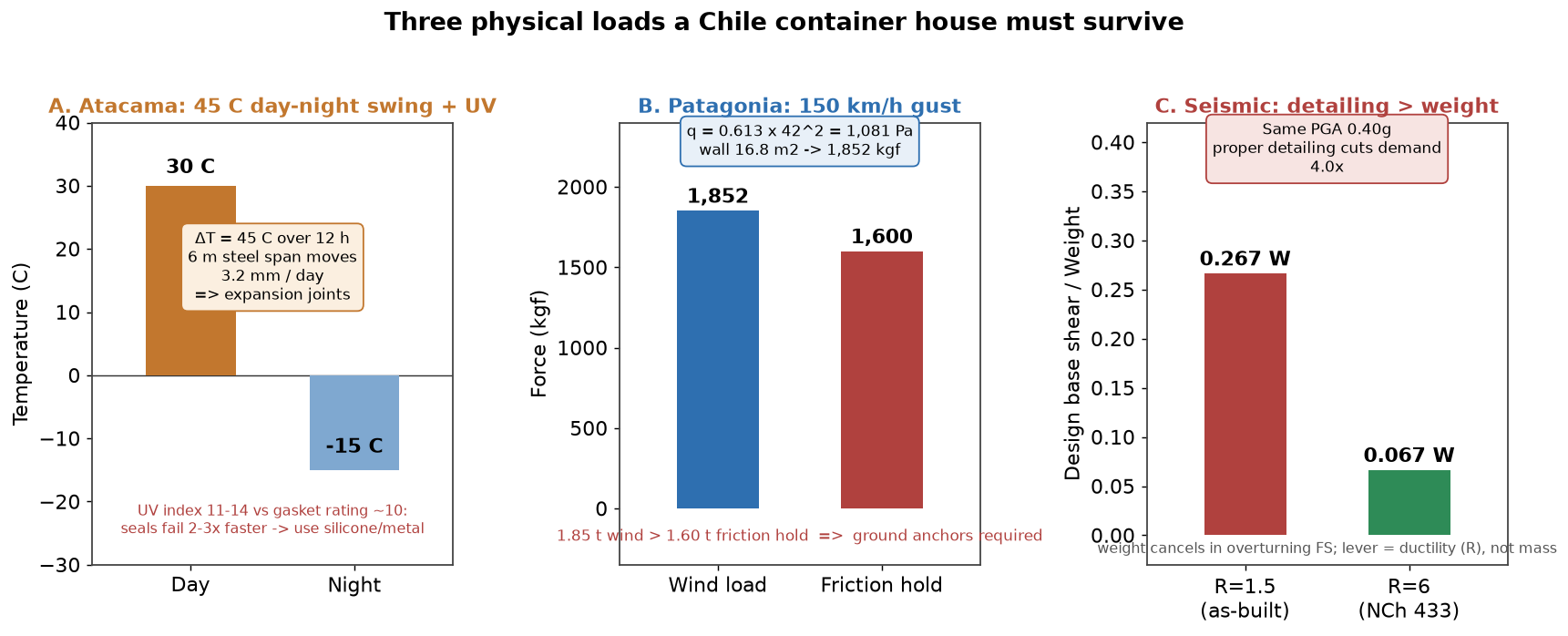
that exceeds friction hold, and seismic base shear that detailing — not weight — controls.
3. Seismic: detailing beats mass
Chile sits on the Pacific subduction zone and runs the most active seismic code regime in the
Americas. The 2010 Maule earthquake reached M8.8; design peak ground acceleration in the high
zones is commonly 0.40 g. Dwellings are governed by NCh 433 (steel building
seismic design) and industrial structures by the updated NCh 2369:2025, both built on
capacity design, strong-column / weak-beam behaviour and prescribed ductility.
The intuitive move is to make the house heavier so it “does not move”. That is wrong, and the
math shows why. Design base shear is V = C × W / R, where R is the response modification
factor. A pin-welded box frame with low ductility carries R ≈ 1.5; a properly detailed
special steel moment frame under NCh 433 reaches R ≈ 6. At the same 0.40 g site that is a
four-fold reduction in seismic demand. Weight cancels out of the overturning safety
factor, so adding mass buys almost nothing — the lever is ductility (R), not tonnes.
The practical consequence is in the connections. Anchor bolts at the far edge of a 20 ft
module must resist roughly 9 kN of tension at 0.40 g; that requires chemical
anchors into the foundation, not friction. Welded moment connections need the continuity
stiffeners and prequalified details that let the joint yield in a controlled way instead of
failing brittle. A container house is light, which is an advantage only if the frame is
detailed to use it.
4. Corrosion: the coast is a different material spec
Valparaíso, Antofagasta and most ports sit in a marine environment, and the Humboldt-current
coastal fog (camanchaca) deposits salt inland. ISO 12944 places these sites at C4 to C5-M.
Factory coatings rated only C3 will show rust bloom in two to three years near the sea. The
cost table below assumes hot-dip galvanising plus an epoxy primer and a C5-M topcoat for
coastal units; skipping it is the most common reason a cheap import looks tired inside five
years.
5. Full landed cost: FOB Tianjin to a Chile site (2026)
The China–Chile FTA (in force since 2006, deepened in 2019) removes the duty entirely when
the shipment carries a valid Form F certificate of origin issued by CCPIT. Without it,
the general 6% MFN rate applies. IVA is 19% and is charged on the CIF value plus duty,
so freight and insurance are taxed too — a frequent surprise for first-time importers.
| Line | 20 ft (US$) | 40 ft (US$) |
|---|---|---|
| FOB Tianjin (ex-works) | 13,500 | 23,000 |
| Ocean freight + marine insurance | 2,968 | 4,415 |
| CIF value | 16,468 | 27,415 |
| Import duty (Form F → 0%) | 0 | 0 |
| IVA 19% on CIF + duty | 3,129 | 5,209 |
| Broker + inland trucking to site | 700 | 900 |
| Landed total | 20,296 | 33,524 |
| Landed as multiple of FOB | 1.50× | 1.46× |
Losing the Form F costs about US$200 on a 20 ft and US$560 on a 40 ft in duty and extra IVA
alone, before the working-capital tie-up of the tax. A licensed agente de aduanas is
required — Chile does not let an importer file directly — and the importer needs a RUT.
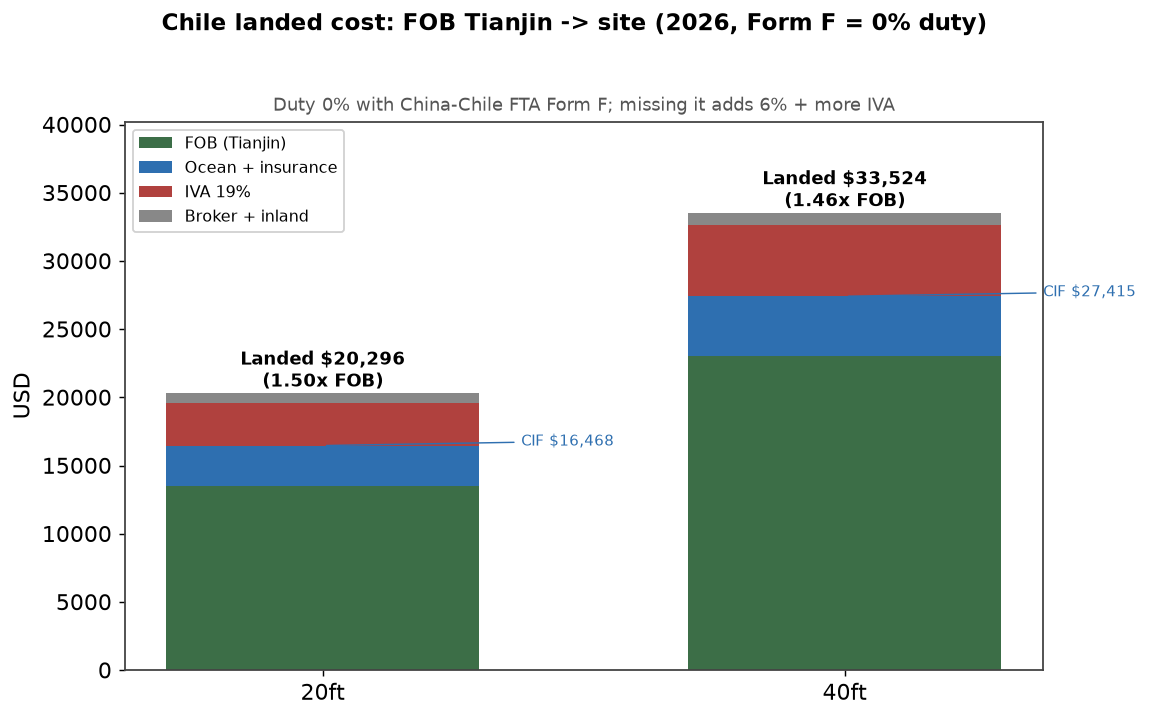
Foundations, cranage and utility connection are site-specific and excluded.
6. Compliance checklist for Chile
| Requirement | Reference | What it means for your unit |
|---|---|---|
| Seismic design | NCh 433 (buildings) / NCh 2369:2025 (industrial) | Ductile connections, R-factor detailing, anchor hold-downs |
| Wind load | NCh 432 (viento) | Gust to 42 m/s in Patagonia → anchorage |
| Thermal envelope | NCh 853 | Insulation + thermal break for the central-valley winter |
| Electrical | SEC certification | Wiring and fittings must carry SEC marks |
| Municipal permit | LGUC / OGUC, DOM | Building permit from the local Dirección de Obras Municipales |
| Wood packaging | ISPM-15 / SAG | Heat-treated pallets and crates for clearance |
| Import duty | China–Chile FTA Form F | 0% with certificate; 6% MFN without |
| VAT | IVA 19% | On CIF + duty; recoverable for VAT-registered importers |
Frequently asked questions
Can one container house design serve all of Chile?
No. A unit detailed for the Atacama (UV-stable seals, expansion joints, minimal corrosion
spec) is under-built for Patagonia wind and over-built for the calm central valley. The frame
and anchorage should follow the strictest condition at the actual site.
Is a light container house unsafe in earthquakes?
Only if the frame is not detailed. Light weight lowers the seismic force, but the demand is
controlled by the ductility factor R. With NCh 433 detailing a light steel frame outperforms a
heavy brittle one. The danger is a pin-welded box assumed to be “inherently safe” because it
is light.
Why does the duty disappear with Form F?
Chile applies a flat 6% MFN duty, but the China–Chile free trade agreement sets it to 0% for
Chinese-origin goods with a valid Form F certificate of origin. The certificate must match the
invoice, HS code and consignee exactly.
Do I pay the 19% IVA permanently?
For a VAT-registered importer the IVA is recoverable as a fiscal credit against domestic
sales, so it is a cash-flow item rather than a final cost. For an end user it is a real cost
on top of CIF.
How long does clearance take?
With a correct Form F and a licensed broker, document clearance is typically a few working
days plus inland transit; wood packaging and SAG inspection add time only when triggered.
What coating do I need near the coast?
Specify at least C4, preferably C5-M per ISO 12944: hot-dip galvanise, epoxy primer and a
marine-grade topcoat. C3-only finishes rust within a few years in Valparaíso or Antofagasta.
Get a site-specific Chile quote
HUAYING builds expandable and flat-pack container houses at >50,000 m² across six
self-owned production sites and ships FOB Tianjin with full Form F documentation. Tell us the
exact Chile region — Atacama, Santiago or Patagonia — and we size the seismic, wind and
corrosion package accordingly.
Contact: jack@huayinghouse.com | +86 153-0318-4505
Related reading: our Chile 20 ft kit price guide,
the New Zealand seismic design guide,
and the Bolivia altitude & seismic guide.