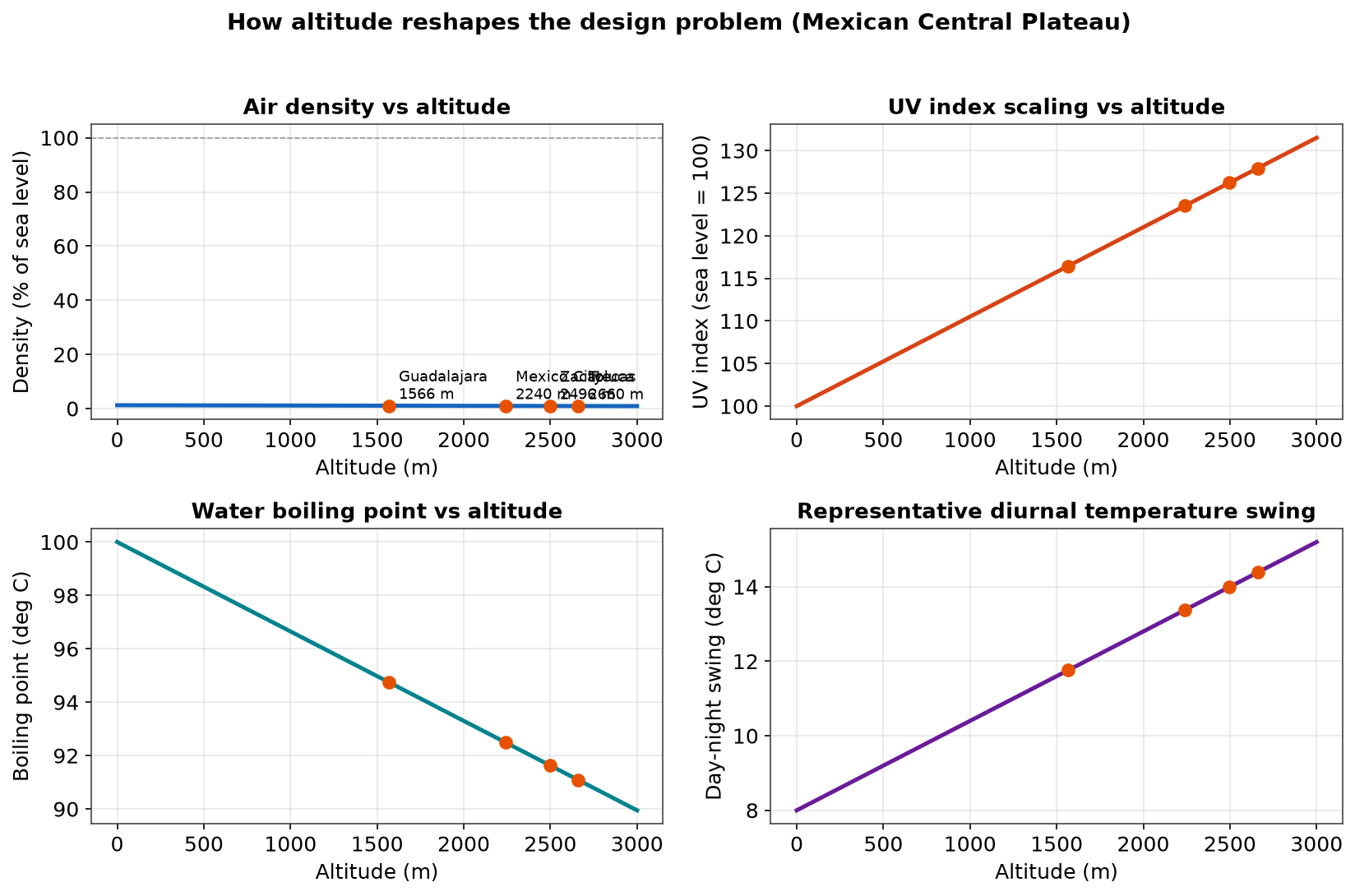
Buyers in Mexico City, Toluca, Guadalajara’s highlands, Zacatecas, Durango and the many Central Plateau towns sitting at 1,500-2,600 m above sea level face a design problem most “container home” vendors never mention: the air is thinner, the sun is stronger, nights turn cold, and the ground moves. A container house that performs perfectly at sea level can quietly underperform – or fail – on the Mexican altiplano. This guide explains, with numbers, what changes and how we engineer around it.
1. Climate data snapshot: the Mexican Central Plateau
The Mexican highlands are not a single condition but a band. Representative altitudes: Mexico City 2,240 m, Toluca 2,660 m, Zacatecas 2,496 m, Guadalajara 1,566 m. The engineering consequences follow directly from altitude plus the fact that Mexico sits on the Ring of Fire.
- Air density: at 2,240 m air density is 80.2% of sea level. Combustion and convective heat transfer both scale with it.
- UV radiation: roughly +22% versus sea level at 2,240 m (about +10-11% per kilometre of elevation).
- Water boiling point: 92.5°C at 2,240 m – relevant for any on-site cooking or sterilisation.
- Diurnal swing: a representative dry-highland day-night swing is about 15°C (roughly 26°C afternoon, 11°C pre-dawn).
- Rainfall: 750-900 mm per year, concentrated June-September. Roof pitch should be 8° or more.
- Sun angles (Mexico City, 19.4°N): summer-solstice noon sun is 86° above the horizon (near vertical); winter-solstice noon is 47°. An overhang sized to E/H ≥ 0.92 controls low winter sun, but the summer sun is so high that east and west vertical shading does the real work.
- Seismicity: subduction trench off the Pacific coast makes central Mexico highly active. The 1985 M8.1 quake killed more than 10,000 people and the 2017 M7.1 killed 369; Mexico City’s lake-bed zone III demands design peak ground acceleration of 0.40-0.60 g.
Altitude also changes HVAC sizing in a way sea-level rules miss. A heat pump’s heating capacity falls as ambient pressure drops, so a unit sized from sea-level tables will be undersized at 2,240 m. We either size the heat pump for the local air density or add electric-resistance backup for the coldest nights. The thin, dry highland air is not all bad: low absolute humidity keeps mould risk low provided the vapour-control layer and ventilation are correct, so the condensation risk is a night-time skin effect rather than a whole-building damp problem.
2. Six failure modes specific to altitude and seismicity
A sea-level container house design transplanted to 2,240 m develops predictable weak points:
- Combustion derating. A gas heater draws a fixed volume of air; at 80% density that volume carries ~20% less oxygen, so the appliance delivers ~20% less heat than its nameplate. Uncorrected, the cabin runs cold.
- UV seal ageing. EPDM gaskets rated for ~10 years at sea level age two to three times faster under +22% UV, opening the path to air and water leaks.
- Nocturnal condensation. A 15°C swing cools the steel skin below the dew point of warmer daytime air, so uninsulated interior surfaces sweat at night.
- Thermal-expansion stress. A 6 m steel seam at ΔT = 15°C grows about 1.08 mm. Multi-module assemblies need deliberate expansion joints or the seams bind.
- Seismic sliding and overturning of an unanchored, light module during a strong shake.
- Coating fatigue from arid highland dust cycling with daily thermal stress.
3. Countermeasure table
| Risk | Engineering response |
|---|---|
| Thin-air combustion | Specify electric heat pumps, or gas burners explicitly rated for altitude derate. Electricity avoids combustion derate entirely. |
| UV seal ageing | Use UV-stable TPO or superior-grade EPDM, shade gaskets where possible, and halve the replacement interval at altitude. |
| Nocturnal condensation | Continuous interior vapour-control layer plus mechanical ventilation; never leave the steel skin uninsulated. |
| Expansion stress | Expansion joints between modules and at long runs; allow the 1 mm-per-6 m growth. |
| Thermal bridging | PIR ≥80 mm in walls, ≥100 mm in roof, with thermal breaks at steel studs (C-series). |
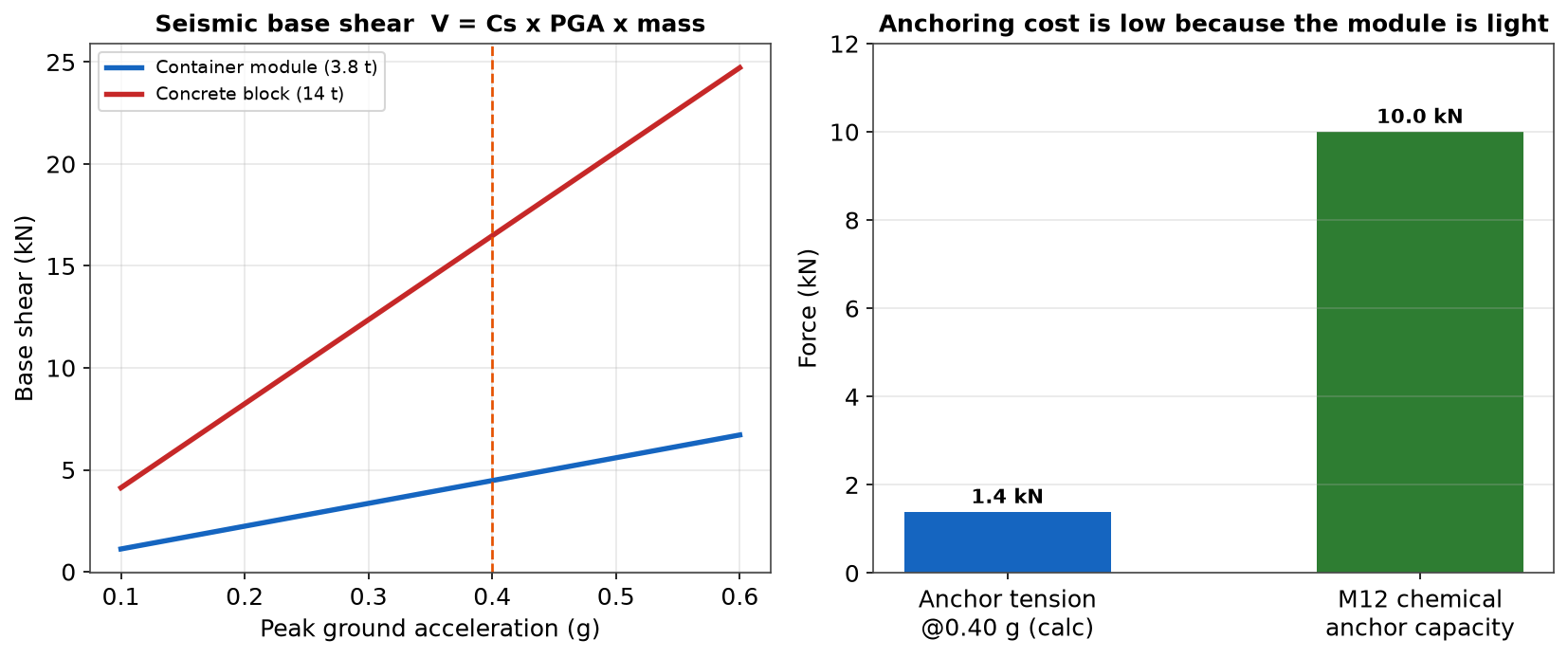
| Seismic anchoring | Chemical or welded anchors to the foundation – inexpensive precisely because the module is light (see Figure 2). |
| Seismic detailing | Anchors per the Mexican seismic code, regular plan shape, steel shear panels at large door/window openings. |
| Rainy season | Roof ≥8°, oversized gutters and downpipes sized for June-September storms. |
Site selection at altitude
Site selection follows the same logic as any container build, with two altitude-specific notes. First, drainage still matters: keep a minimum 2% fall away from the module even though the ground rarely freezes hard at these latitudes, because the seismic anchoring needs a stable, dry footing. Second, wind exposure on an open plateau can exceed that in a sheltered valley, so orient the long axis to the prevailing wind and avoid siting in a funnel between ridges where speeds accelerate. Mild nights mean deep frost-proof foundations are rarely required, but the anchor schedule above is non-negotiable – lightness helps you survive the shake, it does not let you skip the connection to the ground.
4. FOB to landed cost in Mexico (20ft and 40ft)
The table uses the TIGIE base IGIE rate of 15% on HS 9406.10.01 plus 16% IVA. Note that the 2026 “Plan México” trade reforms raised tariffs on non-FTA (Chinese-origin) goods; the 15% base is shown and the current applicable rate should be confirmed with a licensed agente aduanal.
| Item | 20ft expandable | 40ft expandable |
|---|---|---|
| FOB Tianjin (factory) | USD 16,500 | USD 23,000 |
| Ocean freight to Manzanillo | USD 2,200 | USD 3,000 |
| CIF (landed at port) | USD 18,700 | USD 26,000 |
| IGIE duty (15% of CIF) | USD 2,805 | USD 3,900 |
| IVA (16% of CIF + duty) | USD 3,401 | USD 4,784 |
| Landed, customs cleared | USD 24,906 | USD 34,684 |
| Landed / FOB multiple | 1.51× | 1.51× |
| Customs agent + inland freight (est.) | ~USD 1,500 | ~USD 1,800 |
The landed multiple is almost identical for the 20ft and 40ft (1.51x) because both pay the same percentage duty and VAT; the absolute tax grows with size but the ratio does not. Buyers comparing a Chinese container house with a North-American prefab should note the 2026 non-FTA tariff environment before assuming a low delivered price, and should confirm the current IGIE rate with a licensed agente aduanal rather than the 15% base shown here.
5. Compliance and permits
- Customs (SAT): HS code 9406.10.01; IGIE duty plus 16% IVA on (CIF + duty). Importer needs an RFC or appoints a licensed agente aduanal.
- Labelling: NOM-024-SCFI requires Spanish product labelling (model, dimensions, weight, manufacturer, country of origin). NOM-001 covers electrical safety.
- Seismic code: design follows the NTCS (Norma Técnica Complementaria para el Diseño por Sismo) and the local Reglamento de Construcciones; a structural engineer’s letter is normally required for municipal approval. In Mexico City a prefabricated structure under 100 m² can use a Manifestación de Construcción.
- Anti-dumping: as of 2026 there are no anti-dumping duties on Chinese prefabricated steel buildings in Mexico.
6. Where these houses go
The altitude-plus-seismic combination suits mountain eco-lodges, rural clinics, mining and survey camps, weekend cabins and highland Airbnb units – anywhere a fast, light, anchorable structure beats a heavy concrete build.
Frequently asked questions
Will my heater work at 2,000 m? A sea-level gas appliance will run ~20% weaker. We either size the burner up to cover the derate or specify electric heat pumps, which are unaffected by thin air.
Does altitude cause condensation? Yes, through the large day-night swing. The cure is continuous interior vapour control plus ventilation, never leaving the steel skin bare.
Is a container house safe in a Mexican earthquake? Safer than concrete of equal size, because seismic force equals mass times acceleration. A 3.8 t module at 0.40 g needs about 11 kN of base shear – roughly a quarter of what a 14 t concrete block demands – and anchor tension works out near 1.4 kN, far below a standard M12 chemical anchor’s ~10 kN capacity. Anchoring is therefore cheap and mandatory.
How much does import cost? About 1.5× the FOB price after duty and IVA (see the table), before inland freight and the customs agent.
Do I need a permit? Almost always yes at the municipal level; small prefabricated units under 100 m² in Mexico City use a simplified Manifestación de Construcción.
Will UV crack the seals? Only if sea-level-grade gaskets are reused. We specify UV-stable materials and shorten the inspection interval.
Can it handle the rainy season? Yes with an 8°+ roof and oversized drainage sized for June-September storms.
Related reading
See our full Mexico container house guide: landed cost, NOM code and import rules (2026), and the altitude-seismic treatment for neighbouring markets: Bolivia, Chile, Peru and Ecuador.
Get a climate-specific spec
If you are building on the Mexican highlands, tell us your site altitude, city and intended use. We will return a spec sheet with the right HVAC derate, UV-stable seals, anchoring schedule and a delivered landed cost. Contact jack@huayinghouse.com or WhatsApp +86 153-0318-4505.